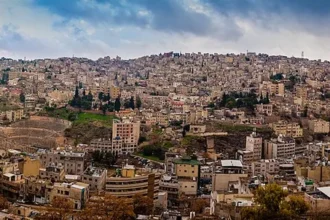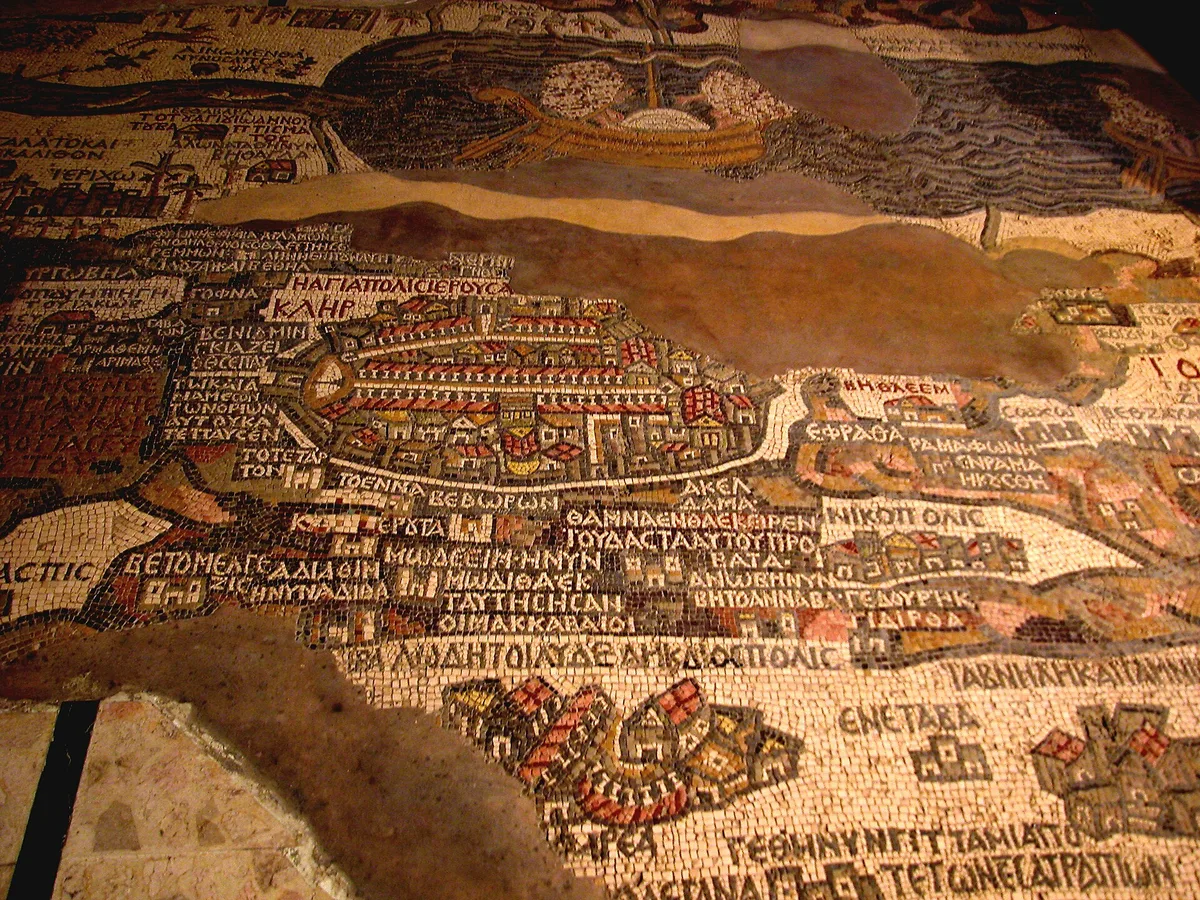
Thirty kilometres south of Amman, the plateau road flattens into a town that looks, at first glance, entirely ordinary – apartment blocks, roundabouts, coffee stands, school-run traffic. Then you step through the door of a working parish church in its centre and find a map of another world set into the floor under your feet, drawn in coloured stone fourteen centuries ago. This madaba travel guide starts from the conviction that Madaba deserves more than the forty minutes most itineraries give it. It is Jordan’s mosaic city, a place where Byzantine craftsmen covered church and mansion floors with pictures in stone, where a significant Christian community still worships in those churches alongside its Muslim neighbours, and where the craft itself never died – Madaba’s workshops still cut tesserae today.
The rewards here are quiet ones, and they reward anyone who slows down. There is the Madaba Map itself, the oldest surviving original map of the Holy Land, with Jerusalem at its centre and fish turning back from the salt water of the Dead Sea. There are whole rooms of mosaic in the town’s archaeological parks – a mansion hall telling a Greek tragedy, a church floor finished under Umayyad rule, a palace that burned. There is the Church of the Apostles, where the Sea herself rises out of the nave floor holding a steering oar. And eight kilometres away stands Mount Nebo, where Moses is remembered as looking out over the Promised Land he would not enter – Madaba’s sights and Nebo’s summit belong to the same half-day, and this guide treats them that way.
Madaba also earns its place in a Jordan trip on practical grounds. It sits at the northern end of the King’s Highway, the old road south to Kerak and Petra, so it works as the first or last night of a southern loop. It lies a short drive from Queen Alia Airport, which makes it one of the most useful airport-eve bases in the country. And it is a real town rather than a resort strip, with the ordinary pleasures that brings – bakeries, market streets, family-run hotels and evenings that belong to residents rather than tour programmes. What follows covers the map and how to read it, the parks and churches, the living craft, the Nebo pairing, the routes in and out, and the honest limits of the place, so you can decide how much of your Jordan time Madaba should get.
Madaba at a Glance

| Question | Short answer |
|---|---|
| Where is Madaba | On the plateau about 30 km south of Amman, in the hills west of the Desert Highway country |
| What is it known for | Byzantine mosaics above all – the Madaba Map, church floors and mansion floors across the old town |
| The one unmissable sight | The Madaba Map, the 6th-century floor mosaic inside St George’s Greek Orthodox Church |
| The natural pairing | Mount Nebo, 8 km north-west – the Memorial of Moses, the Brazen Serpent and the Jordan Valley view |
| How long it takes | Half a day covers the map, the parks and the Apostles church; add Nebo and it becomes a full, unhurried day |
| How it fits a route | The start of the King’s Highway south to Kerak and Petra, a short hop from the Dead Sea shore, and a practical base the night before a flight |
| Also in the area | Umm ar-Rasas, south-east of town, where the Church of St Stephen holds one of the largest and best-preserved mosaic floors in Jordan |
Madaba’s centre is compact, and that shapes how you should use this madaba travel guide. The great sights stand within a short walk of one another around the old town – St George’s Church, the archaeological parks and the workshops cluster together, with the Church of the Apostles a longer walk or a short taxi ride away at the town’s southern edge. Nothing here requires a tour bus or a guide with a flag. What it requires is time at floor level, because almost everything Madaba is famous for lies flat on the ground, and the pleasure is in reading pictures laid in stone the size of fingernails.
The town’s deeper story is one of layers. Madaba was a Moabite and then a biblical town, a Roman city with a colonnaded main street, and then, in the fifth and sixth centuries, a prosperous Christian city whose bishops, merchants and mansion-owners commissioned mosaic floors the way other ages commissioned paintings. An earthquake in the eighth century and centuries of quiet buried those floors under later building, and they have been coming back to light ever since – most famously in 1884, when workmen clearing the site of St George’s Church uncovered the edge of the great map. Madaba today is the product of both halves of that story, an ancient mosaic capital and a modern Jordanian town of churches, mosques, schools and workshops sharing the same streets.
The Madaba Map – a Sixth-Century Atlas in a Church Floor
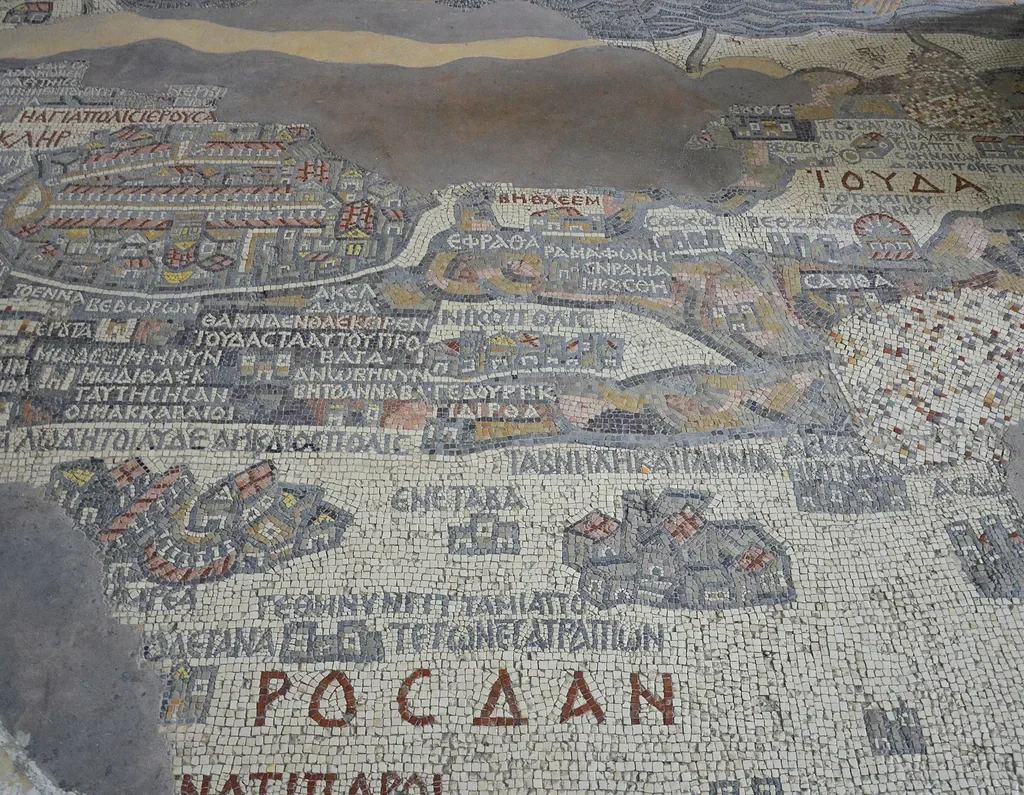
The Madaba Map is the floor of the apse end of St George’s Church, and it is worth being clear about what you are looking at, because no photograph prepares you for its logic. It is a mosaic map of the Holy Land made in the sixth century, in the Byzantine period, by craftsmen who never signed it. In its complete state it measured roughly 21 metres by 7 and was built from more than two million individual stone cubes – tesserae – in white, black, red, yellow, green and blue-grey. Across it, the makers spread the known biblical world, from Lebanon in the north to the Nile Delta in the south, and from the Mediterranean in the west to the desert in the east, and they labelled what they drew with more than 150 captions in Greek naming cities, villages, rivers, tribes and biblical events.
Scholars date the map by what it shows and what it does not. Jerusalem’s great Nea Church, dedicated in the year 542, stands proudly in the city vignette, so the floor cannot be earlier than that. Nothing on the map was built after about 570, so it cannot be much later. Within that window – a generation, in other words – anonymous mosaicists, very likely working from Eusebius’s Onomasticon, a fourth-century gazetteer of biblical place names, laid out the Holy Land as their age understood it. It is the oldest surviving original cartographic depiction of the region, older than any paper map of it by centuries, and it survived by accident, buried and forgotten after the earthquake of 746 wrecked the town, until builders preparing the ground for the present church in 1884 found its edge and recognised what it might be.
What you see today is the surviving fragment, roughly 16 metres by 5 – a large part of the centre and south of the original, including Jerusalem, the Jordan Valley, the Dead Sea and the hills of Moab, but with the northern reaches and the coastal plain mostly lost. Parts were damaged over the centuries by new building, by burial cuts and by the simple traffic of a church built over it. None of that diminishes it. Stood at the viewing edge with the fragment unrolled before you, this madaba travel guide would argue, you are looking at the single most instructive object in Jordan – a picture of how the Byzantine world saw its sacred geography, drawn by men who could walk out of the church door and into the landscape it depicts.
Jerusalem at the Centre of the Map
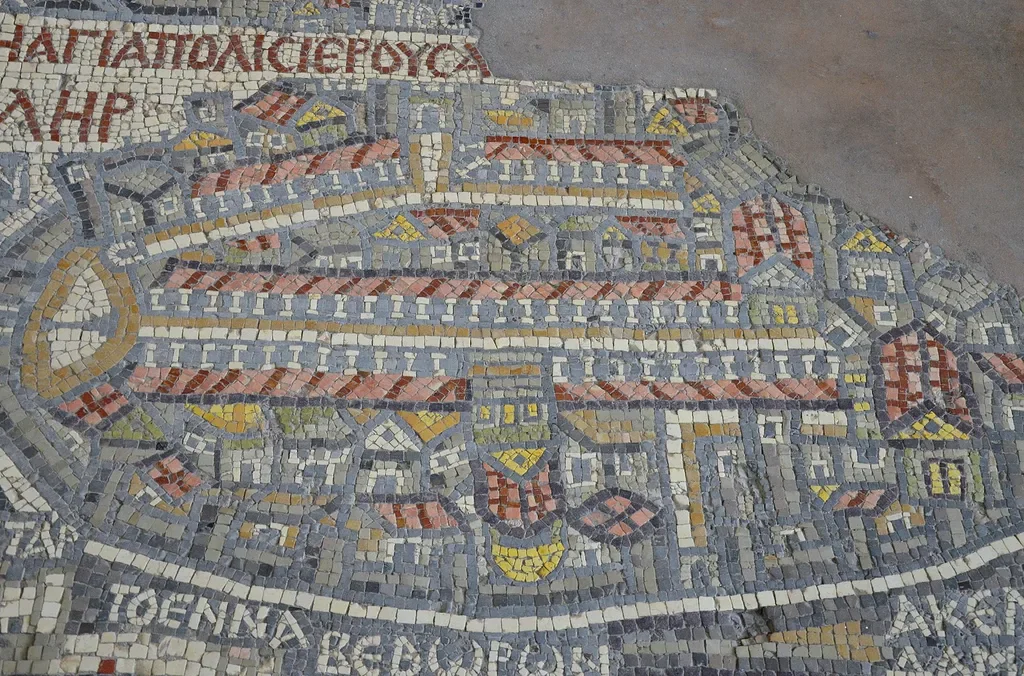
Every map reveals its maker’s priorities, and the Madaba Map’s priority is unmistakable. Jerusalem sits at the exact centre of the composition, drawn far larger than scale allows, as an oval walled city seen slightly from above – the only place on the floor given this full portrait treatment. Work around it slowly. The walls bristle with towers and gates. Through the middle runs the colonnaded main street, the cardo, its rows of columns picked out in red and white, running from the great gate at the northern end – the Damascus Gate, with its plaza and column – down through the city. Churches crowd the interior, each a little gabled building in stone cubes, and the largest composition of all is the Church of the Holy Sepulchre, its basilica, rotunda and courtyard laid out in gold and red at the city’s heart.
The caption above the city names it in Greek as the Holy City, Jerusalem. Around it, the map settles back into something closer to scale – Bethlehem to the south with its great church, Hebron, the towns of Judaea each reduced to a formula of towers, gates and a church or two, each with its name written beside it. The effect, once you see it, is of a pilgrim’s universe – Jerusalem enormous because Jerusalem mattered most, the biblical countryside around it drawn faithfully but smaller, the whole floor organised not by measurement but by meaning. Modern maps pretend the world is equally important everywhere. This one is honest about what its world was for.
It also preserves a Jerusalem that has partly vanished. The map shows the city’s sixth-century street plan and churches as they stood in Justinian’s age, including buildings since lost or buried, and archaeologists have used it for over a century as evidence for the Byzantine city – its gates, its streets, the position of its churches. When you later walk a modern Jerusalem, parts of what you see were confirmed, and in places guided, by this floor in Madaba. A map that outlives the city it depicts and becomes a document for rebuilding knowledge of it – that is the measure of what the mosaicists achieved, working at knee height with baskets of cut stone.
The River, the Sea and the Fish That Turn Back
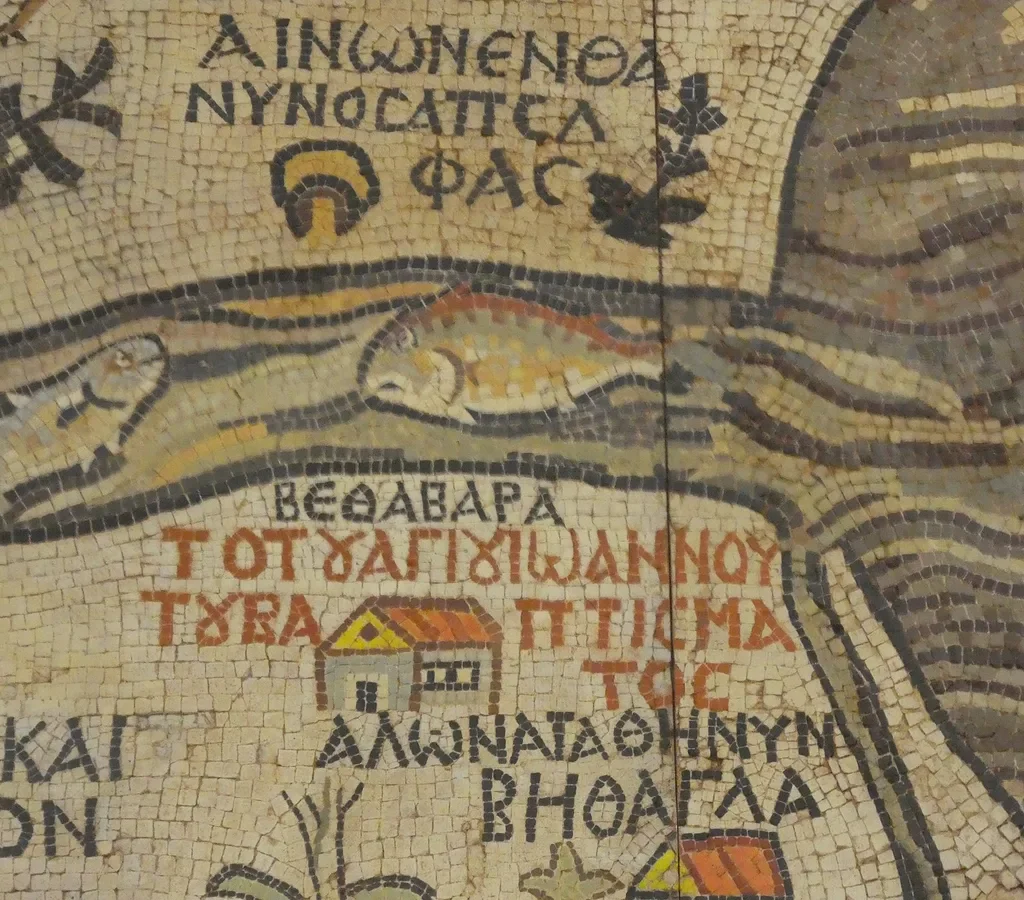
Once Jerusalem has released you, walk your eye east – remembering that the map is oriented with east at the top, towards the altar, so take your mental compass and turn it a quarter-turn from a modern map’s habit. The River Jordan winds down the composition in a band of blue-grey, ferries and fords marked along it, and at Bethabara, where tradition placed the baptism of Jesus, the mosaicists put in their most famous joke of observation – fish swimming down the river who, meeting the salt water of the Dead Sea, turn around and swim back. It is a tiny detail, a few centimetres of stone, and it tells you these craftsmen knew their landscape the way fishermen and ferry-men know it, not the way copyists in a scriptorium would.
The Dead Sea itself is drawn as a broad expanse of patterned water, and on it sail two boats, laden, their hulls and cargoes carefully picked out – the salt and bitumen trade that crossed this strange lake in the Byzantine age, when its shores held farms, hermitages and ports. On the far shore rise the hills of Moab, Madaba’s own country, and there the mosaicists placed another vignette travellers still look for – a lion hunting a gazelle across the desert plain. Parts of that little scene were deliberately scrambled in the age of iconoclasm, when living images in churches were disturbed and re-laid as patterns, and the lion’s prey survives partly disordered, a small scar of a later century’s theology on the floor.
What makes these details matter is that they are not decoration. The map’s makers worked in a tradition that took geography seriously as a form of devotion – to know where the events of scripture happened was to hold them more truly. So the floor is full of observed life – palm groves at Jericho, ferries on the river, boats on the bitter lake, wild animals in the hills where the mapmakers themselves lived. Read this way, the Madaba Map is not only the oldest map of the Holy Land. It is also a portrait of sixth-century Jordan drawn by Jordanians, and the country it shows – the river, the lake, the desert edge, the towns of the plateau – is recognisably the country outside the church door.
St George’s – a Working Church Around an Ancient Floor
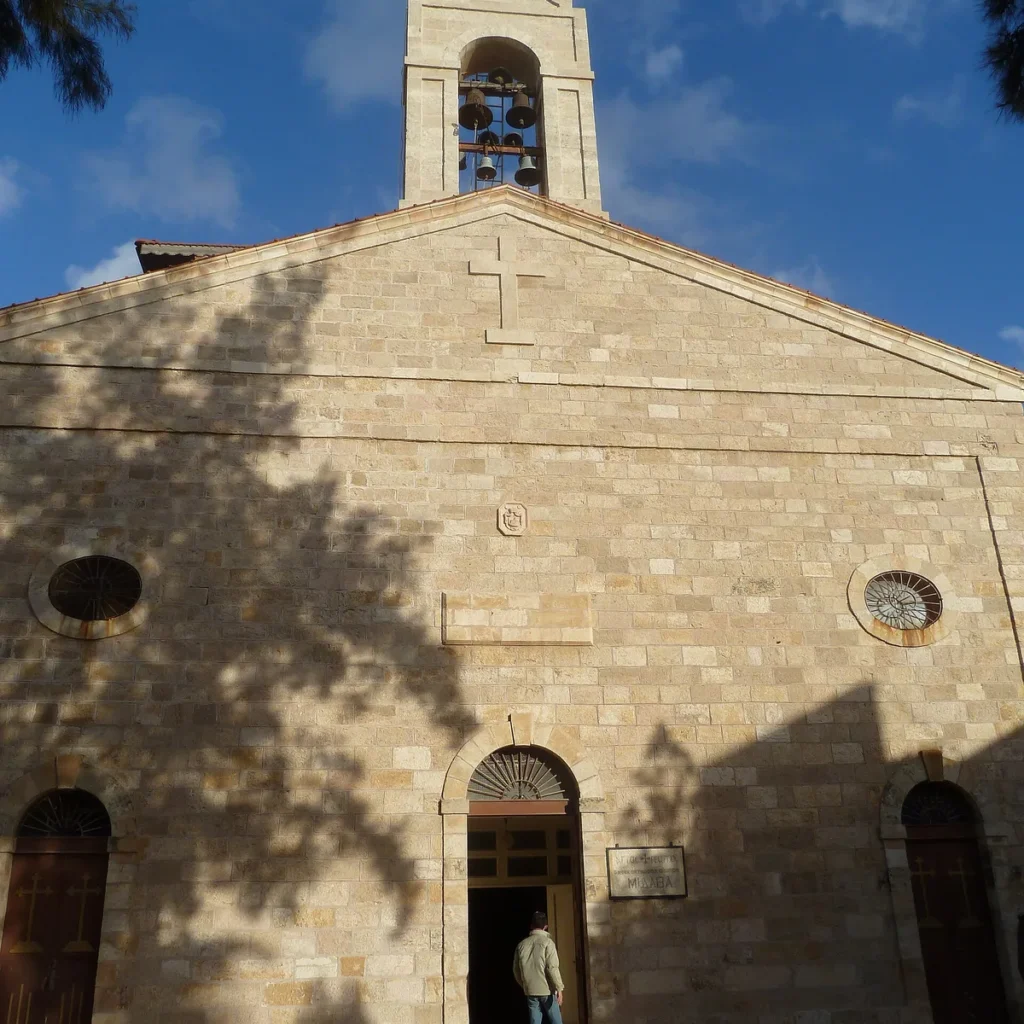
It helps to understand what St George’s is, because it is not a museum and does not behave like one. The present church is a Greek Orthodox parish church, built in 1896 on the site of the earlier Byzantine church whose floor the map was, and it serves one of the oldest Christian communities in Jordan. Madaba remains a town where Christians form a significant part of the population, living street by street with their Muslim neighbours, and St George’s is the working heart of that community – baptisms, weddings, funerals, feast days and the ordinary Sunday liturgy all happen on and around a floor that scholars cross the world to see. The icons are modern, the lamps are lit, the candles burn, and the map lies where it always lay, in the middle of a living church’s business.
That has practical consequences a good madaba travel guide should state plainly. Visiting fits around worship, not the other way round. On Sunday mornings, above all, the church belongs to its congregation, and during services visitors may be asked to wait, to keep to the back, or simply to share the space quietly rather than circulate around the floor. Fridays run differently again, because Friday is Jordan’s principal day of rest and the town around the church moves at a slower rhythm. None of this is a barrier – the church receives visitors warmly and has done for generations – but dress and behaviour should respect a place of prayer. Shoulders and knees covered, voices down, and no standing on the mosaic are the whole of the rule, and they cost nothing.
Give the rest of the church its due while you are there. The building itself is handsome nineteenth-century stone work, and the interior carries the layered devotion of a parish that has prayed here through Ottoman, Mandate and Hashemite times. But the honest hierarchy of the place is clear – everything else in St George’s is the frame, and the map is the picture. Most visitors come in a small surge in the middle of the day, look for ten minutes and leave. The floor deserves better. Come early or late if you can, when the light is lower and the church quieter, and let your eye make the journey from Jerusalem to the Dead Sea at walking pace.
The Archaeological Parks – Streets and Houses of the Mosaic Age
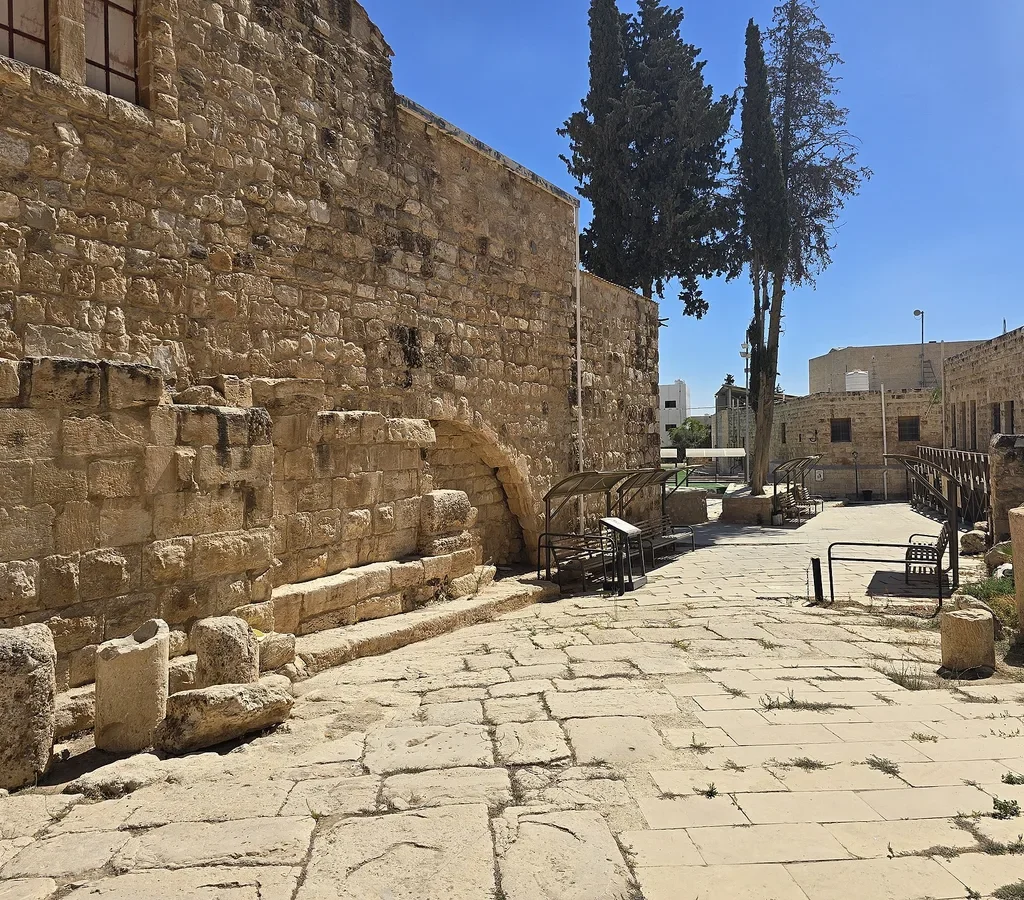
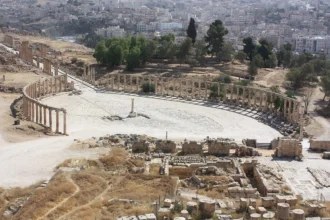
Scattered through the old town, in two fenced and sheltered groups, the Archaeological Parks preserve the Madaba that the map’s makers lived in. Their spine is a stretch of the Roman colonnaded street – the decumanus that ran through the ancient city – its paving worn, its column drums fallen or re-erected along the line. Around that street, excavators uncovered the floors that made the town’s modern reputation all over again – not in churches alone, but in the houses of the wealthy, which is what makes the parks so valuable. St George’s shows you what Byzantine Madaba believed. The parks show you how it lived, entertained and showed off.
Near the entrance of one park, look for a small, easily missed fragment that carries an outsized claim – a piece of mosaic brought here from Machaerus, the Herodian fortress-palace across the valley where John the Baptist was imprisoned and, by tradition, beheaded. The fragment is dated to the first century BC and is often described as the oldest mosaic in Jordan. Whether or not the superlative survives every scholar’s scrutiny, standing in front of a floor laid before the birth of Christ, in a town whose fame rests on floors laid six centuries later, gives you the full arc of the region’s mosaic tradition in a single glance – this corner of Jordan was decorating in stone cubes for a very long time.
The parks reward a slow circuit rather than a checklist march. Floors are protected under modern shelters, walkways carry you over and around them, and the churches and houses stand roofless to the sky, their walls at waist or shoulder height, their pictures flat at your feet. This madaba travel guide suggests walking the Roman street first to get the geography of the ancient town into your legs, then taking the great set-pieces in turn – the mansion hall, the church built above it, and the burnt palace in the second park – because together they tell one continuous story of a rich little city at its peak, and of the long centuries that buried it.
The Hippolytus Hall, the Virgin’s Church and the Burnt Palace
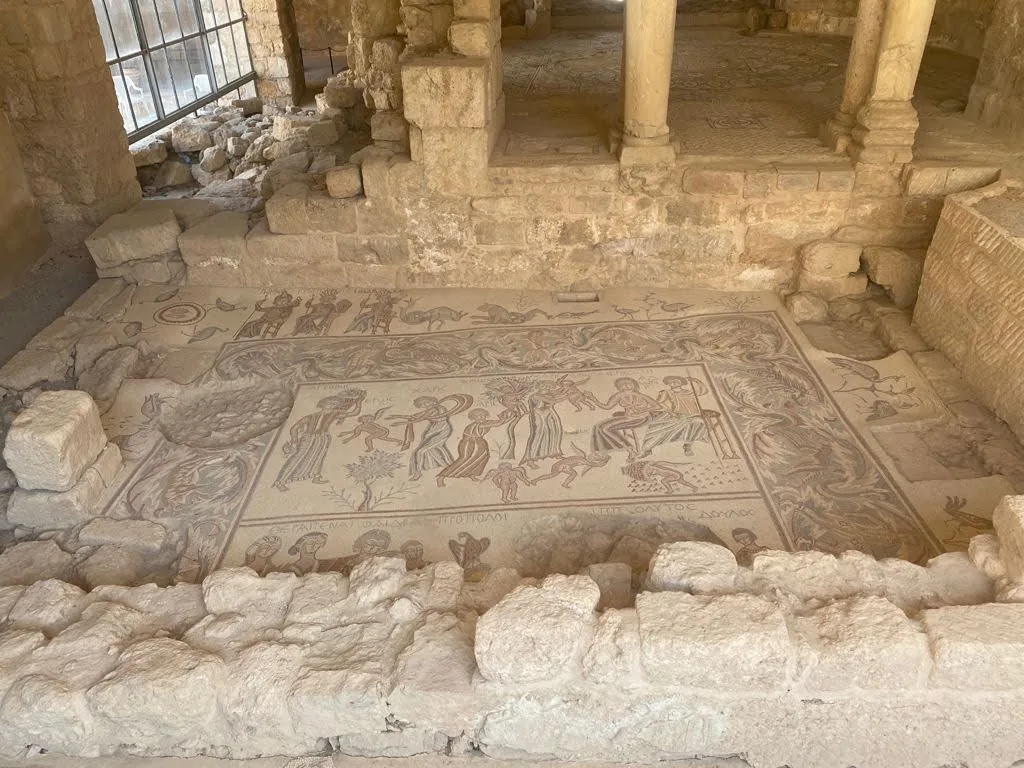
The Hippolytus Hall is the parks’ masterpiece of domestic art – the reception hall of a grand sixth-century house, uncovered in 1982, its floor an anthology of everything its owner’s world admired. In the central panel the mosaicists told the tragedy of Phaedra and Hippolytus from Euripides – the queen who loved her stepson, the letter, the catastrophe – a pagan Greek love story laid in a Christian city’s best room without embarrassment. Around it, the corners carry the Four Seasons as female figures with their produce, and the borders unwind in acanthus scrolls full of hunting and country life – huntsmen, dogs, birds, beasts and fruit, all observed with the same pleasure the map-makers took in their fish and lions. A family that could commission this floor was announcing that it was rich, educated and entirely at home in both the classical and the Christian worlds.
Directly in the layers above and beside the hall stands the Church of the Virgin Mary, a sixth-century church built over an earlier Roman temple site and first uncovered in 1887, whose floor holds the parks’ most quietly astonishing detail. Its great central medallion is a piece of pure geometric patterning – interlaced, exact, abstract – and it is dated to about the year 767, well into the Umayyad period, generations after the church was built. A mosque-ruled age did not smash this church’s floor; it renewed its centre with pattern work of the highest quality, the kind of image a changed theology could love. Elsewhere the same floor carries the cities of the world as women bearing gifts – Rome, a place named Gregoria, and Madaba herself among them, the little plateau town setting its own portrait beside the capital of empire.
In the second park lies the Burnt Palace, a palatial residence of the later sixth century that met the fate its name records – destroyed and abandoned after a fire in the early seventh century. Its rooms keep mosaics of the chase and of the natural world, hunting scenes and processions of animals, trees, birds and fish, scorched into the archaeological record by the disaster that preserved them under collapse. Taken together, hall, church and palace make the parks the essential second act of a Madaba visit – the map shows the world as the town imagined it; these floors show the town as it was.
The Church of the Apostles and the Face of the Sea

At the southern edge of the old town, where the ancient King’s Highway ran, stands the church that holds Madaba’s most beloved single image. The Church of the Apostles is a late sixth-century building, lost for centuries and rediscovered in 1902, now protected under a modern shelter that keeps the weather off its floor. From the outside it promises little. Inside, the whole nave is one great carpet of stone, and at its centre, in a medallion over two metres across, rises a woman from the waves – Thalassa, the personification of the Sea.
She is worth every step of the walk. The mosaicists gave her a steering oar – a rudder – to show her rule over her element, and around her in the round frame of the medallion swim her subjects – fish in variety, a jellyfish, sharks and a small sea monster, the whole population of the deep paying court to its queen. Personifications like her were the Byzantine mosaicist’s shorthand for the forces of the world, and the Apostles floor uses her with real daring, setting the pagan sea-goddess in splendour at the centre of a Christian church built by named local patrons. Around the medallion, an inscription preserves the human side of the commission – a prayer naming the donors Anastasius, Thomas and Theodora, and something rarer still, the name of the mosaicist himself. The floor is signed by its maker, Salamanios, one of the very few artists of this whole tradition whose name survives.
The medallion’s fame has travelled further than the church. In 1992 it was exhibited at the Seville Expo, carrying Madaba’s name to a world fair. Back home it rests under its shelter in a quiet corner of town that many visitors, hurried between the map and Nebo, never reach – which is precisely why this madaba travel guide sends you there. Piccirillo, the Franciscan archaeologist who did more than anyone to document Madaba’s mosaics, dated this floor to the year 578, and it represents the town’s mosaic art at its confident height, a generation after the map, in a church on the road south that every ancient traveller to Petra would have passed.
The Floor Around the Medallion

Do not leave the Apostles church having seen only its centre, because the floor around Thalassa is a garden in stone. Panels and borders carry parrots and other birds among fruiting branches, pomegranates and grapes, beasts and geometric patterning, the whole surface alive with the created world the sea-queen rules from her medallion. The birds are the delight of it – plump, alert, individually characterised, tethered in the old convention by little collars and cords to the branches they feed on, a device Byzantine mosaicists used across the region and which Madaba’s craftsmen handled as well as anyone in the empire.
The floor also teaches the practical truth about all of Madaba’s mosaics – that they were made to be walked on, in a working building, by a congregation that saw them weekly in lamplight rather than in the flat white light of a modern shelter. Colours that look muted at noon would have glowed at dusk. Patterns that read as geometry from the walkway were, at floor level, theology – paradise pictured as a garden, the sea and its creatures gathered into order, the world made by God and ruled by His providence, with the donors’ names and the artist’s signature woven into the prayer of it. The Apostles church is the place in Madaba where that whole way of seeing survives most completely in one room.
The Living Craft – Mosaic School and Workshops
In most ancient cities, the craft that made them famous is a chapter in a museum. In Madaba it is a trade you can watch through a workshop door. The town is home to the Madaba Institute for Mosaic Art and Restoration, an institute devoted to exactly the two skills its name carries – teaching new mosaicists to make floors and panels in the Byzantine technique, and training the restorers on whom Jordan’s ancient floors depend. Its existence is no accident of tourism. The modern revival of Madaba’s craft grew from the archaeological work itself – the Franciscan-led excavations and restorations around Mount Nebo and Madaba needed hands that could read and repair sixth-century floors, and a school in the town was the answer, passing the technique from the men who conserved the old mosaics to a new generation from the town.
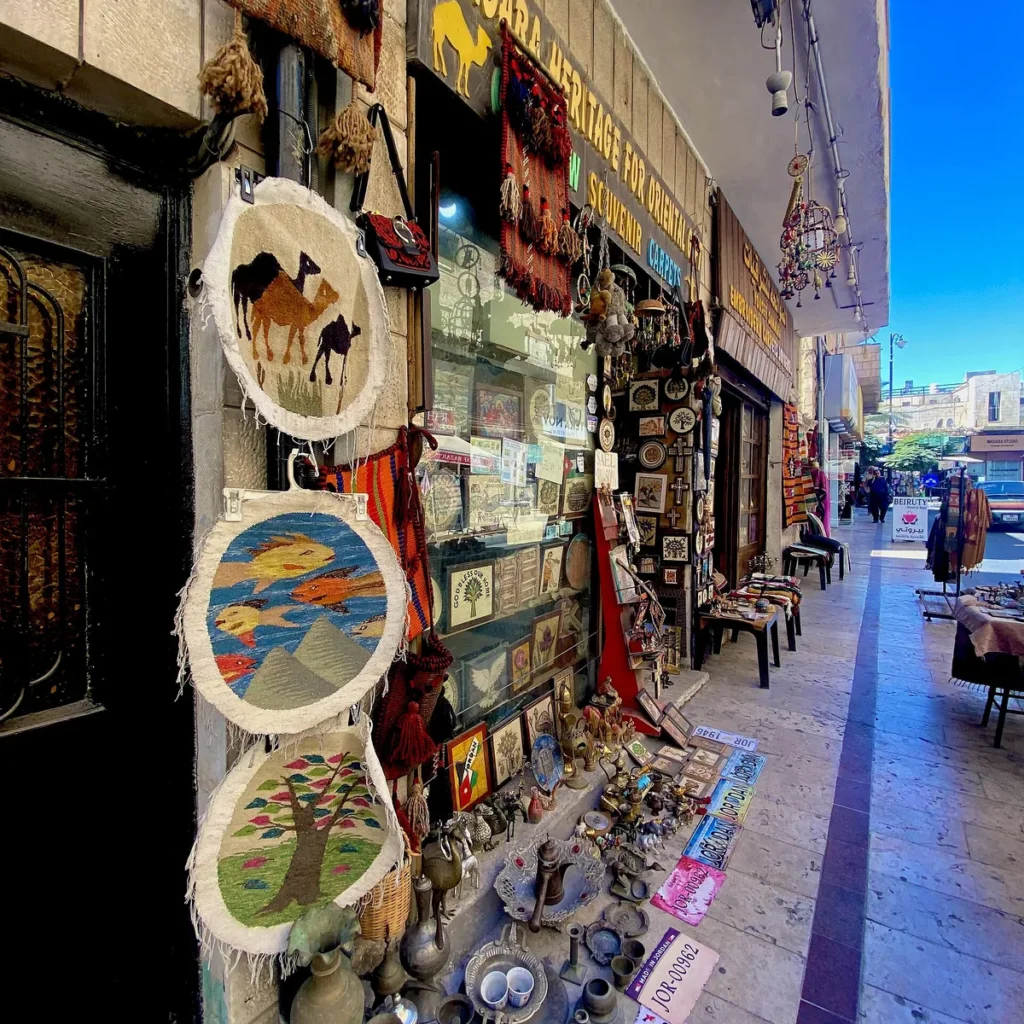
Around the institute, the centre of Madaba is dotted with workshops and showrooms where the process is on open display, and stopping to watch is one of the genuine pleasures of this madaba travel guide. The method has barely changed in fourteen centuries. Stone is cut into cubes with a hammer against a hardie – a small upright blade – the craftsman turning and judging each piece by eye, the tesserae falling in a rhythm that speeds up with the years of practice in the hands. Pieces are set into a prepared bed, face by face, following a drawn design, and the finest work uses cubes so small that a face or a fish can be modelled in graded colour almost like paint. Many workshops specialise in faithful smaller copies of the town’s celebrities – the Jerusalem vignette from the map, Thalassa from the Apostles floor – alongside geometric panels and commissions.
Buying here comes with a context no souvenir strip can offer. You can watch the panel in the window being made, ask which floor inspired it, and handle offcuts of the same local stone the Byzantines used. Prices vary with size and fineness, and the honest measure is time – a densely worked small panel represents days of cutting and setting, and is priced like it, while simple geometric pieces are correspondingly modest. Whether or not you buy, the workshops complete Madaba’s argument. The map is not a relic of a dead art. It is the founding masterpiece of a living one, and the town that produced it still produces its descendants.
Mount Nebo – the Other Half of the Day
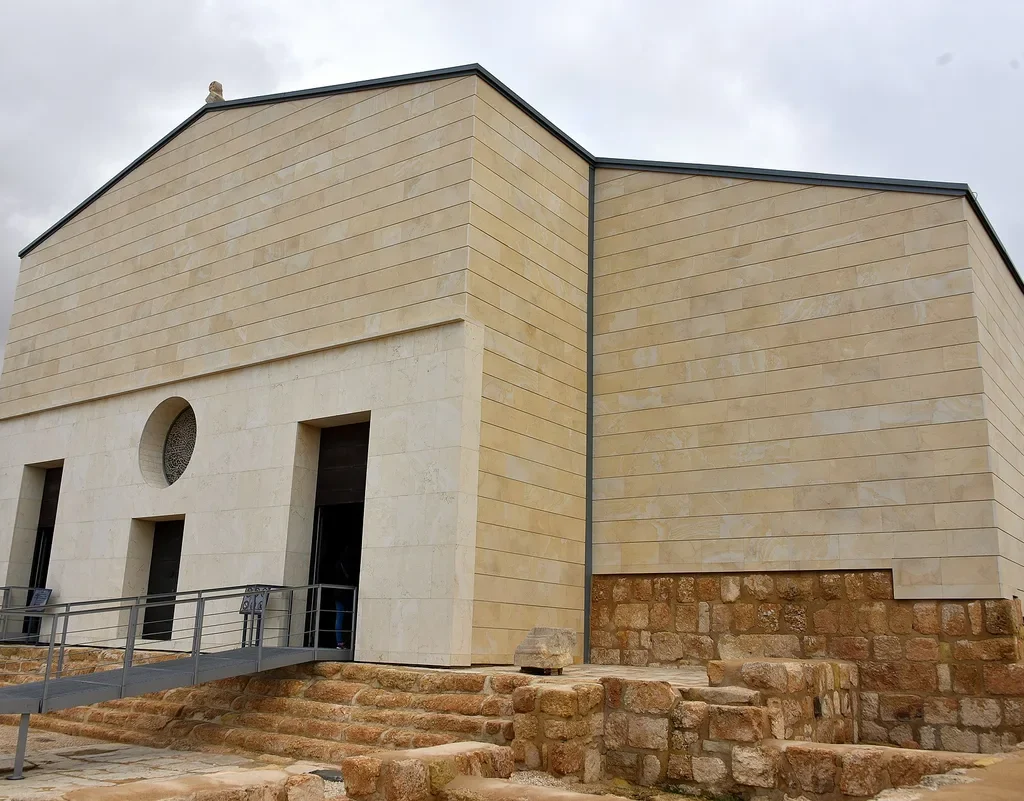
Eight kilometres north-west of Madaba, the plateau ends at a ridge the Bible calls Pisgah and the maps call Mount Nebo, and the two places belong together so completely that most travellers visit them in a single outing. This is Ras Siyagha, the western summit of the ridge, and by the account in Deuteronomy it is where Moses stood to look over the Promised Land – the Jordan Valley, the Dead Sea, Jericho and the hills beyond – before his death, in a place whose burial site the same text says no one knows. That distinction matters, and the Franciscans who care for the site honour it. What stands here is a memorial, not a tomb – a church raised over the place of the vision, commemorating a viewpoint rather than guarding a grave.
Christians were coming here astonishingly early. A church on the summit is first recorded in the year 394, in the travel account of the pilgrim Egeria, and over the following centuries it grew into a three-naved basilica rich with the same mosaic art that fills Madaba’s floors, completed in its grand form around the turn of the seventh century. Monastery, pilgrimage church and ruin followed in the usual Levantine sequence, until in 1932 the Franciscan Custody of the Holy Land acquired the summit and, from July 1933, its archaeologists – Sylvester Saller, then Virgilio Corbo and Michele Piccirillo, whose grave lies in the convent garden – excavated and studied the site across the twentieth century. The basilica’s modern resurrection came in our own time, when a long restoration was completed and the Memorial Church of Moses reopened in October 2016, its ancient floors sheltered inside a clean new stone church.
The pairing works because the two halves comment on each other. Madaba gives you the Byzantine world in pictures; Nebo gives you the Bible story those pictures served, at the very viewpoint the story describes. This madaba travel guide recommends giving Nebo the morning of your Madaba day if you can – the light comes from behind you onto the valley, the summit is quieter, and the view stands its best chance before the day’s haze builds – then returning to town for the map and the parks in the afternoon, when Nebo’s coach parties have moved on and Madaba’s churches have settled again.
The Memorial of Moses
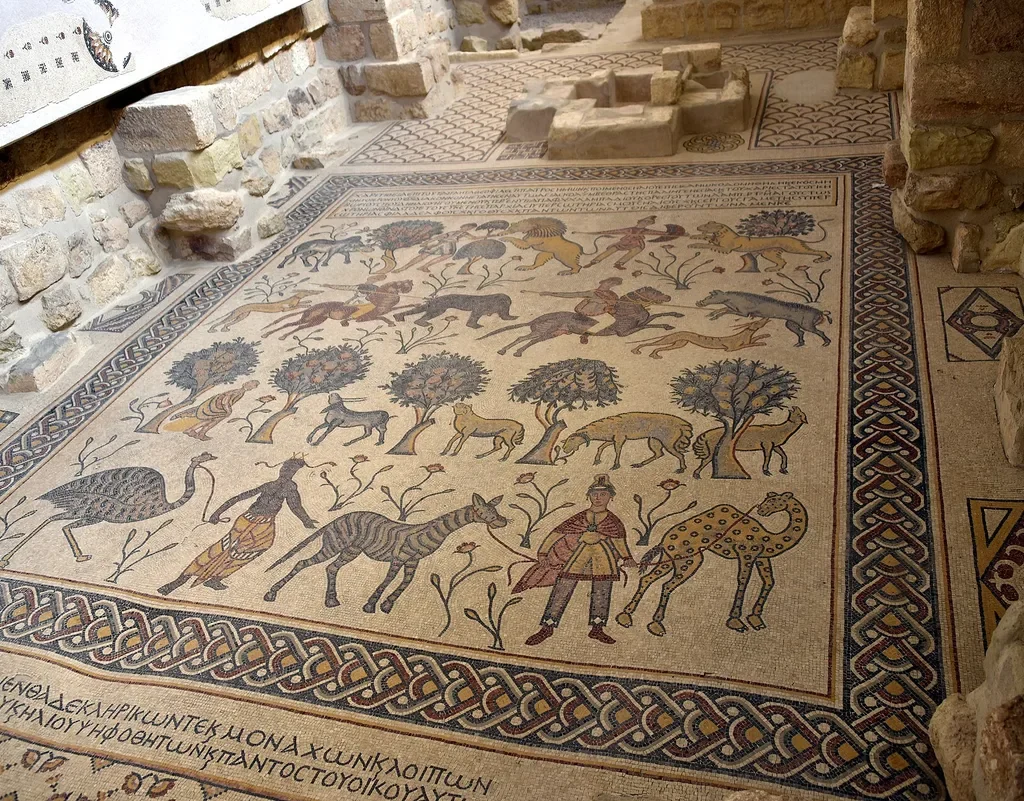
Inside the memorial church, the arrangement is a palimpsest you can walk around. The modern building protects the footprint of the Byzantine basilica, and set into its floor and along its sides are the mosaics the excavations recovered – above all the great sixth-century floor of the baptistery chapel, a procession of hunters, shepherds and animals between fruit trees, with ostriches, a zebra-like horse and a camel-driver among its figures, bordered in guilloche and accompanied by Greek inscriptions. It is the single finest mosaic on the mountain and a direct sibling of the floors in town – the same hands, the same century, the same world of huntsmen and herdsmen rendered in cut stone.
Around it, the memorial keeps the smaller evidence of fourteen centuries of devotion – earlier church phases in the masonry, fragments and finds in the small museum collection, and the modern layer of memory too. Pope John Paul II prayed here in March of the year 2000, at the start of his pilgrimage to the Holy Land, and planted an olive tree that still grows by the church – a living exhibit that does more than any plaque to explain what this summit means to the Christian world. Nebo also sits on UNESCO’s Tentative List of World Heritage candidates, a formal acknowledgement of what the pilgrim crowds have always assumed.
Stand a moment with the geography of the place. From the church door you are minutes from the terrace and its famous view, but the interior has its own argument to make first – that the Moses story drew people up this hill so powerfully, and for so long, that they built one of Byzantine Jordan’s great pilgrimage churches on a waterless ridge to house it, and covered its floors with the best art money and faith could buy. The memorial is not a viewpoint with a church attached. It is a church that happens to stand at a viewpoint, and it rewards being read in that order.
The Brazen Serpent
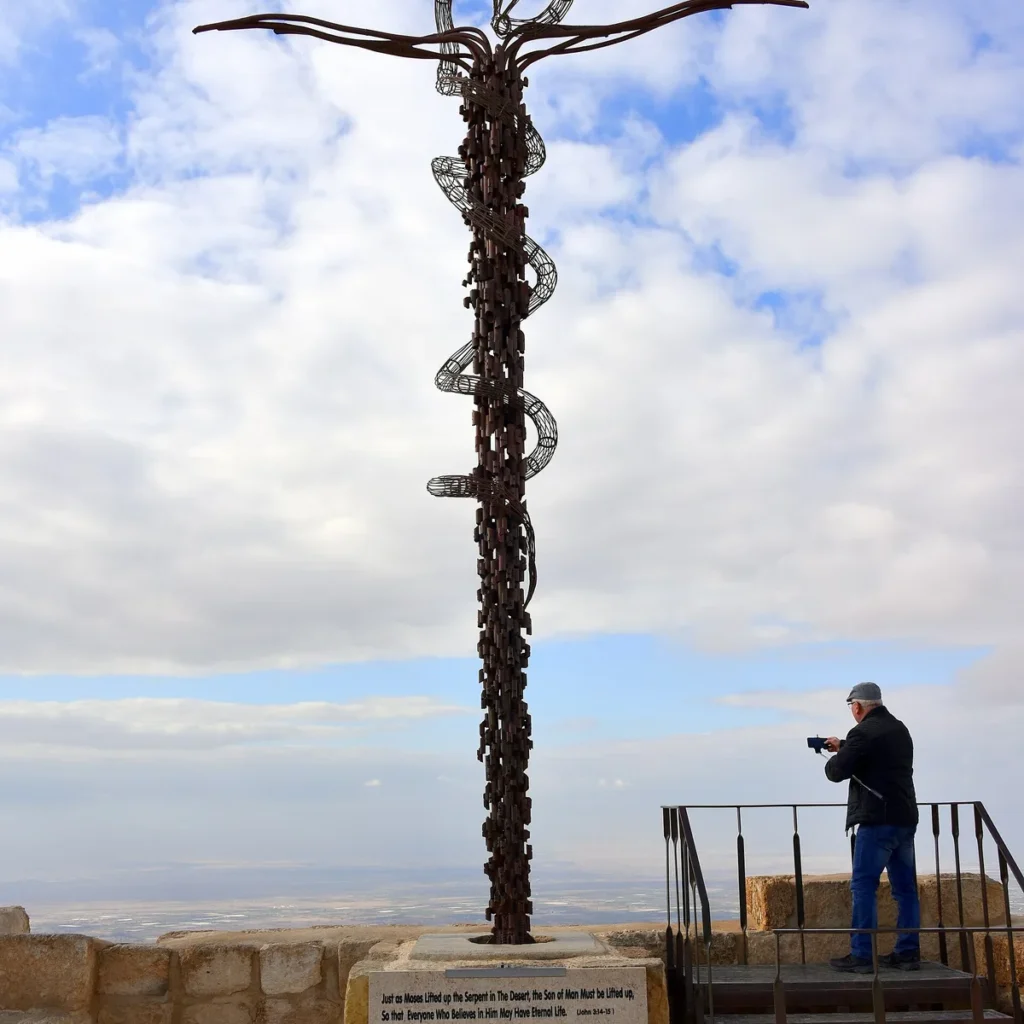
On the terrace edge stands Nebo’s emblem, and one of the most photographed silhouettes in Jordan – a tall serpentine cross, its shaft wound about by a serpent, raised against the sky above the valley. The sculpture is the work of the Italian artist Fantoni, and its imagery is a deliberate fusion of two scriptures. In the Book of Numbers, Moses raised a bronze serpent on a pole in the wilderness, and those who looked at it lived – the original of every healing-serpent emblem since. In John’s Gospel, that lifting up is taken as a foreshadowing of the crucifixion. Fantoni’s monument pours the two together – serpent and cross in a single twisting form, the plague of the desert journey transfigured into the sign of salvation, planted at the spot where the desert journey’s leader ended his own story.
Photograph it, by all means – everyone does, against the valley haze – but it earns a slower look than most monuments get. The metalwork is rough and organic, more grown than built, and its silhouette changes against the sky as you circle it, now cross, now serpent, now something between a staff and a tree. It has become so completely the symbol of the site that it is easy to forget how recent it is, a modern artwork standing in an ancient sanctuary. That layering is Nebo in miniature, and honest to its history – every age, from Egeria’s fourth century to Fantoni’s twentieth, has left its own reading of the Moses story on this ridge.
The View Towards the Dead Sea and Jericho
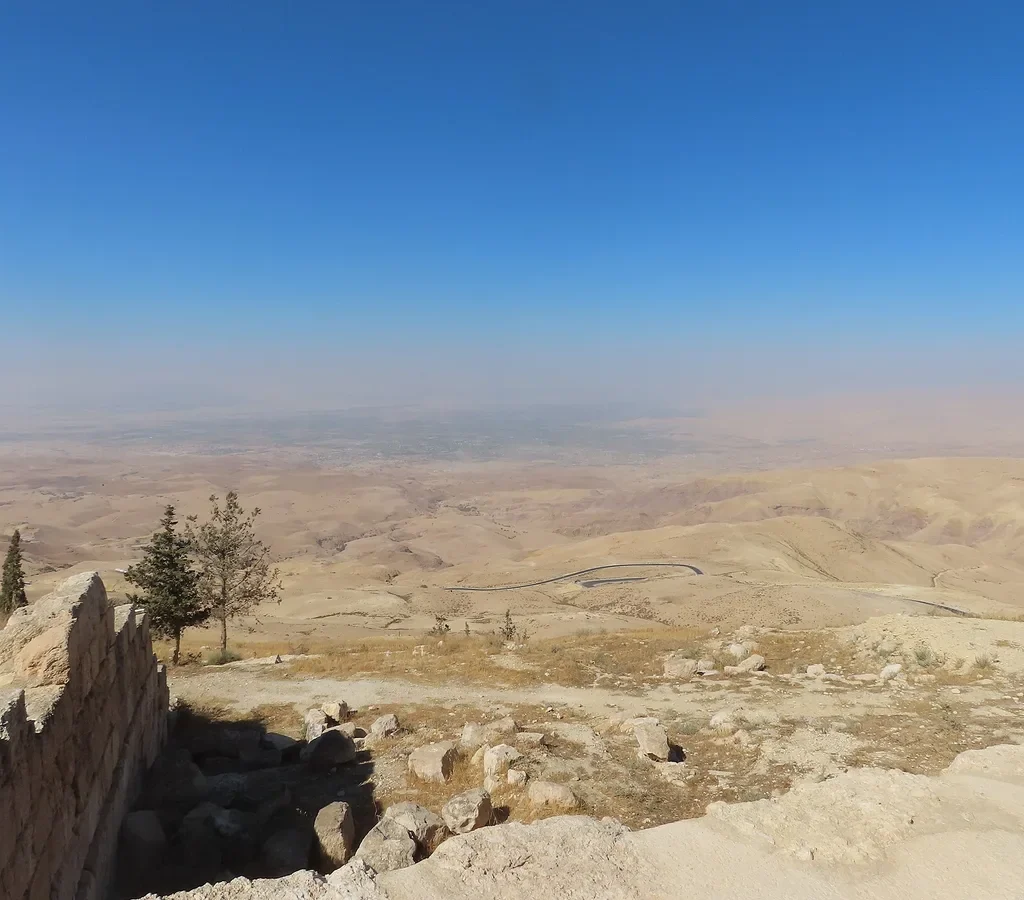
And now the view, about which this madaba travel guide intends to be completely honest. On a perfect day – most often a winter morning after rain has washed the air – the prospect from Nebo’s terrace is one of the great set-piece views of the Levant. The ground falls away westward in folds of pale hill to the Jordan Valley, the lowest landscape on earth. The northern shore of the Dead Sea glitters at the valley’s foot. Jericho lies in its green oasis across the river, and the hills of Judaea rise behind it, with Bethlehem and Jerusalem on their crests, said to be visible on the very clearest days. This is the arrangement Deuteronomy describes, and standing in it gives the old text a force no commentary can.
On an ordinary day, you will see a good deal less. Haze is the valley’s normal condition, heat shimmer its summer one, and many visitors look out at a white-gold murk in which Jericho is a rumour and the Dead Sea is a rumour’s glint. The memorial’s own displays quietly acknowledge this by showing you labelled photographs of what a clear day offers. Plan accordingly – come early, come in the cooler months, treat a clear view as a gift rather than an entitlement, and do not let a hazy day sour the visit. Moses, the story insists, saw the land but did not enter it. A traveller who sees only its outline through the haze is, in the story’s own terms, having the authentic experience.
What is guaranteed, clear or hazy, is the geography lesson. From this one terrace you can read the whole structure of the country you are travelling – the high plateau behind you with Madaba on it, the rift valley dropping away in front, the river at its floor, the next range rising beyond. Jordan’s trips make more sense after Nebo. The King’s Highway you are about to drive runs along the plateau’s spine precisely because the valley below was a barrier; the Dead Sea resorts sit where they sit because the shore is the plateau’s foot. Ten minutes on this terrace orientates a whole itinerary.
Madaba in a Jordan Route

Madaba’s second gift to a Jordan trip is position. The town stands where the King’s Highway – the ancient plateau road, older than Rome, that carried caravans between Damascus and Arabia – begins its run south from the Amman area towards Kerak’s castle and Petra. A traveller heading south the slow, scenic way almost necessarily passes Madaba’s door, and the town makes a natural first night of that journey – an easier, smaller landing than the capital, with the map and Nebo as its welcome. Equally, northbound travellers end their southern loop here, decompressing among the mosaics before the flight home. Our Jordan itinerary 7 days threads exactly this pattern, and Madaba slots into it without a single detour.
Westward, the other pairing is the Dead Sea. A road drops off the plateau from Madaba’s side down through the hills to the shore, making the town an easy base for a float and a sunset at the lowest point on earth, or for the Baptism Site on the Jordan’s east bank, which tour planners have combined with Madaba and Nebo in a single half-day circuit for years. The contrast is part of the pleasure – a morning among mosaic floors on the cool plateau, an afternoon suspended in brine hundreds of metres below it. Madaba also looks outward to its own countryside. South-east at Umm ar-Rasas, the Church of St Stephen preserves a mosaic floor of the year 718 that maps fifteen cities of the region in its borders – the map habit outliving the empire that taught it – and it pairs naturally with a Madaba stay for anyone the floors have converted.
Then there is the airport trick, the use of Madaba that seasoned Jordan hands swear by. Queen Alia Airport stands south of Amman, on Madaba’s side of the capital, roughly half an hour’s drive from the town in ordinary traffic. A traveller finishing a trip in the south can sleep the last night in Madaba – dinner in a real town, a final morning look at the map – and reach an early flight without an Amman traffic gamble or a joyless airport hotel. The same logic works in reverse on arrival, landing and driving the short hop to Madaba to start the trip somewhere human-scaled. One caution, stated as carefully as everything else in this guide – traffic is traffic, and for a flight you cannot miss, leave the margin you would anywhere. But as bases go, Madaba is the rare one that is both a destination and a convenience.
Timing a visit is mostly a matter of seasons. Spring and autumn give the plateau its kindest weather and the Nebo view its best odds. Winter days can be crisp and brilliantly clear – the finest viewing conditions of the year – between spells of rain and real cold at this altitude. Summer on the plateau is hot but bearable in the mornings and evenings, and notably gentler than the furnace of the valley floor below, which is one more argument for sleeping in Madaba and day-tripping down. Whenever you come, order the day the same way – Nebo early for the view, the town’s floors in the middle hours, the workshops and the streets as the light softens.
The Honest Downsides

Every place this madaba travel guide sends you to has its limits, and Madaba’s are worth stating kindly and plainly. The first is scale. For most itineraries this is, honestly, a half-day town – the map, the parks, the Apostles church and Nebo can all be seen well between breakfast and a late lunch, and travellers who book three nights expecting a Petra-scale programme will run out of headline sights. The town answers that not with more sights but with a different offer – a base, a breathing space, a working Jordanian town to live in briefly rather than a monument to complete. Judge it on those terms and it rarely disappoints; judge it as a rival to Petra and it will seem slight.
The second limit is the nature of the art itself. Madaba’s treasures are floors – flat, horizontal, viewed from walkways and platforms, in shelters and a working church. If mosaic does not move you, no amount of significance will convert you, and even the converted should know that the famous map is a fragment viewed in a busy church, sometimes in the middle of other people’s worship and other tours’ explanations. The crowds have a rhythm – the middle of the day brings the coach parties to St George’s and to Nebo’s car park together – and the traveller who can shift a few hours earlier or later escapes most of it. Nebo’s view, as its own section admits, is a gamble the weather settles. And summer midday in the unsheltered parts of the parks is genuinely hot work, stone radiating stone’s heat.
Finally, the honest texture of the town itself. Madaba is not a polished heritage quarter; it is a provincial city with traffic, building sites, ordinary shops and pavements that end without warning. Its hotels are mostly family-run and comfortable rather than grand, its evenings quiet rather than lively. For many travellers that ordinariness is exactly the charm – this is Jordan unperformed. But go expecting a resort and you will misread it. Madaba rewards the traveller who likes real towns and very old floors, and politely lets everyone else pass on to the Dead Sea.
Frequently Asked Questions

How long do you need in Madaba? Half a day covers the essential ground – the Madaba Map, the archaeological parks and the Church of the Apostles – and Mount Nebo turns it into a full and satisfying day. Stay overnight if you are using the town as a King’s Highway or airport base, which this madaba travel guide recommends as the way Madaba gives most back.
Can you see Madaba and Mount Nebo in one trip from Amman? Yes – it is one of the classic half-day outings from the capital. Madaba lies about 30 kilometres south of Amman and Nebo stands 8 kilometres beyond it, so the two pair naturally, with the churches and workshops of the town in one half of the outing and the memorial and its view in the other.
How do tickets work for the churches, the parks and Nebo? Each site runs its own entrance arrangement at its own door – St George’s as a working church receiving visitors, the archaeological parks as a ticketed site, and Mount Nebo under the Franciscan Custody, which cares for the summit and manages entry at its own gate rather than through the state. Prices change and this guide deliberately prints none, so check the current arrangement at each door on the day.
What is the best time of year to visit Madaba? Spring and autumn, for mild plateau weather and the best odds of a clear view from Nebo. Winter brings the clearest air of all between rainy spells, along with genuine cold. Summer is hot at midday but the plateau is kinder than the Dead Sea floor below it, and early starts solve most of the problem.
Can you visit St George’s Church during services? St George’s is a living Greek Orthodox parish church, and its services – Sunday morning above all – come first. Visitors are received warmly outside service times; during a service, expect to wait or to stand quietly at the back, dress modestly, and treat the map as part of a place of prayer rather than a museum floor, because that is what it is.
Is Madaba a good base for Queen Alia Airport? It is one of the most practical in Jordan. The airport lies south of Amman on Madaba’s side of the capital, roughly half an hour’s drive away in ordinary traffic, so a last night in Madaba – a real town, a good dinner, a final look at the map – reaches an early flight more pleasantly than an airport hotel, provided you leave a sensible margin for the road.
Are the mosaic workshops worth visiting if you are not buying? Yes. Watching a craftsman cut tesserae with hammer and hardie, and set a face or a fish cube by cube, teaches you more about the Madaba Map than another hour of looking at it – you leave understanding what two million tesserae actually means. The workshops around the centre welcome watchers, and the town’s mosaic institute keeps the craft’s future staffed.
How does Madaba fit with Petra and the south? As the doorstep. Madaba is where the King’s Highway begins its run south to Kerak and Petra, so it works as the first night of a southern journey or the gentle last night of one – the small, floor-covered town at the end of the road from the rose-red city, asking for a day and repaying it.
The Short Version

If this madaba travel guide could leave you with only three instructions, they would be these. Stand over the floor in St George’s and read the Madaba Map slowly – Jerusalem first, then the river, the turning fish, the boats on the salt sea – because it is the oldest map of the Holy Land in existence and the most human one. Then walk the town’s other floors, the mansion, the palace and the Sea at the Apostles church, and watch a living craftsman cut stone in a workshop, so the masterpiece becomes a tradition. And pair it all with Mount Nebo in the morning, serpent, mosaics and whatever view the day allows, before the road south or the short hop to the airport takes you on.
Do that, and Madaba stops being the forty-minute stop it is on lesser itineraries and becomes what this madaba travel guide set out to show – Jordan’s mosaic city, a working Christian-Arab town wrapped around the greatest floor of the Byzantine world, and one of the most useful and likeable bases in the country.