Most lists of things to do in Jordan read like a gazetteer – place names in a row, each with a sentence about being ancient and amazing. That is not much use when you are standing in Wadi Musa at dawn wondering whether the Monastery climb is worth your last pair of legs, or when a camp owner in Wadi Rum is explaining that the “jeep tour” you booked is actually forty minutes long. Jordan rewards doing over listing. It is a small country where the headline sights are genuinely world-class, but where almost every one of them has a right way and a wrong way to experience it, and the difference is rarely money. It is timing, sequence, and knowing what the experience actually involves before you commit a day to it.
A note on how to use what follows. Every entry stands alone, so you can read the guide out of order and build your own combination – a Petra-and-Rum trip, a King’s Highway road trip, a long weekend around Amman. Where an experience has a catch that brochures skip, the catch is stated in the entry itself rather than softened, because a Jordan trip is short, the days are full, and the only genuinely wasted experience is the one nobody warned you about. Distances in Jordan are mercifully small; the scarce resource is not kilometres, it is mornings, evenings and legs. Each entry tells you what doing it really feels like, how it works in practice, and the catch nobody mentions. The order runs roughly the way most trips flow – Petra first, then the southern deserts and the Red Sea, then the Dead Sea corridor and the King’s Highway, then Amman and the Roman north, and finally the food, because in Jordan eating is an activity in its own right. If you want these same experiences arranged as a route with the driving logic worked out, our Jordan itinerary for 7 days strings them into a day-by-day first-timer trip. What follows is the menu. That itinerary is the meal plan.
Petra and the South – Walk the Rose-Red City Like It Matters
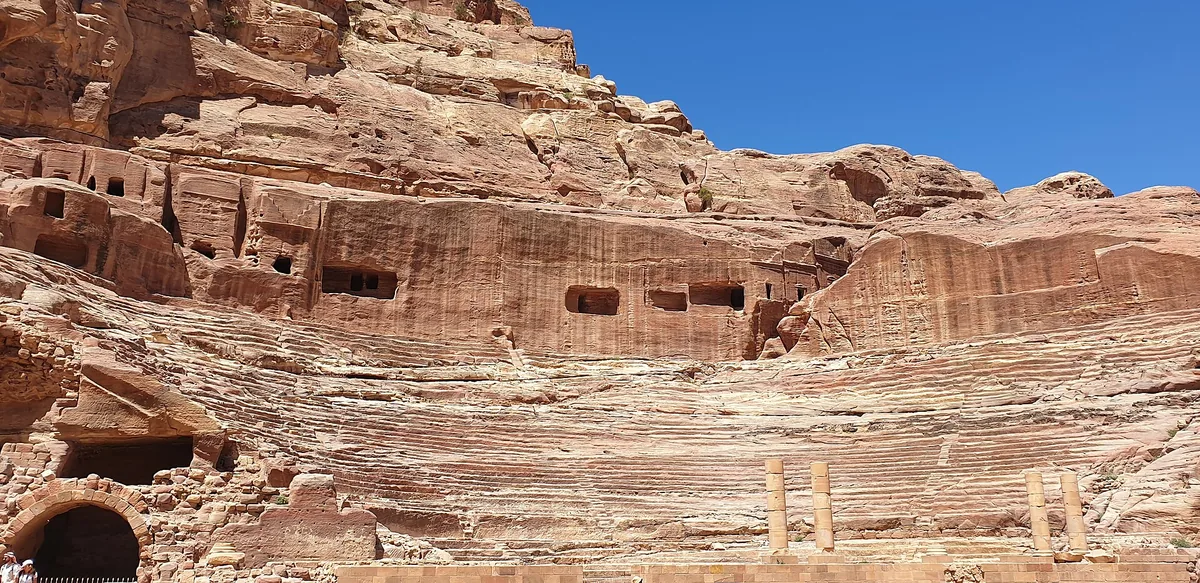
Petra is the reason most people come to Jordan, and it deserves more than the photograph-and-leave treatment it often gets. The archaeological park is not a single monument but a whole Nabataean city spread through a mountain basin – temples, tombs, a theatre, colonnaded streets, churches and cisterns, reached through a crack in the rock and big enough to absorb two full days without repeating yourself. It has been a UNESCO World Heritage Site since 1985 and the centrepiece of Jordanian tourism for decades, yet the basic shape of a good visit is still widely misunderstood. People rush the Siq at midday in a crowd, photograph the Treasury, walk to the theatre, decide they have “done Petra”, and leave having seen perhaps a tenth of it.
The better shape is simple. Enter as early in the day as you can manage, walk the Siq slowly, give the Treasury its moment, then keep going – through the Outer Siq, past the theatre and the Royal Tombs, down the Colonnaded Street to the basin, and up to the Monastery if your legs agree. That full arc is the experience. Everything in this section, and the fuller detail in our Petra travel guide, follows from it. Petra is also where the Jordan Pass earns its keep most visibly, since the pass is sold in versions covering different numbers of Petra days – the mechanics of that choice matter more than any other single booking decision on a Jordan trip, and they are covered in the questions at the end of this guide.
Walk the Siq and Stand in Front of the Treasury
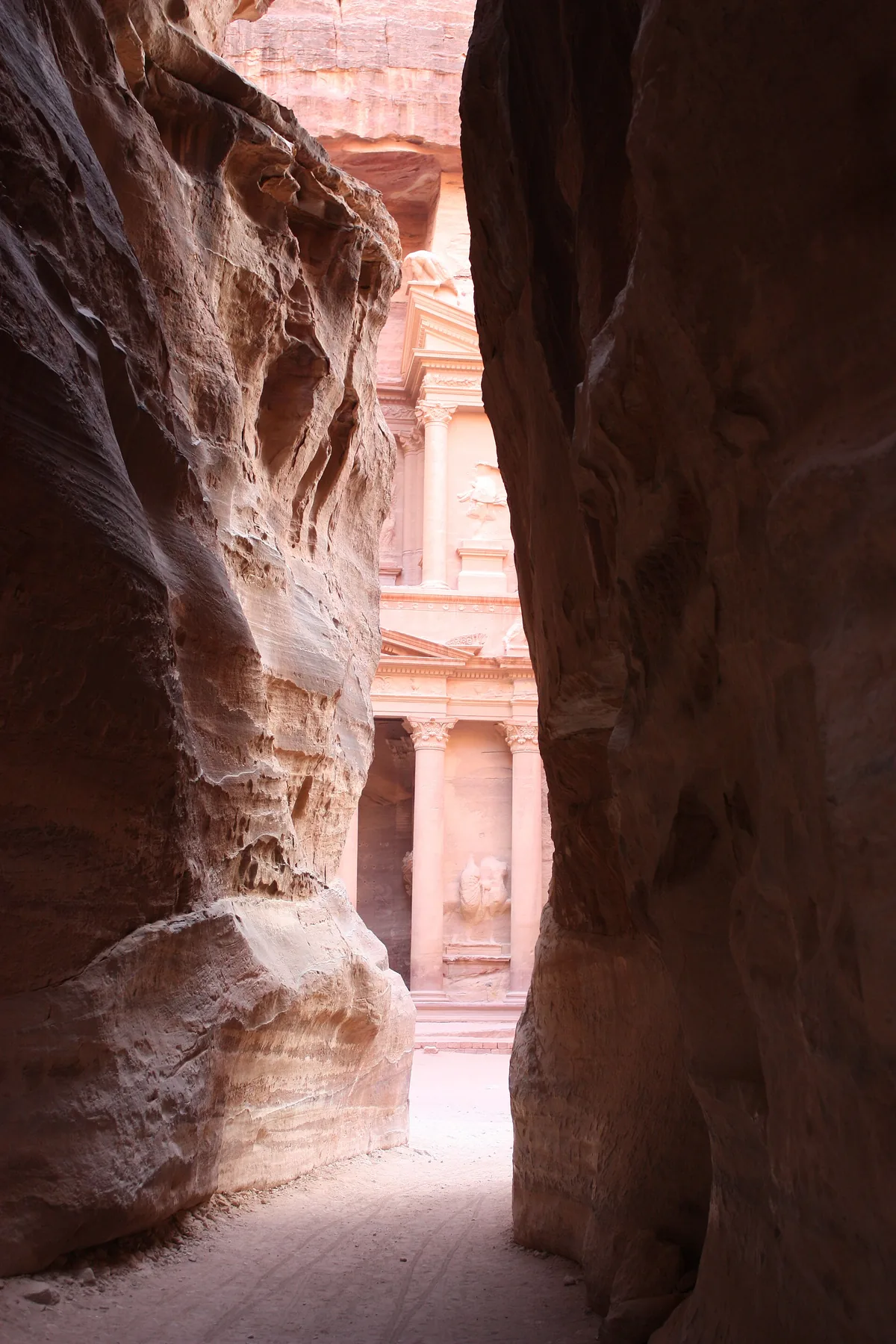
The Siq is a natural fissure in the sandstone, a little over a kilometre of winding, shaded corridor that was the Nabataeans’ ceremonial entrance to their capital – and walking it, rather than riding through it, is the first real experience of a Jordan trip. The walls close in to a few metres apart in places and rise far above your head, banded in reds, purples and ochres that change as the light moves. Look down as well as up. The Nabataeans carved water channels along the walls and laid a paved road whose worn surface still shows in stretches, with carved niches and weathered reliefs appearing at intervals. This was engineered infrastructure dressed as theatre, and it still works as theatre: the whole gorge is a slow build to a single reveal.
That reveal, when the Treasury – Al-Khazneh – first shows as a bright sliver between the dark walls, is one of the great staged moments in travel, and it lands even if you have seen the photograph a thousand times. The facade is some 39 metres high, carved in the 1st century BC most likely as a royal tomb, its columns and pediment softened by two thousand years of wind. The honest catches are two. First, you cannot go inside – the interior is a plain chamber and entry is not part of the visit, so set expectations accordingly. Second, the plaza in front fills quickly once the day’s groups arrive, which is the practical argument for the early start: the same facade, half an hour after opening, is a different and quieter experience. Walk it, stand there, and then resist the urge to turn back – the city is only just starting.
Climb the Steps to the Monastery
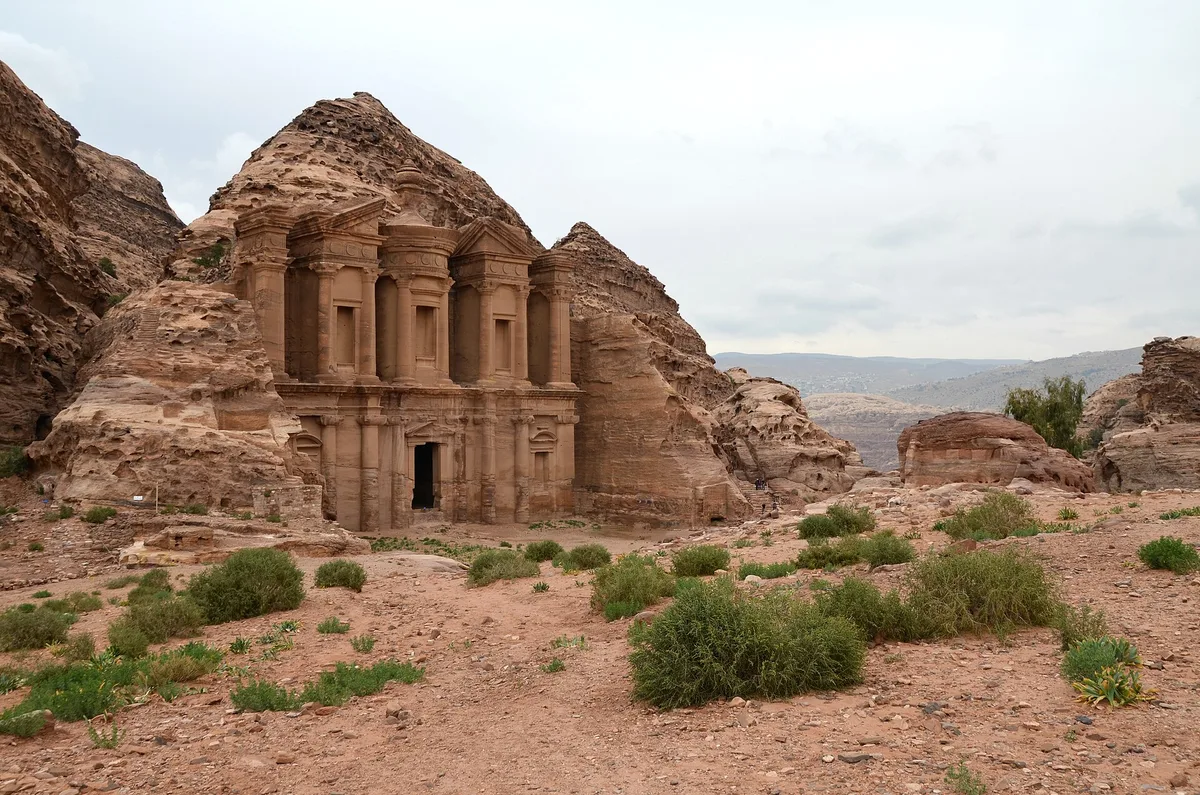
If the Treasury is Petra’s postcard, the Monastery – Ad Deir – is its payoff. From the basin at the end of the Colonnaded Street, a stairway of roughly 850 rock-cut steps climbs through a side valley to a plateau high in the mountains, where a facade even larger than the Treasury’s – around 45 metres wide – faces west over some of the wildest country in Jordan. The climb takes most people the better part of an hour, on steps worn smooth and uneven, shared in places with the donkeys that work the route. It is hot work by late morning and genuinely satisfying work at any hour, because the Monastery cannot be reached any other way. Everyone standing on that plateau walked up. The crowd thins accordingly.
The building itself, probably a Nabataean temple or royal tomb of the 1st century BC later reused by Byzantine Christians – the crosses carved inside are the clue behind the name – rewards the effort twice over. The facade is plainer and more massive than the Treasury’s, and the plateau around it has room to breathe: tea stalls with views back over the basin, and viewpoints a short walk further on that look out over Wadi Araba towards the Negev. Plan the day around it rather than bolting it on. A workable rhythm is Treasury early, the basin by late morning, the climb before the worst heat or after a long lunch in its shade, and the walk out in the long evening light – the return through the Siq, when the day visitors have gone, is one of the calmest hours Petra offers.
See Petra by Night – Candles, Music and Honest Expectations
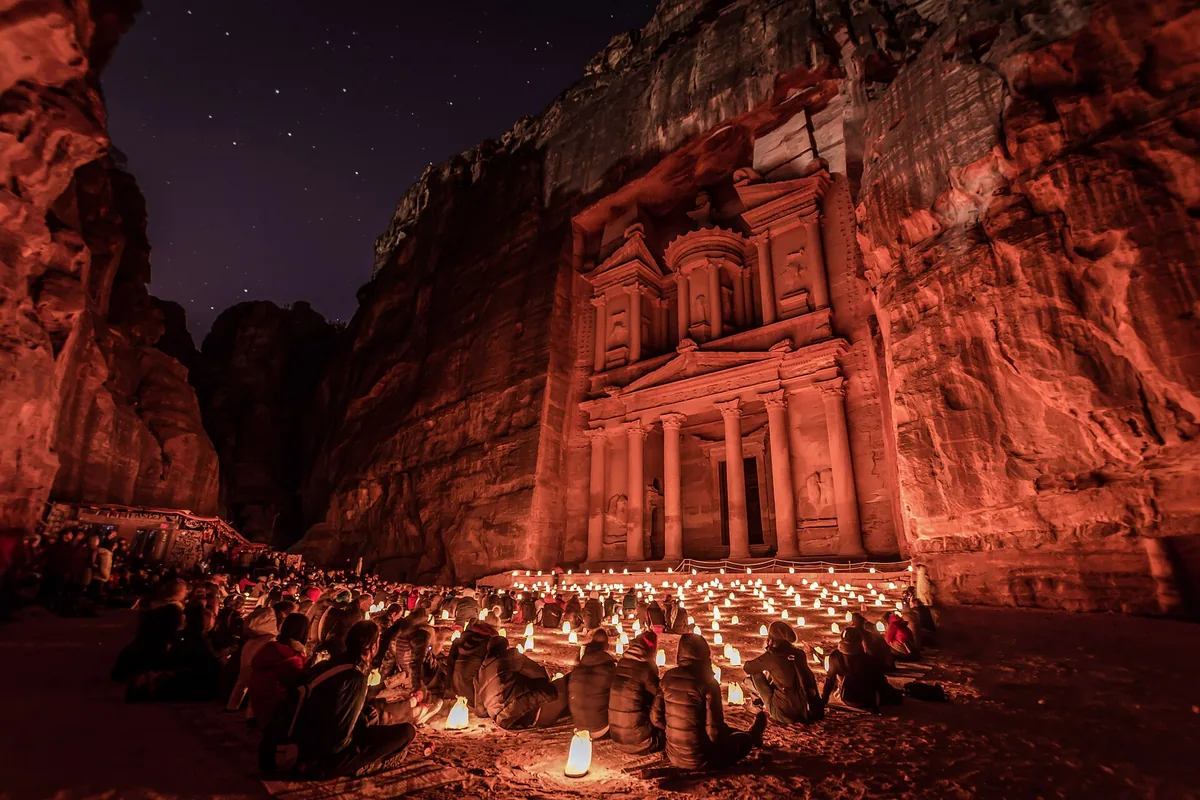
Petra by Night is the evening event that walks you back down the Siq by candlelight to the Treasury, where rows of candles in paper lanterns cover the plaza and the facade is lit for a programme of music and, since the event’s relaunch in 2025, projection mapping across the carved stone. It has run since 1998 and is operated as a private event separate from the park’s daytime admission. Done right, the walk itself is the best of it – the gorge at night, quiet except for footsteps, with candles lining the route and the rock walls reduced to shapes. The Treasury reveal, which you already know is coming, still works in the dark.
Now the honesty, because this is the most oversold and under-explained experience in Jordan. It is a separate ticket, bought at the visitor centre, and it is not included in the Jordan Pass. You must already hold a valid daytime Petra ticket to attend – the event is an add-on to a day visit, not a substitute for one. It runs on selected evenings rather than every night, and the current pattern of nights and the start time are set by the operator, so check the official Petra by Night channels when you are in Wadi Musa rather than trusting any printed schedule, including ours. The plaza gets busy, the show portion polarises people – some find the music and projection moving, others find it long – and the walk back up is in the dark with the crowd. Verdict: if you have a second evening in Wadi Musa and you loved the Siq by day, go. If it is your only evening and you are choosing between this and an early night before a Monastery climb, choose the climb.
Wadi Rum and the Red Sea – Desert Days, Desert Nights
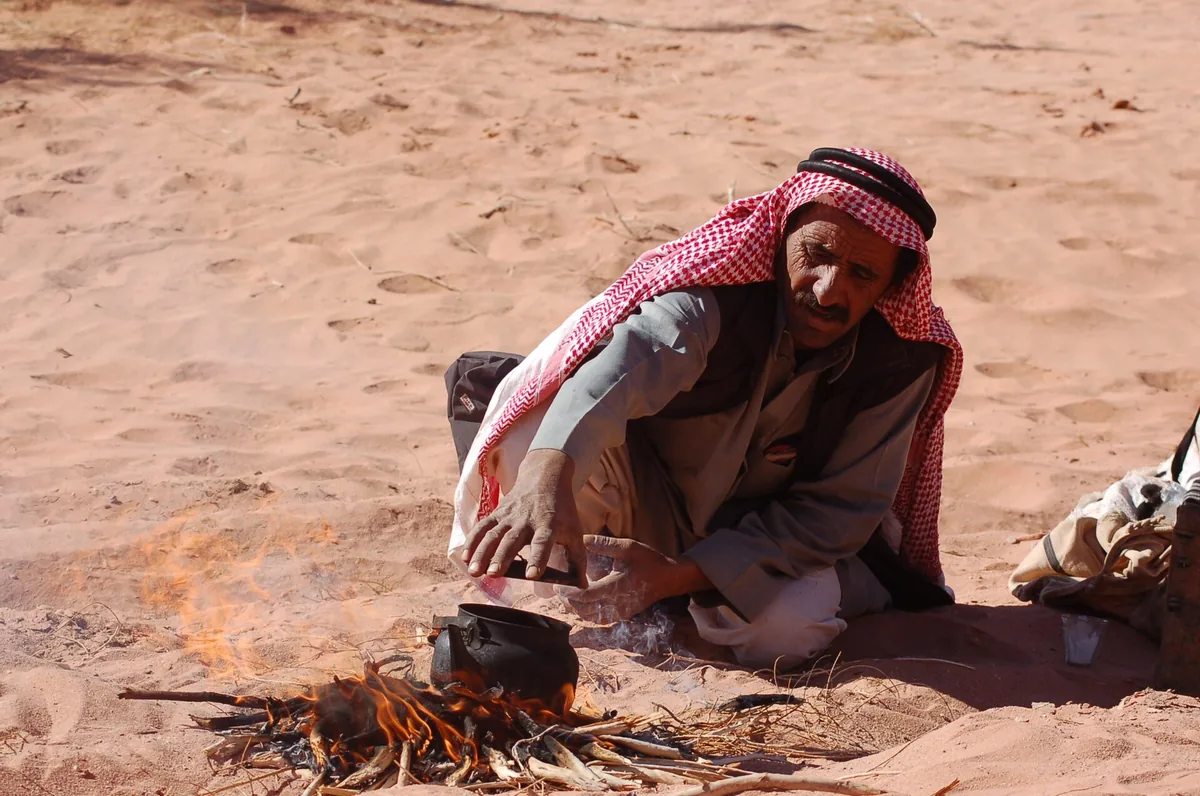
South of Petra the country opens into Wadi Rum, a protected desert valley of red sand and sheer granite and sandstone massifs that has been inscribed on the World Heritage List since 2011 as a mixed cultural and natural site – the petroglyphs and inscriptions of thousands of years of travellers are part of the listing alongside the landscape. The standard way in is a jeep tour with a local Bedouin driver, booked through your camp or arranged at the visitor centre, and the standard mistake is treating all jeep tours as the same product. They are not. Tours come in different lengths, and the difference between a short loop and a full day is the difference between seeing Rum’s edge and understanding its scale. A full day typically strings together the valley’s set pieces – Lawrence’s Spring, the Khazali canyon with its rock inscriptions, a great red dune to scramble up, natural rock bridges, canyons and viewpoints – with stops where your driver builds a small fire and makes sage tea in the sand, as guides here have always done.
The mechanics matter more than the checklist. You ride in the open back of a pickup, which is windy, dusty and exactly as fun as it sounds; bring a scarf or buff, sunglasses that seal, and more water than you think. Distances inside the protected area are long, the light is best early and late, and the middle of the day in summer is fierce. Ask, before you pay, how many hours the tour actually runs and what it includes – this single question separates the good operators from the disappointing ones more reliably than any review score. And notice the desert itself between stops: Rum’s silence and emptiness are the real attraction, and a driver who is happy to stop in the middle of nowhere and let you stand in it understands the assignment.
Sleep in a Bedouin Camp Under the Stars
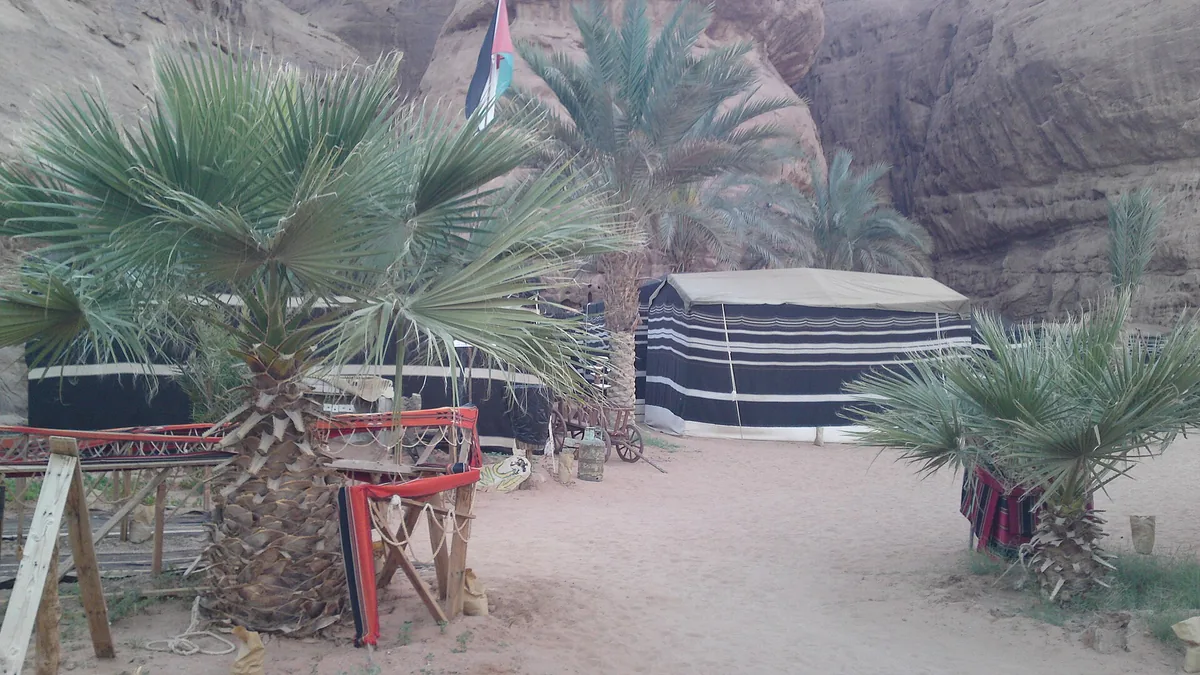
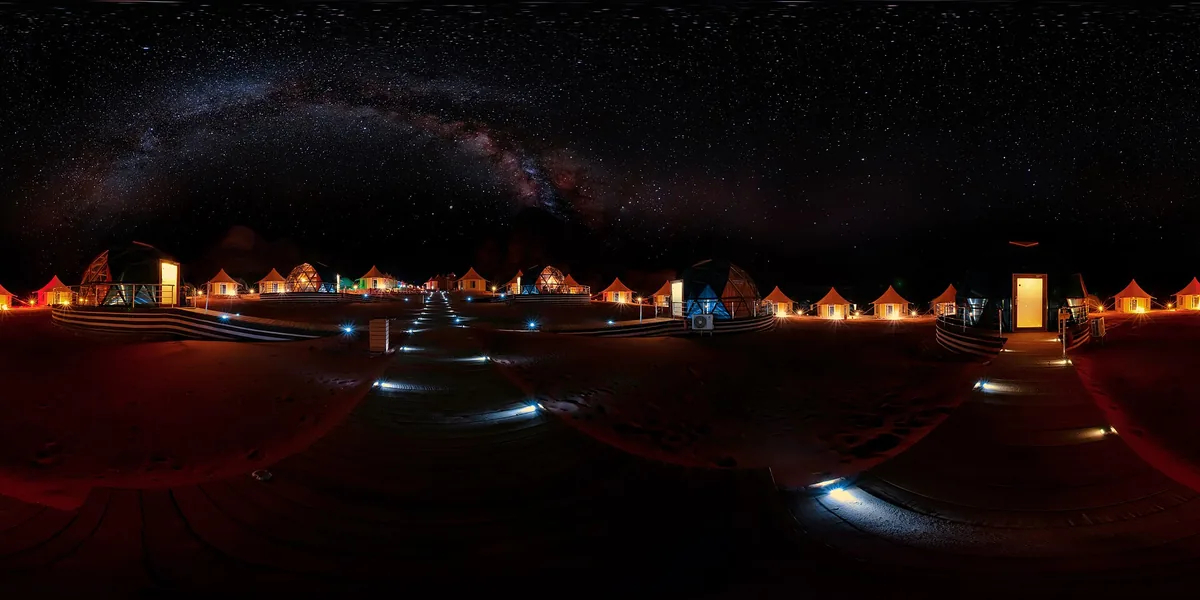
Almost everyone who tours Rum by day also sleeps there, and the overnight is the part people talk about for years. Camps range from simple traditional goat-hair tents with shared bathrooms to luxury domes with glass fronts built for stargazing from bed, but the shared grammar of the evening is constant: arrive before sunset, climb something nearby to watch the light go, eat dinner cooked the Bedouin way – traditionally zarb, meat and vegetables slow-cooked in an underground oven and unveiled from the sand with a small ceremony – then sit out in the dark. Rum’s night sky, far from any town’s glow, is the headline act. On a clear, moonless night the Milky Way is not a smudge but a structure, and camps that switch off their lights after dinner give you the full show from a mattress dragged out onto the sand.
Choose your camp by the things that actually vary. Location matters most: camps deep inside the protected area are darker, quieter and surrounded by the big scenery, while those near Rum village are easier to reach but sit under more light and noise. Then ask about the dinner, the bathroom arrangements and whether the price includes the jeep tour or sits on top of it – bundled camp-and-tour packages are the norm and usually the cleanest way to buy both. Nights are colder than the day suggests in any season, and properly cold in winter, so the romantic idea of sleeping outside needs a layer or two of reality. None of this is a reason to hesitate. Of all the experiences in this guide, a Rum overnight is the one with the highest ratio of memory to effort.
Snorkel and Dive Aqaba’s Red Sea Reefs
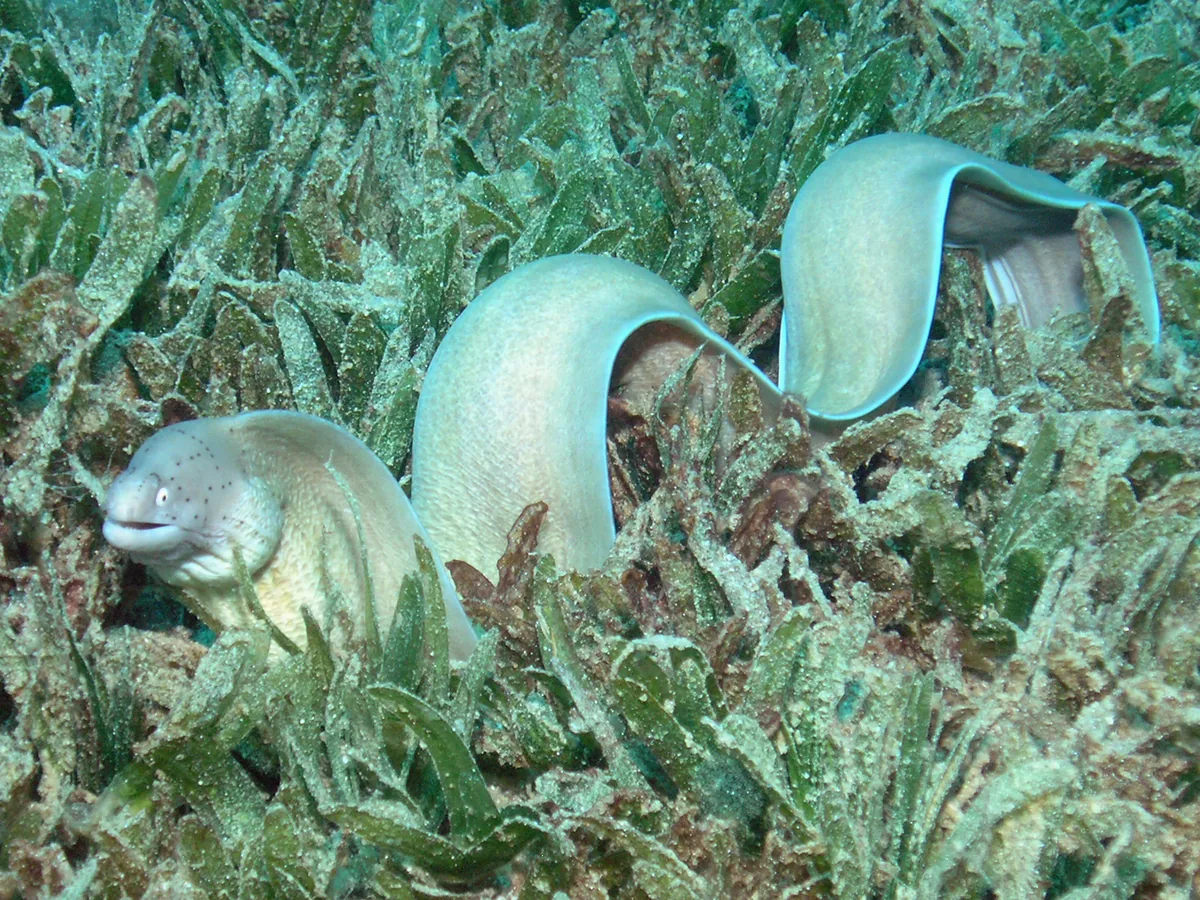
Jordan’s only coastline, a short strip at the head of the Gulf of Aqaba, holds the trip’s complete change of register: warm Red Sea water, coral reefs that begin a few fin-kicks from the beach, and a resort town that works as either a grand finale or a decompression stop. Most of the reef lies inside the Aqaba Marine Reserve along the southern coast, a protected stretch of fringing reef, seagrass beds and dive sites running south from the port towards the Saudi border – a reserve whose significance was recognised with World Heritage inscription in 2026, Jordan’s newest listing. The seagrass is not scenery to skip on the way to the coral: it is where turtles graze and morays like the one pictured here hunt, and snorkellers who only stare at the reef wall miss half the cast.
For snorkellers, the joy of Aqaba is access – at several sites along the southern beach road you can walk in from the shore and be over coral within minutes, no boat required, which makes it an easy half-day rather than an expedition. Divers get the bigger menu: reef dives for every level, and wreck diving on the Cedar Pride, a Lebanese freighter scuttled in the 1980s as an artificial reef and now encrusted and fish-rich, sitting at depths that suit qualified divers. The honest catches are practical ones. The town beaches and the dive coast are different places – the reef is south of town, so you need a taxi, a hotel on the southern strip, or a dive centre’s transfer. Port and shipping traffic keeps the northern waterfront for looking at, not swimming in. And the reef is protected, which means no touching, no feeding and reef-safe habits throughout. Warm water, shore entry and a World Heritage reef, all within a taxi ride of your Petra dust – as a final Jordan experience, it balances the trip beautifully.
The Dead Sea and the King’s Highway – Float, Soak, Wade and Wander
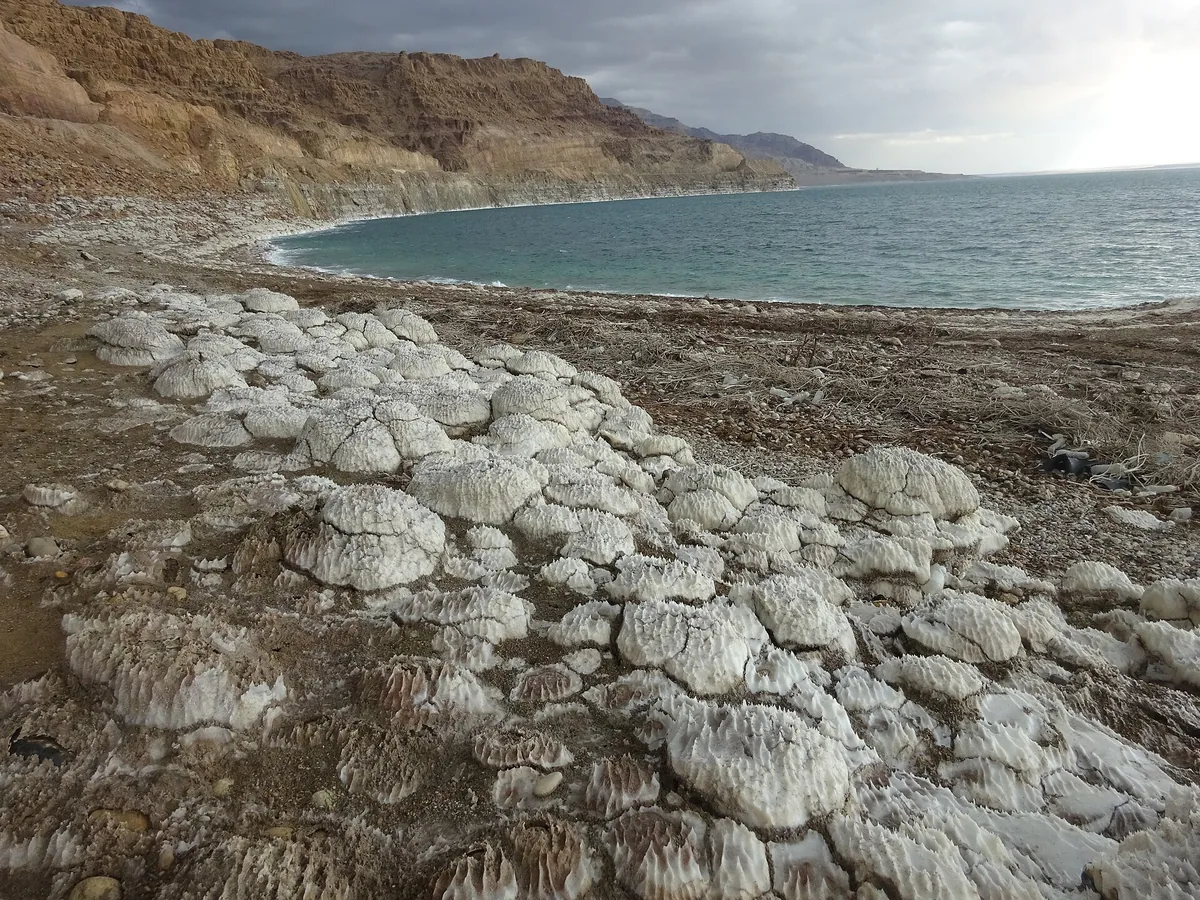
The western edge of Jordan drops off the plateau in a long escarpment to the lowest land on Earth, and the road that runs along it – and the older King’s Highway that climbs and falls through the hills above – packs an improbable variety of experiences into a couple of days. Float in the Dead Sea in the morning, wade a flooded canyon after lunch, soak under a hot waterfall the next day, stand where Moses stood, puzzle over a mosaic map, and finish inside a crusader castle. Nothing here needs more than half a day on its own, which is precisely the temptation to resist: this corridor rewards slowness, because each stop is a different physical sensation as much as a sight. Together they are Jordan’s great second act after Petra.
The King’s Highway half of the pairing deserves a word of its own, because driving it is one of the experiences. This is one of the oldest continuously used roads on Earth – a route threaded through the hill country east of the rift by biblical kings, Roman engineers, crusader supply lines and Ottoman caravans in turn – and as a modern drive it trades the speed of the desert highway for drama: hairpins dropping into the vast Wadi Mujib canyon and climbing out the other side, villages, olive country, and viewpoints that stop you whether you planned to or not. Travellers in a hurry take the fast road south and see none of it. The six experiences below are written to be mixed and matched between the two roads – the shore road for the water, the high road for the stone – across two or three unhurried days.
Float in the Dead Sea at the Lowest Point on Earth
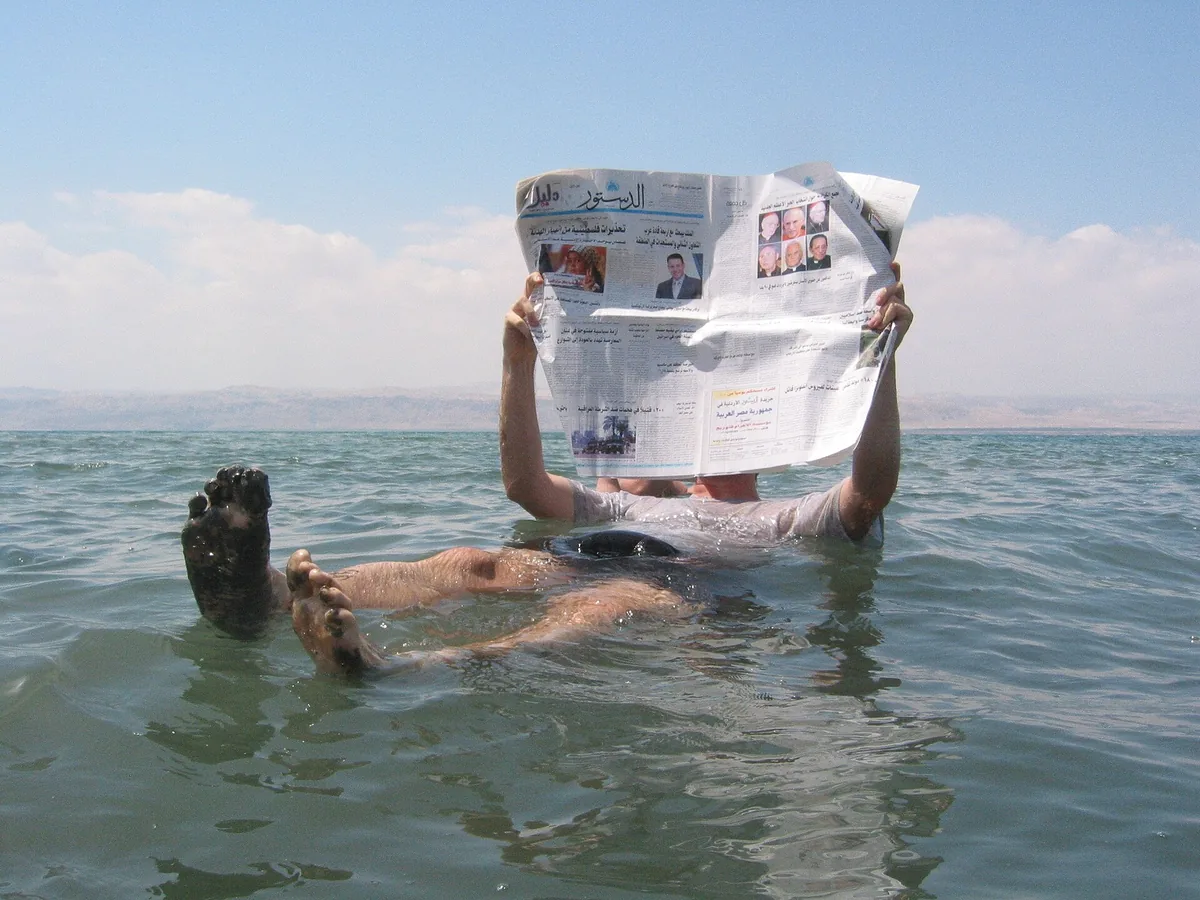
Floating in the Dead Sea is the one Jordan experience that is exactly as strange as advertised. The lake’s surface sits at roughly 440 metres below sea level – the lowest exposed land on the planet – and its water, around ten times saltier than the ocean’s, holds you up with a force that feels like a trick. You do not swim here; you sit in the water as if in an armchair, or lie back and read the newspaper for the photograph everyone takes, because it is genuinely easy and genuinely funny. The setting helps: the Jordanian shore faces west across still, dense water to the hills on the other side, and the salt crusts the shoreline rocks white. It is beautiful, eerie and effortless in roughly equal measure.
The how matters, because the Dead Sea punishes carelessness mildly but memorably. Access is through the resort hotels’ beach clubs and a small number of public beaches along the northeastern shore, where you pay for entry and, just as importantly, for the showers – you will want fresh water on your skin promptly afterwards. Enter slowly, because the salt-encrusted shore is sharp and the bottom drops away unevenly; water shoes earn their place in your bag. Do not splash, do not put your face in, and if you get water in your eyes, get out and rinse rather than rubbing. Shaving the day before is a mistake you make once. Short floats of ten or fifteen minutes at a time are the rhythm, with the black mud – scooped from pots on the beach or the shore itself, smeared on, dried in the sun, rinsed off in the lake – as the companion ritual. People have bathed here for the minerals since antiquity; the modern spa framing is new, the impulse is not.
Wade the Siq Trail in Wadi Mujib
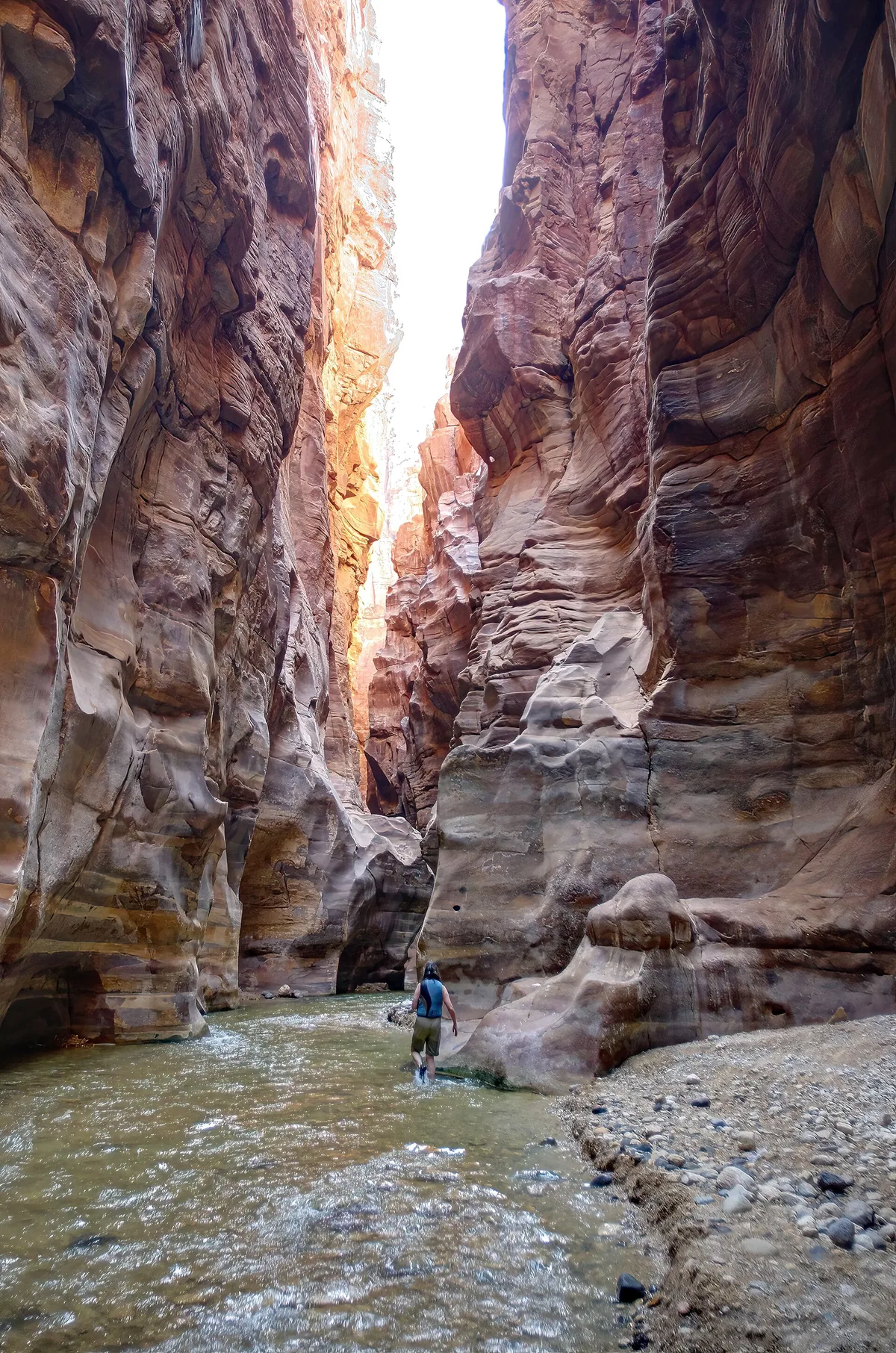
A few kilometres south of the Dead Sea resorts, the Mujib river cuts one final slot canyon through the escarpment before reaching the lake, and in the warmer months you can walk up it – in it, mostly, wading against the current between walls of banded sandstone that close to a corridor overhead. The Siq Trail is Jordan’s adventure headline for people who do not climb or dive: a self-guided water hike of a couple of hours, out and back, where the river does the route-planning. You wear a life jacket issued at the visitor centre, you get wet to the waist and sometimes beyond, and you haul yourself up small cascades on fixed ropes and ladders where the canyon steps. At the end of the navigable stretch a waterfall pours into a pool, and then you turn around and let the current help you home, floating the deeper sections with your feet up.
This is run by Wild Jordan, the tourism arm of the Royal Society for the Conservation of Nature, inside the Mujib Biosphere Reserve – a reserve that protects the dramatic country between the plateau and the Dead Sea shore. The rules are the experience’s frame, and they are sensible: the trail is seasonal, opening only in the drier months when the river is safe, and it can close at short notice after rain anywhere upstream, because slot canyons and flash floods are a serious combination. There is a minimum age for the water trails, and you will get entirely wet, so phones live in dry bags or stay behind. None of this is fine print to skim – the seasonality is the single most common reason travellers miss Mujib entirely, arriving in winter to find the canyon shut. If your trip falls in the open season, prioritise it. Jordan is mostly a dry country of stone and sand, which is exactly why two hours soaked in a red-rock river gorge feels like a plot twist.
Soak Under the Waterfalls at Ma’in Hot Springs
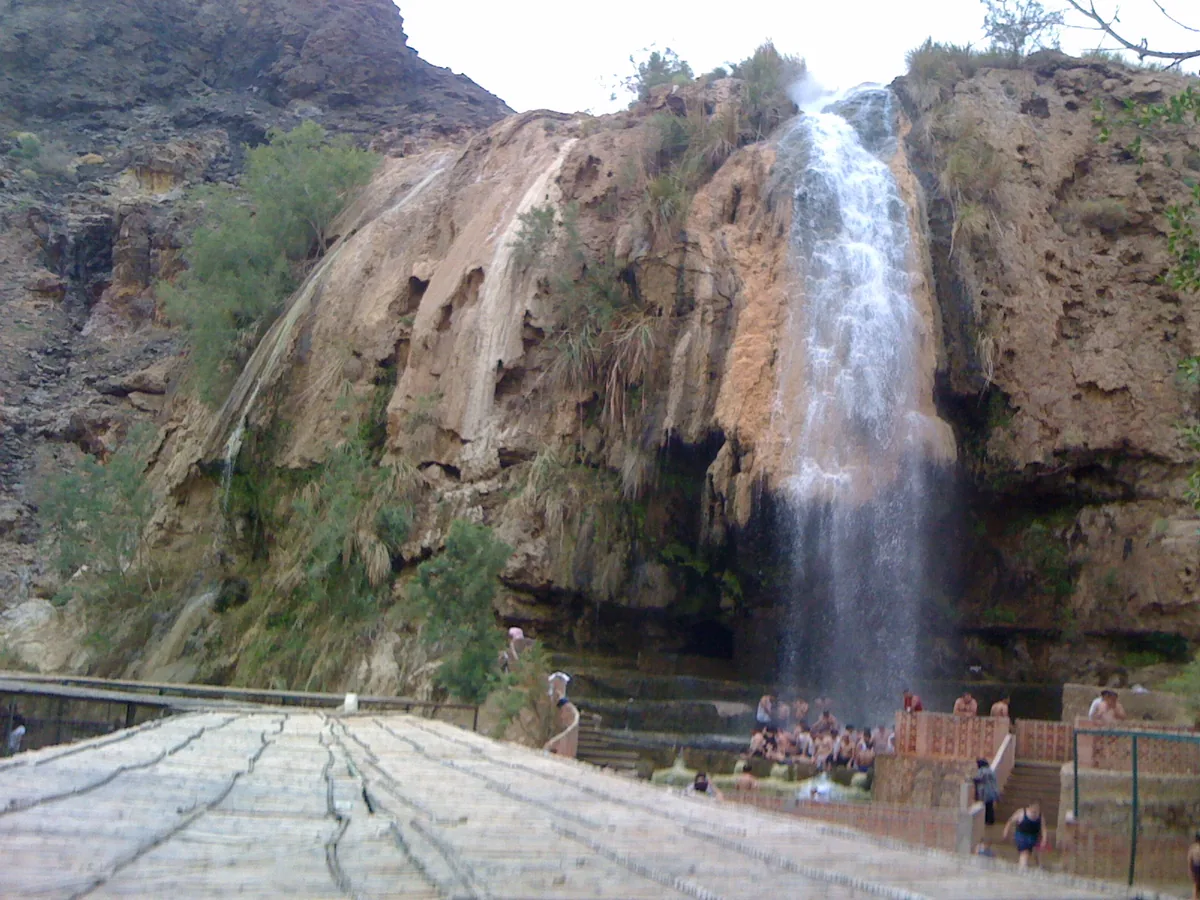
Below the Dead Sea road, in a steep ravine where the springs emerge hot from the rock, Hammamat Ma’in is the corridor’s slow experience – a complex of natural hot waterfalls and pools that Jordanians have used for generations as the country’s traditional place to soak away aches. The centrepiece is exactly what the photograph shows: mineral water sheeting down a travertine cliff into open-air pools, steam rising when the air is cool, bathers standing under the falls for a free pressure massage. The water leaves the ground hot enough that the pools are graded by temperature, and part of the ritual is finding your level – easing from warm to hot, then cooling off and going again.
Access comes in two flavours that suit different trips: the resort and spa at the springs for the full pampering version with treatments and a private feel, or the public bathing area by the main falls for the local, unvarnished one. Either way it pairs naturally with the neighbourhood – Ma’in sits between Madaba and the Dead Sea, so it slots into a King’s Highway day as the afternoon unwind after castles and mosaics, or into a Dead Sea stay as the evening excursion. Go in the cooler months or later in the day if you can, since hot water under a midday summer sun tests even enthusiastic soakers. It will never headline a Jordan itinerary, and it should not; Ma’in is the deep breath in the middle of one, and trips are better for having one.
Find Jerusalem on Madaba’s Mosaic Map and Stand on Mount Nebo
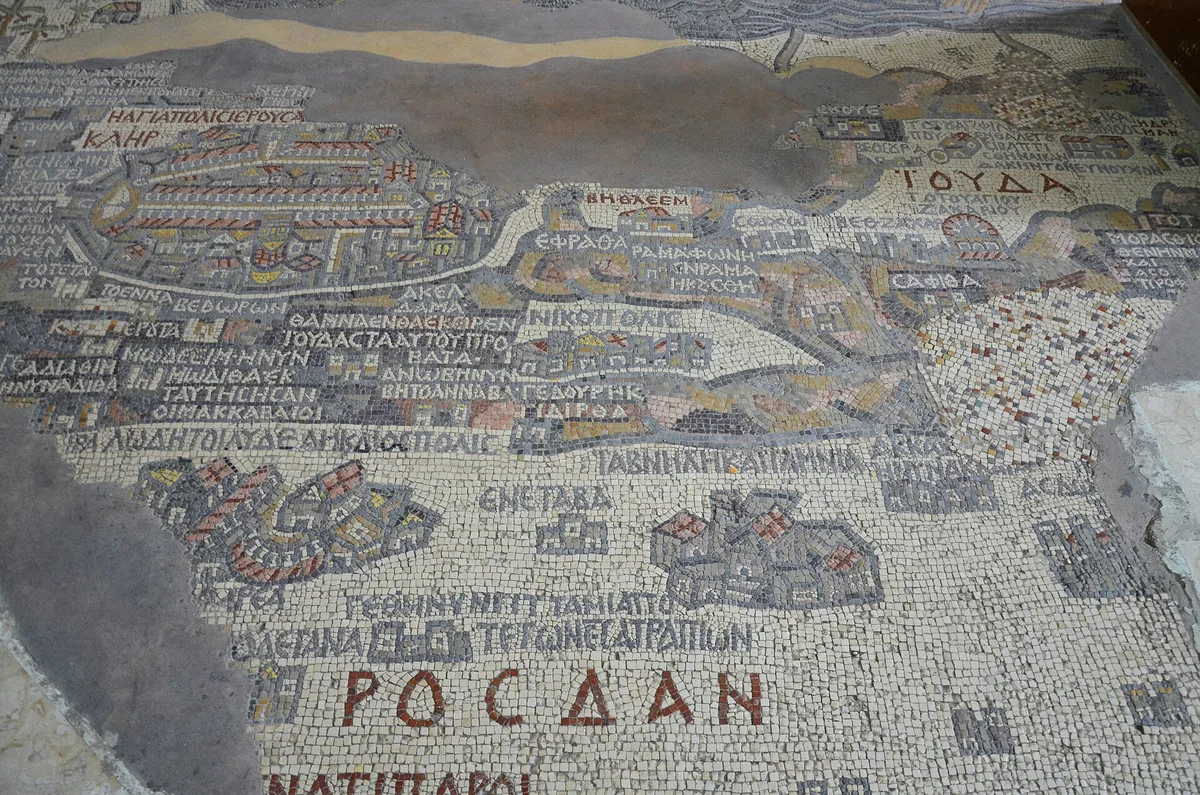
Madaba, a market town on the plateau south of Amman, is Jordan’s mosaic city, and its treasure is a map. In the Greek Orthodox Church of St George, set into the floor where an earlier Byzantine church stood, survives the oldest known geographic floor mosaic – a 6th-century map of the Holy Land made from millions of stone cubes, with Jerusalem at its centre drawn in remarkable detail: walls, gates, churches, and the colonnaded main street you can pick out in the photograph. Only part of the original survives, but what survives is the heart of it, and standing over a map older than most countries – one that has been used to verify the locations of biblical sites – is a quietly astonishing ten minutes. The rest of Madaba extends the theme gently: an archaeological park of excavated mosaic floors, churches full of later mosaics, and workshops where the craft continues, all walkable in a couple of unhurried hours.
Ten minutes west, the road climbs Mount Nebo, the ridge from which Moses is said to have viewed the Promised Land before his death – a memorial church with more fine Byzantine mosaics, a modern sculptural cross entwined with a serpent, and the view itself: across the Dead Sea and the Jordan Valley to Jericho and, on the clearest days, the hills of Jerusalem. Come in the morning before the haze builds, or accept the haze as part of the atmosphere. Neither stop demands half a day, and that is their charm – Madaba and Nebo are the thoughtful, low-key counterweight to Jordan’s blockbusters, and almost everyone who makes time for them is glad they did.
Explore the Vaulted Halls of Karak Castle
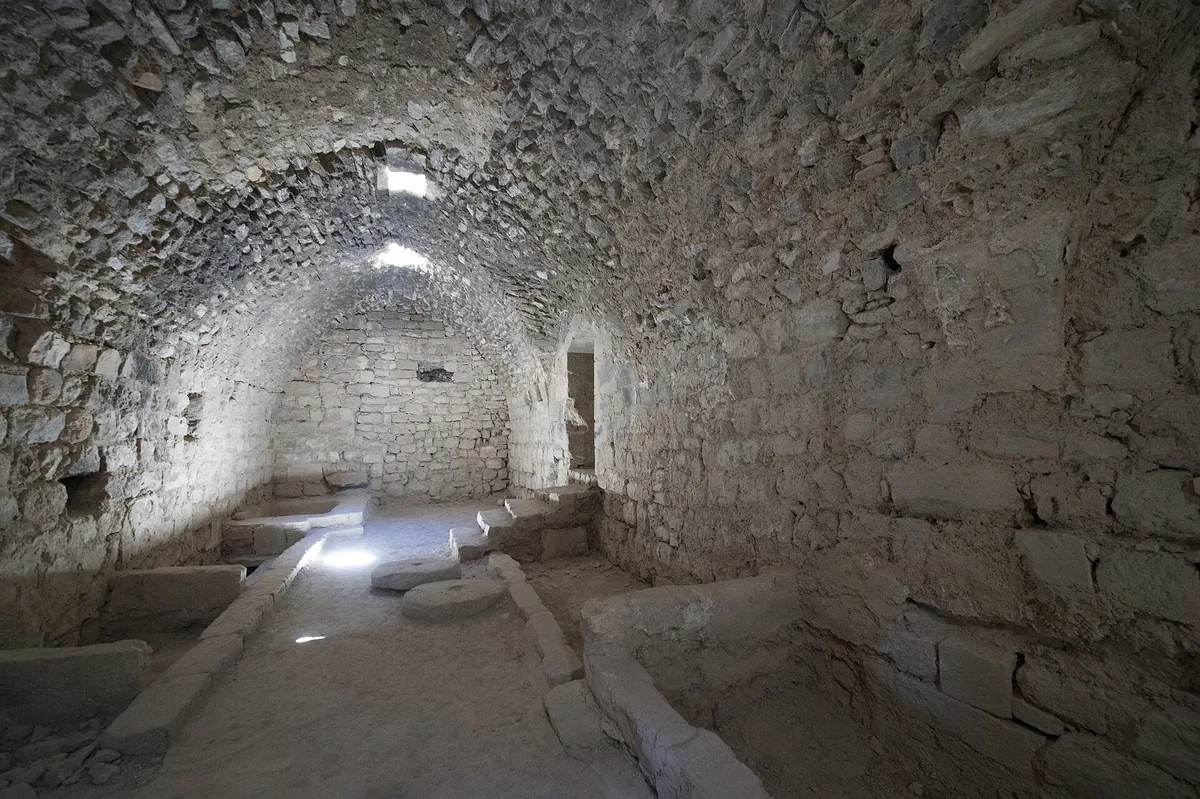
The King’s Highway’s great fortress is Karak, a crusader castle on a triangular plateau above the town of the same name, built in the 12th century to guard the road between Syria and Egypt and famous in the crusades’ bloodier chapters – it was held by Reynald de Châtillon, whose provocations helped bring on the confrontation with Saladin that ended at Hattin, after which Karak endured sieges before falling in 1188. What makes visiting it an experience rather than a photo stop is its verticality. From the outside it is walls on a hill; inside, it is a stone warren on several levels – vaulted galleries that stabled horses and stored supplies, dark passages lit by shafts from above, a chapel, cisterns, and ramparts with views clear to the Dead Sea rift on a good day.
Exploring it is pleasingly unstructured. You wander, duck through doorways, climb, get mildly lost in the lower vaults – a torch or phone light genuinely helps down there – and emerge blinking onto another terrace. The castle museum fills in the story from the Bronze Age town beneath your feet to the Ottoman period. Karak also anchors the drive: it is the natural lunch stop on the King’s Highway between Madaba and Petra, and the town’s mansaf has a serious local reputation, which gives you the day’s itinerary in one line – mosaics in the morning, castle by midday, Jordan’s national dish for lunch, and the long scenic road south to Petra by evening.
Hike From Dana Village Down to Feynan
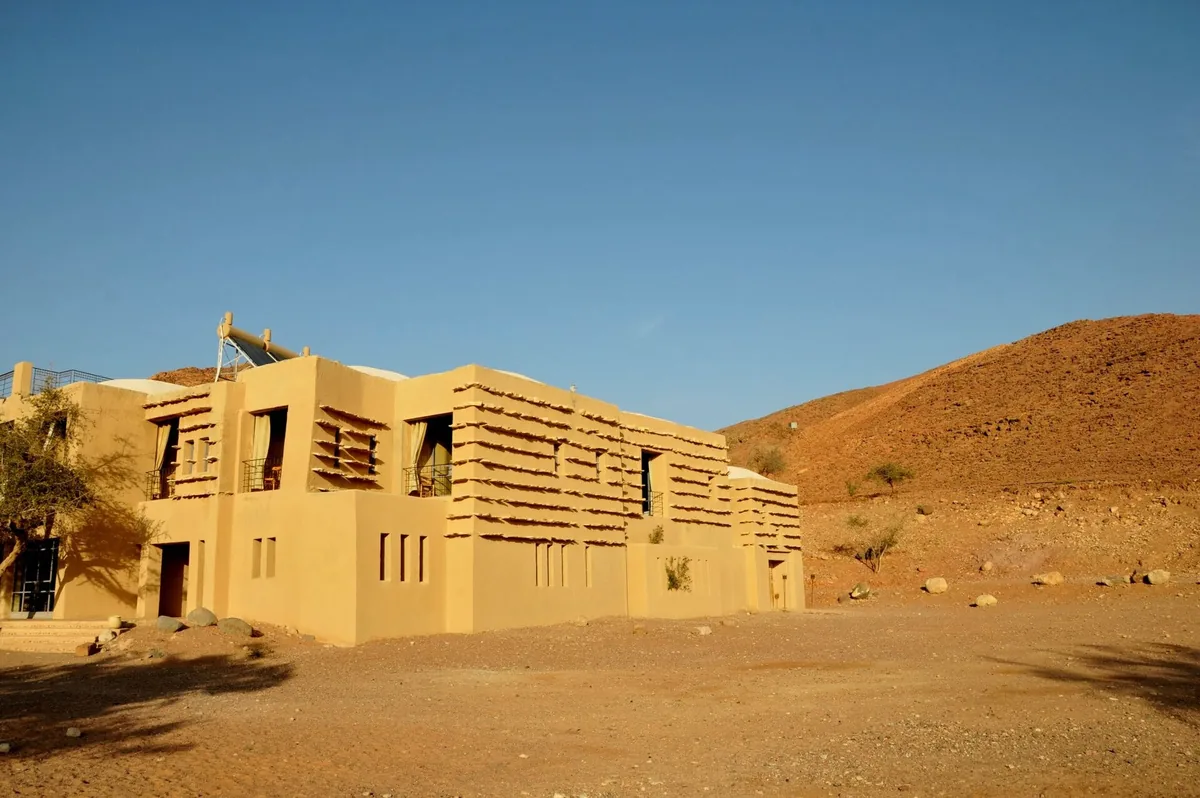
Dana Biosphere Reserve is Jordan’s flagship protected area for walkers – the largest of the RSCN reserves, dropping from the plateau rim at Dana village through wadis and sandstone country all the way down towards Wadi Araba, and holding four of the region’s vegetation zones in a single protected sweep. The signature experience is the Dana to Feynan trail: a full-day, mostly downhill hike of some 14 kilometres from the stone village at the rim to Feynan Ecolodge, the solar-powered, candlelit lodge in the photograph, which sits at the valley floor and can only be reached on foot or by rough track. Along the way the country changes under your boots – juniper and oak scrub giving way to sandstone gorges, then open desert – with ibex, birds of prey and desert foxes all on the reserve’s resident list for the lucky and the quiet.
The trail is usually walked with a local guide arranged through the reserve, and the logistics are part of the pleasure: you walk down through a day, your bag travels by road, dinner is at the lodge by candlelight, and the next morning you either walk out to the roadhead or continue on the multi-day trek towards Petra, one of the great point-to-point hikes of the Middle East. Shorter options exist for tighter schedules – rim trails around Dana village, the walk down to the guesthouse and back – but the full descent is the one to build a day around if your trip has the slack. Dana is the experience travellers cite when they say Jordan surprised them, because it replaces monuments with landscape and effort, and it pairs with nothing else on this list precisely because it is unlike all of them.
Amman and the Roman North – Cities Living and Dead
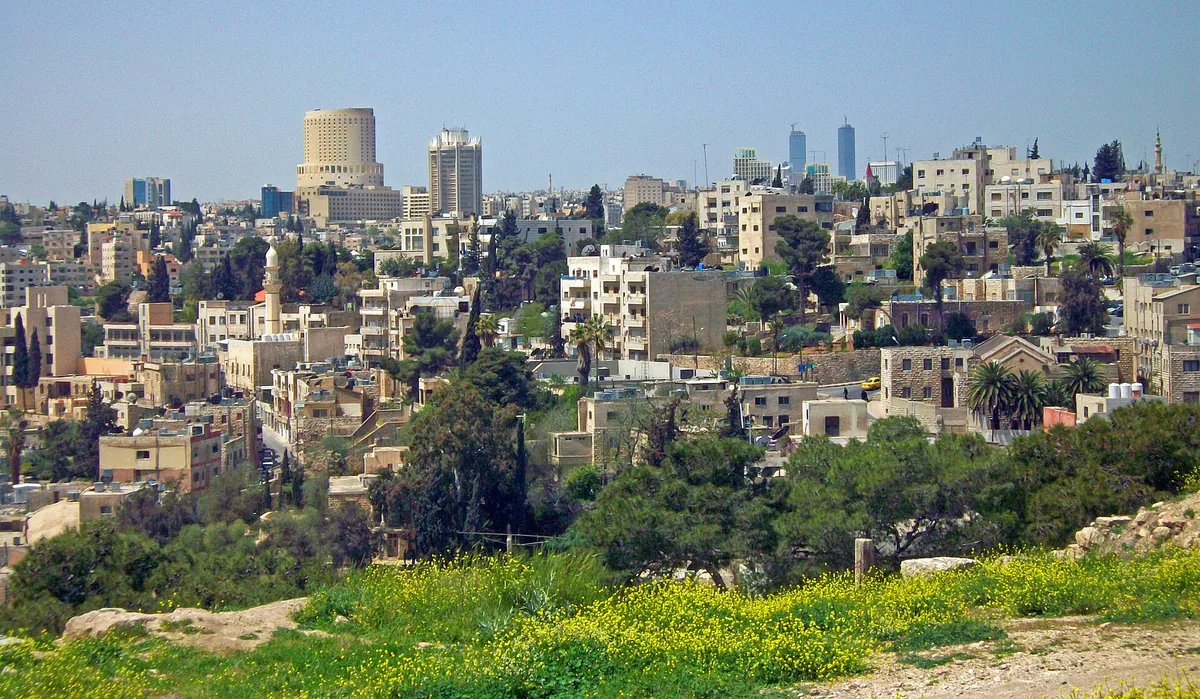
Most Jordan trips begin and end in Amman, and too many treat the capital as a runway with a hotel attached. That misses a real pleasure. Amman is a city of hills and limestone, spread over ridge after ridge, where Roman ruins sit in the middle of traffic and the downtown souks still do the city’s everyday shopping. It will not out-monument Petra and it does not try to. What it offers is texture: a citadel with a view and four thousand years of layers, a Roman theatre folded into the downtown bowl, coffee and knafeh on Rainbow Street, gold and fabric and spice in the Balad. Give it one full day rather than two half ones, walk it in the sequence below – high to low, ancient to living – and it stops being the place your trip starts and becomes one of the things your trip was about.
Start on the Citadel, Jabal al-Qal’a, the hill the photograph looks across from: the columns of the Roman Temple of Hercules, an Umayyad palace complex, a small archaeological museum with some of the country’s most important finds, and the panoramic argument for Amman’s hill-city geography laid out in every direction. Come down into the Balad, the old downtown in the valley below, where the Roman Theatre seats its six thousand against the hillside – climb to the top row for the scale of it – and the surrounding streets hold the city’s souks: the gold market glittering in a covered lane, fabric, spices, household goods, and the glorious, syrup-soaked crush of the famous knafeh shops. Finish up the hill again in Jabal Lweibdeh or on Rainbow Street in Jabal Amman, the first-circle neighbourhood of old villas, galleries and cafes, where Amman goes to stroll in the evening. That arc – citadel, theatre, souks, cafe hill – is a full and satisfying city day.
Walk the Cardo at Jerash, Rome’s Best-Kept Secret
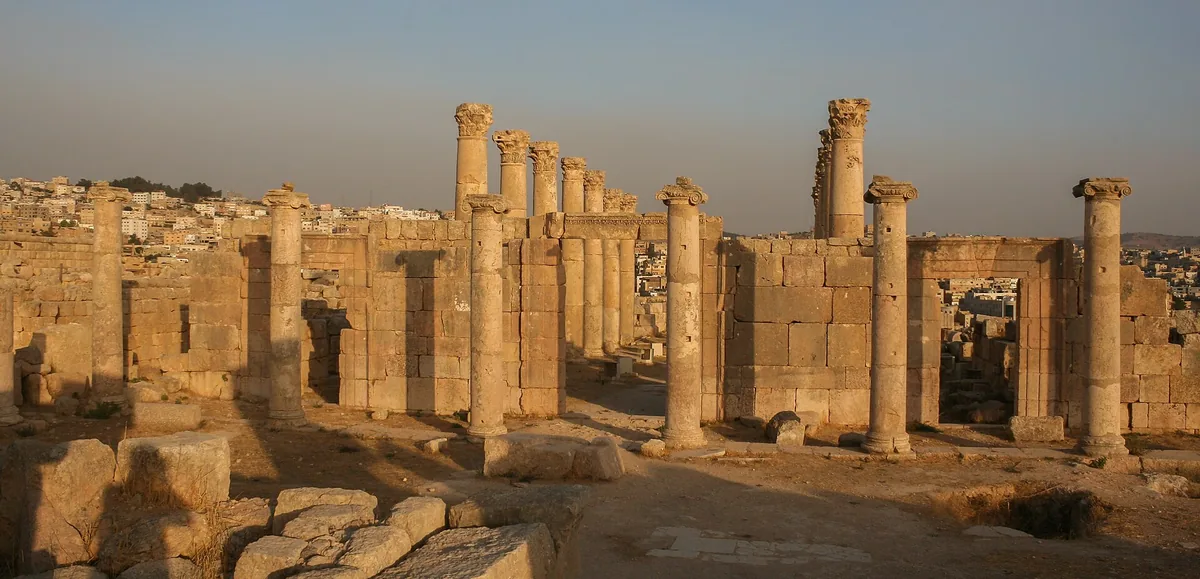
An hour north of Amman stands the trip’s biggest surprise for anyone who skipped the guidebook: Jerash, ancient Gerasa, one of the best-preserved Roman provincial cities anywhere – and it is not a fragment. You enter through Hadrian’s Arch, raised for the emperor’s visit in the 2nd century AD, pass the hippodrome, and come into the Oval Plaza, a colonnaded ellipse that still feels like a public space. From there the Cardo, the main colonnaded street, runs the length of the city – original paving with chariot ruts worn into the stone, hundreds of columns standing, temples and theatres and baths and an elaborate nymphaeum fountain spaced along it. Walking that street end to end, at street level, in a city rather than an exhibit, is the experience: Jerash gives you Roman urbanism at full scale and almost empty compared with Italy’s equivalents.
Practical notes that shape the visit: the site is big and mostly shadeless, so treat it like Petra in miniature – earlier is better, water is essential, and the far end (the north gate, the second theatre) is where the crowds never reach. It is worth knowing, in a guide full of UNESCO listings, that Jerash is not one of them – it sits on Jordan’s Tentative List, a distinction that surprises most visitors given the quality of what survives. As a half-day from Amman it combines naturally with lunch and an afternoon back in the capital’s cafes, and families rate it highly: children can run on Roman streets here in a way that precious, fragile sites do not allow. If you have to choose between a second day in Amman and the Jerash trip, choose Jerash.
Drive the Desert Castles Loop East of Amman
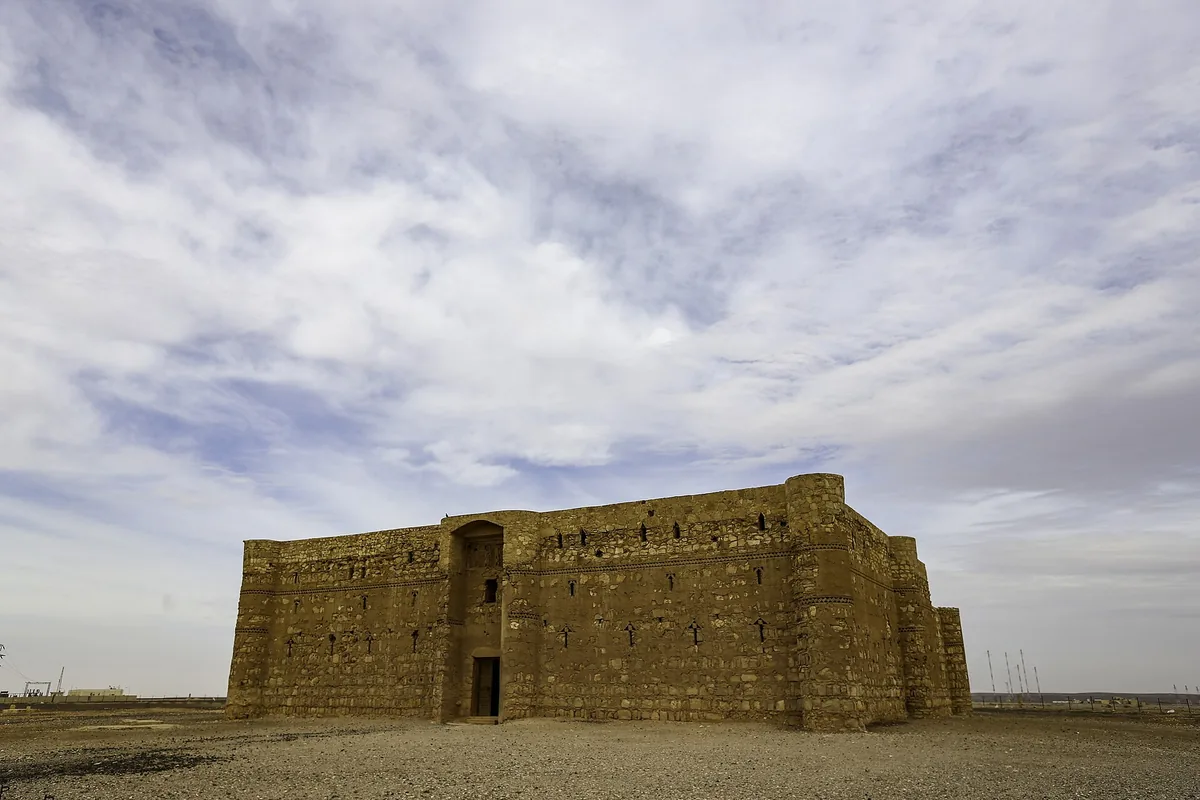
East of the capital, where the city gives way to basalt desert and gravel plains running towards Iraq, a loop road strings together the so-called desert castles – a scatter of Umayyad-era buildings from the 7th and 8th centuries whose purposes scholars still debate: hunting lodges, bath houses, caravanserais, desert retreats for caliphs, probably several of these at once. The loop makes a self-contained road trip of half a day to a full day, and its appeal is contrast – after days of famous, interpreted, ticketed sites, these are lonely buildings in an empty landscape that you often have entirely to yourself. Qasr Kharana, in the photograph, is the most complete and the most fortress-like, two storeys of stone around a courtyard standing utterly alone on the plain, its function genuinely unresolved – too far from water and farmland for easy explanations.
The loop’s jewel, though, is Quseir Amra, and it is a jewel with a UNESCO certificate: inscribed in 1985 for the frescoes that cover its bath house interior – dancing figures, hunting scenes, a zodiac painted across a domed ceiling, early Islamic art of a frankness that surprises everyone who walks in expecting austerity. Add the black basalt fort at Azraq, with its oasis and wetland reserve nearby, and Qasr Mushatta’s carved facade story (the original’s showpiece section is famously in Berlin, the ruins still atmospheric), and the loop becomes one of Jordan’s most satisfying drives. You need a car or a driver for the day, the sites are spread along good desert roads, and several sit within the Jordan Pass’s list of included attractions – one more reason the pass maths, covered below, is worth doing before you arrive.
Eat Your Way Through Jordan – Mansaf, Mezze and the Cooking Class
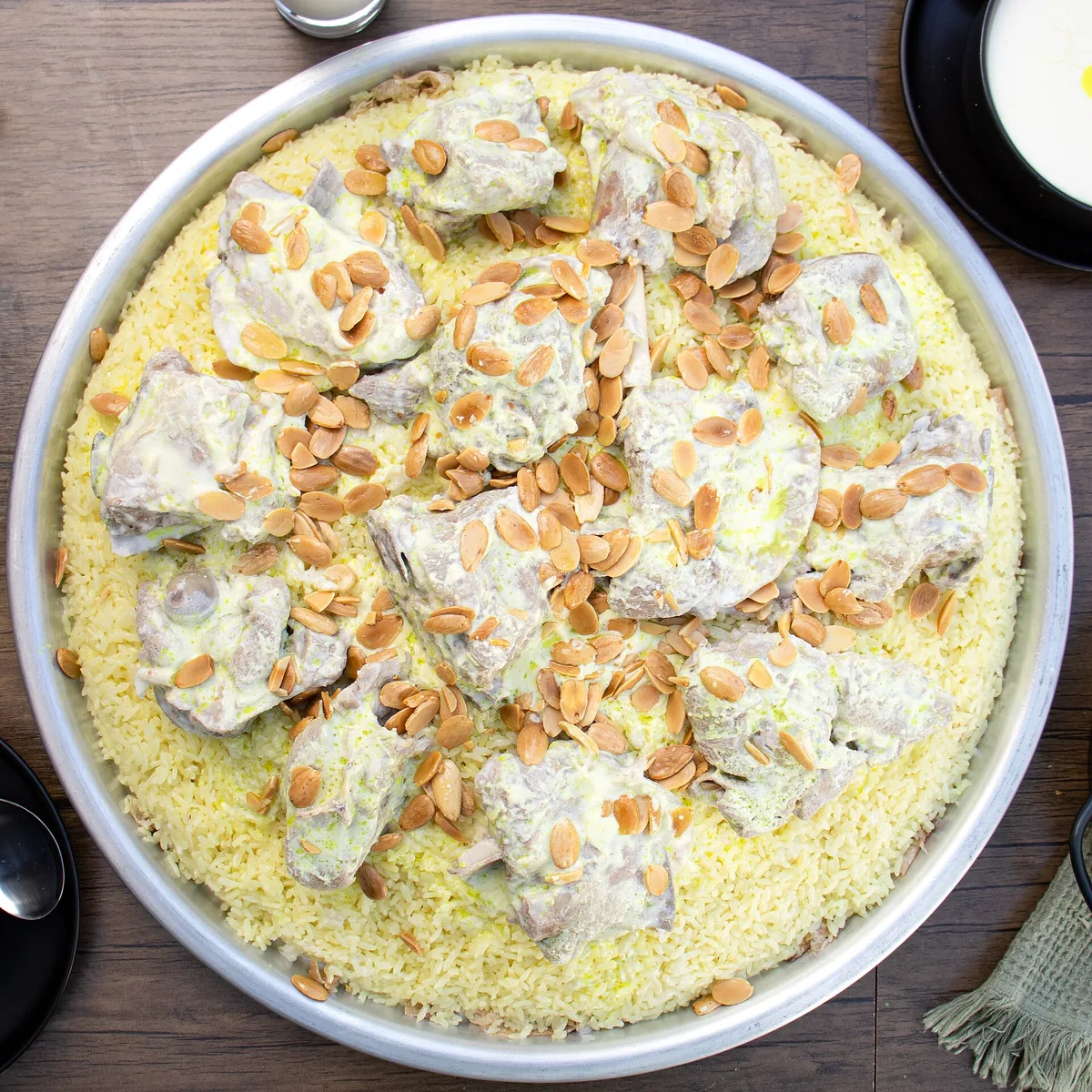
No list of things to do in Jordan is honest without food promoted from fuel to activity. Jordanian cooking is Levantine at its core – mezze, grills, flatbreads, olives and herbs – but it has its own signatures, and eating them where they belong is as much an experience of Jordan as any castle. The centrepiece is mansaf, the national dish: lamb cooked in jameed, a sauce of fermented dried yoghurt that gives it a distinctive tangy depth, served over rice spread across a layer of thin flatbread on a great shared platter, finished with toasted almonds and pine nuts. It is a dish of hospitality and occasion – weddings, honours, Fridays – traditionally eaten communally, standing around the platter, right hands only, rolling rice and meat into balls. Your first mansaf will probably be in a restaurant, where cutlery removes the performance anxiety; if you are ever invited to eat it the traditional way, say yes before you finish hearing the invitation.
Around the headline act, build the supporting cast into your days rather than treating them as refuelling. Mezze spreads that could end the meal before the grills arrive. Falafel and hummus at downtown Amman institutions where both are a civic argument. Kenafeh – molten cheese under shredded pastry and syrup – eaten standing at a counter in the Balad as the locals do. Mint tea and cardamom coffee in quantities that stop being countable by day three. And in Wadi Rum, zarb from the underground oven, which belongs in your camp evening as much as the stars do. The fullest version of the experience is a cooking class: Amman has a small scene of them, most famously the grandmother-style classes held in old houses in Jabal Lweibdeh, where you shop the downtown markets with your host, cook a full Jordanian menu through the morning – mansaf very much included on many menus – and eat it on a terrace over the city. Half a day, every sense engaged, and the only souvenir skill on this entire list that you will still be using in ten years.
Questions Travellers Ask Before Doing Jordan
How does the Jordan Pass work, and do the experiences in this guide fit it? The Jordan Pass is the country’s official sightseeing package, bought online – ideally before you arrive. Mechanically, it does two things: it prepays your entry to a list of more than 40 attractions, which includes Petra, Jerash, Wadi Rum’s protected area and several desert castles and museums named in this guide; and it waives the tourist visa fee for eligible travellers who buy before arrival and stay the required minimum number of nights in the country. It comes in versions that differ mainly by how many consecutive days of Petra entry they include, which is why your Petra plan – one day or two – should be settled before you buy. It is not a transport pass, it does not cover Petra by Night, guided hikes or reserve water trails like Mujib’s, and it activates on first use rather than on a date you choose. Do the arithmetic against the entries you actually plan to use; for most first-time trips following this guide, it comes out ahead.
Is Petra by Night worth it? Sometimes – it depends on your evenings, which is why the section above gives it a conditional verdict rather than a star rating. The candlelit walk through the Siq is genuinely atmospheric and unlike anything else in this guide. Against that: it needs a separate ticket on top of a valid daytime Petra ticket, it is not covered by the Jordan Pass, it runs on selected evenings only with details set by the operator, and the plaza and show can feel crowded and drawn out. With two nights in Wadi Musa, most people enjoy it. With one, the early night before a full Petra day is usually the better buy.
What is the one experience people skip and then regret? Two tie for the title. The Monastery climb at Petra, skipped because the Treasury felt like “the sight” and the steps looked daunting, is the one travellers mention most – the travellers who did climb it rarely stop talking about it. And Wadi Mujib’s Siq Trail, skipped because it needs the right season and a spare half-day, is the one that surprises people most when they do it. Both share a trait: they ask for effort or timing rather than money, which is exactly why they get skipped – and exactly why they deliver.
How many days do these experiences actually take? Petra deserves two days if the Monastery and a viewpoint trail are on your list, one long day at minimum. A Wadi Rum jeep tour plus camp overnight is a full day and night. Aqaba is a half-day of water inside a one-night stop for most trips. The Dead Sea float is a half-day; Mujib adds half a day more in season; Ma’in is two or three hours. Madaba with Nebo is a half-day, Karak a half-day with the drive, Dana to Feynan a full day, Jerash a half-day from Amman, the desert castles loop a half to a full day, and Amman itself one full day. That is the honest maths behind the classic week – and why the week works.
Can you swim in the Dead Sea, and is it safe? You float rather than swim, and it is safe if you follow the few rules the section above sets out: enter slowly on the sharp salt shore, keep the water out of your eyes and mouth, float on your back in short sessions, and shower in fresh water afterwards. The water is not toxic – people have bathed in it for millennia – but it is aggressively salty, and every unpleasant Dead Sea story involves splashing, diving or staying in far too long. Children need close watching for the same reason: the danger is not depth but a face-full of brine.
When is Wadi Mujib’s Siq Trail open? Only in the drier part of the year – the trail operates seasonally because the canyon is a flood channel, and Wild Jordan opens and closes it according to conditions rather than a promise printed months ahead; it can also close for a day at short notice after upstream rain. Treat any fixed opening dates you read anywhere, including in guidebooks, as indicative rather than guaranteed, and check the current status close to your visit. If it is closed during your trip, the reserve still offers the Ibex Trail on the plateau above the canyon for guided hiking in season – a different, drier pleasure with Dead Sea views.
The Short Version
Jordan is a country you do, not just see. Walk the Siq at opening time and keep walking – past the Treasury, through the basin, up the 850 steps to the Monastery – and let Petra by Night be the optional extra it is rather than the headline. Ride the back of a pickup through Wadi Rum by day, eat zarb from the sand and sleep under its sky by night, then trade red desert for blue water on Aqaba’s protected reef. Float in the Dead Sea without getting a drop in your eyes, wade Wadi Mujib if the season allows, soak at Ma’in, and work the King’s Highway slowly – Madaba’s map, Nebo’s view, Karak’s vaults, and the long green descent from Dana to Feynan. Give Amman its day, walk Jerash’s chariot-rutted Cardo, loop the desert castles for Quseir Amra’s frescoes, and eat mansaf like it counts, because here it does. Do those things and you will not just have visited Jordan’s sights – you will have done Jordan properly.