Turkey is the rare country where a list of the top tourist attractions in Turkey has to cover twelve thousand years. The oldest sight in these pages was raised by hunter-gatherers before farming existed; the youngest has been standing for only four centuries. In between come the marble cities of Rome, the dome that defined an empire, the palace of the sultans, a theatre so complete it still works for a living, and a monastery pasted onto a cliff in the rain-green north-east.
This article takes the top tourist attractions in Turkey sight by sight rather than city by city. That is the difference between this list and a destinations roundup: here the Basilica Cistern gets its own entry instead of a line inside an Istanbul paragraph, and Pergamon’s Trajaneum stands on its own instead of sheltering under “the Aegean”. Eighteen sights, grouped by region — Istanbul, the Aegean, the Mediterranean, Cappadocia and the centre, and the east with the Black Sea — each given its history, what you actually see, and the honest caveats. The order is our editorial order, the way the regions unfold on a journey; it is nobody’s official ranking, because no official ranking exists.
One thread runs through the list. Fifteen of the eighteen sights are UNESCO World Heritage Sites or stand inside inscribed properties, from the Historic Areas of Istanbul to Göbekli Tepe, and this guide is precise about the rest: Sümela Monastery, often listed as if inscribed, is on UNESCO’s Tentative List — a candidacy, not an inscription — and is described that way here. Türkiye has 22 inscribed properties in total. Where a famous sight has shrunk — the Temple of Artemis is one column, as the Ephesus entry says plainly — this guide says so.
The 18 Attractions at a Glance
Read the table of the top tourist attractions in Turkey as a map, not a league table. Each cluster is a trip in itself, and the UNESCO column states inscription years where a sight is inscribed — and says so plainly where it is not.
| # | Attraction | Region | What it is | UNESCO |
|---|---|---|---|---|
| 1 | Hagia Sophia | Istanbul | Justinian’s great church of 537, mosque again since 2020 | 1985, within Historic Areas of Istanbul |
| 2 | Topkapi Palace | Istanbul | The sultans’ palace-city for four centuries | 1985, within Historic Areas of Istanbul |
| 3 | Blue Mosque | Istanbul | The six-minaret imperial mosque of 1616 | 1985, within Historic Areas of Istanbul |
| 4 | Basilica Cistern | Istanbul | Justinian’s underground reservoir of 336 columns | 1985, within Historic Areas of Istanbul |
| 5 | Grand Bazaar | Istanbul | The covered market founded in 1455, still trading | 1985, within Historic Areas of Istanbul |
| 6 | Ephesus | Aegean | Rome’s Asian capital, preserved street by street | 2015 |
| 7 | Pamukkale and Hierapolis | Aegean | Travertine terraces below a Roman spa city | 1988, mixed |
| 8 | Pergamon | Aegean | The Attalid kings’ citadel city above Bergama | 2014 |
| 9 | Troy | Aegean | Nine cities stacked on one mound by the Dardanelles | 1998 |
| 10 | Aspendos | Mediterranean | The world’s most complete Roman theatre | Not inscribed |
| 11 | Kaleiçi, Antalya | Mediterranean | The old town inside Roman and Ottoman walls | Not inscribed |
| 12 | Xanthos and the Lycian Coast | Mediterranean | The Lycian capital of pillar tombs, above Patara beach | 1988, as Xanthos-Letoon |
| 13 | Göreme Open Air Museum | Cappadocia and the Centre | Rock-cut churches and Byzantine frescoes in the tuff | 1985, mixed, within Göreme and the Rock Sites of Cappadocia |
| 14 | Safranbolu | Cappadocia and the Centre | A complete Ottoman caravan town of timber houses | 1994 |
| 15 | Göbekli Tepe | The East and the Black Sea | The world’s oldest monumental sanctuary, c. 9600 BC | 2018 |
| 16 | Mount Nemrut | The East and the Black Sea | A king’s tomb and colossal gods at 2,150 metres | 1987 |
| 17 | Ani | The East and the Black Sea | The empty medieval Armenian capital on the border gorge | 2016 |
| 18 | Sümela Monastery | The East and the Black Sea | The cliff monastery of the Pontic Mountains | Tentative List since 2000 – not inscribed |
Istanbul – Five Sights in One Square Mile
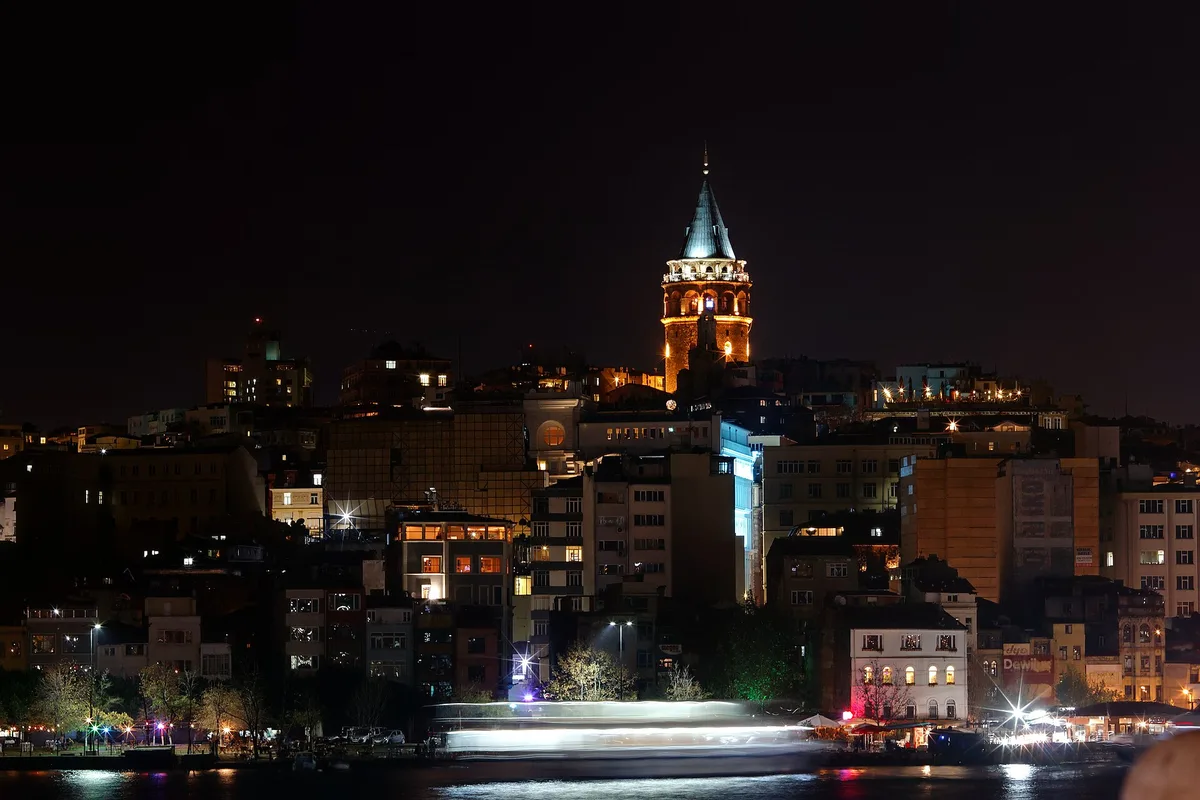
No other city on earth concentrates five world-class sights inside one walkable square the way Istanbul’s Sultanahmet does. Within a few hundred metres stand the greatest church of the Byzantine world, the palace from which an empire was governed for four centuries, the most famous mosque of the Ottoman age, a reservoir like a drowned cathedral under the streets, and a market trading since 1455. All five fall within the Historic Areas of Istanbul, inscribed by UNESCO in 1985, and all five can be seen — though not done justice — in a single long day. This site’s Istanbul travel guide plans that day street by street.
The entries follow the order you would walk them — Hagia Sophia, the palace, the Blue Mosque, the cistern, then up the hill to the bazaar.
Hagia Sophia
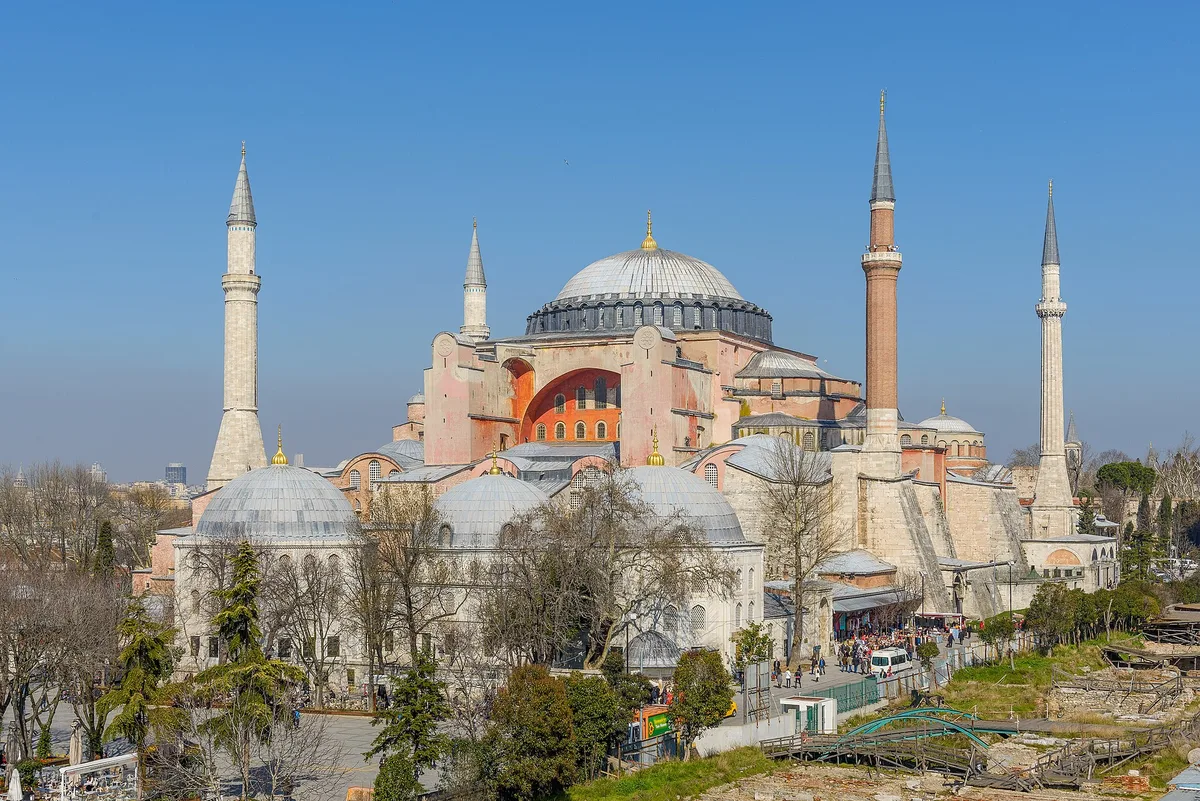
Hagia Sophia is the single most important building in Turkey, and the strongest candidate on this list for first place. Raised in just five years, between 532 and 537, on the orders of the emperor Justinian, it was the largest cathedral in the world for nearly a thousand years — and its dome, roughly 31 metres across and floating on a ring of forty windows, was an engineering leap so audacious that its architects, Anthemius of Tralles and Isidore of Miletus, were mathematicians rather than master builders. Standing under it, you understand the contemporary account that the dome seems suspended from heaven by a chain. The scale is not decorative. It is the point: an empire stating, in masonry, what it believed about God and itself.
What you see today is three buildings in one. The Byzantine church survives in the dome, the vast nave and the gold-ground mosaics — Christ Pantocrator, the Virgin and Child in the apse, emperors kneeling with their offerings. Onto it the Ottomans grafted the four minarets in the photograph, the great buttresses, the sultan’s lodge and the calligraphy medallions that hang like shields in the nave: after 1453 Hagia Sophia was the imperial mosque of the conquerors, a role it kept for nearly five centuries, before serving as a museum from 1935 and returning to use as a mosque in 2020. Older guides still call it a museum; it is a working mosque now, and visiting means mosque rules — dress, quiet, and respect for worshippers — in a building that happens to be a masterpiece. It is still the most eloquent room in Turkey.
Topkapi Palace
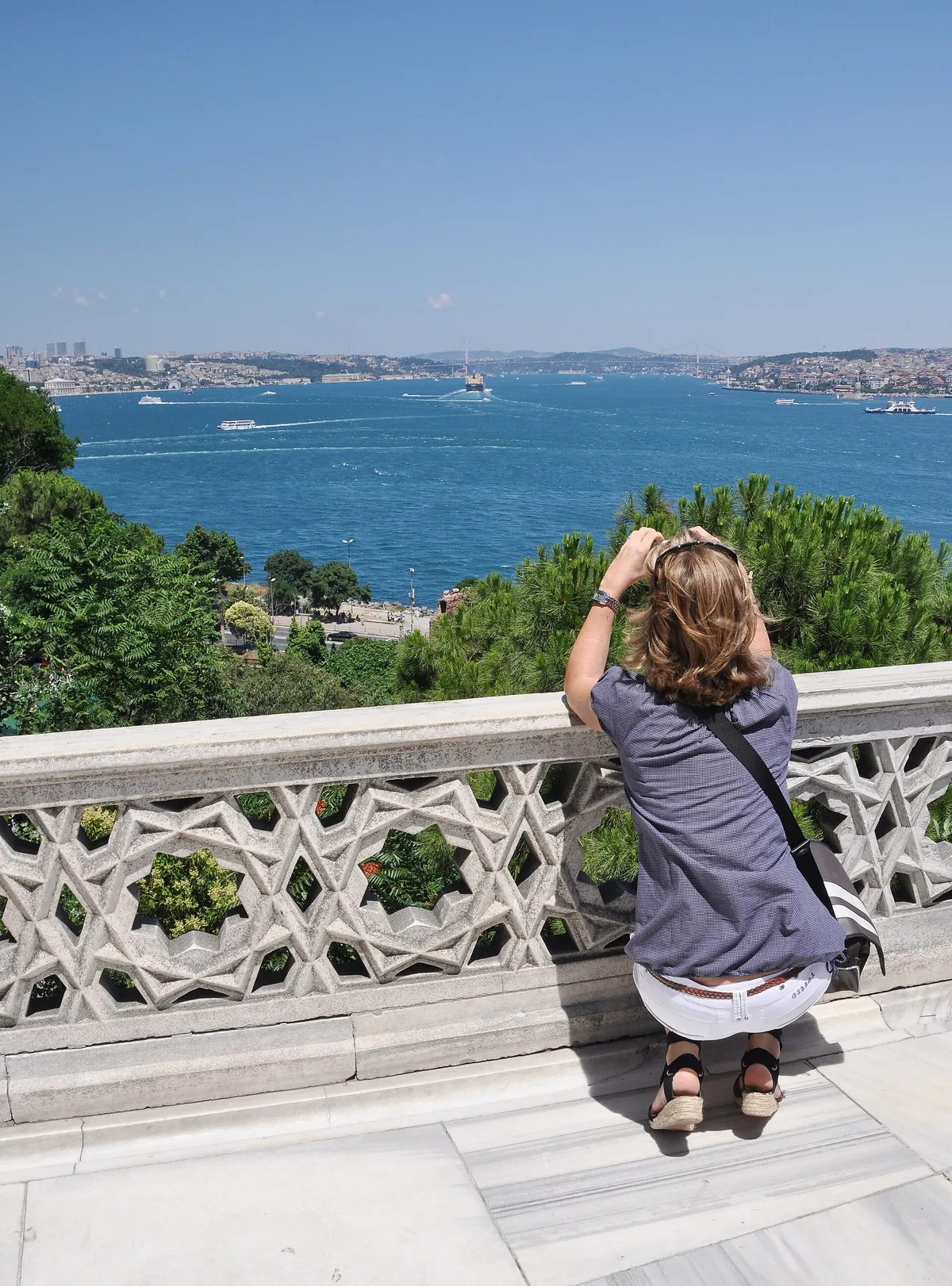
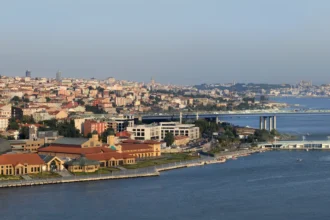
If Hagia Sophia is Istanbul’s soul, Topkapi is its machinery. From the 1460s, when Mehmed the Conqueror laid it out on the acropolis above the Golden Horn — the view in the photograph is the one the sultans kept for themselves — the palace was the seat of Ottoman government for roughly four centuries, until the court moved to Dolmabahçe in the nineteenth century. It is not a palace in the European sense of one grand building. It is a walled city of courts, pavilions, kitchens, stables and gardens, and walking its four courtyards is walking inwards through layers of ceremony towards the sultan’s increasingly private world.
The collections match the plot. The Treasury holds the Topkapi Dagger, crusted with emeralds, and the 86-carat Spoonmaker’s Diamond; the kitchens, which fed a court of thousands, display one of the world’s great collections of Chinese porcelain; the pavilions of the Fourth Courtyard show Ottoman taste at its most refined. Topkapi became a museum in 1924 and needs the better part of a day; its subject is not a moment but a system — how an empire actually ran, ate, worshipped and amused itself, preserved at full size.
The Blue Mosque
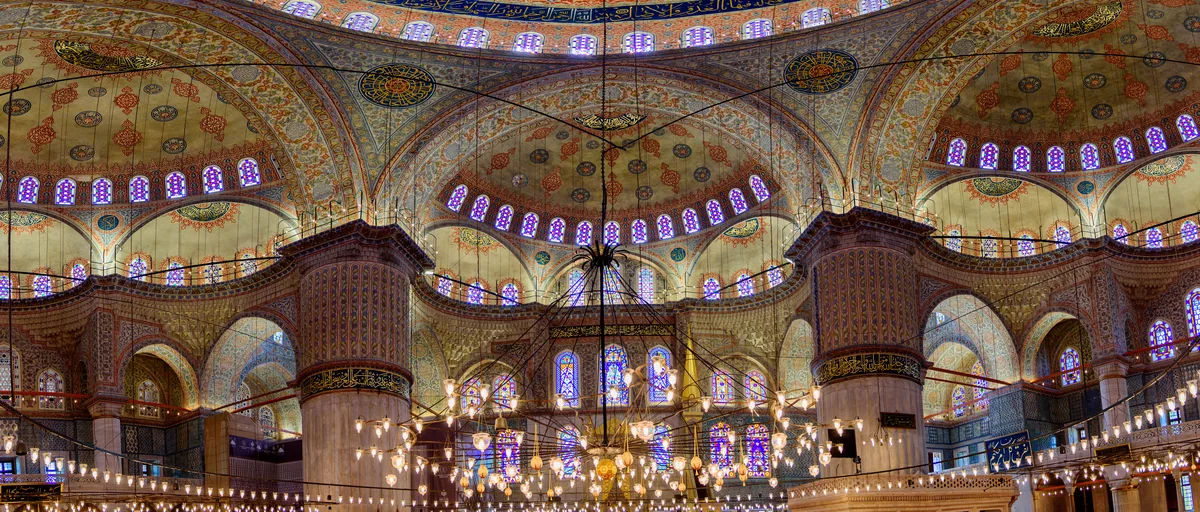
Across Sultanahmet Square from Hagia Sophia stands its deliberate Ottoman answer. The Sultan Ahmed Mosque, built between 1609 and 1616 for a sultan who came to the throne at fourteen, was a young man’s statement of parity: a mosque to rival the great church across the square, raised by Sedefkâr Mehmed Ağa, a pupil of Sinan. Its six minarets — one more than was proper for any mosque but Mecca’s — caused a scandal neatly solved, the story goes, by endowing a seventh minaret at Mecca itself. The cascade of domes stepping down from the central dome is Sinan’s structural idea at its most photogenic, and the skyline it makes with Hagia Sophia is the most famous view in Turkish architecture.
The “Blue” of the name is inside. More than twenty thousand İznik tiles in tulip, rose and carnation patterns line the lower walls and galleries, lit by over two hundred windows, so that the prayer hall in the photograph glows blue-green even on a grey day. Unlike its neighbour, the Blue Mosque has never been anything but a mosque: it is a working place of worship first and a sight second, which shapes the visit — entry between prayer times, a dress code at the door, a congregation at worship while visitors file along the designated route. That living quality is not a drawback.
The Basilica Cistern
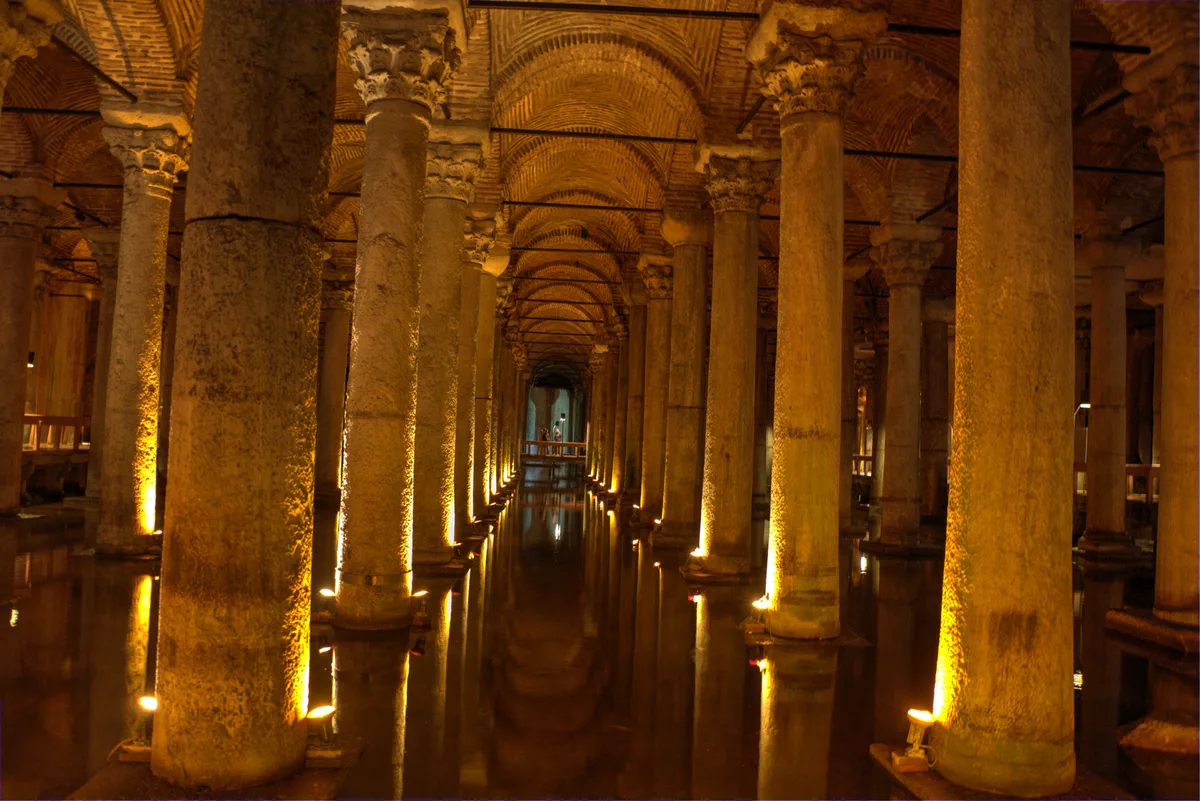
The Basilica Cistern is the Istanbul sight nobody expects to love most, and a great many visitors do. A few steps from Hagia Sophia, a modest entrance leads down into a vaulted hall some 140 metres long, where 336 marble columns stand in rows in shallow water, holding up the city above. Justinian built it in the sixth century to store water for the Great Palace — Roman-Byzantine infrastructure at its most beautiful — and for centuries after the conquest it was half forgotten, known to locals who drew water, and even fished, through holes in their floors, before a travelling scholar rediscovered it in the 1540s.
The details are the delight. Most columns are recycled from older buildings, spolia with mismatched capitals; two in the far corner rest on Medusa heads, one upside down and one on its side, whether to neutralise the Gorgon’s gaze or simply because the blocks fitted. The cistern is also the most manageable of the Istanbul five: one chamber, one route, and a constant cool that makes it the perfect middle-of-the-day sight in summer. Above ground, Istanbul displayed its faith and its power; below ground, it stored the water that made both possible — and built the store beautifully enough to outlast the palace it served.
The Grand Bazaar
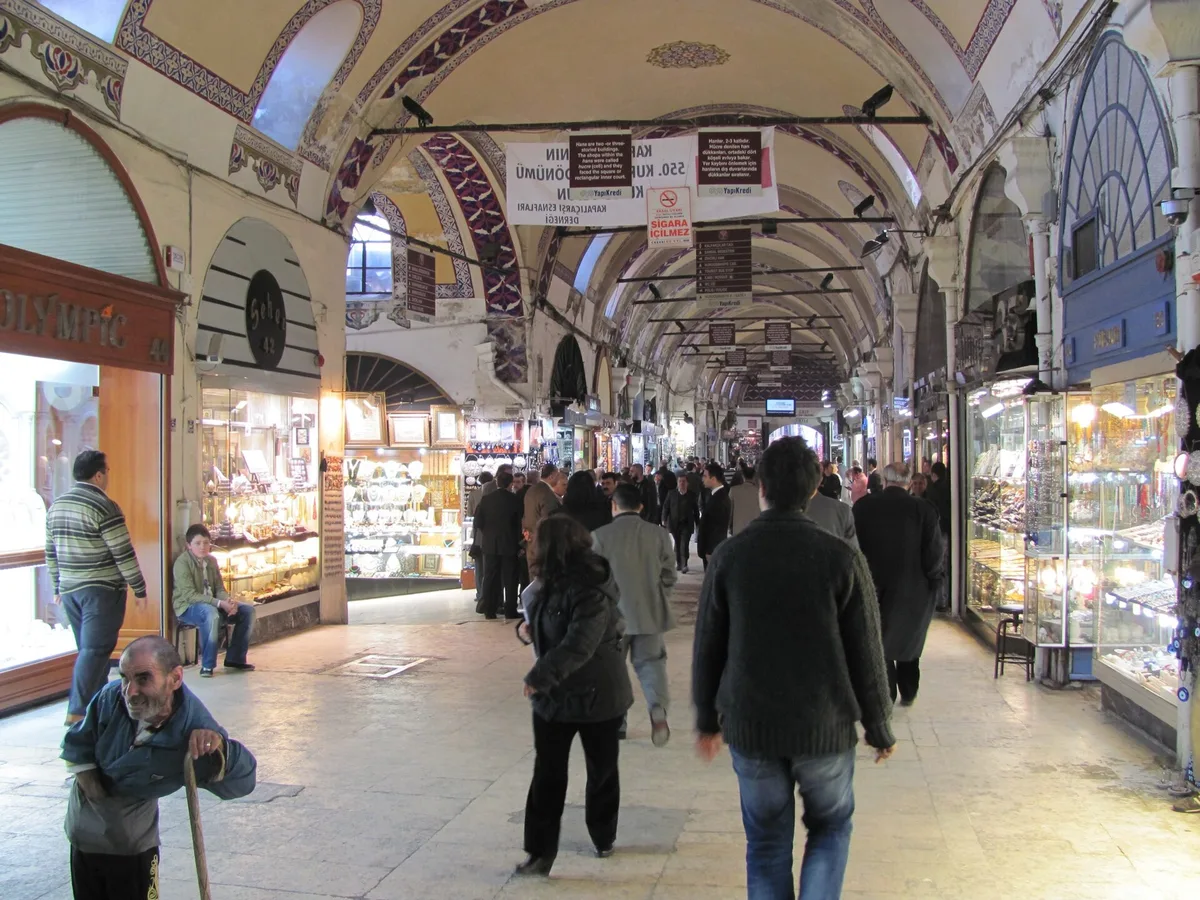
The Grand Bazaar is the oldest sight on this list that is still doing its original job. Founded in 1455, when Mehmed II raised the stone bedesten at its core for the cloth trade, it grew street by vaulted street into a covered city of some sixty streets and several thousand shops, organised by guild and trade as it had been for centuries: goldsmiths in one arcade, carpets in another, leather, ceramics, lamps and antiques each in their quarter, under painted ceilings like the one in the photograph. Earthquakes and fires rebuilt it repeatedly; the bazaar you walk is substantially the bazaar of the nineteenth century, which in Istanbul counts as continuity.
Arrive with the right expectations. The Grand Bazaar is not a museum of shopping and not, at its tourist-facing edges, a place of bargains; the famous haggling is a game both sides expect, and the best of the bazaar lies a few streets in from the main gates — in the old bedestens at the core, the hans where workshops still operate, and the teahouses where porters and goldsmiths take their breaks. Among the Istanbul five, the bazaar is the living one — the sight where the city’s past is not preserved but employed.
The Aegean – Rome at Full Scale
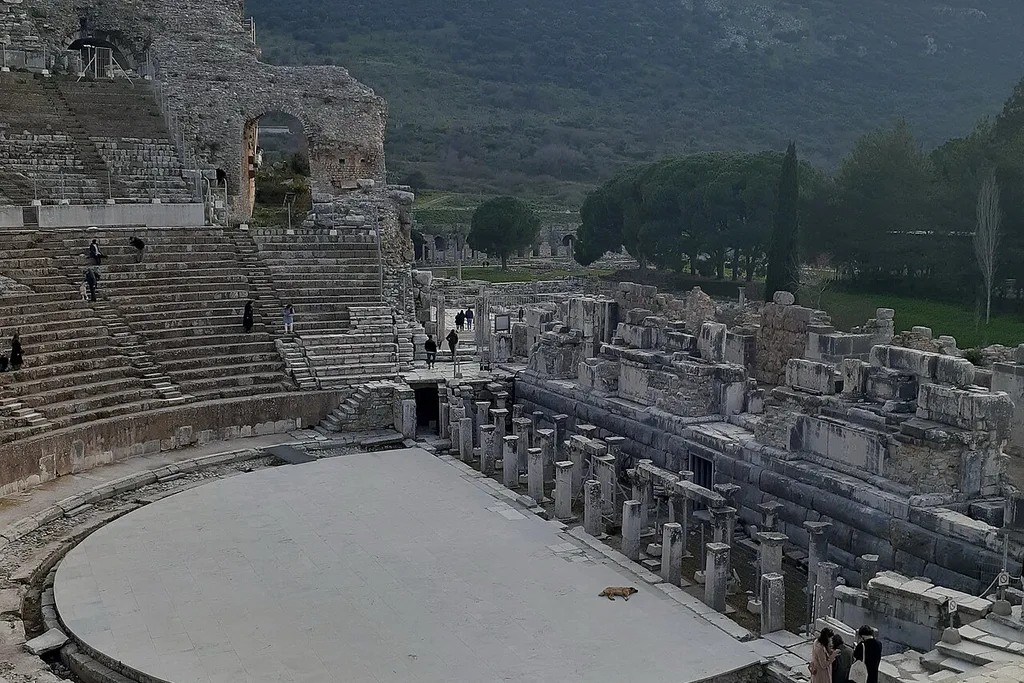
Turkey’s Aegean hinterland holds the classical world at a density no other part of the country matches: a Roman metropolis preserved street by street, a spa city draped over a white mineral hillside, a Hellenistic royal capital on a citadel rock, and the most famous archaeological mound on earth. They string naturally along one road south from İzmir and back, which is why the Aegean loop is the classic second journey of a Turkish trip.
What distinguishes the four is variety. Ephesus is a city you walk for hours; Pamukkale is a landscape you cannot quite believe is natural; Pergamon is a citadel you climb; Troy is a trench through nine cities on one windy hill. Each of the four is a UNESCO World Heritage Site, inscribed between 1988 and 2015.
Ephesus
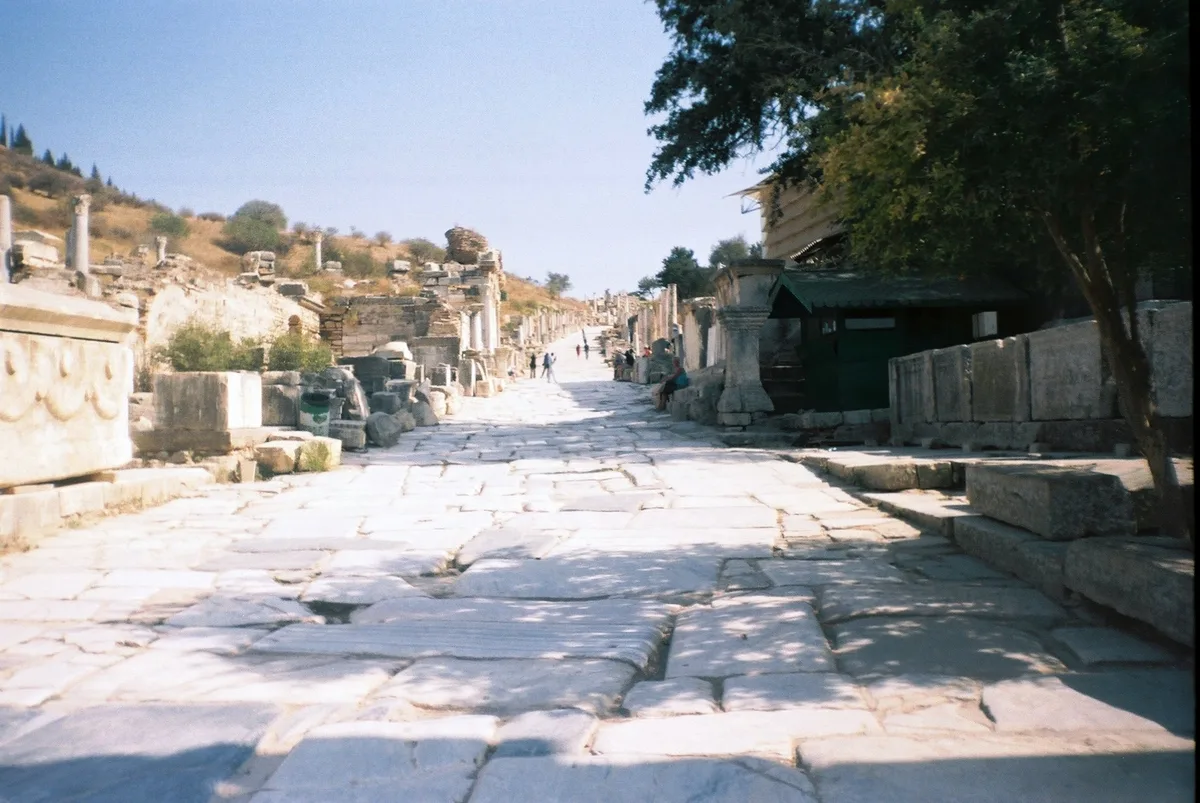
Ephesus is the greatest Roman city a traveller can walk, and the standard against which every other ruin in Turkey is judged. Capital of the Roman province of Asia and one of the largest cities of the empire, it survives not as a temple or a theatre but as the connective tissue of a whole urban life: marble streets with cart ruts worn into them, a public latrine with seats in a sociable row, fountains, temples, a brothel sign carved into the pavement, and — in the Terrace Houses — wall paintings and mosaics preserving the interiors of the rich in a state that Pompeii alone rivals. You do not visit Ephesus so much as commute through it, downhill, the way its citizens did.
Two buildings anchor the walk. The Library of Celsus, raised in the early second century AD as a tomb and library for a Roman proconsul, wears a two-storey facade that has become the most reproduced image in Turkish archaeology — beautiful, and in the flesh more delicate than the postcards suggest. At the street’s foot stands the Great Theatre, cut into the hillside to hold some 25,000 spectators, where the riot of the silversmiths against St Paul, recorded in Acts, gives the stones a documented crowd scene. Beyond the main street, honesty deepens: the Temple of Artemis, once one of the Seven Wonders of the Ancient World, survives as a single re-erected column in a marshy field. The wonder is gone; the city that worshipped it is the wonder now. Ephesus was inscribed by UNESCO in 2015.
Pamukkale and Hierapolis
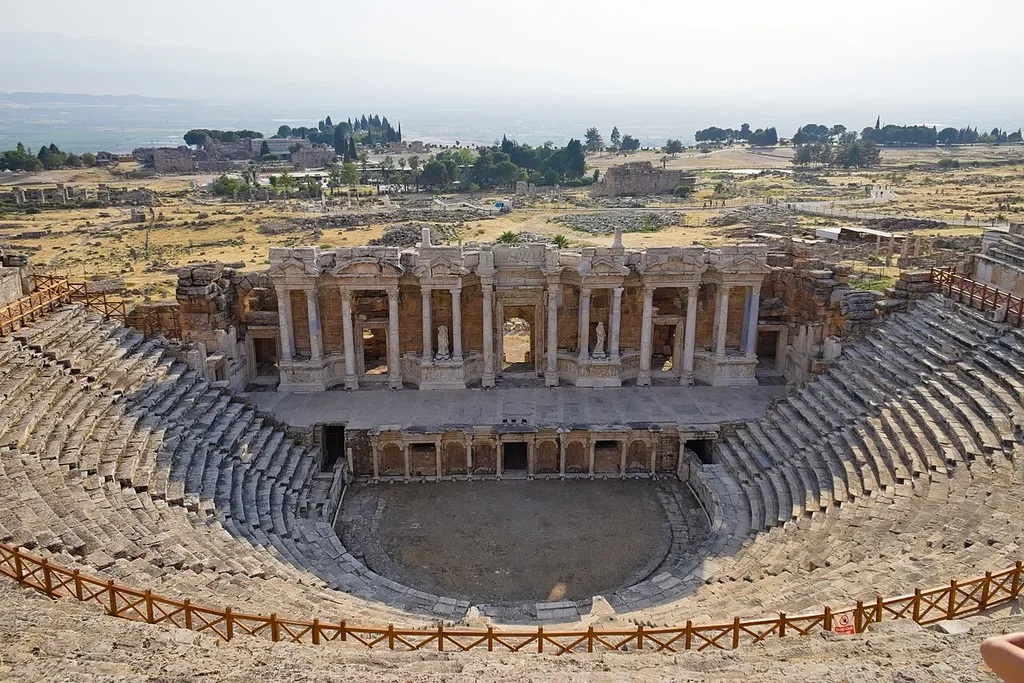
Pamukkale is two attractions sharing one hillside, and the pairing is the point. Below is the natural wonder: a cascade of white travertine terraces, built up over millennia by hot, mineral-laden spring water depositing its calcium as it cools, spilling from pool to pale-blue pool down the slope — “cotton castle”, which is what Pamukkale means in Turkish, visible from far across the plain. Above, along the plateau the springs feed, stands Hierapolis, the Greco-Roman spa city founded under the kings of Pergamon and rebuilt by Rome, which existed because of the same water. The sick and the fashionable came for the cure, and a great many stayed forever — which is why its necropolis, tomb after tomb along the northern road, is among the largest in the ancient world.
The two halves correct each other’s weaknesses: the terraces alone would be a photo stop, the city alone a fine but ordinary ruin. Together they make a full day — the white pools walked barefoot, as the site’s rules require, in the cool of the morning, then the uncrowded walk up through Hierapolis: the colonnaded main street, the Plutonium where the ancients believed the underworld breathed poisonous air, the martyrium of St Philip, and the theatre in the photograph, its seats climbing to a view over the whole white hillside. The Antique Pool, where bathers swim among fallen Roman columns, is the city’s spa in working form — the name “Cleopatra’s Pool” is marketing, not history, and the real story needs no queen to sell it. Hierapolis-Pamukkale is one of Turkey’s two mixed UNESCO sites, inscribed in 1988 for nature and culture together.
Pergamon
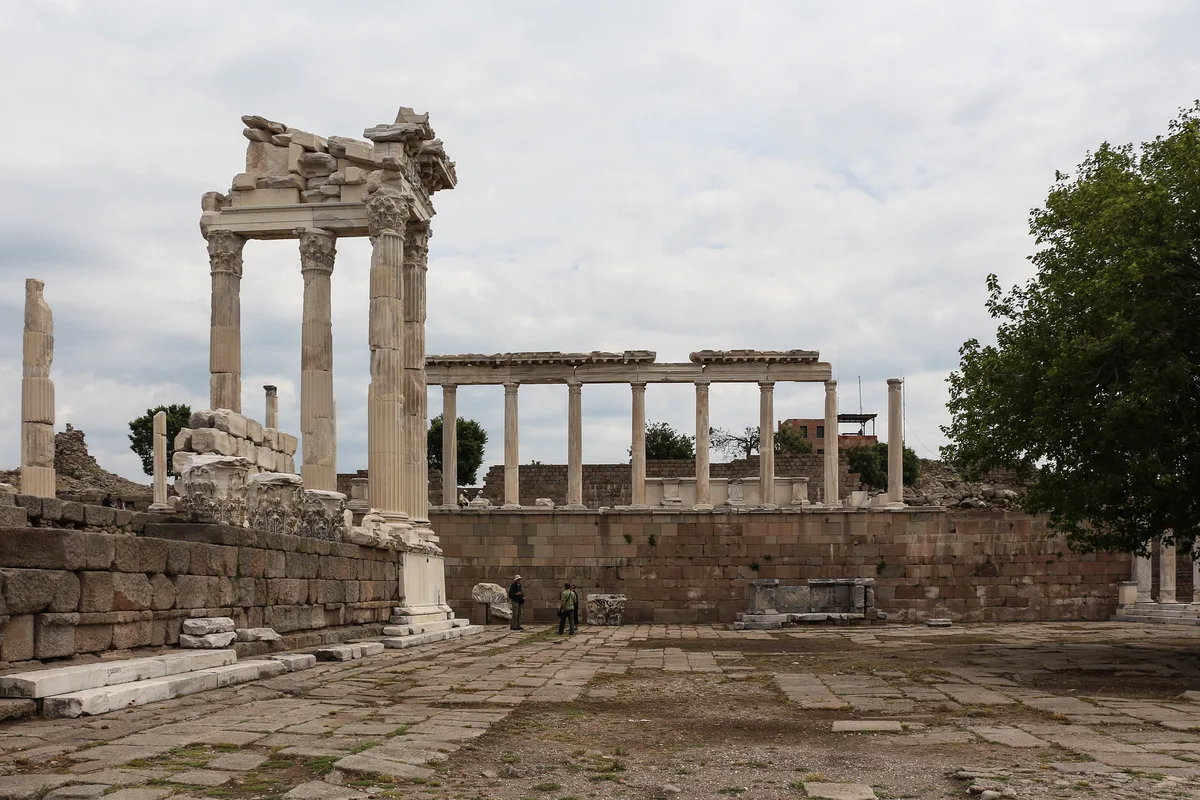
Pergamon is the connoisseur’s classical city — the one travellers reach after Ephesus and frequently end up preferring. Capital of the Attalid kingdom, which ruled much of western Anatolia in the Hellenistic age, it was a royal seat of genuine brilliance: its library rivalled Alexandria’s (legend credits the rivalry with the invention of parchment, when Egypt cut off papyrus exports), its sculptors produced the writhing giants of the Great Altar, and its kings built their citadel up a cone of rock so steep that the theatre cut into its slope is among the steepest in the ancient world. The acropolis in the photograph — the marble terrace of the Trajaneum, a temple to the emperor Trajan — shows the city’s second life under Rome, layered directly on the Hellenistic citadel.
The honest account includes an absence. Pergamon’s most famous object, the Great Altar with its frieze of gods and giants, is not here: it fills a museum in Berlin that bears the city’s name, and the altar’s platform stands empty. What remains is the city itself — citadel, theatres, temples, gymnasia, the vast red-brick Red Basilica down in modern Bergama, and the Asclepion across the plain, the healing sanctuary where the physician Galen trained. Nothing is roped into a single postcard view, and the site rewards unhurried, imagination-on walking at far greater scale than Troy. Pergamon was inscribed by UNESCO in 2014.
Troy
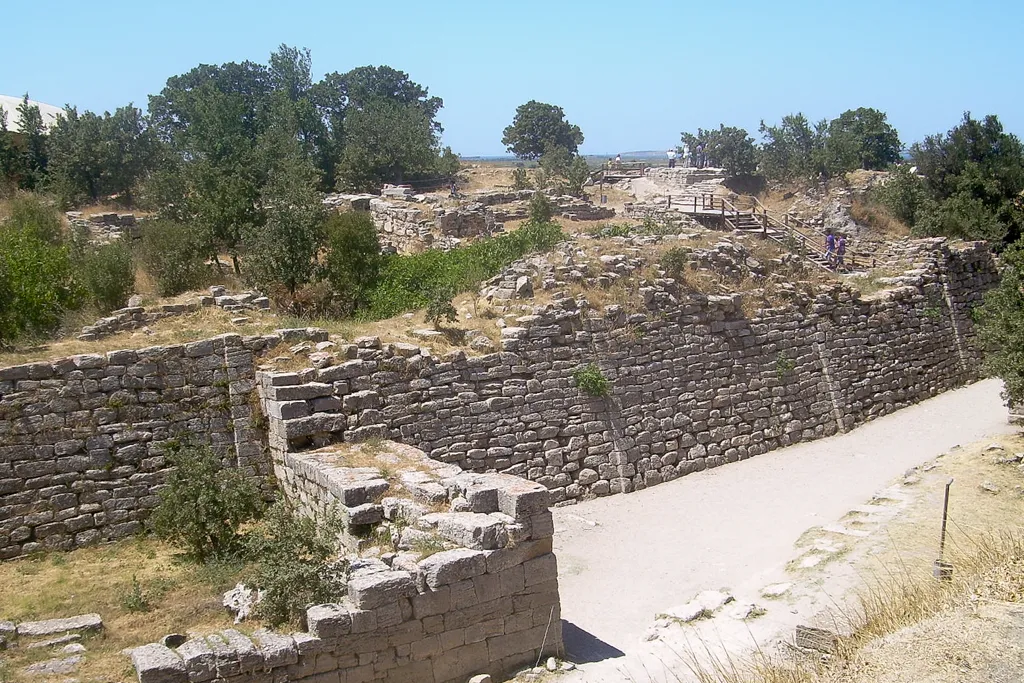
Troy is the one sight on this list that everyone arrives at carrying a story, and the visit is the negotiation between the story and the stones. The stones, first: a fortified settlement mound at the mouth of the Dardanelles, occupied and rebuilt again and again from the early Bronze Age to Roman times — nine main layers in the archaeologists’ numbering — excavated since the 1870s, when Heinrich Schliemann dug his great trench through the middle of it looking for Homer, and damaged a good deal of what he found. What you walk today is that layered reality: Bronze Age ramparts and a paved ramp, the walls of the later cities, a Roman odeon, and the trench itself, displaying the whole stacked sequence in a single cut. It was inscribed by UNESCO in 1998.
The story needs the honesty this guide applies everywhere. The Iliad is a poem, composed centuries after any Bronze Age war it may remember; a wealthy, well-fortified trading city certainly stood here and was certainly destroyed more than once, but no excavated layer can be labelled “the Trojan War” with scholarly certainty, and the wooden horse by the entrance is a modern replica that knows it is one — climb into it for the photograph, in the knowledge that it is a piece of theatre, not a find. Read this way, Troy stops being the disappointment some visitors report and becomes something better: the place where archaeology, literature and wishful thinking have argued for 150 years, with the evidence in the ground in front of you.
The Mediterranean – Theatres, Tombs and an Old Town
Turkey’s Mediterranean shore is sold as beach country, and it is — but the same coast holds three sights of a completely different order, all within the orbit of Antalya: a Roman theatre so complete it still stages performances, an old town you can sleep inside whose gate was built for an emperor’s visit, and a Lycian capital of tombs and silence with one of the country’s great beaches a few kilometres away. They are arranged below in the order a traveller based in Antalya meets them.
What unites them is that each survives by being used. Aspendos still fills with audiences; Kaleiçi is a living quarter of hotels, houses and cafes, not a museum set; and Xanthos, the exception, survives by the opposite means — by having been left alone in its hills.
Aspendos
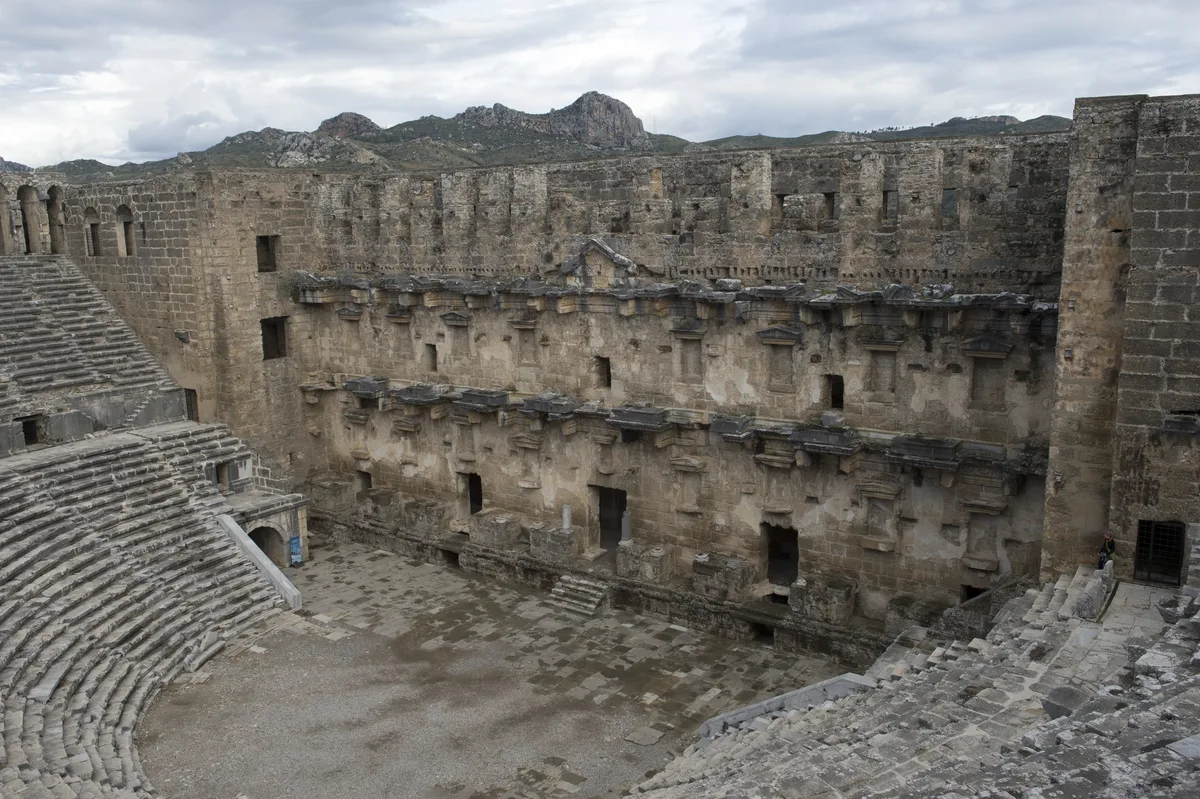
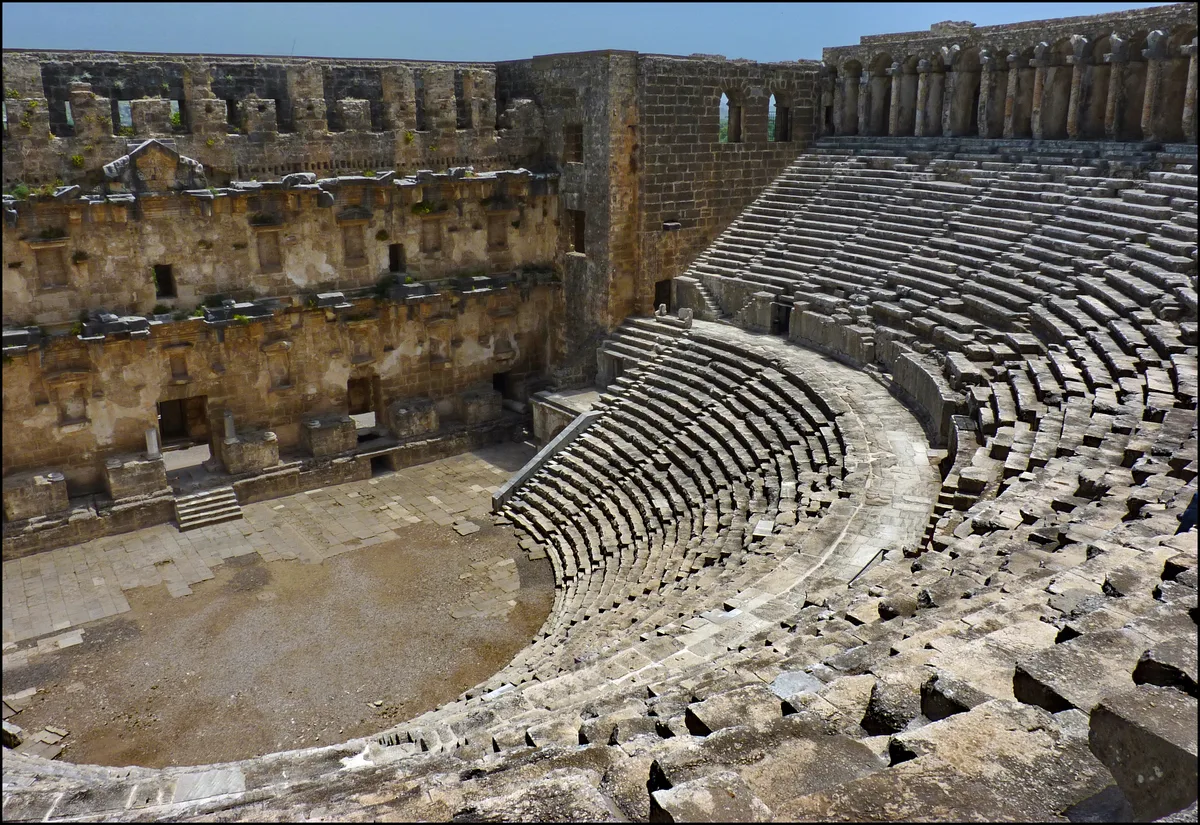
Aspendos, east of Antalya, holds the most complete Roman theatre in the world, and completeness is a quality that has to be seen to be believed. Built around 155 AD, in the reign of Marcus Aurelius, to a design by a local architect named Zeno whose inscription still records him, the theatre kept everything other theatres lost: the full semicircle of seating for some 12,000 spectators, the vaulted galleries behind it, and above all the stage building standing to its full height, its facade of niches and doorways as crisp as the photograph shows. Roman theatres elsewhere are skeletons; Aspendos is the body. The reason is use and luck together: the Seljuks later made the building a caravanserai and repaired it, and repair is what preservation looked like before the word existed.
The visit is simple and overwhelming. You enter, you sit in the seating, and the geometry closes around you — which is why the featured image of this article is Aspendos’s empty bowl, the single most eloquent theatre photograph in Turkey. The acoustics remain famous and are easily tested by a companion standing on the stage; the aqueduct that served the city strides across the plain nearby, its siphon towers a quieter marvel of Roman engineering. And the theatre’s working life never entirely stopped: it has long hosted performances, most famously a summer festival of opera and ballet, so on the right evening the most complete Roman theatre on earth does again exactly what it was built to do.
Kaleiçi – Antalya’s Old Town
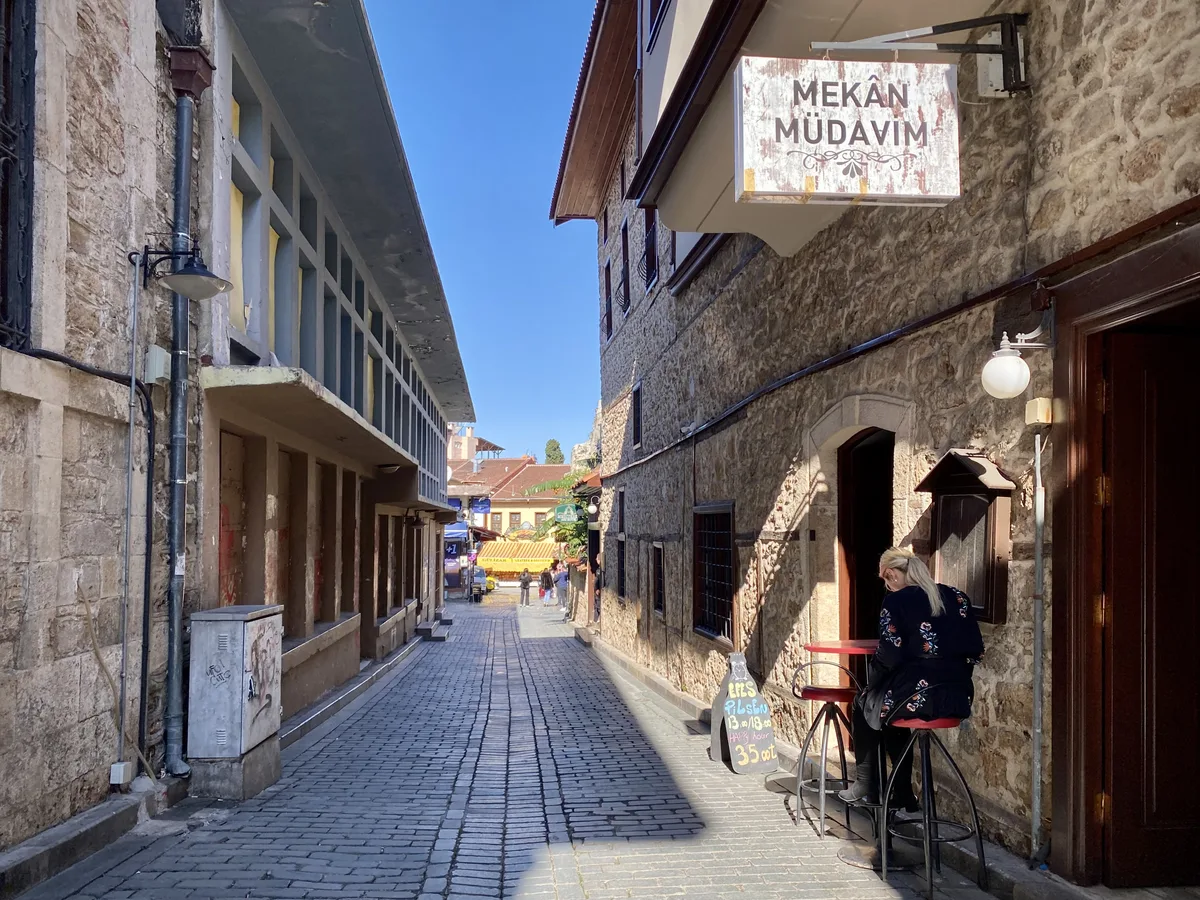
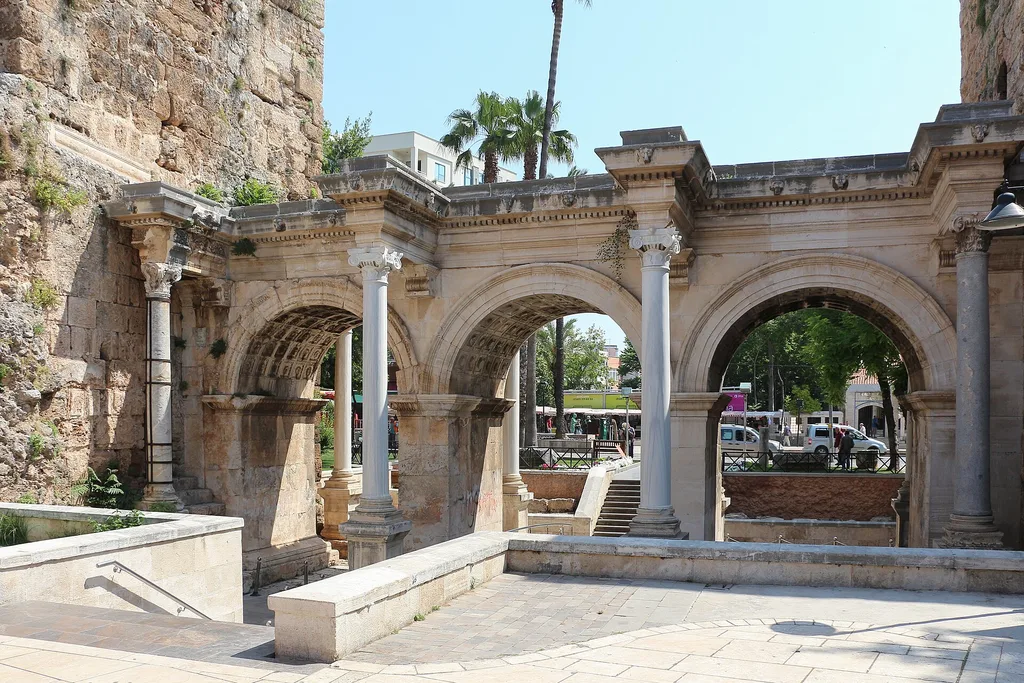
Kaleiçi is the exception on this list: an attraction that is not one building or ruin but a whole small town, and the only one you can sleep inside. Antalya’s old quarter gathers within its Roman and Ottoman walls everything the city’s two thousand years left behind — the marble bulk of Hadrian’s Gate, raised around 130 AD for the emperor’s visit and still the ceremonial entrance to the quarter; the fluted brick Yivli Minare, the Seljuk symbol of the city; Roman towers, Ottoman mosques, and street after street of the bay-windowed Ottoman houses in the photograph, many now small hotels, pensions and restaurants. At the quarter’s foot, down the cliff stairs, lies the Roman harbour, a yacht marina in a natural cove where the ancient port worked.
The pleasure of Kaleiçi is texture rather than monuments, and it should be visited in that spirit. The lanes climb and double back, cats occupy the doorsteps, bougainvillea comes over the walls, and every third doorway opens into a courtyard garden, a carpet shop or a pension of six rooms. It is a working, living old town — Antalya residents shop and drink here — which is exactly what distinguishes it from preserved museum quarters elsewhere. Come down at dusk, when the heat leaves the stone and the harbour lights come on, and again in the early morning, when the streets belong to deliveries and cats.
Xanthos and the Lycian Coast
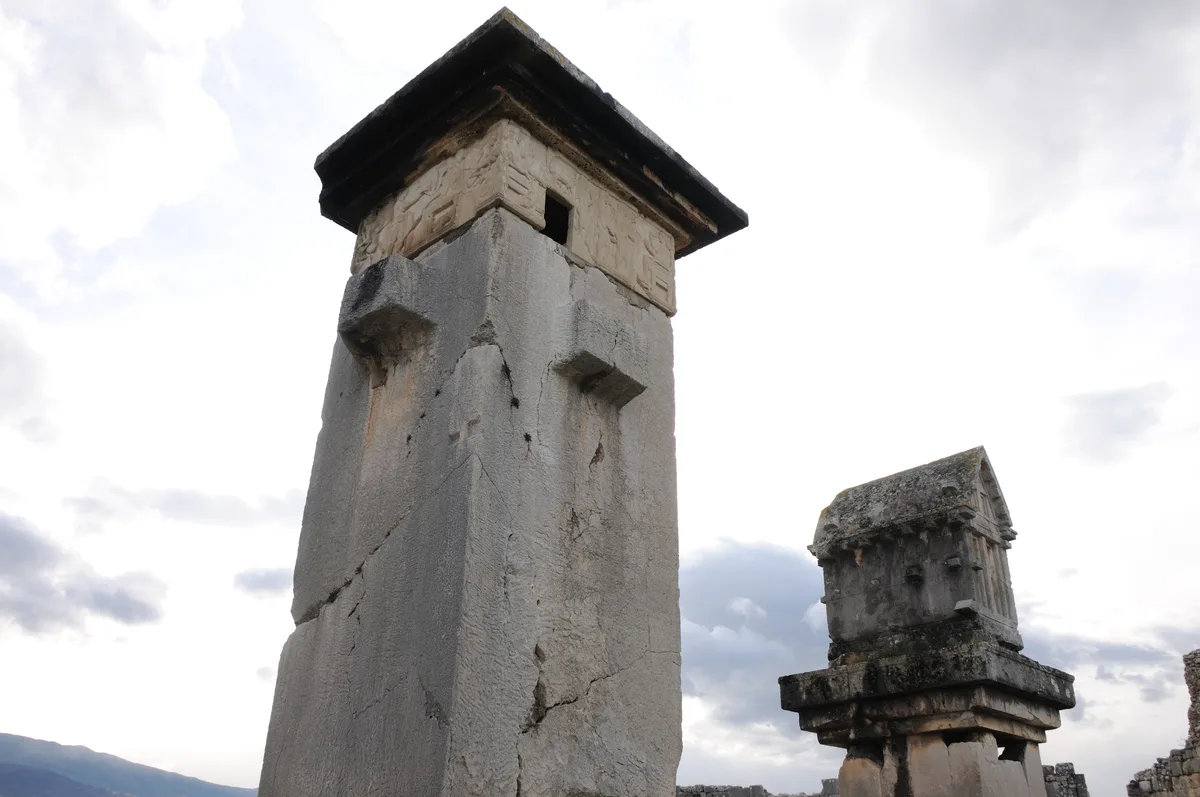
West along the coast, in the hills behind the shore near Kalkan and Kaş, stands the quietest great sight in this list. Xanthos was the capital of ancient Lycia, a people with their own language, their own federation and a way of burying their dead that no other culture copied: in sarcophagi raised on tall stone pillars, and in tombs cut into cliffs with carved house-fronts, so that the dead kept addresses above the city. The pillar tombs in the photograph — including the great Harpy Tomb, named for the winged figures on its reliefs — still stand over the agora, and a Roman theatre, a paved square and Byzantine churches spread below them through the olives. With its sanctuary of Letoon a few kilometres away, where three temples stand side by side in a reed-fringed hollow, Xanthos was inscribed by UNESCO in 1988.
The honesty this guide owes you concerns where some of Xanthos’s art is. The Harpy Tomb’s original reliefs, like the famous Nereid Monument, are in the British Museum, removed in the nineteenth century; casts stand in their place on the pillars. Travellers can hold two thoughts at once — that the removals were of their time and preserved the carvings, and that the site is poorer for them — and the pillars themselves lose none of their strangeness. A trilingual inscription found at Letoon, in Greek, Aramaic and Lycian, became a key to reading the Lycian language, which tells you what this coast was: a crossroads civilisation, literate, federated and distinct. Xanthos pairs with the sea it overlooks: a few kilometres away lies Patara, a Lycian and Roman port city, Saint Nicholas’s birthplace by tradition, with one of Türkiye’s longest unbroken sandy beaches behind its dunes, protected because turtles nest on it.
Cappadocia and the Centre
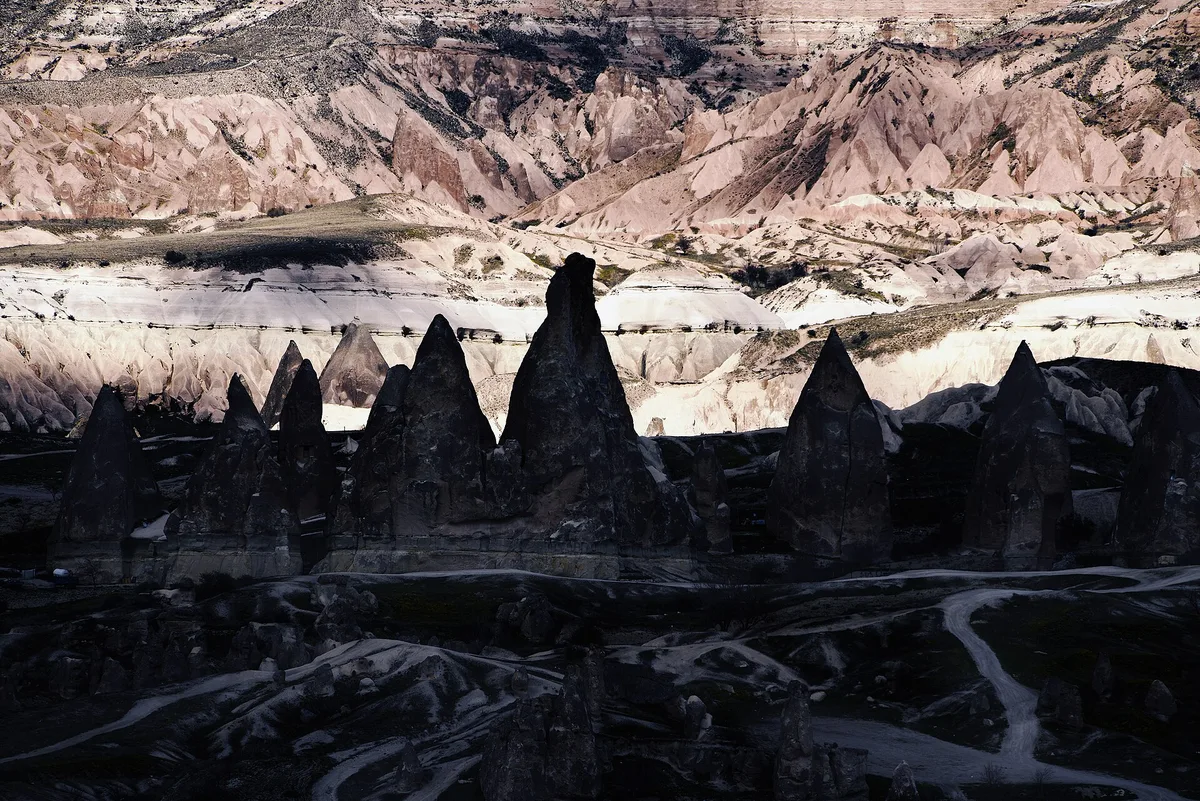
The Anatolian plateau holds two sights of opposite kinds. In Cappadocia, a volcanic landscape was hollowed by monks into churches and painted with some of the finest Byzantine art to survive anywhere; in Safranbolu, further north, an Ottoman caravan town was preserved entire by the simple accident of the trade routes moving away. One is a landscape you descend into, the other a town you stroll through, and between them they carry the centre of the country on this list — the plateau that coastal itineraries fly over, and which repays the traveller who lands.
Both are also made of perishable stuff. Cappadocia’s churches are cut into stone soft enough to carve with hand tools, and Safranbolu’s houses are timber and plaster.
Göreme Open Air Museum
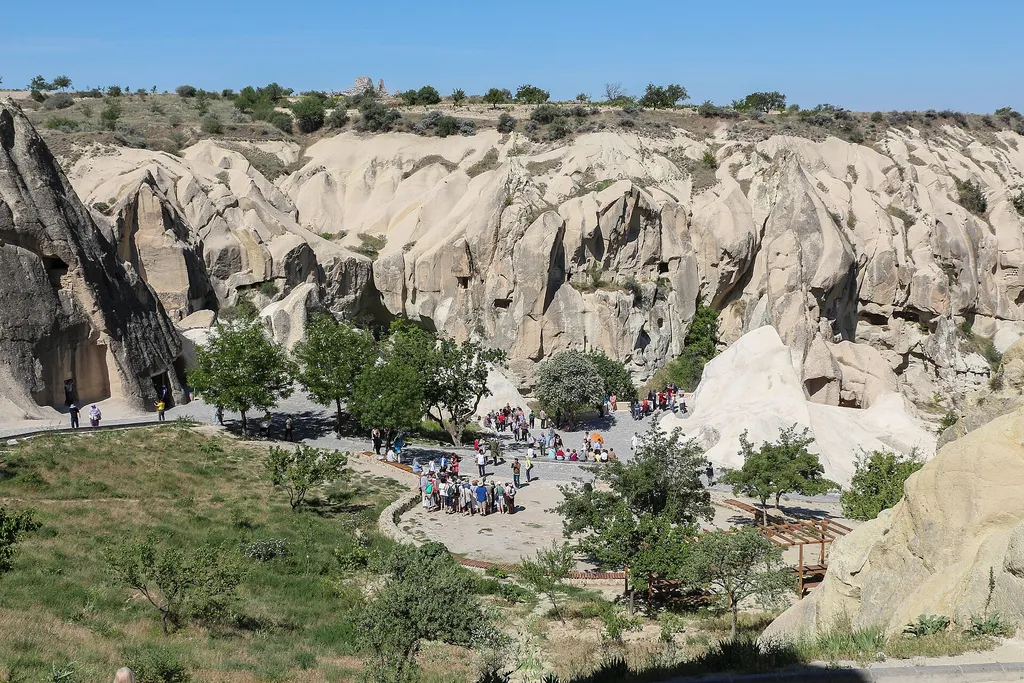
The Göreme Open Air Museum is the cultural heart of Cappadocia: a compact valley of rock-cut churches, chapels and refectories, hollowed by Byzantine monastic communities into the soft volcanic tuff and painted, between roughly the tenth and twelfth centuries, with fresco cycles that rank among the finest Byzantine painting anywhere. Church follows church along the valley path — the Apple Church, the Snake Church, the Church of St Barbara with its strange red-ochre symbols — each a room cut from a fairy chimney or a cliff, each interior a burst of lapis blue, gold and madder in the dark. The finest of them, the Dark Church, takes its name from the near-absence of light that protected its colours: its vaults carry a full programme of Christ’s life in a state of preservation that feels impossible for paintings a thousand years old in a cave.
The museum is the anchor of a landscape rather than the whole of it. Cappadocia’s valleys were inhabited and worshipped in for centuries: whole villages inside the rock, pigeon houses cut into cliffs, and underground cities like Derinkuyu and Kaymaklı descending storey after storey as refuges beneath the plateau. The Open Air Museum gathers the best of the painting into one walkable valley, which is why it is the entry here; the rest is its context, and the Cappadocia travel guide on this site covers the valleys and underground cities in the order they deserve. Göreme National Park and the Rock Sites of Cappadocia were inscribed by UNESCO in 1985 as one of the country’s two mixed properties — culture and geology listed together, because here they are the same thing.
Safranbolu
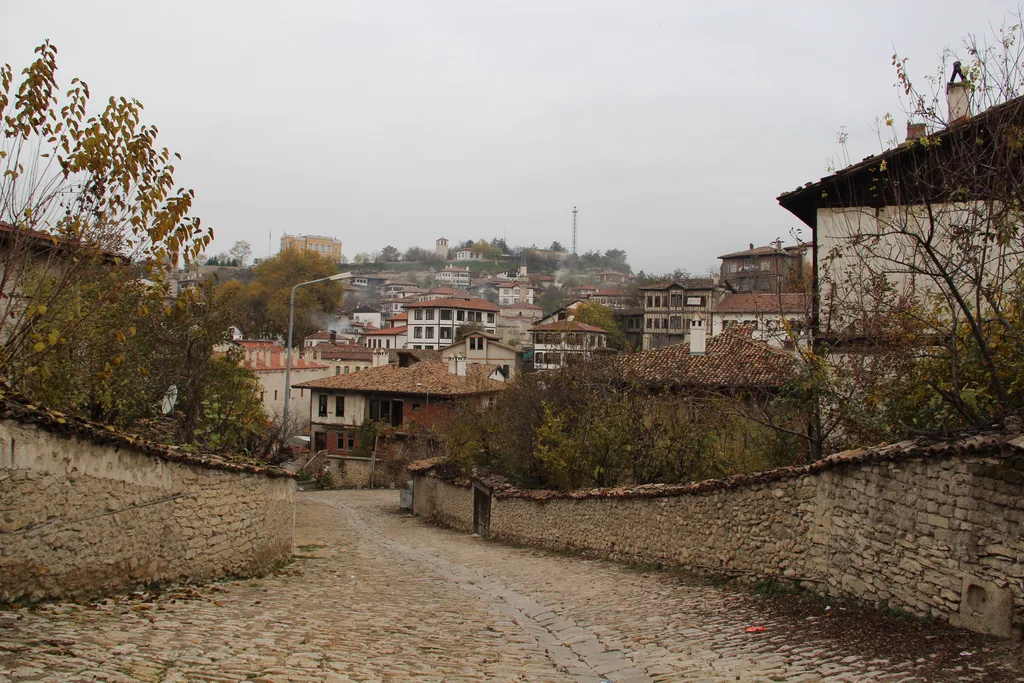
Safranbolu is the Ottoman Empire preserved at town scale. Set in a gorge in the hills south of the Black Sea, it grew rich as a caravan station on the trade route between Istanbul and the Black Sea port of Sinop — its very name carries the saffron traded and grown here — and its merchants built the handsome town in the photograph: hundreds of timber-framed, white-walled houses with red-tiled roofs, deep eaves and latticed windows, stacked up the hillsides around a market quarter of mosques, baths, a great caravanserai and craftsmen’s bazaars. When the caravans stopped coming, nothing replaced them, and the town simply kept its shape. UNESCO inscribed it in 1994 as an exceptionally complete surviving Ottoman caravan city — not a monument but a whole urban organism, still lived in.
The visit is deliberately unhurried, because Safranbolu has no single must-see and is the better for it. The Cinci Han, the great seventeenth-century caravanserai, anchors the market; the smiths’ and coppersmiths’ bazaars still ring with hammering; the great houses — some now museums, many still family homes or small hotels — show Ottoman domestic architecture at its most graceful, all carved ceilings and rooms that turn their best windows to the street. Safranbolu is this list’s counterweight to the classical world: proof that Turkey’s heritage is also provincial, wooden and domestic — an ordinary rich town of three centuries ago, kept.
The East and the Black Sea
The last four sights on this list ask the most travel and give back the most time. In the south-east, a hilltop sanctuary older than farming rewrites the beginning of human history, and a king’s gravel tomb at over two thousand metres watches the sun rise over a row of fallen gods. In the far east, a medieval capital stands empty in the grass on a closed border. And in the green Pontic mountains of the north-east, a monastery hangs on a cliff in the mist. None of them fits a weekend; all four are the kind of sight travellers describe years later without prompting.
Turkey in the west is classical and Ottoman, marble and tile; Turkey in the east is older and stranger — Neolithic, Commagenian, Armenian, Pontic Greek — and its sights carry civilisations the western lists rarely reach.
Göbekli Tepe
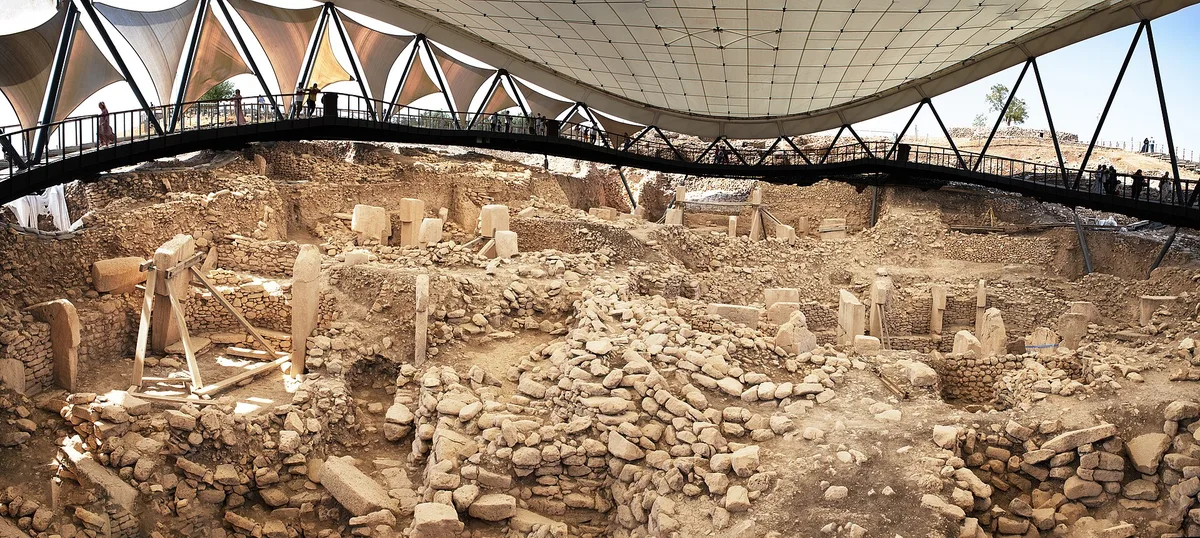
Göbekli Tepe is the oldest sight on this list by a factor that breaks the scale — older than the pyramids by some six and a half thousand years, older than farming, pottery, writing and the wheel. On a limestone ridge above the plain near Şanlıurfa, from around 9600 BC, communities of hunter-gatherers raised great circular enclosures of T-shaped stone pillars, the largest weighing many tons, carved with foxes, boars, cranes, lions and abstract signs, roofed them, used them — and then, for reasons nobody knows, deliberately buried them and built anew. Monumental architecture, it turns out, did not follow settled farming life as every textbook once assumed. At Göbekli Tepe it came first, and the organising of labour to build it may itself be part of what pushed people towards the settled life that followed.
The visit today is sheltered and spare, which suits the place. Great canopies protect the main enclosures, walkways carry you above them, and the pillars stand in their stone circles much as the excavators — working here since the mid-1990s — uncovered them. Şanlıurfa itself, the pilgrim city below with its sacred pools, bazaars and one of Türkiye’s finest regional museums, is the essential second half of the day. Göbekli Tepe was inscribed by UNESCO in 2018, and of all the sights here it is the one that most changes the visitor: Ephesus astonishes, Hagia Sophia overwhelms, but this quiet ridge reorders what you thought the sequence of civilisation was.
Mount Nemrut
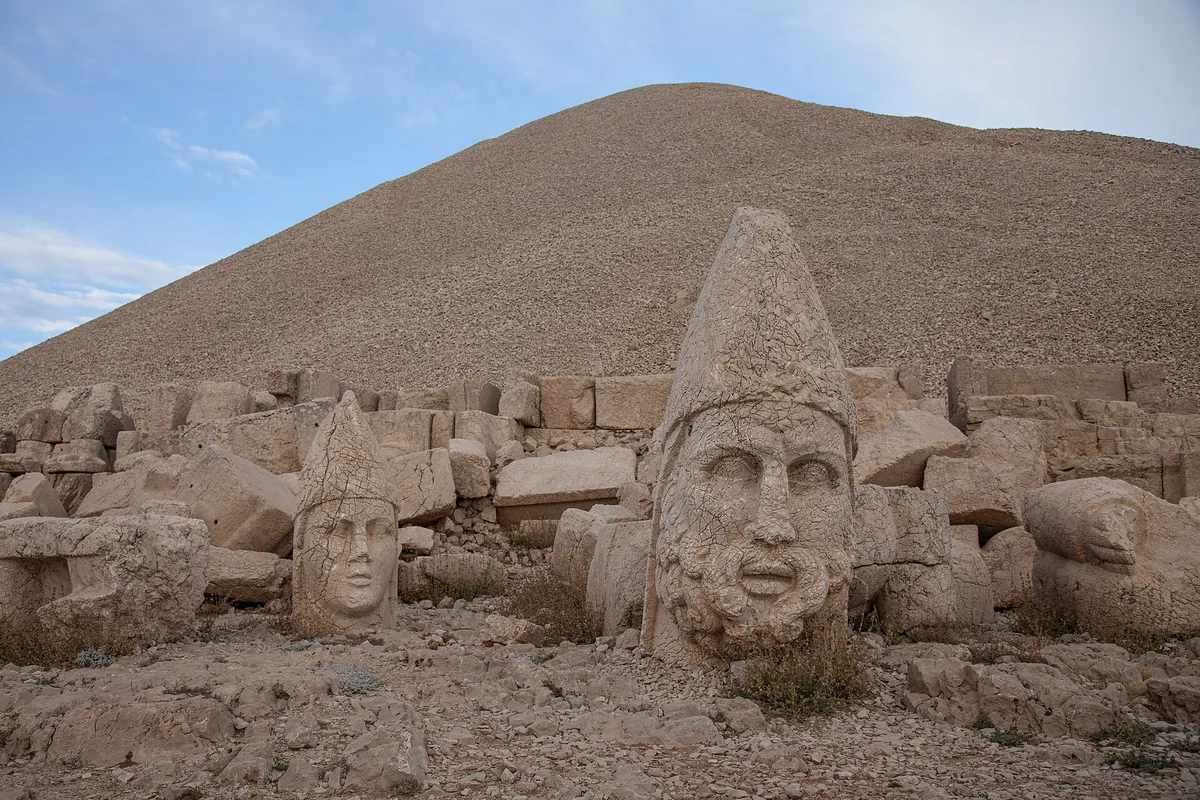
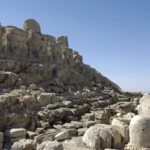
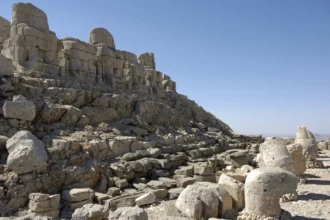
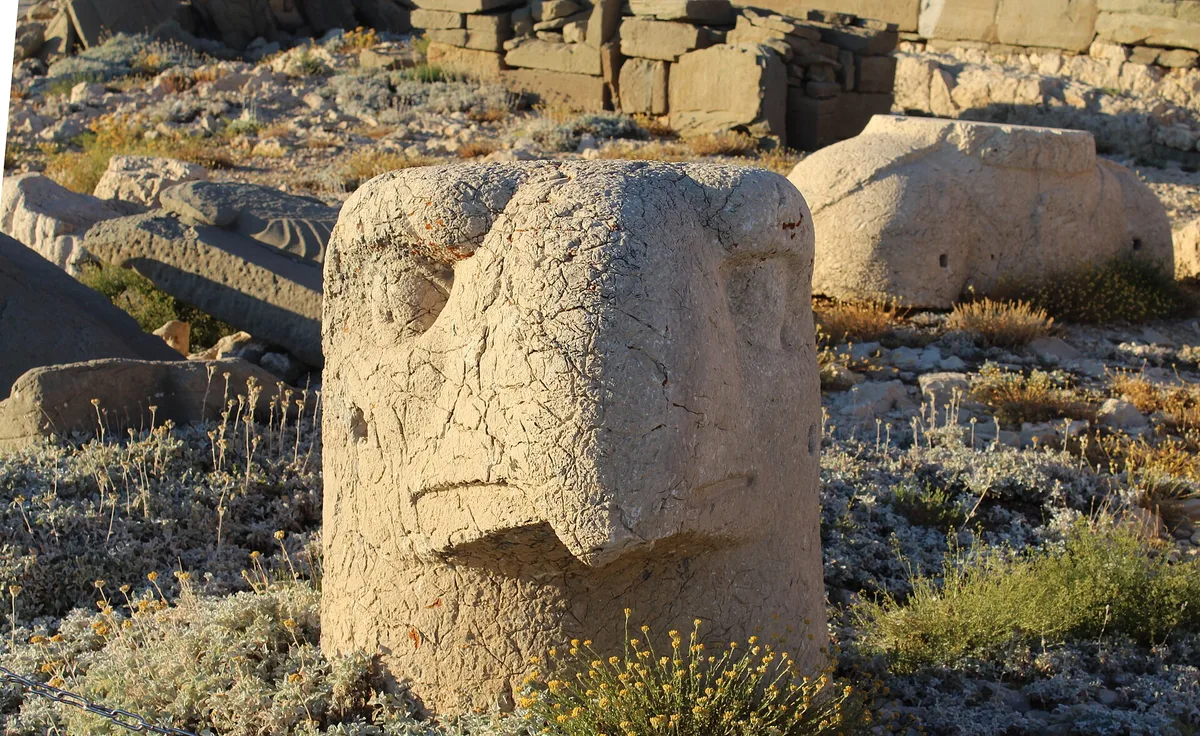
High in the mountains of Adıyaman province, at 2,150 metres, a king built himself a tomb that doubled as a throne room among the gods. Antiochus I of Commagene, ruler of a small Hellenistic kingdom squeezed between Rome and Parthia in the first century BC, raised on the summit a great cone of crushed stone — his presumed burial mound, some fifty metres high and never successfully entered — flanked by terraces of colossal seated statues: Zeus, Apollo, Hercules, Fortune, and Antiochus himself among them, in a deliberate fusion of Greek and Persian religion with himself at the centre of the pantheon. The statues’ heads, each taller than a person, were toppled by earthquakes across the centuries and now sit in a row before their bodies, gazing across the Euphrates valley, in the arrangement the photograph shows.
The visit has a ritual shape the mountain imposes. The summit is seasonal — snow closes it for part of the year — and the classic times are the day’s two ends: sunrise on the east terrace, when the light strikes the heads full-face, and sunset on the west, with a final climb on foot and serious cold at almost any season. Between the terraces, relief stelae show Antiochus shaking hands with his gods, and the eagle and lion guardians — the eagle’s head in this section’s opening photograph — watch over the approaches. It is a royal ego trip, honestly assessed: a minor king of a buffer state demanding eternity at the top of a mountain. The astonishing thing is that he got it. UNESCO inscribed Nemrut Dağ in 1987.
Ani
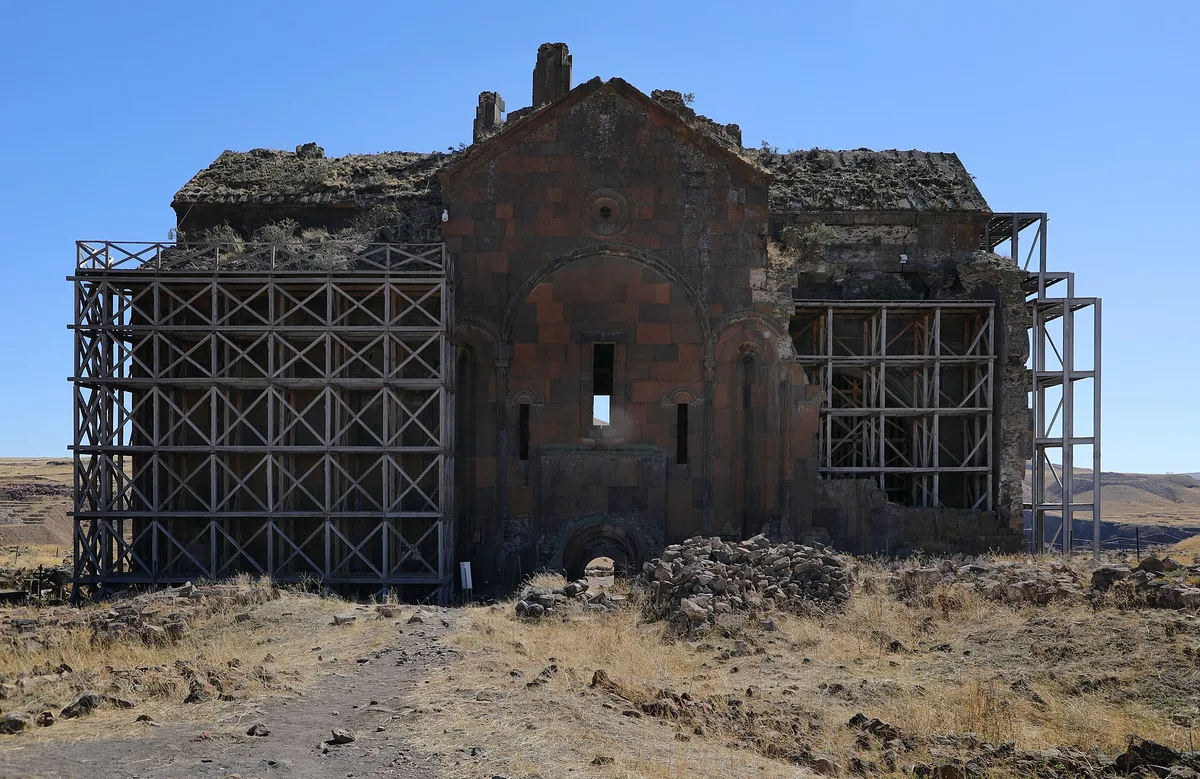
At the far eastern edge of Turkey, on a plateau cut by the Akhurian river gorge that forms the border with Armenia, stands a city with nobody in it. Ani was the capital of Bagratid Armenia in the tenth and eleventh centuries, a Silk Road metropolis that its admirers called the city of 1,001 churches, enriched by the trade routes between Byzantium and the east. Later centuries took it in turns — Byzantine, Seljuk, Georgian, Mongol — earthquakes shook it, trade moved away, and by the modern age the capital of a kingdom had become a grass-grown plateau of ruins at the end of the road from Kars, its cathedral roofless in the wind, its broken bridge spanning a gorge to a border that is closed.
What remains is the most affecting ruin-field in Turkey. The cathedral, completed in 1001 to the design of Trdat — the architect who also repaired Hagia Sophia’s dome — stands in reddish stone in the middle of emptiness, its pointed arches a preview of Gothic forms a world away. Churches stand alone in the grass with their frescoes fading; a mosque of the first Seljuk years in Anatolia keeps its minaret; the great double walls cross the landward neck of the plateau; and everywhere is the silence, broken by wind and birdsong, of a place that was never built over — precisely its value, recognised when UNESCO inscribed the Archaeological Site of Ani in 2016.
Sümela Monastery
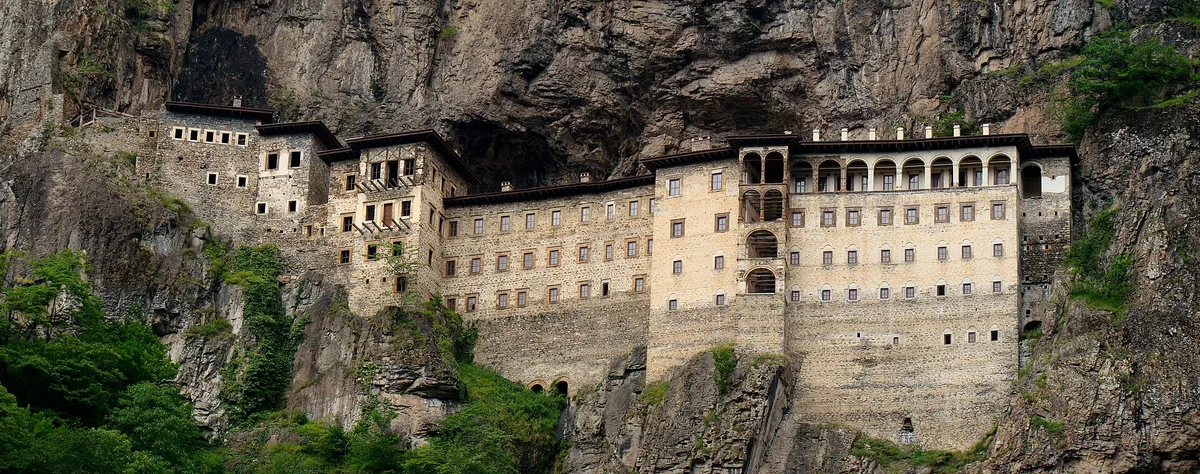
Sümela is the sight that looks least possible on this list: a Greek Orthodox monastery dedicated to the Virgin Mary, pasted onto a sheer cliff face in the green Pontic Mountains south of Trabzon, its long stone facade rising from the rock above the forested Altındere valley. By tradition it was founded in the fourth century by Athenian monks who found an icon of the Virgin in a cave here; what you see is the accumulation of centuries — the cave church at its heart, chapels, monks’ cells, kitchens and guest rooms built out from the cliff between the thirteenth and nineteenth centuries, frescoed inside with layers of painting. The setting does half the work: this is the wet, green, misty Black Sea Turkey of tea gardens and pine forest, as unlike the Aegean’s dry marble as anywhere in the country.
Accuracy matters here, and this guide states it plainly: Sümela is on UNESCO’s Tentative List, where it has sat since 2000 — it is not one of Türkiye’s 22 inscribed World Heritage Sites, whatever less careful lists imply. It also carries a practical caveat: the monastery spent years under major restoration and has been reopening in stages, so what is open varies, and the wise traveller checks the current position before travelling up the valley.
How to Choose – Pairing the Attractions Into Trips
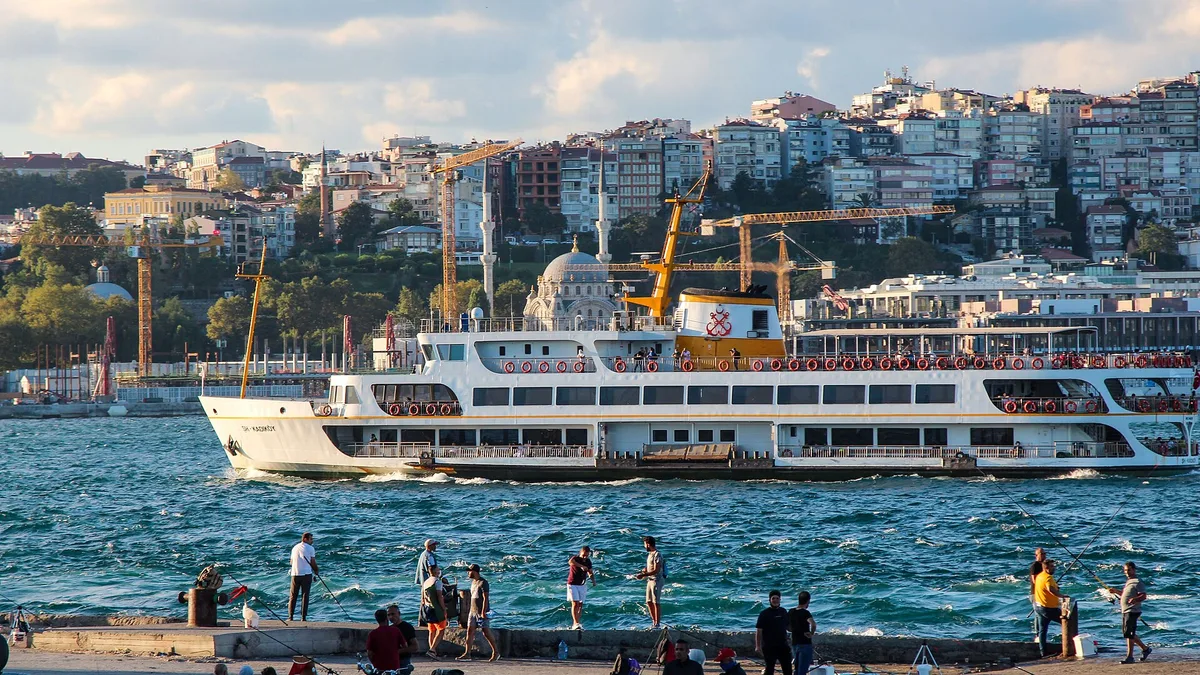
Eighteen sights, one very large country, and the honest arithmetic of travel: nobody sees them all in one holiday, and the traveller who tries will remember the transfers better than the sights. The list was grouped by region because the regions are the trips. Istanbul’s five form one stay. The Aegean four form one loop of the best part of a week. Aspendos and Kaleiçi form a Mediterranean base of a few days, with Xanthos as its western excursion. Göreme and Safranbolu belong to a central journey through the plateau. And the eastern four belong to the expedition, one committed journey of its own, best taken whole rather than nibbled.
Two rules protect any version of the plan. The first is the one-site rule: one great sight per day is a feast, two is a full day, and three is a blur — these are large, demanding places, and the traveller who schedules three into one arc of a trip will keep the photographs and lose the places. A first trip that takes Istanbul, Ephesus and Göreme, slowly, has seen the country’s core — and left itself the rest as real, distinct reasons to return.
Questions Travellers Ask
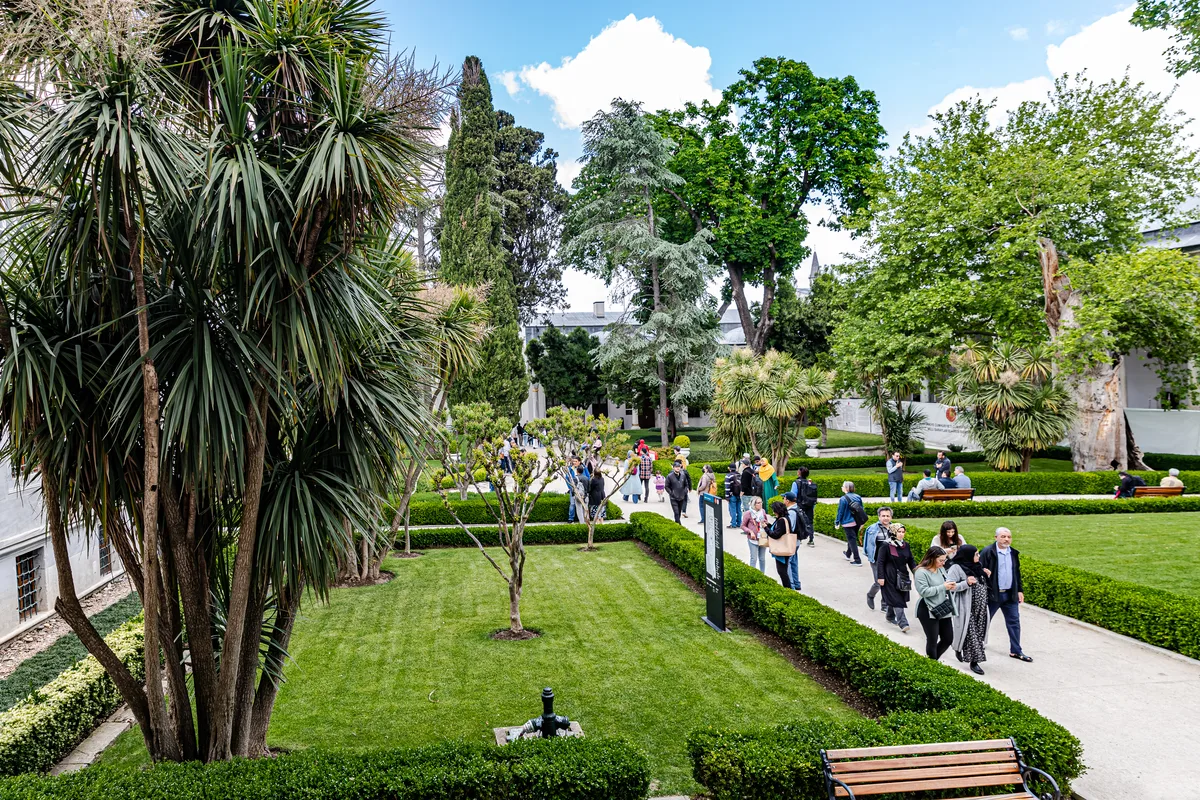
Which attraction in Turkey should I see if I only have time for one? Hagia Sophia, and it is not close. No other sight in the country combines its age, its engineering, its layered history and its physical power in a single room. If the one sight can stretch to a day, make it the Sultanahmet square mile — Hagia Sophia, Topkapi and the cistern together — because the three explain each other.
Is Hagia Sophia a mosque or a museum now? A mosque. It served as a museum from 1935 until 2020, when it returned to use as a mosque — which is why older guides, and at least one page currently ranking for this subject, still describe it as a museum. The practical consequences are those of a working place of worship: the dress code and conduct that implies, and parts of the building managed differently from the museum years. The building, its mosaics and its dome are unchanged. Check the current visiting arrangements close to your trip rather than trusting any printed summary, this one included.
How many UNESCO World Heritage Sites does Turkey have, and which sights on this list are among them? Twenty-two, verified against UNESCO’s official list for Türkiye in October 2026 — twenty cultural properties and two mixed ones. Fifteen of this list’s eighteen sights are inscribed or stand inside inscribed properties: the Istanbul five within the Historic Areas of Istanbul (1985), Ephesus (2015), Hierapolis-Pamukkale (1988, mixed), Pergamon (2014), Troy (1998), Xanthos-Letoon (1988), Göreme and the Rock Sites of Cappadocia (1985, mixed), Safranbolu (1994), Göbekli Tepe (2018), Nemrut Dağ (1987) and Ani (2016). Aspendos, Kaleiçi and Sümela are not inscribed; Sümela is on the Tentative List, which is a candidacy, not an inscription.
What is the best time of year for these sights? Spring and autumn suit almost all of them — the Istanbul interiors are year-round, but the Aegean and Mediterranean ruins are exposed places that punish high-summer afternoons, and Cappadocia’s valleys are at their best in the shoulder seasons’ light. The east runs on its own calendar: Nemrut’s summit is snowbound for part of the year and belongs to the late spring-to-autumn window, and Ani’s plateau is bleak in an east-Anatolian winter. This site’s best-time guide treats the seasons region by region; the short version is April to June and September to October for a multi-region trip, with the east fitted inside its shorter summer.
Are these sights suitable for children and travellers with limited mobility? Mixed, honestly. The Istanbul sights are the most manageable, though Topkapi is a large site with long distances between its parts, and the cistern’s modern walkways are the easiest underfoot in the old city. Ephesus’s marble streets are steep in gradient and slippery when polished by millions of shoes, Göreme’s churches involve steps and low doorways cut in rock, and Nemrut ends in a climb on a mountain path that no amount of goodwill makes level. Troy and Pergamon’s lower town are gentler; Aspendos’s seating is steep but its ground-level orchestra is reachable. Treat each sight on its own terrain rather than assuming a national standard, and check current access arrangements for the sights that matter to your party.
Can I visit all eighteen on one trip? Not honestly in less than about three weeks, and the attempt would cheapen the best of them. The geography forbids the sprint: Istanbul and Ani are farther apart than London and Rome, and the eastern sights sit at the ends of mountain roads that answer to weather. The list is better used as a framework for several journeys — the west, the centre and the east taken one at a time, each at walking pace.
The Short Version
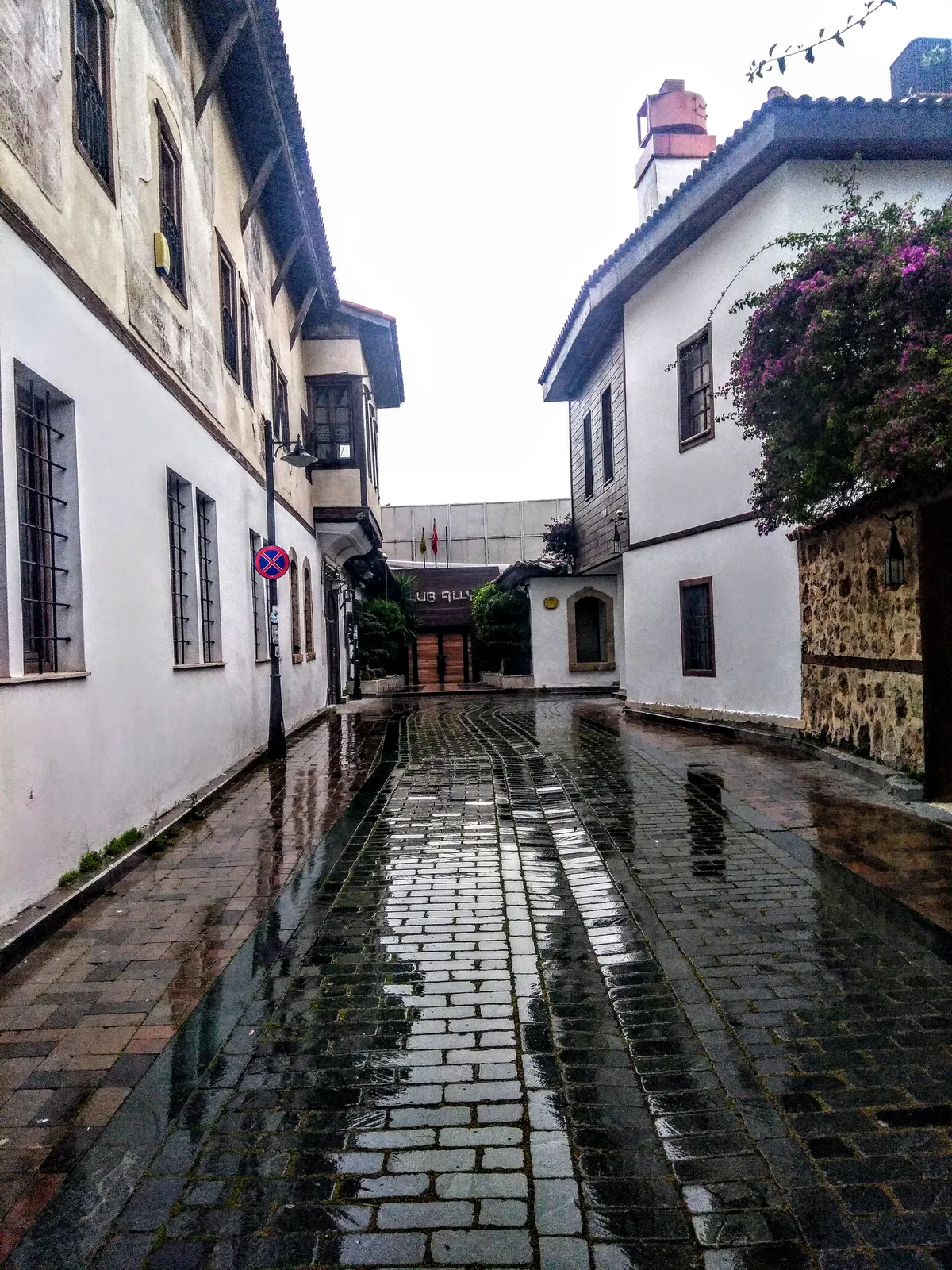
Turkey’s attractions, taken sight by sight, are a history of the world told in one country: a Neolithic hilltop where building itself began, the marble cities of Greece and Rome, the dome that defined Byzantium, the palace and mosque of the Ottoman centuries, a caravan town in timber, and a monastery in the clouds.
Start where every trip starts, in the Sultanahmet square — Hagia Sophia above, the cistern below, the palace beside, the bazaar behind — then let the regions take you: Ephesus and Pergamon for Rome at full scale, Aspendos for the theatre that time forgot to ruin, Göreme for painting in stone, and the east for the sights that change what you thought you knew. Eighteen attractions, five journeys, twelve thousand years.