Pamukkale Travel Guide – White Terraces, Hierapolis and the Ancient Spa City
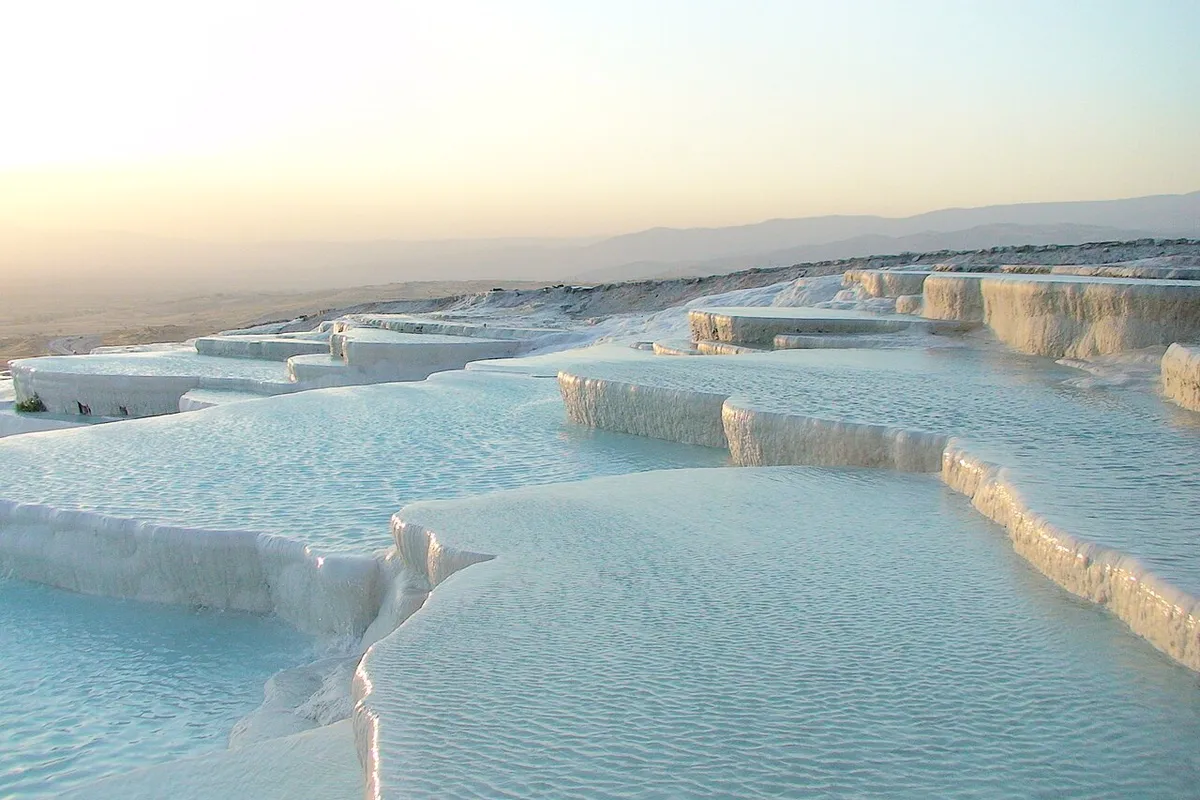
Pamukkale is two sights sharing one hillside, and most visitors only understand one of them. The white terraces get the photographs — a cliff of stepped, milky-blue basins that looks like a frozen waterfall or a spill of snow in the wrong climate, and which gave the place its Turkish name, cotton castle. Above them, usually treated as a backdrop you cross on the way to the pools, lies a whole Greco-Roman city built for the hot water itself. Hierapolis was a spa town of the ancient world, with baths, temples, a great theatre and one of the largest cemeteries of antiquity, and it exists for exactly the same reason the terraces do. The springs made both. Read the two together and Pamukkale stops being a photo stop and becomes what it actually is, which is a single story told in stone of two kinds — the stone the water built, and the stone people built beside it.
This pamukkale travel guide is organised the way the ground is. It starts with the terraces and how they form, because the geology explains every rule you will meet on the white slope, from bare feet to the pools you may not enter. It then walks the walking route honestly, crosses to the city plateau for Hierapolis — its main street, its theatre, its two-kilometre necropolis and the shrine of an apostle — and deals plainly with the Antique Pool, the famous swimming spot whose royal legend does not survive scrutiny. Practical questions of light, season and where to sleep come after the sights, because at Pamukkale timing and base change the visit more than any checklist of things to do. Nothing here prints a price or an opening hour, for reasons the How to Visit logic running through this guide will make clear — those figures change, and the official portal named throughout is where they live.
At a Glance
| Sight | Why it matters | Where on site |
|---|---|---|
| Travertine terraces | The white stepped basins built by the mineral springs themselves, the reason the place is famous | The cliff face between the village and the plateau |
| Hierapolis | The Greco-Roman spa city founded for the hot springs, a UNESCO-listed ruin field of streets, baths and temples | The plateau above the terraces |
| Theatre of Hierapolis | A grand Severan-era theatre with a richly carved stage building, still used for performances | Upper city, on the slope above the centre |
| Necropolis | Among the largest cemeteries of the ancient world, over 2 kilometres of tombs outside the walls | North of the city, along and beyond the main street |
| Temple of Apollo and the Plutonium | The city’s main sanctuary, built over a fault that breathed out poisonous vapours | Central Hierapolis, near the great baths |
| Martyrium of St Philip | The 5th-century octagonal shrine over the apostle’s martyrdom site, reached by a monumental stairway | Outside the north-west wall, on the hill |
| Antique Pool | The modern swimming facility in the ancient agora’s earthquake lake, among fallen columns, charged separately | Central Hierapolis, by the site museum |
| Laodicea | The wealthy sister city in the Lycus valley, a separate excavation field and an easy extension | Near Denizli, a short drive from Pamukkale |
Two planning facts follow from the table. First, the terraces and the city are one ticketed archaeological landscape, not two attractions — the walk up the white slope is also the most direct route into Hierapolis, and treating the ruins as an optional extra is the commonest mistake a first visit makes. Second, the site rewards vertical thinking. The village sits at the foot of the cliff, the terraces climb its face, and the city spreads across the plateau at the top, so the day has a natural one-way shape — up through the water, then out across the stones — and the sections below follow that shape exactly.
How the Terraces Form
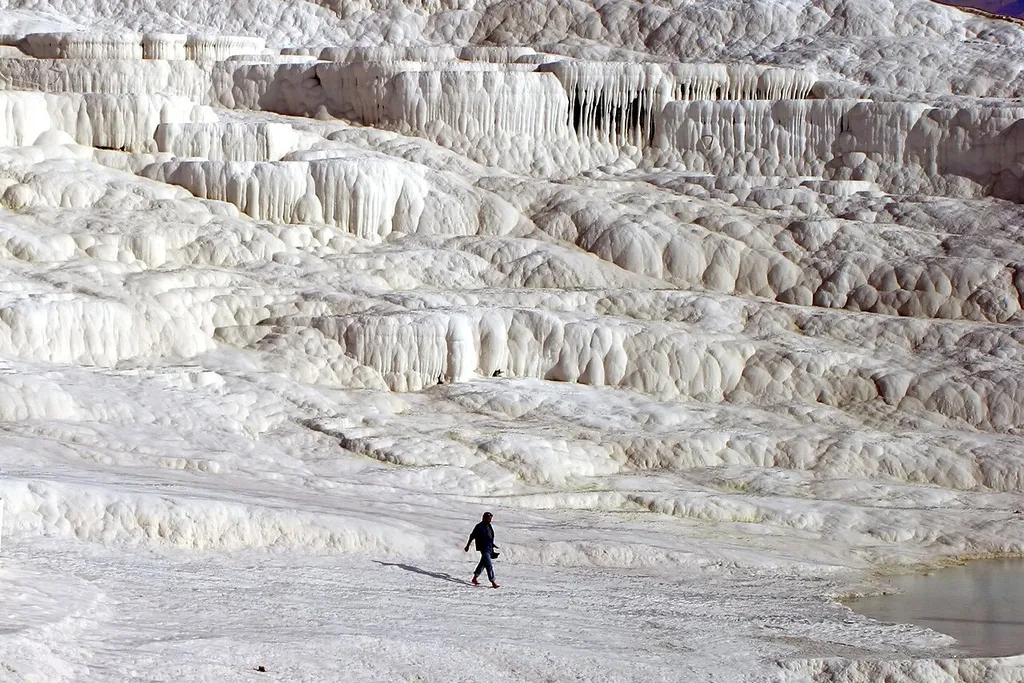
The terraces are built by the water, continuously, and the mechanism is simple enough to hold in one sentence. Hot spring water rises through the faulted hillside loaded with dissolved calcium carbonate, picked up underground; when the water reaches the open air it releases carbon dioxide, and the carbonate it can no longer hold in solution settles out as a fresh white crust of travertine. Where the flow runs fast it lays down sheets, where it slows at a lip it builds a rim, and rim upon rim the slope has grown its staircase of basins. UNESCO’s account of the property describes exactly this landscape — petrified waterfalls, stalactites and pools with step-like terraces, some less than a metre high and others as high as six metres, all of it fed by springs emerging from a cliff almost 200 metres high above the Çürüksu plain. The whiteness is not the rock’s permanent colour. It is the colour of new deposit, renewed wherever the water currently runs.
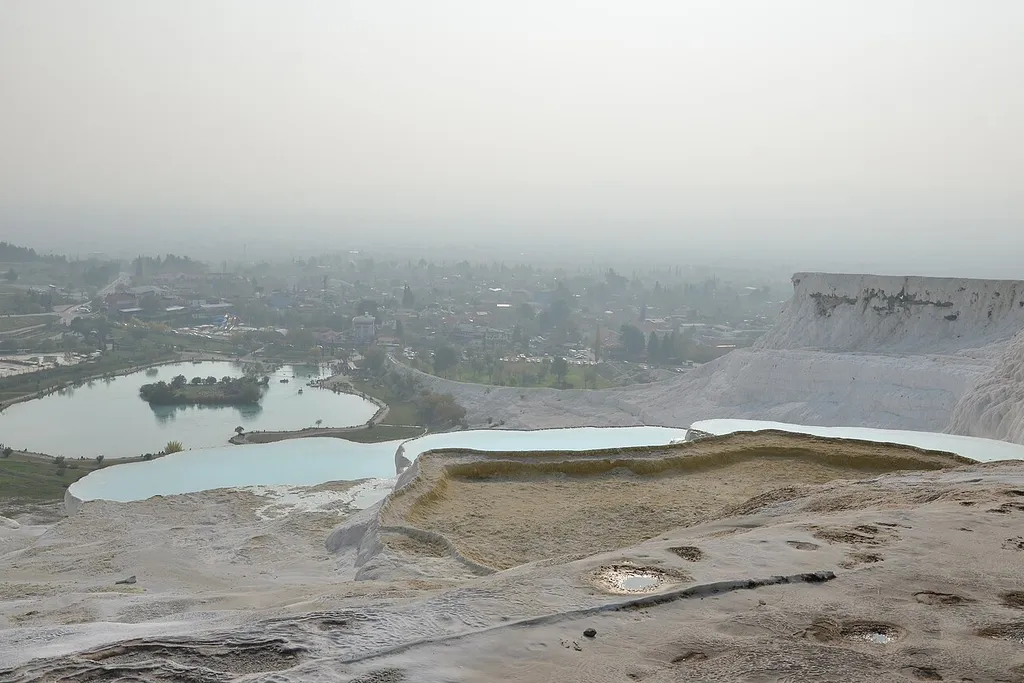
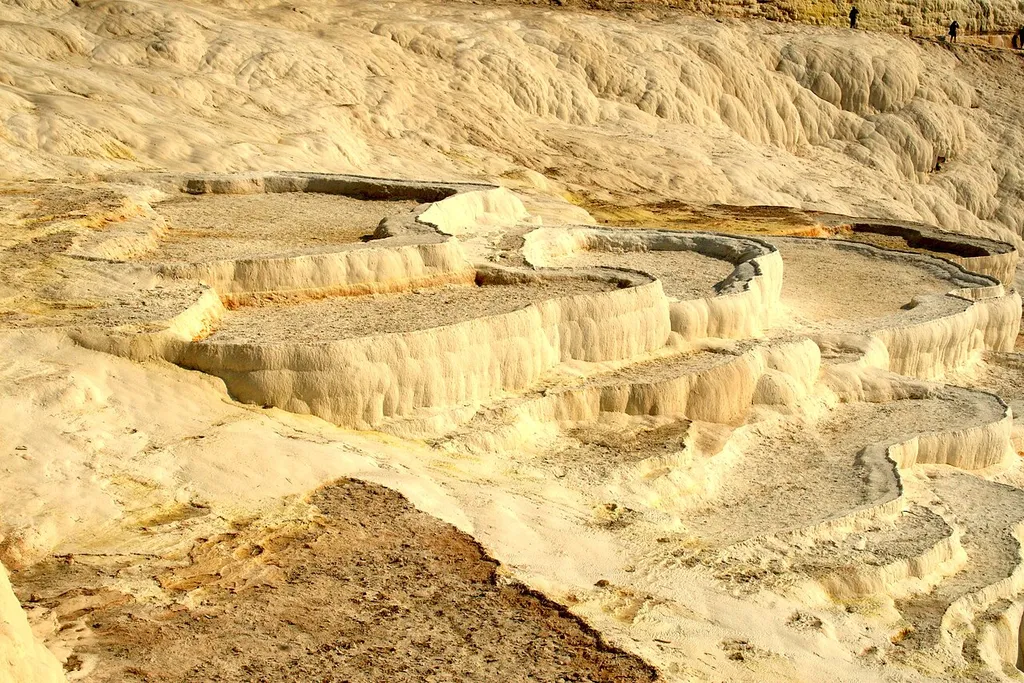
That one fact explains the Pamukkale that photographs never show, which is a hillside of two tones. Where spring water flows, the travertine is dazzling white and the basins fill with that milky blue. Where water has been diverted away, the surface weathers to grey and cream, and the empty terraces look like a quarry rather than a wonder. The site’s managers route the limited spring water across different parts of the slope in rotation, so that each section gets its turn under the flow that keeps it white and growing, and the consequence for visitors is honest and unavoidable — on any given day, part of the famous view will be dry. This is conservation, not neglect, and the terraces you see in the oldest travel posters, every basin brimming at once, show more water on the hill than the springs now supply. Go expecting a living, managed landscape in mid-process and Pamukkale will not disappoint you. Go expecting the poster and it might.
The water was working for people long before it was photographed. UNESCO notes that the springs of Hierapolis were used in antiquity for scouring and drying wool — the hot mineral flow was an industrial asset to the textile city above, not just a cure — and that the canal system carrying thermal water out to the villages and fields of the valley ran for some 70 kilometres along the Menderes river system. The terraces, in other words, are the visible leak of a much larger ancient plumbing network, the place where the city’s water supply broke the surface on its way downhill. Stand at the top of the white slope and look along the valley and you are looking at the route of those canals. The cotton castle is the decoration on an aqueduct.
Walking the Travertines – Rules and Route Logic
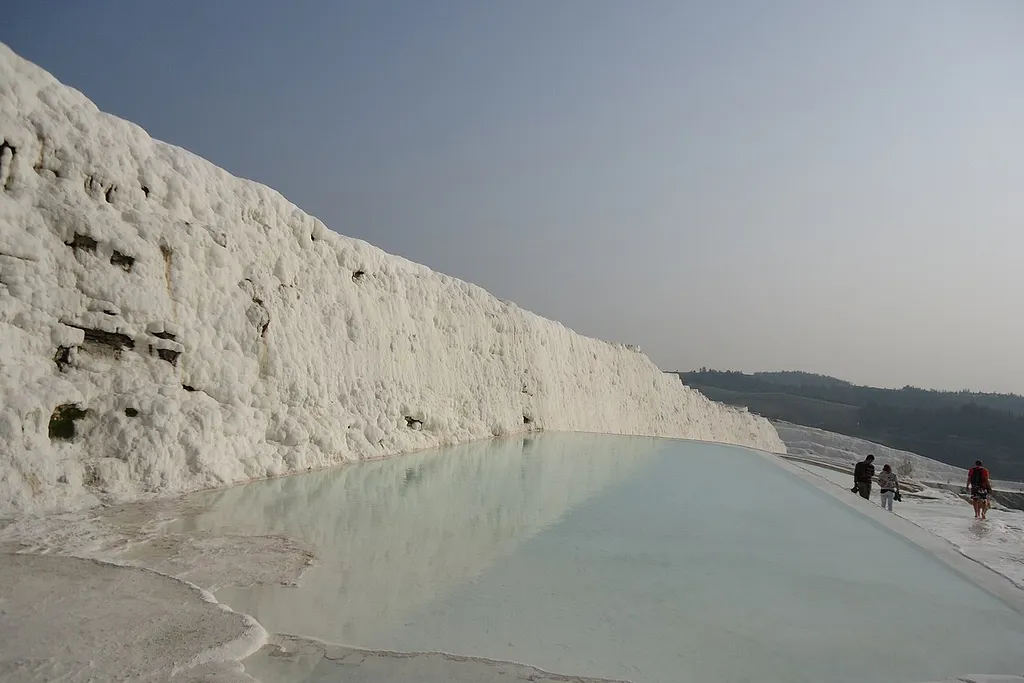
The walk up the terraces is the heart of a Pamukkale visit, and it runs on rules that surprise people who arrive expecting a beach. The published rules for the travertine slope, as set out by the site authorities and summarised in UNESCO’s protection account, are that visitors cross the white surface barefoot, follow the single established route, and do not bathe in the terraced pools themselves — UNESCO’s wording is that visitor access across most of the terraces is prohibited in order to sustain the water flow and maintain the colour and structure of the formations, with designated areas established where bathing in the hot springs is allowed. Shoes come off at the bottom and go in your bag, because the same crust your feet would scuff is the deposit the springs laid down last season. Treat any rule detail as changeable, because site management adjusts arrangements, and confirm the current position at the gate or on muze.gov.tr, the Ministry of Culture and Tourism’s museum portal, in the week you travel. This guide prints the principles, which are stable, and no operational detail that could quietly rot.
Understood properly, the rules improve the walk rather than restrict it. Bare feet give you the site’s best information — the travertine underfoot is warm where the film of spring water runs over it, rippled into natural tread on the flow lines, smooth and genuinely slippery on the still basin floors, and sharp-edged in places where fresh crust has formed into ridges. You will walk slowly because the ground asks you to, and slow is the right speed for reading a hillside that is still being built. The route logic is equally simple. The walking line climbs the face of the terraces from the village side toward the plateau, passing basin after basin in sequence, so the ascent is also a transect of the whole formation — dry rims, flowing rims, filled pools and empty ones, in the order the water management of the moment dictates. There is no shortcut and no alternative line, and there does not need to be. The route is the exhibit.
Two honest warnings belong in this section rather than in a tips box. The first is glare. A white hillside under a Turkish summer sun is a reflector, and the combination of brightness, heat radiating off the stone and water underfoot catches visitors out more reliably than the climb itself does — the ascent is short, but it is exposed from first step to last, and the plateau at the top offers the first real shade. The second is that the pools along the route are for looking into, feet at most where the route crosses shallow flow, and not for settling into. Travellers who arrive picturing a long soak distributed across a dozen blue basins are working from photographs of the protected sections, not from the visit that exists. The swimming at Pamukkale is real, but it happens in one specific place, and it is dealt with on its own terms in the Antique Pool section below.
Hierapolis – the City Above the Pools
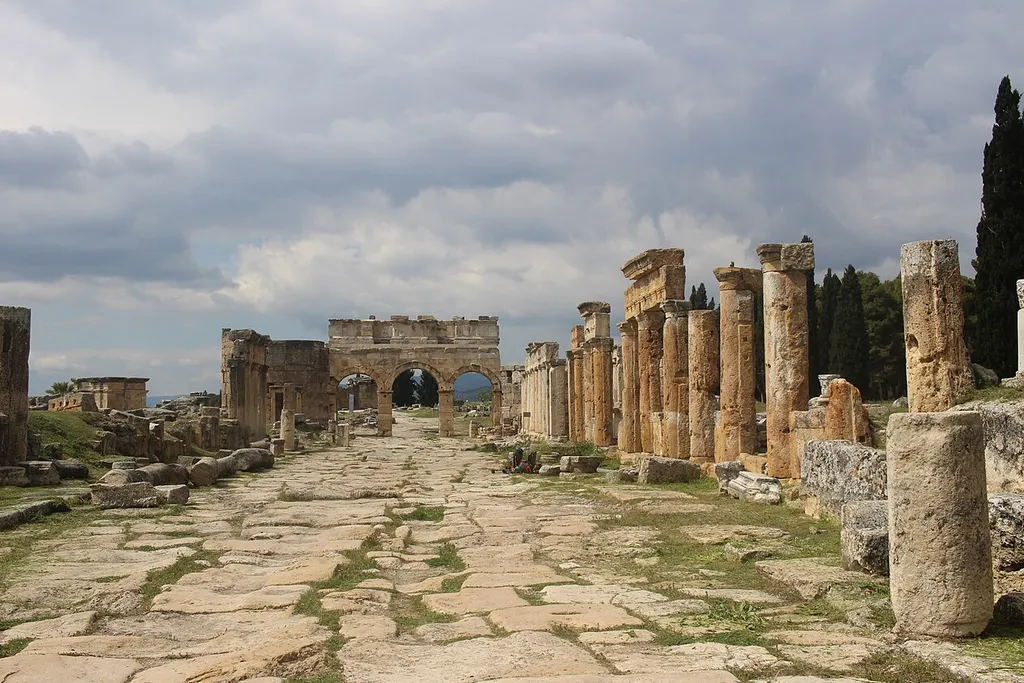
Hierapolis was founded at the end of the 2nd century BC by the Attalid kings of Pergamon, placed deliberately at these springs beside an older cult site, and it passed to Rome in 133 BC with the rest of the Pergamene kingdom. An earthquake destroyed it in AD 60 and the city was rebuilt in the imperial fashion, reaching its peak in the 2nd and 3rd centuries AD as one of the great spa towns of the Roman east — a place where the therapeutic waters, in UNESCO’s phrase, were exploited at immense hot basins and pools for swimming, and where hydrotherapy was accompanied by religious practice at every step. That pairing is the key to reading the ruins. Hierapolis was never a resort bolted onto a temple or a shrine with baths attached. Cure and cult were one business, and the city’s plan says so — great bath complexes stand at the edges of town where arriving patients entered, temples crowd the centre, and the whole street grid serves people who came a long way to be healed and stayed to be entertained, fleeced and, in very large numbers, buried.
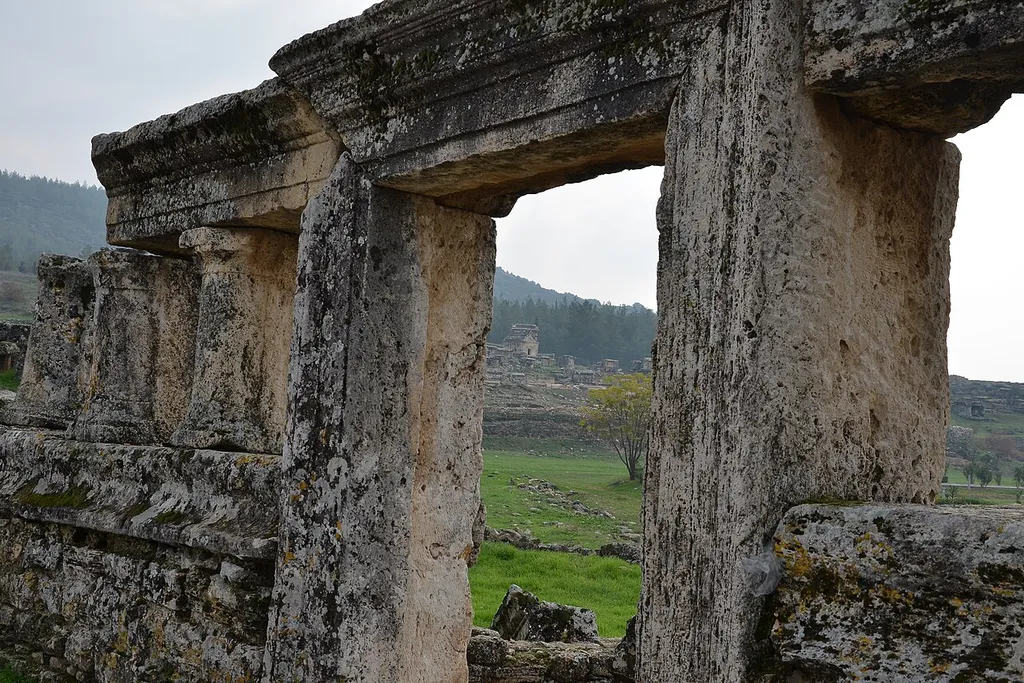
The walkable core rewards a slow crossing. Frontinus Street, the colonnaded main avenue, runs from the monumental Domitian Gate past latrines, shops and the great baths toward the civic centre, and it still gives the clearest sense of the city’s scale — this was a substantial town, not a village grown around a spring. Near its heart stand the remains of the Temple of Apollo, the city’s chief sanctuary, and beneath the temple precinct lies the strangest survival at Hierapolis. The Plutonium was a shrine built directly over the geological fault from which, as UNESCO puts it, noxious vapours escaped — a cave whose carbon dioxide, pooling invisibly at ground level, killed the sacrificial animals led into it while their priests, who understood the gas and breathed above it, emerged unharmed. Modern researchers have measured the same gas still seeping at the same spot. Of all the ruins on the plateau it is the one that closes the distance between geology and religion completely — the fault that feeds the springs also fed the god.
After Constantine, the spa city became a bishopric and a place of Christian pilgrimage, and its later layers are as substantial as its pagan ones — a cathedral, a baptistery and several churches among the ruins, and the converted bath-basilica on the city’s edge. The site museum, housed in the vaulted halls of the great Roman bath complex, holds what excavation has lifted from all of it — sarcophagi, statues, and the small finds of a city that lived on visitors for half a millennium. Give the museum its half hour, because it collects the portable city the way Selçuk’s museum completes Ephesus. Hierapolis above ground is architecture and street lines. The museum is where its objects, and so its people, are kept.
The Martyrium of St Philip – the Shrine Above the City
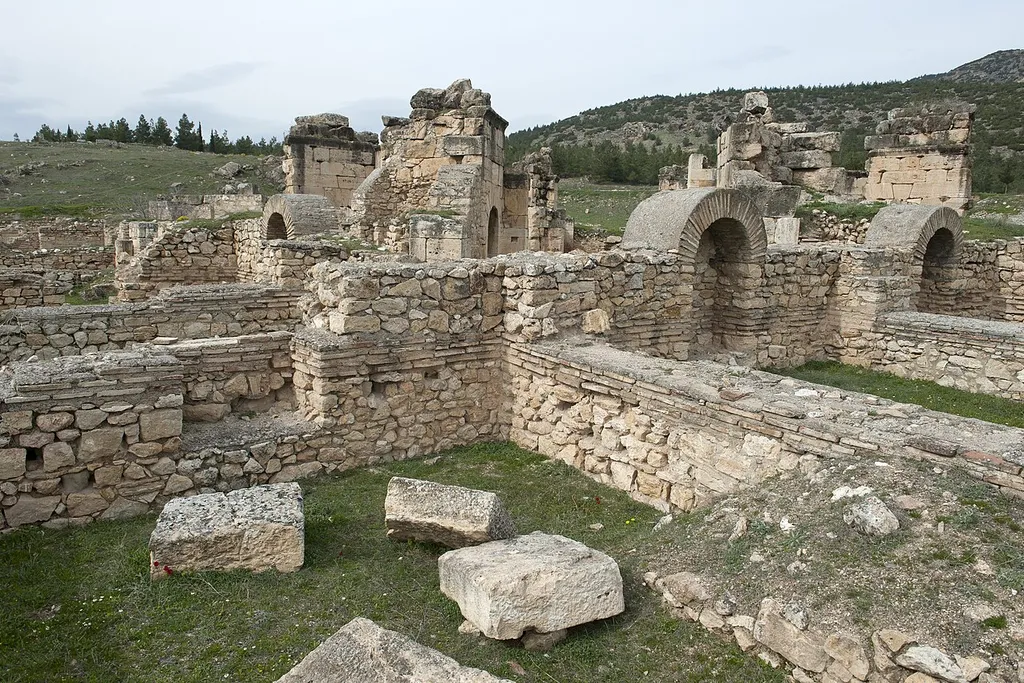
Outside the north-west wall, up a monumental stairway on the hill above the necropolis road, stands the building that made medieval Hierapolis famous. The Martyrium of St Philip was raised in the 5th century to commemorate the apostle Philip, martyred at Hierapolis in AD 80 by the tradition the city kept, and UNESCO singles out its design as remarkable — a central octagon from which chapels, polygonal halls and triangular rooms radiate, the whole ingenious geometry wrapped inside a square outer structure ringed with porticoed cells. In its day this was pilgrimage architecture of the first rank, built to move crowds of the faithful around a holy tomb in an orderly circuit, and it drew those crowds across the same plateau where pagan patients had once taken the waters. The spa had become a shrine without changing its essential trade, which was hope, administered on a hillside.
Today the Martyrium is a ruin of standing walls and foundations in open ground, and reaching it is the most skippable walk on the site — uphill, exposed, and at the far end of a long day. Make the climb anyway if your legs allow, for two reasons. The first is the building itself, whose octagonal plan still reads clearly from inside its walls and rewards anyone interested in how early Christian architecture solved the problem of a crowd around a tomb. The second is the view it was placed to command. From the shrine hill you look back across the whole of Hierapolis — theatre, streets, necropolis running north — and down to the white terraces and the plain beyond, the complete Pamukkale landscape in one frame. Most itineraries end at the theatre. The Martyrium is where the site explains its own geography, and it is usually quiet enough to hear the wind while it does so.
The Theatre and the Necropolis – Spectacle and the City of the Dead
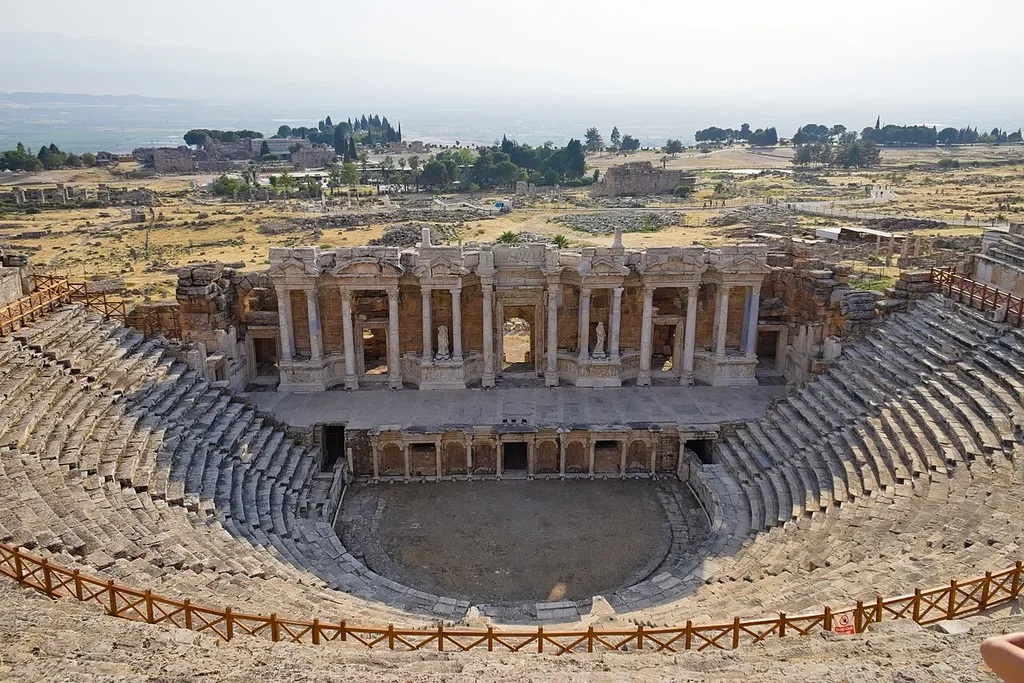
The theatre of Hierapolis is one of the best-preserved grand theatres of the Roman world, and it announces the city’s wealth more bluntly than any temple. Built into the slope above the centre in its surviving Severan-era form — raised in the great rebuilding culture that followed the earthquake of AD 60, on the site of an earlier theatre — it held the crowds of a prosperous provincial city in a semicircular bank of seats that still climbs the hillside in long, legible tiers. Its stage building has been substantially re-erected by anastylosis, the same put-the-fallen-stones-back method used at Ephesus, and UNESCO draws attention to its carved frieze, which depicts a ritual procession and a sacrifice to the Ephesian Artemis — a reminder that this city’s religious imagination ranged well beyond its own springs. The theatre is not a museum piece even now. Performances are still held in it, with audiences in the thousands, which makes it the one building at Hierapolis whose original function a modern visitor can simply watch happening.
Sit in the upper seats before you admire the stage. The view from the top rows is the city’s own prospect — the plateau falling away through streets and baths to the white cliff and the green plain, with the necropolis running north outside the walls — and it explains the theatre’s placement better than any panel. A Hierapolis audience watched the play with their whole world arranged behind it. Allow the building real time, too, because its detail is in the stage front and the seating inscriptions rather than in the panorama, and the groups that climb to the top row for a photograph and leave in five minutes have technically visited one of the great theatres of antiquity without seeing it. The theatre rewards the same slowness as the terraces, and for the same reason — it is a working piece of the same city, not a monument that happens to stand near one.
The Necropolis – Two Kilometres of Tombs
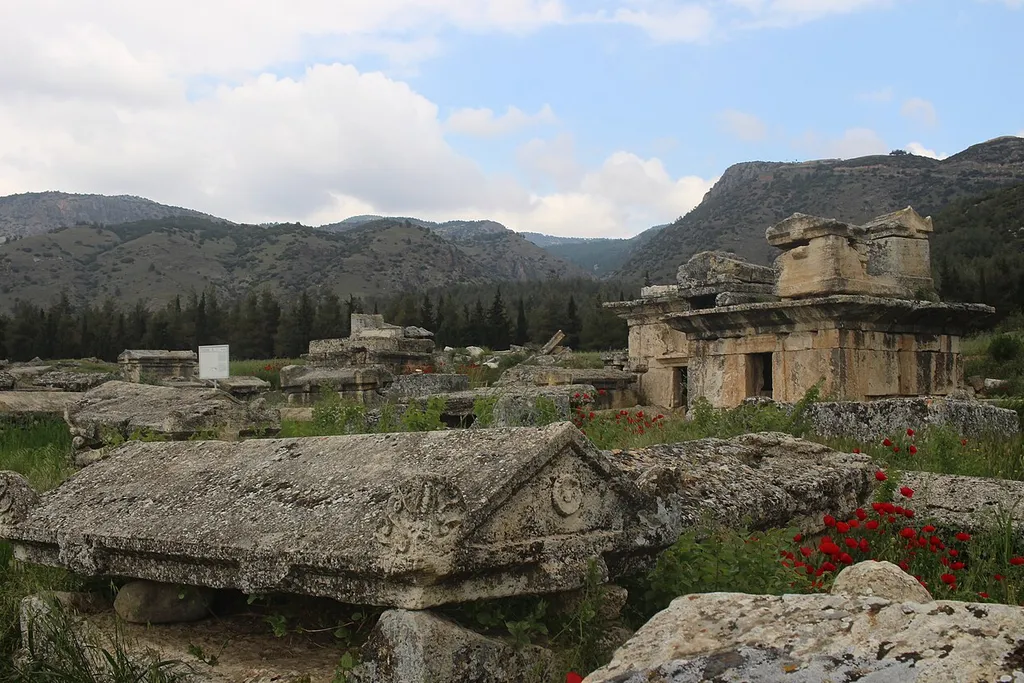
Every spa town has a shadow, and at Hierapolis the shadow is enormous. The necropolis extends over two kilometres outside the city walls, a vast spread of sarcophagi, tumuli and house-shaped tombs in every state of preservation from crisp carved marble to scattered drums, and UNESCO calls it what it is — one of the great panoramas of Greco-Roman funerary practice, and by most accounts among the largest ancient cemeteries in the world. Its scale is usually explained by the springs themselves. People travelled to Hierapolis from across the Roman east to take a cure that did not always work, and many of the healed city’s visitors stayed permanently, in the only accommodation the waters could not improve. That is interpretation rather than inscription, but the graves support it — this is a cosmopolitan dead, buried in the styles of a dozen home cities, along the roads out of a town whose fame was medical.
Walk at least part of it. The necropolis is where Hierapolis stops being picturesque and becomes moving, because a tomb is a biography in a way a bathhouse never is — names, trades, family griefs and hometown pride carved for strangers on a road. The northern stretch beyond the gate, where the grandest house tombs stand among the sarcophagi, gives the strongest sense of the cemetery as a second city mirroring the first, street by street. It is also, not incidentally, the quietest major sight on the plateau. The crowds cluster at the pools and the theatre, and the city of the dead keeps its two kilometres largely to itself and to the walkers who make the effort. On a hot day, do the necropolis in the cooler hours and keep the shaded museum and the pool for the middle of the visit — the dead, who have waited two thousand years, are patient about your scheduling.
The Antique Pool Honestly Explained
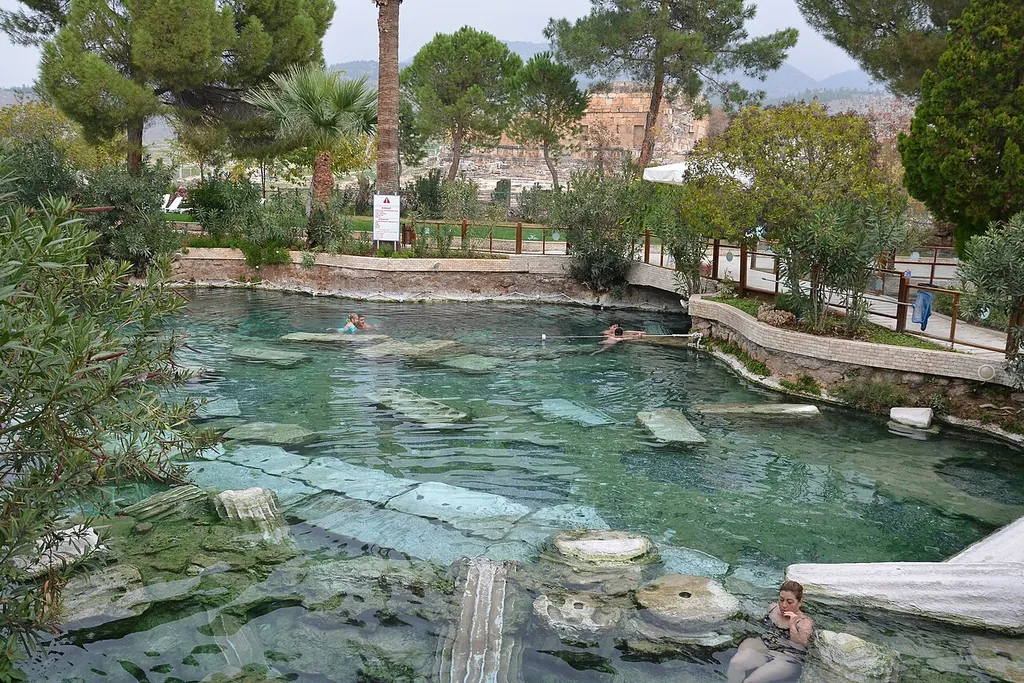
In the centre of Hierapolis, beside the museum, lies the one place at Pamukkale where swimming is not only allowed but is the entire point. The Antique Pool is a modern swimming facility set in an ancient hollow — a small lake formed, as UNESCO’s integrity assessment describes it, by earthquakes and thermal sources around the ancient civil agora, where visitors swim between ancient columns and marble architectural fragments lying in clear, warm spring water. The experience is genuinely singular. You float over a drowned chunk of the Roman city, among column drums that fell where an earthquake dropped them and stayed because the spring filled the hole faster than anyone could drain it. Facilities around the water are contemporary — this is a run, managed pool with its own entrance arrangements, not a ruin you wander into — and it sits inside the main site while standing apart from it, reached through the ruins but operated as its own attraction within them.
The honesty this section owes you concerns the name. The pool is marketed everywhere as Cleopatra’s Pool, usually with the story that Mark Antony gave it, or the springs, to Cleopatra as a gift. No ancient source places Cleopatra at Hierapolis, and the gift story appears in no classical text — it is a modern legend attached to a pool whose genuine history needs no royalty to sell it. Repeat it as a story told about the place if you like, but do not let an invented queen decide your afternoon, because the real decision is simpler and more personal. The Antique Pool is charged separately from site entry, as a distinct paid facility — the current figure, what it includes and how entry is arranged all change, and all belong on muze.gov.tr in the week you travel rather than in this article. What does not change is the trade itself. The pool costs the best sightseeing hours of a short visit if you let it, and it repays them with the most memorable swim most travellers ever take. With a full day at Pamukkale, take the swim. With half a day, the city and the terraces should win, and the pool will still be there, warm and full of columns, on the longer visit this place tends to produce.
One conservation note belongs here, because UNESCO states it plainly and visitors should know the terms of the pleasure. The same assessment that describes the swimming warns that the ancient marble in the pool suffers constant erosion and biological pollution from its thousands of swimmers, and that the authorities plan monitoring to manage it. Swimming among ruins is a privilege the site extends under pressure, and the ordinary courtesies — no soaps, no climbing on the submerged marble, nothing left behind — are not etiquette here but preservation. Enjoy the pool as a guest of the archaeology, because that is precisely what you are.
When to Come – Season and Light Logic
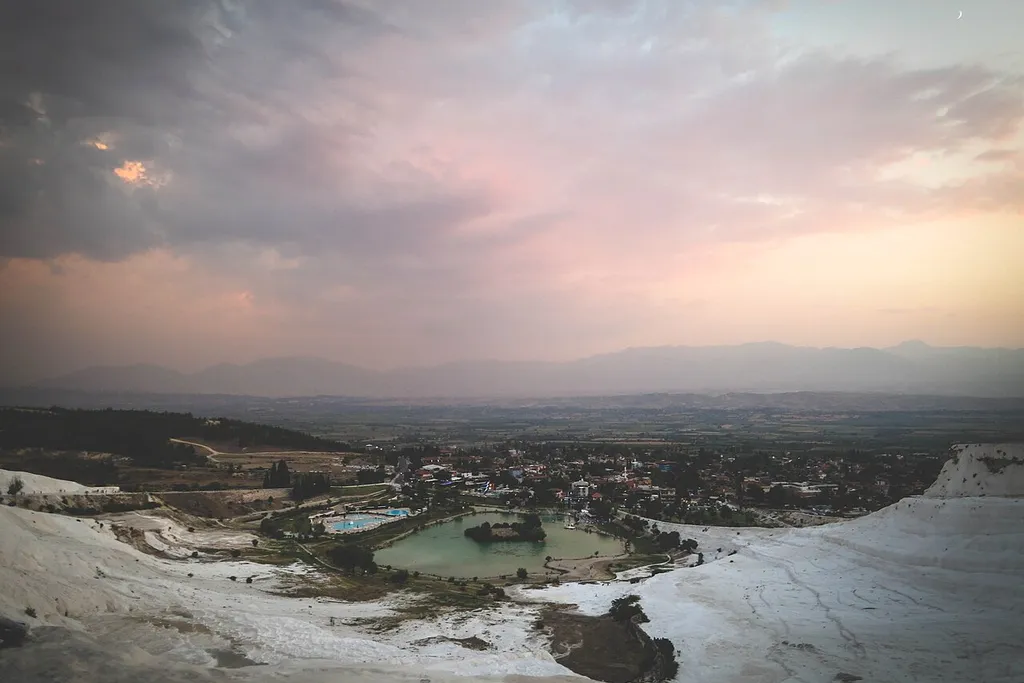
Pamukkale is a site where the clock matters as much as the calendar, because its subject is light on water and white stone. At midday in the warm half of the year the terraces are at their most famous and their least readable — the sun stands high, the white surface reflects it straight back, contrast collapses, and the basins photograph as a single glaring sheet while the visitor crossing them squints through the same white-out. The formations have modelling, ripple and depth, but flat overhead light erases all three. Early and late in the day the geometry returns. Low sun runs along the rims, each basin wall throws its small shadow, the water takes colour from the sky, and the whole cliff reads as the staircase it is. If your visit allows only one careful choice, make it this one — be on the terraces when the light is low, either climbing in the cool of the morning or crossing toward evening, and give the fierce middle hours to the plateau, the museum and the pool, where shade and water exist.
The seasons trade the same variables at larger scale. Spring and autumn offer the balanced version — walking weather on the exposed slope, water in the basins, and the necropolis and Martyrium comfortable at any hour. Summer brings the fullest, warmest site and the heaviest company, and it demands the early-or-late discipline above rather than merely suggesting it. Winter is the connoisseur’s version and the honest risk — the crowds thin to almost nothing, steam rises off the warm water into cold air in the mornings, and the white hill under a grey sky is a stranger, more beautiful sight than the postcard; against that stand short days, cold wind on wet bare feet, and the chance that weather closes over the view entirely. None of these seasons is the wrong one. They are four different sites wearing one name, and the choice between them is a choice about which Pamukkale you want — the social, swimming one of summer or the quiet, steaming one of winter.
What this section deliberately does not give you is times. Gate hours at Ministry sites change by season and by decision, tour marketing prints them as if they were geology, and an out-of-date hour in an article like this one can cost a traveller the best light of their visit. Check the current opening arrangements for the site on muze.gov.tr when you plan, and build your day backwards from the light rather than forwards from a printed timetable. The terraces keep their own schedule, written in sun angle, and it has not changed in two thousand years.
Where to Base Yourself – Pamukkale Village, Denizli or Karahayıt
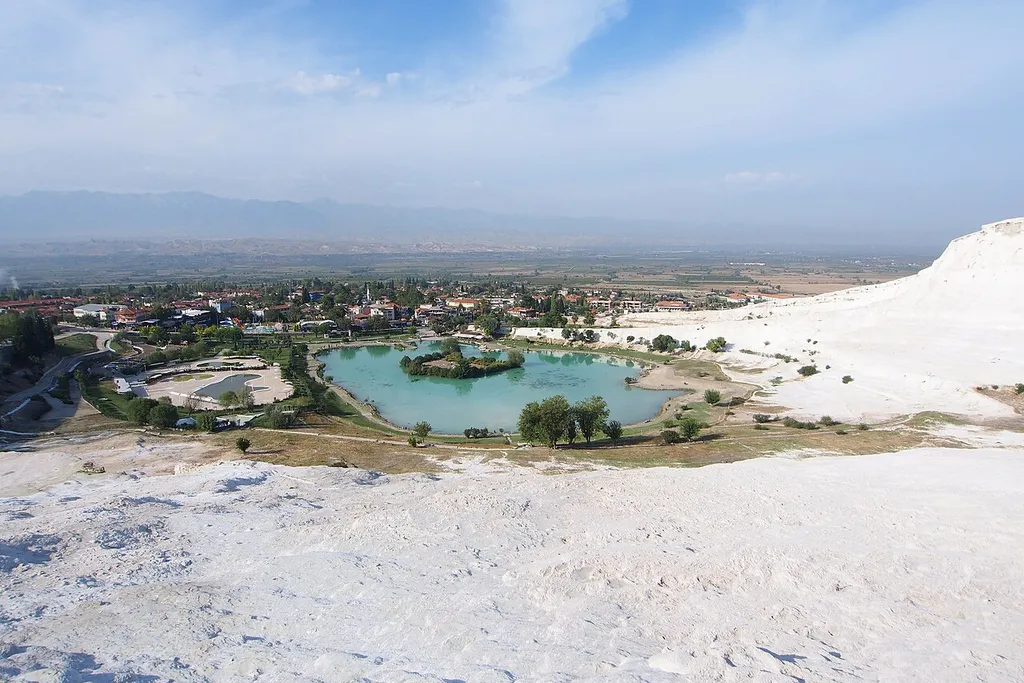
Three bases serve Pamukkale, and they serve three different trips. Pamukkale village itself, the small town at the foot of the cliff, is the base of proximity — a compact settlement of small hotels, pensions and restaurants arranged around the lake below the terraces, from which the lower entrance and the start of the barefoot climb are a short walk. Its virtues are time and evenings. Based in the village you can be on the white slope in the first light and still be there when the day crowds leave, and the sight of the illuminated terraces above the town is the village’s own nightly reward. Its limits are the limits of a small resort town — a short restaurant row, an early night, and little to do that is not the site. For a traveller whose purpose is Pamukkale itself, those limits barely register. The village is the correct default.
Denizli, the provincial city in the valley, is the base of the transport network and of ordinary urban life. It is a working textile city rather than a resort, with the region’s bus and rail connections, a full range of city hotels, and streets that feed locals first and visitors second — and from it, Pamukkale is an excursion up the hill rather than the ground you sleep on. Choose Denizli if you are passing through the region on a longer Turkish route and want one efficient base, if you arrive late and leave early on public transport, or if you prefer a real city’s evenings to a resort village’s quiet. Karahayıt, the third option, is the spa traveller’s base — a thermal resort village a short distance north of Pamukkale whose own springs run red, laying down rust-coloured travertines from iron-rich water where Pamukkale’s run white. Its hotels are built around their own hot pools, its pace is slow and largely domestic, and it suits a traveller who wants the region’s waters as a treatment as much as a sight, with Pamukkale itself as the great day out next door. White terraces for the eyes, red ones for the soak — the pairing is the region in miniature.
The Laodicea Extension – a Sister City in the Valley
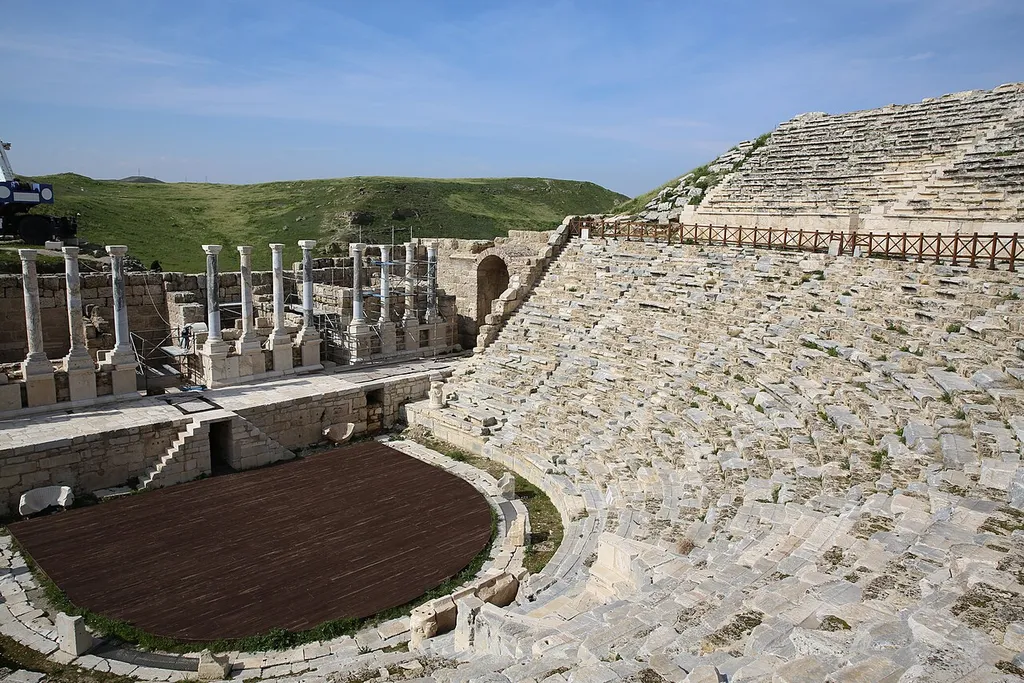
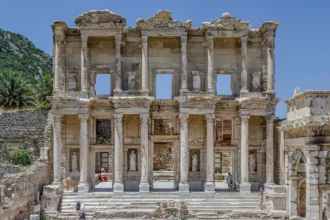
If Pamukkale gives you a second day, spend its spare half in the valley. Laodicea, the wealthy banking and textile city of the Lycus valley, stood a short drive from Hierapolis in antiquity and stands the same distance from Denizli now, excavated across a broad hill as one of the most active dig sites in Türkiye. Its remains run to colonnaded streets, temples, one of the largest stadia of the ancient world and a theatre whose stage building and seats have been substantially restored — the photograph above is not a minor ruin but a working piece of urban archaeology. The city also carries a name half the world has heard without knowing it was a place, as one of the Seven Churches addressed in the Book of Revelation, whose lukewarm verdict on Laodicea’s faith borrowed its sting from the city’s own tepid water supply. Few extensions anywhere repay a half day this efficiently — a second complete ancient city, a generation’s excavation in progress, and a fraction of Pamukkale’s company.
Sequence it honestly. Laodicea is a separate site with its own entry arrangements, administered within the same Ministry system — confirm them on muze.gov.tr rather than assuming any pass or ticket from Pamukkale carries over. It pairs naturally with a Denizli base, which sits between the two hills, or with a late start from Pamukkale village on a two-night stay. Because the excavation is active, parts of the field change between seasons — streets reopen, scaffolding moves, new sections of the city emerge from the soil — and a visit shows archaeology as a process rather than a finished product, which is its own distinct pleasure after the settled completeness of Hierapolis. What it should not do is cannibalise the main visit. Hierapolis and its terraces come first, whole and unhurried. Laodicea is the dividend a well-timed trip pays, not a rival for the same morning.
Frequently Asked Questions
Can I swim in the travertine pools?
No — the terraced pools on the white slope are protected formations, and UNESCO’s account of the site states that visitor access across the terraces is restricted to sustain the water flow and preserve the colour and structure of the travertine, with bathing confined to designated areas. The swimming at Pamukkale happens in the Antique Pool in Hierapolis, a separate paid facility described in its own section above. Walk the terraces barefoot, trail your feet where the route crosses shallow flow, and save the actual swim for the pool.
Why do I have to walk barefoot?
Because the surface you walk on is the exhibit. The travertine crust is soft, fresh mineral deposit, and shoe soles scuff, stain and break it faster than the springs can renew it. The barefoot rule on the established route exists to keep the white slope white, and it has the side effect of making the walk better — warm water, rippled stone and basin floors are all information your feet give you for free. Carry your shoes in a bag, and take the smooth patches slowly, because wet travertine is genuinely slippery.
Why are some of the terraces dry or grey?
Water management, not decay. The springs supply a limited flow, and the site routes it across different sections of the hillside in rotation so that each part takes its turn under the water that keeps it white and growing. Sections resting out of the flow weather to grey and cream and their basins stand empty. A partly dry hillside is what a conserved Pamukkale looks like, and the all-basins-full version in old posters shows more water on the slope than the springs now provide.
Did Cleopatra really swim in the Antique Pool?
There is no evidence that she did. No ancient source places Cleopatra at Hierapolis, and the story that Mark Antony gave her the pool or the springs appears in no classical text — it is a modern legend attached to a genuinely ancient swimming place. The pool itself needs no queen. It is a warm spring lake in the ruins of the Roman agora, filled with fallen columns, and that is remarkable enough on its own terms.
How long do I need at Pamukkale?
Half a day is the honest minimum for the terraces and the core of Hierapolis — the main street, the theatre and a look at the pools — and it will feel brisk. A full day is the right allowance for the complete site this guide describes, adding the necropolis, the Martyrium climb, the museum and either the Antique Pool or an unhurried second crossing of the terraces in better light. Two nights in the village adds Laodicea comfortably. The site punishes the two-hour visit more than most, because its best parts are its far parts.
Plan Your Next Step
Fix the shape of the day before its details. Base in Pamukkale village unless your trip gives you a real reason to choose Denizli or Karahayıt instead, be on the terraces in low light with your shoes in your bag, and climb the white slope as your entrance into the city rather than as a detour from it. Cross the plateau in the order the city reads — baths and main street, temple and Plutonium, theatre, then the necropolis running north and the Martyrium above it if your legs agree — and decide the Antique Pool by the time you honestly have, not by the legend on its sign. Check the moving parts on muze.gov.tr in the week you travel, and read UNESCO’s own account of why this ground matters at whc.unesco.org.
If Pamukkale is one stop on a longer Turkish route, our istanbul travel guide plans the city most travellers pair with the Aegean and Anatolian interior, and Laodicea waits in the valley if your stay runs to a second day. However you arrange it, keep the visit’s proportions honest — the terraces are the beginning of the story here, not the whole of it, and the city above them deserves at least half of whatever time you have brought. Pamukkale rewards the visitor who understands that the water built everything on this hillside — the terraces, the city, the cemetery and the legend alike — and who walks up the white hill slowly enough to watch it still working.