Albanian Riviera Travel Guide – Towns, Beaches and Bases Compared
The Albanian Riviera is not a resort strip. It is a single mountain road with a coastline attached: the SH8, which climbs out of Vlore, hauls itself over the Llogara Pass and then threads south along the Ionian Sea through a string of villages, bays and one real city, until it reaches Sarande and, just beyond, the little beach town of Ksamil and the ancient ruins of Butrint. North of the pass the sea is the Adriatic, broad and shallow. South of it, the water turns the deep, clear blue of the Ionian, the mountains come down almost to the shoreline, and every few kilometres the road rounds a headland and offers up another cove, another village, another argument for stopping. Travellers who understand that shape — one road, one mountain wall, a chain of very different places strung along it — plan the Riviera well. Travellers who treat it as a list of beaches to collect tend to spend their trip in the car, retracing the same bends.
The second thing to understand is that the places are not interchangeable. Vlore is a working city and a gateway. Dhermi is a hillside village with a long beach life below it. Himare is a small, settled town that keeps its local character even in season. Qeparo and Borsh are the quiet middle — olive groves, a vast open shore, very little noise. Sarande is the coast’s city in the south, with the transport links, the promenade and the day trips. Ksamil is a beach village built around a handful of small islands. Choosing between them is the real decision of a Riviera trip, and most of this guide is given over to making it honestly, town by town, rather than ranking beaches nobody can objectively rank.
This page stays on the coast. For the country the Riviera belongs to — the historic towns inland, the capital, the northern mountains and the routes that join them — our wider Albania travel guide carries the full picture. Here, the subject is one road and the places along it, taken in the order the road itself takes them: over the pass, and south.
At a Glance
Short on time? Here is the coast on one screen — each town and base, its character in a line, and the traveller it suits best. The pattern underneath the table matters more than any row in it: the Riviera divides into a livelier north end below the pass, a quiet middle, and a busier, better-connected south, and most trips work best by choosing one base in one of those thirds rather than sleeping somewhere new every night. Nothing in this guide prints a price, a driving time presented as a promise, or an opening hour — on a coast developing this quickly, treat any figure you find elsewhere as a claim to re-check on your own dates.
| Town or base | Character | Best for |
|---|---|---|
| Vlore | Gateway city where the Adriatic meets the Ionian, with a long seafront promenade | Arriving, departing, and a first or last night with city comforts |
| Dhermi | Stone village on the hill, long beach below, the Riviera’s social north end | Beach days with an evening scene, and the Gjipe cove country nearby |
| Himare | Small working town with its own bays, castle hill and local life | A settled middle base that reaches beaches in both directions |
| Qeparo and Borsh | Twin quiet villages, olive groves and the coast’s longest open beach | Slowing down — space, quiet and very little built up |
| Sarande | The south’s real city — promenade, port, transport and day trips | Travellers without a car, and anyone using the coast as a hub |
| Ksamil | Small beach town facing a cluster of little islands | Sea-first stays, and Butrint on the doorstep |
Two judgements sit behind that table. First, the base matters more than the beach: almost every named beach on this coast is somebody’s day trip, reachable from several bases, while the character of the place you sleep in decides your mornings, your evenings and your mood for the whole trip. Second, our round-up of the best places to visit in Albania budgets the Riviera as one stop among the country’s regions; this guide assumes the opposite trip — the coast itself as the destination — and gives it the space that assumption deserves.
The Road Itself – Llogara and the SH8
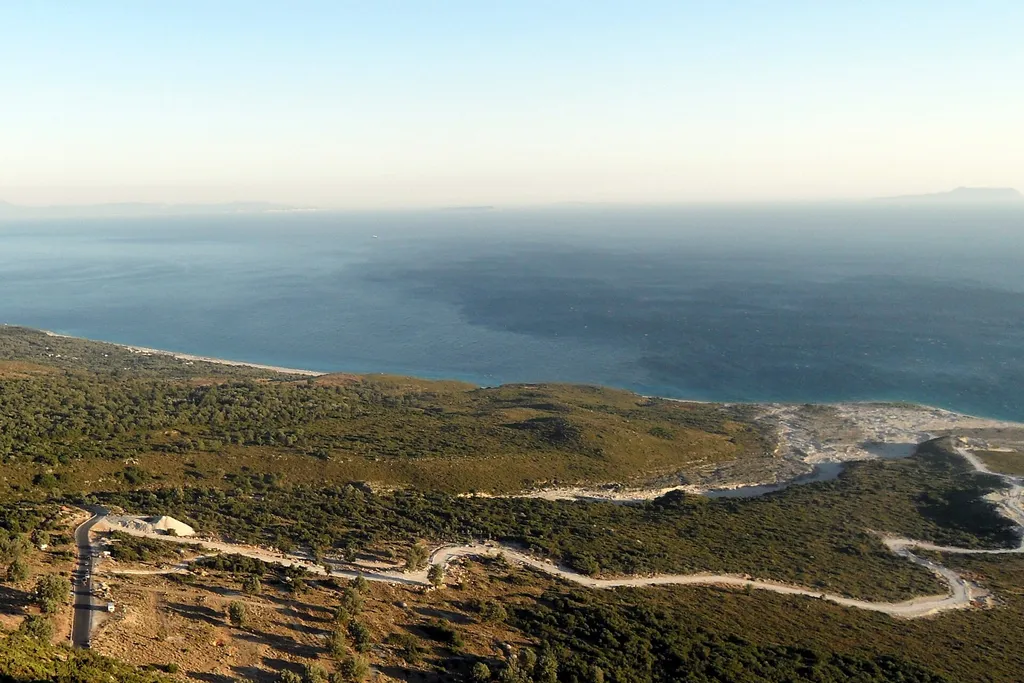
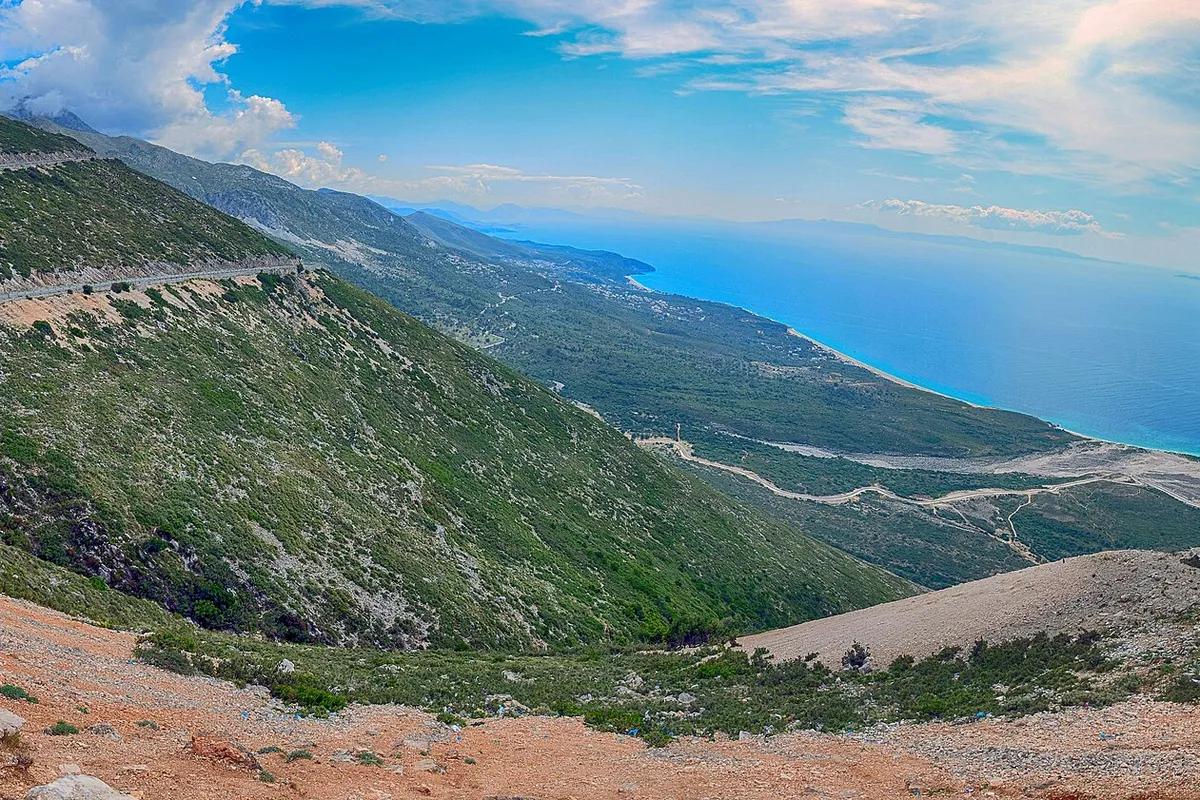
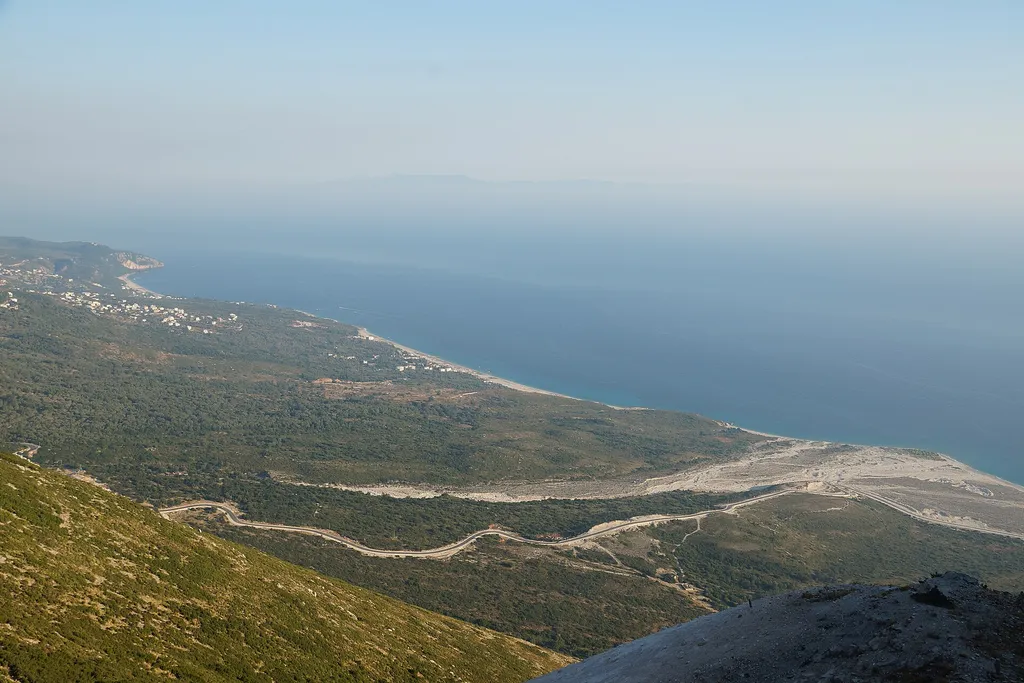
Most famous coasts are driven along a road that runs beside the sea. The Riviera’s road runs above it, cut into the flank of the Ceraunian mountains, and that single fact shapes everything. The Ceraunians are the wall that makes this coast what it is: a limestone range that rises straight out of the Ionian and runs the length of the Riviera, forcing the villages onto ledges and terraces between slope and shore, keeping the beaches in separate bays divided by headlands, and giving almost every viewpoint the same dramatic grammar — green and grey mountain above, impossible blue below. The road is not how you get to the Riviera. In large part, it is the Riviera, and the drives between places are not dead time between swims; they are some of the best hours of the trip.
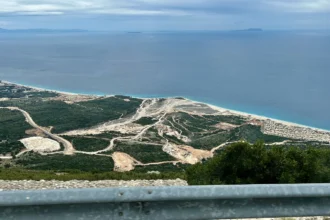
The set piece is the Llogara Pass, where the SH8 climbs out of the Vlore side through the pines of Llogara National Park and crosses the shoulder of the mountains before dropping, in a long series of bends, to Palasa and the first Ionian bays. The national park protects the high ground around the pass — pine and fir forest, cooler air, and a famous wind that has made the area known to paragliders, who launch from the slopes near the pass and land on the beach far below. Even if you never leave the car park, stop at the pass. The view south from the top — the coast unrolling bay by bay towards Greece, the island of Corfu standing off the southern shore — is the single best orientation a Riviera trip offers: the whole geography of the week ahead, laid out in one look.
South of the pass, the SH8 settles into its rhythm: climb around a headland, drop to a village, cross the back of a bay, climb again. It is a good road by mountain standards, but it is a mountain road, and it asks for the respect mountain roads ask for everywhere — daylight driving where you can, patience behind the slow vehicle on the climb, and no timetable built on motorway assumptions. Travellers with a car get the coast at its best, stopping where the road allows and the view insists. Travellers without one are not excluded — buses and the shared minibuses Albanians call furgons run the road between the main towns — but they should plan around the towns rather than the coves, which is one of the honest reasons Sarande and Himare feature so strongly in the base choices below.
Vlore the Gateway
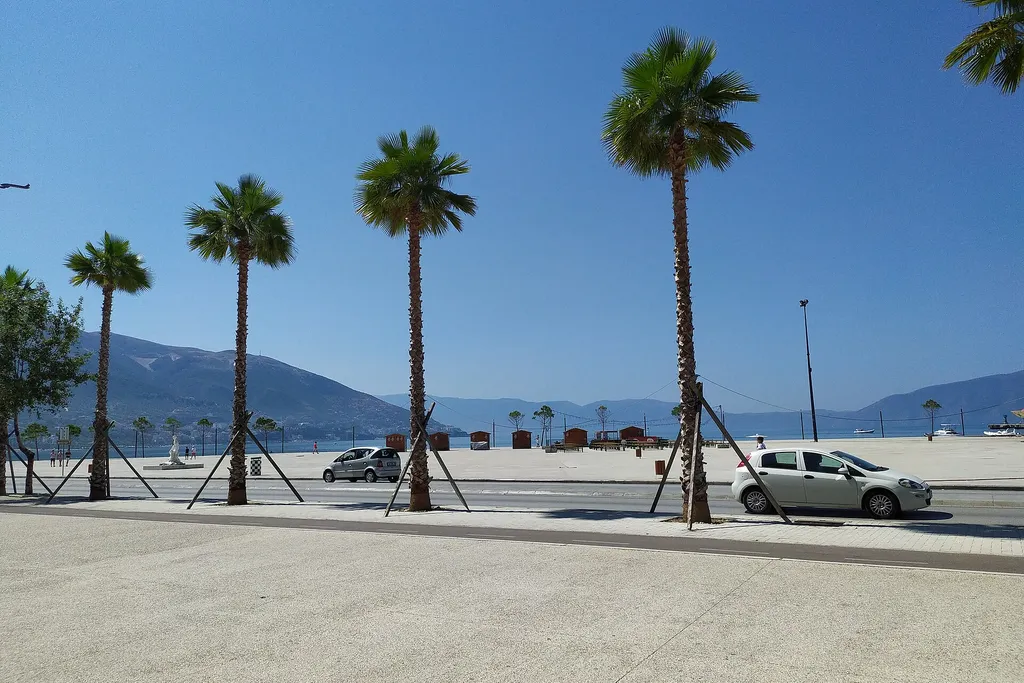
Vlore is where the Riviera begins and where most Riviera trips begin, and it is worth being precise about what it is. This is a real Albanian city — a port, a place of work and ordinary life, with a history that matters to the whole country: it was here that Albanian independence was declared in 1912, and the city carries that role in its monuments and its main square. Its seafront, the Lungomare, is a long modern promenade of palms and cafes looking south along the bay, and standing on it you are standing on a genuine geographic seam: the Adriatic ends and the Ionian begins around the Karaburun peninsula that closes the bay to the south-west, a wild, largely undeveloped headland protected, with the island of Sazan offshore, as a marine park.
What Vlore is not is a Riviera beach town in the Dhermi or Ksamil sense, and travellers who arrive expecting the postcard cove are sometimes disappointed by its city beaches and its scale. Judge it instead as a gateway and a bookend. It is the easiest place on the coast to arrive in and leave from, the natural last stop before the road or the highway back towards Tirana, and a good place to do the unglamorous things trips run on — stock up, sort out onward travel, eat well in a city that cooks for itself rather than for visitors. A night here at the start or the end of a Riviera trip costs the coast nothing and buys the journey a calm edge.
Vlore also offers the one Riviera excursion that points north rather than south: the lagoon and monastery country around Narta and Zvernec, just above the city, where a small island monastery stands among pines at the end of a wooden walkway over the lagoon. It is a half-day of a completely different temper — flat, quiet, bird-haunted water rather than mountain coast — and it makes a gentle first morning for travellers who land in Vlore with a day in hand before driving over the pass. Then the road south calls, and the Riviera proper begins with the climb to Llogara.
Dhermi and the Middle Coast
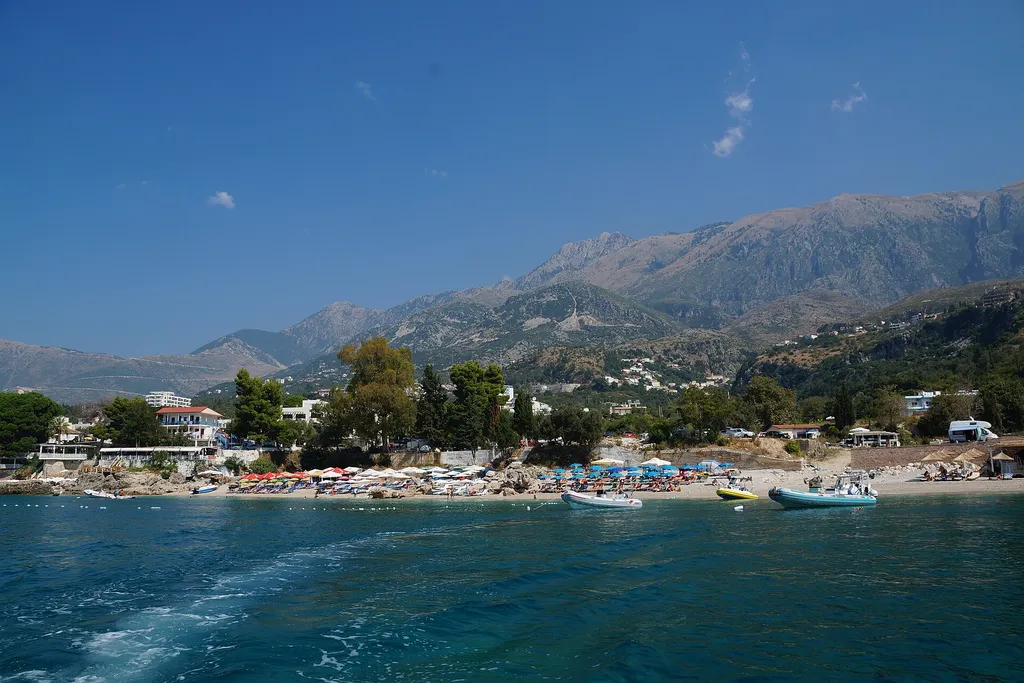
The first village below the pass is Palasa, where the road’s descent ends at a long, pale bay, and just beyond it the Riviera arrives at its best-known name: Dhermi. Dhermi is really two places sharing a name. Up on the hillside, where Albanians built when the sea was a danger rather than an attraction, sits the old village — stone houses, narrow lanes, churches, and views that explain every postcard. Below it, strung along the shore, is the beach Dhermi of the brochures: a long curve of pale shingle and clear water, with the neighbouring beach of Drymades continuing the same bay’s sweep around the headland. In high season this is the Riviera’s social end — the busiest stretch of sand, the liveliest evenings, the youngest crowd. In the shoulders of the season it relaxes into something gentler, and the walk between the village above and the beach below becomes one of the coast’s small pleasures.
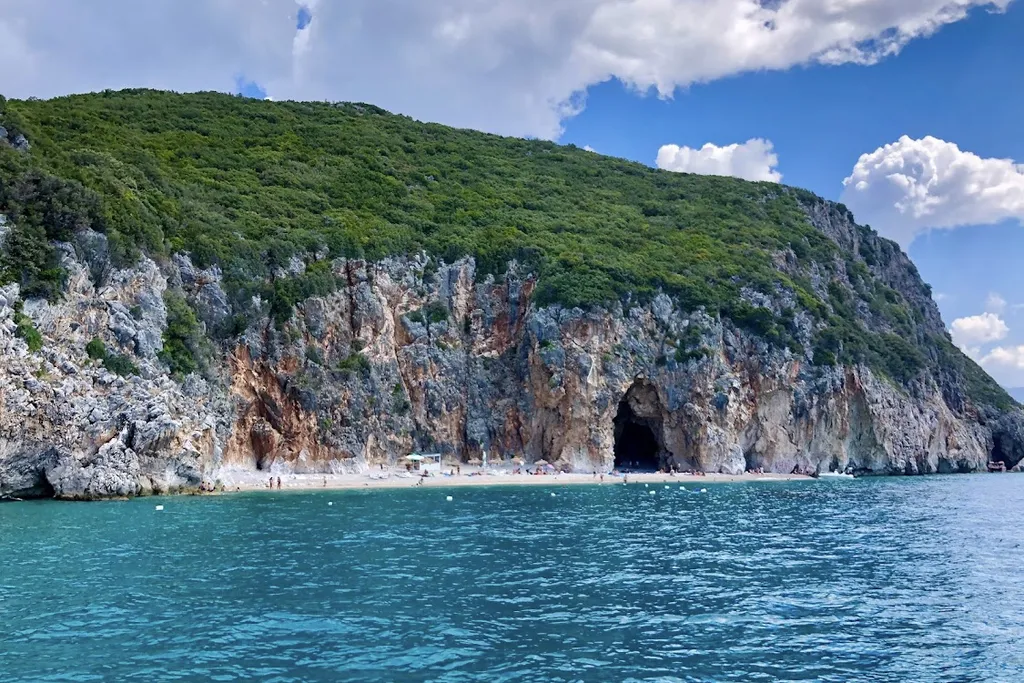
Dhermi’s coastline also holds the middle Riviera’s most celebrated cove: Gjipe, a beach set where a canyon reaches the sea, backed by cliffs and reached on foot along a path, or by boat — there is no road down to it, which is precisely why it has kept its character while easier beaches have filled. Treat Gjipe the way the coast intends it: as a walk with a swim at the end, planned with water, shade and the climb back in mind, not as a beach to drive to. The same stretch of coast hides smaller coves between the headlands, some signed, some found by asking, and part of a Dhermi stay is the gentle sport of finding the bay that the day-trippers have not.
As a base, Dhermi suits travellers whose trip is sea-first and social: stay up in the village for quiet and views, or down by the beach for the season’s full hum, and accept the trade that defines the place — in July and August you are sharing it, and in the peak weeks the sharing is the atmosphere as much as it is the cost. Travellers who want the middle coast without the hum should keep driving: the road south from Dhermi passes Jale, a smaller bay with its own loyal following, and arrives at a town of a different temper entirely.
Himare and the Quiet Villages – Qeparo and Borsh
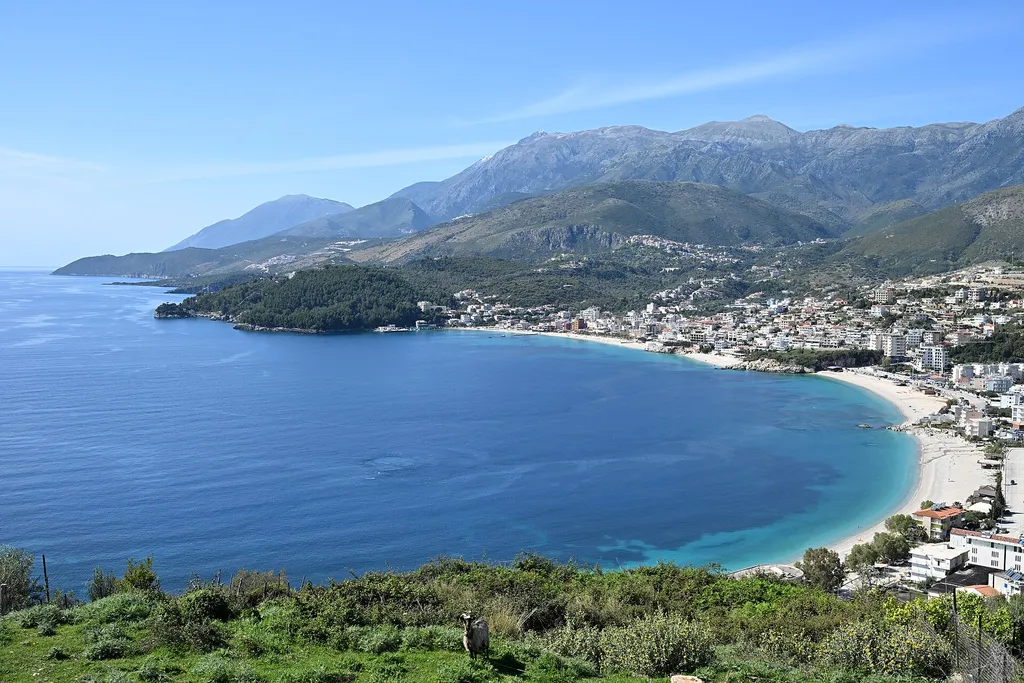
Himare is the Riviera’s middle in every sense — geographically near the centre of the coast, and in character the balance point between the beach scene of the north and the city energy of the south. It is a small town that was a town before it was a destination: a seafront where local life and holiday life share the same promenade, a spread of bays within walking distance of the centre, and above it all the old town on its hill, where a castle with ancient origins looks down over the bays and the road in both directions. Himare also has a character none of its neighbours share in the same measure: it is the centre of Albania’s Greek-speaking minority, bilingual in its signs and its conversations, and that gives its cafes, churches and festivals a flavour that belongs to this stretch of coast specifically. As a base it is the guide’s quiet recommendation for many travellers: settled enough for a week, local enough to feel lived-in, and positioned to day-trip both ways.
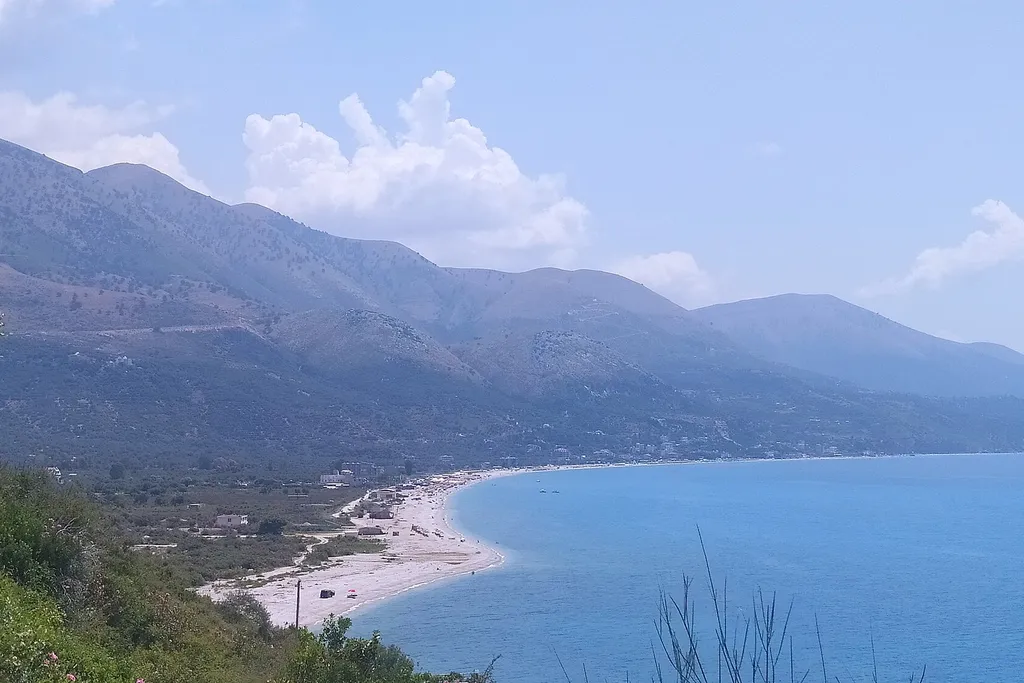
South of Himare, the coast softens into its quietest third. The road passes Porto Palermo, a small, almost landlocked bay watched over by a triangular fortress on its peninsula, attributed to the era of Ali Pasha — the kind of stop that takes an hour and stays in the memory out of proportion to its size. Then comes Qeparo, a village in two halves like Dhermi but smaller and sleepier: an old stone village up on the hillside, largely emptied as life moved down, and a low-key beach settlement below among the olive groves. And beyond Qeparo the coast opens into Borsh, where the pattern of cove after cove finally breaks: Borsh beach runs long and open under the mountains, backed by one of the great olive landscapes of the south and a village of the same name, with a ruined castle on the hill above it. There is room at Borsh in a way there is not at Ksamil or Dhermi in season, and room is the luxury this part of the coast sells.
Base yourself in this middle-south stretch and the Riviera changes key. Evenings are village evenings. Beaches are reached in minutes and shared with dozens rather than hundreds. The day trips run to Himare’s bays in one direction and towards Sarande in the other, and the middle coast’s own pleasures — a long shore, old villages in the hills, a fortress on a point — are the ones that need no driving at all. What you give up is choice after dark and ease of transport: this is car country, and dinner options are counted in handfuls. For the right traveller, that is not a compromise. It is the entire point.
Sarande the Working Base
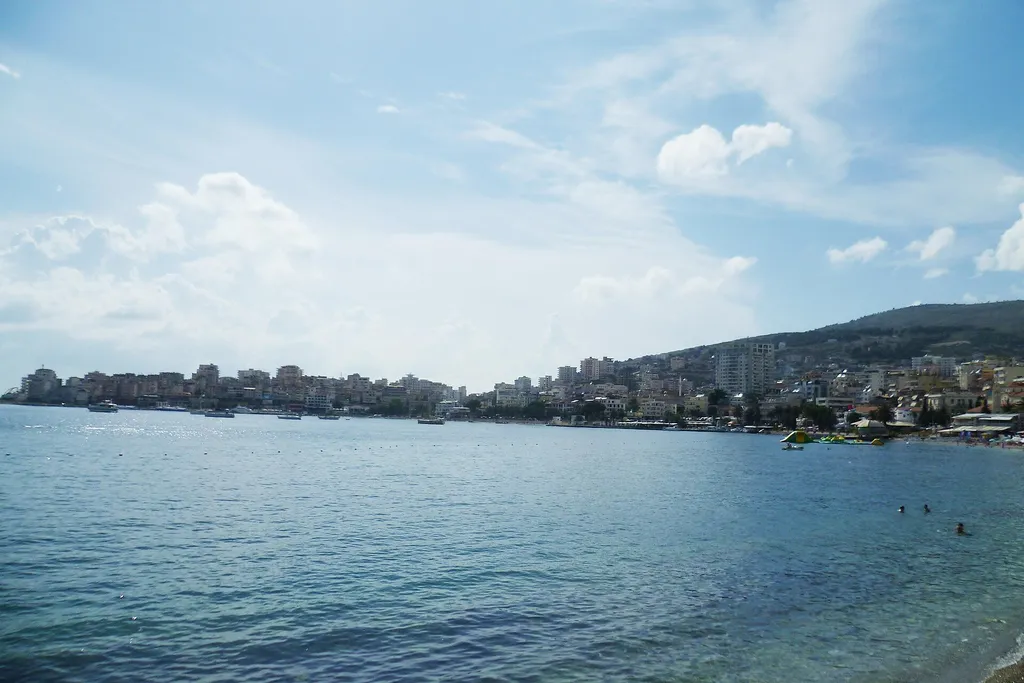
Sarande announces the end of the village coast. The road comes down from the hills and the bays give way to a city wrapped around a broad bay: apartment blocks and hotels climbing the slope in tiers, a promenade along the water, a port with boats coming and going, and across the strait the unmistakable shape of Corfu, close enough to feel like a neighbour — which, by ferry, it is. Sarande is the largest place on the Riviera by a wide margin, and it does not pretend otherwise. Its own beaches are city beaches, convenient strips along the bay rather than the coast’s best swimming, and travellers who come to Sarande expecting a village tend to mark it down for failing a test it never sat. Judge it as what it is — the south’s working base — and it is very good at its job.
That job, spelled out, is logistics and range. Sarande is where the transport is: the port, the buses, the taxis, the travel agencies, the full spread of places to eat at every hour a traveller might want one. It is the natural base for anyone travelling without a car, because from Sarande the south organises itself — Ksamil and Butrint are a short journey south, the Blue Eye spring is inland on a main road, and the middle coast’s towns are reachable back up the SH8. It is also the base with the widest choice of places to stay at every level, in every month the coast is open, including the quiet ends of the season when smaller villages have largely closed their doors. A stay in Sarande trades scenery outside the window for capability outside the door, and for many trips — short ones, car-free ones, off-season ones — that is the right trade.
The city rewards a little curiosity beyond the promenade, too. In its centre stand the remains of an ancient synagogue complex, a reminder that this bay has been a meeting place of cultures far longer than it has been a resort, and on the hill above the town the ruined castle of Lekuresi looks down over the bay, the strait and the plain towards Butrint — the best single viewpoint in the south, and the place to come at the end of the day when the light does the work. Eat on the promenade at least once, not because it is the city’s best cooking but because the evening walk along the water, with the whole town out doing the same, is Sarande’s real daily ceremony.
Ksamil and Butrint
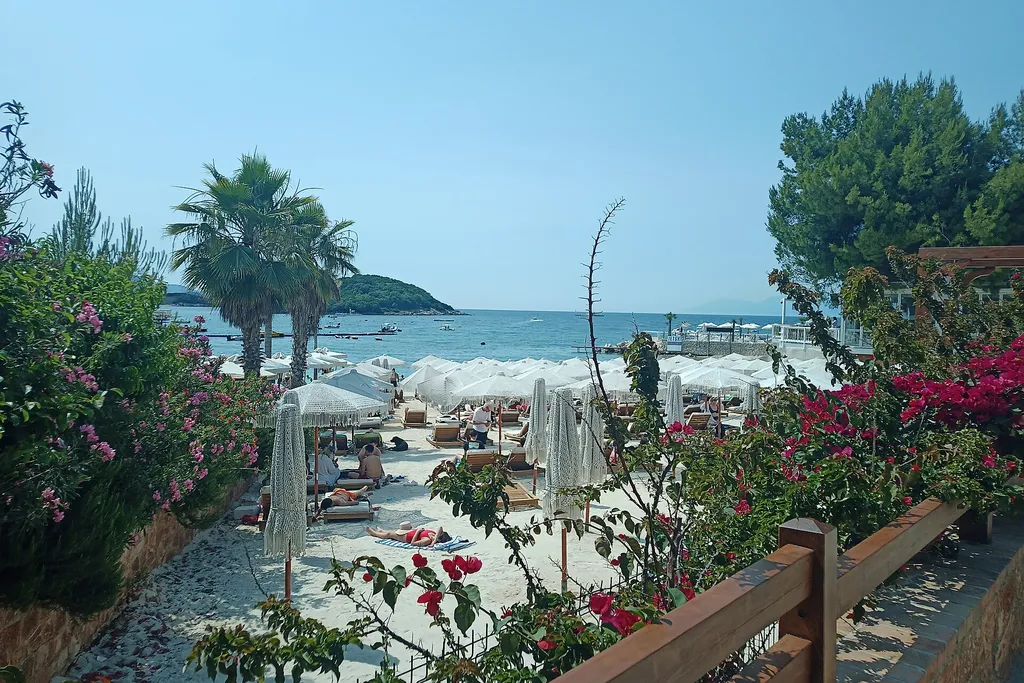
South of Sarande the road flattens, the mountains step back, and the Riviera ends in a different landscape: low, green and lagoon-edged, where the sea shallows into the pale turquoise that fills the postcards. This is Ksamil, a small town built facing a cluster of little wooded islands, close enough to swim or take a small boat to, in water so clear and calm on a still day that it explains every superlative the marketing reaches for. The honest sentence about Ksamil has two halves and both matter. On a quiet morning, in June or September or at the start of a day before the beach fills, it is as beautiful as any small coast in Europe. And in the peak weeks of summer it is the busiest place on the Albanian coast, its small bays crowded well beyond their size, and travellers who arrive then expecting the empty postcard will feel misled — not by the place, but by the season. Ksamil is a when as much as a where.
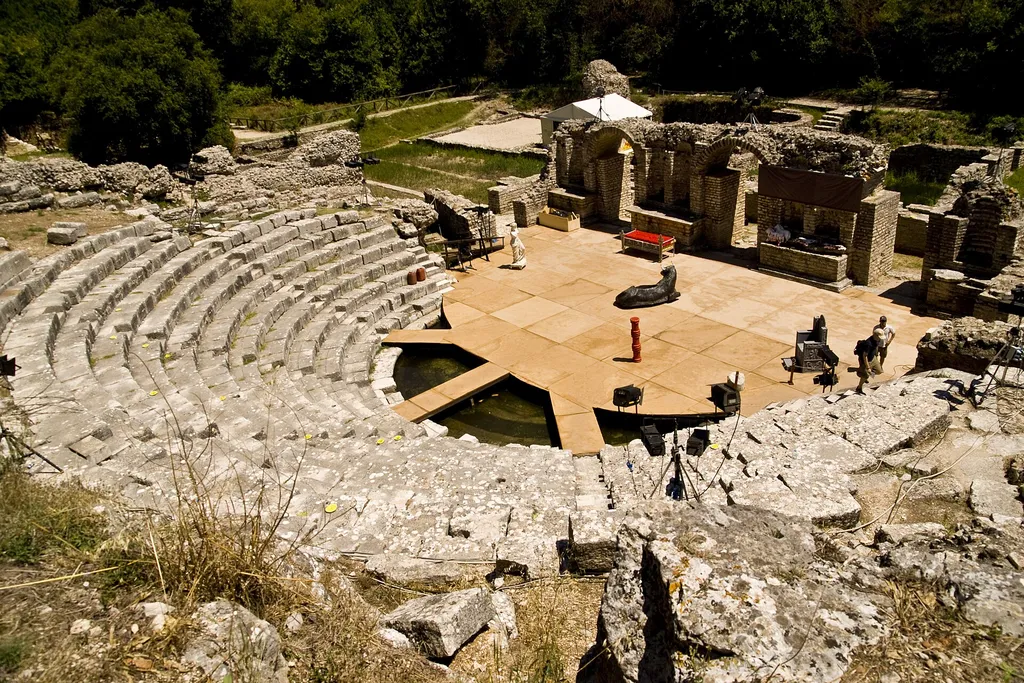
Ksamil also has the Riviera’s one essential sight that is not a beach at all, a short distance south at the end of the road: Butrint, an ancient city in a wooded park on a lagoon channel, protected as a UNESCO World Heritage site and a national park together. Butrint was Greek, Roman, Byzantine, Venetian and Ottoman by turns, and its ruins — a theatre, a baptistery with a mosaic floor, city walls, a Venetian castle — stand among trees and water in a way that makes the archaeology feel discovered rather than displayed. It deserves half a day taken slowly, ideally early or late when the light and the quiet suit it, and it changes a beach trip’s balance for the better: the Riviera’s south end is not just sand, it is one of the great ancient sites of the Mediterranean, sitting at the end of a coast road.
Stay in Ksamil if the sea is the trip — if your plan is mornings in the water, lunch within sight of it, and the islands as your daily geography — and take Sarande as your service town and Butrint as your one great excursion. Stay in Sarande instead if you want the same days with a city around them. Either way, do not leave this end of the coast unvisited because the road ran out: the journey south from Himare, through the quiet villages and down into this green, shallow, ancient landscape, is the Riviera completing its argument.
Choosing Your Base Honestly
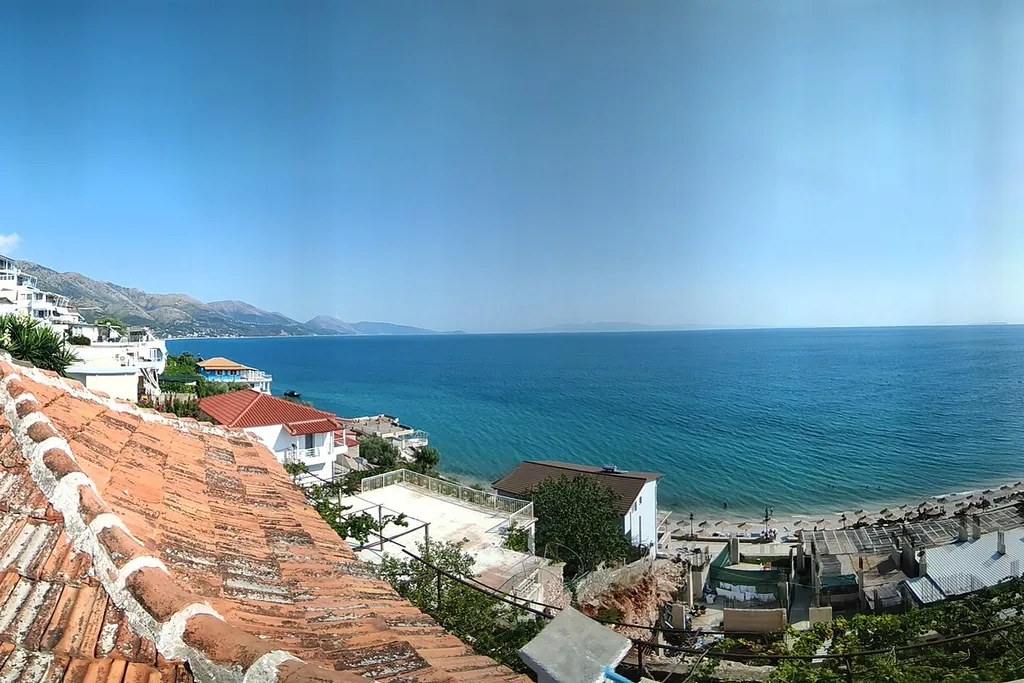
Everything in this guide converges on one decision, so here it is argued by traveller rather than by town. Beach-first travellers who want the sea to organise the day should look at Dhermi and Ksamil — the two places where the swimming is the headline — and choose between them by temperament: Dhermi for the long bay, the village on the hill and the social season; Ksamil for the islands and the shallows, taken in the shoulder months if at all possible. Slow travellers — readers, walkers, people whose holiday speeds are measured in long lunches — belong in the middle: a village base around Qeparo or Borsh, or settled Himare, with the car doing day trips and the evenings left deliberately empty. The coast rewards this style more than any other, because its best asset is not any single sight but the accumulation of unhurried days on the same beautiful road.
Travellers without a car should be the most decisive of all: base in Sarande, where the transport, the tours and the services are, and treat the middle coast as excursions rather than as a base — a village stay without a car on this coast means negotiating every beach, meal and departure around thin local transport, and it wears a holiday down. Himare is the one workable car-free alternative, small enough to live in on foot with its own bays around it. Families generally do best where the water is gentle and the logistics are simple: Ksamil’s shallow bays in the quieter weeks, Borsh’s long open shore where there is space for everyone, or Himare, where the town’s ordinary life — shops, bakeries, a promenade — supports a family week without everything depending on the beach. Travellers mixing coast and culture should split the trip: a middle-coast base for the sea days, then Sarande for Butrint and the south, with the historic towns of the interior added from our Albania travel guide rather than squeezed into day trips from the beach.
Two practical judgements close the argument. First, one base is usually better than two, and two is almost always better than three: the SH8 is beautiful and slow in equal measure, and every change of base costs half a day of it in packing, driving and settling, which on a week’s trip is a real tax. The exception is the long trip — ten days or more can honestly hold a north and a south base, Dhermi or Himare first, then Sarande or Ksamil, and that split is the coast’s best shape at that length. Second, book the character, not the photograph: every town on this coast can produce one perfect image, but you are sleeping in a place, not a picture, and the sections above describe places. Choose the evenings you want, and the beaches will follow.
When to Come
The Riviera’s season has a clear shape, and being honest about it is most of what good timing advice amounts to. High summer — July and August — is the peak in every sense: the warmest sea, the longest days, every beach business open and every town at full stretch, and with it the coast at its busiest and most expensive, the road at its slowest, and the famous small bays at their most crowded. Travellers whose holidays are fixed to those months should not be put off — the coast is alive, the water is glorious, and the crowds concentrate in a few famous places while the long shores at Borsh and the smaller coves stay workable — but they should book early, base carefully, and swim early in the day. What high summer cannot offer is the empty-coast version, and no honest guide should let a July traveller expect it.
The shoulder months are the Riviera at its best for most travellers. Late spring — May and June — brings a green coast, wildflowers on the Ceraunian slopes, warm days and a sea that freshens rather than bathes at the start of the period and warms properly as June goes on; some beach businesses open as the season builds rather than all at once. September and the start of October answer from the other side: the sea at its warmest after the summer, the light softening, the crowds gone home, and the villages returning to themselves — with the honest caveat that services thin as the season winds down and the weather grows less settled towards October’s end. Winter is a different coast entirely: many seasonal businesses close, the sea is for looking at, and the Riviera becomes a quiet, local place of green hills and empty roads — not a beach holiday, and not sold as one here, though travellers who come for the landscape, the walking and Butrint in solitude will find it has a case.
One variable deserves its own sentence, because it cuts across every month: the sea itself. The Ionian here is generally clear and calm in the mornings in season, with afternoons sometimes bringing a breeze that roughens the surface and sends the small boats home — the local rhythm of swimming early and lunching long is not a habit, it is an adaptation. After heavy rain, the mountain coves can run cloudy for a day where streams reach the sea. None of this needs a forecast table; it needs the traveller’s oldest skill, which is to arrive, look at the water, and plan the day around what it is actually doing.
Frequently Asked Questions
Five questions decide most Riviera trips, and they are answered here the way the sections above argue them — briefly, and by character rather than by timetable. The thread running through all five is that this coast is one road with a chain of different places on it: almost every problem travellers have here comes from choosing the wrong place for their trip, or the wrong month for the place, and both are fixable before booking rather than after arrival.
How many days do I need for the Albanian Riviera? Three days is the honest minimum for the coast alone: one for the pass and the north around Dhermi, one for the middle around Himare and the quiet villages, one for Sarande, Ksamil and Butrint. Five days lets the trip breathe, with beach days that are not also driving days. A week is the comfortable version and the one this guide quietly assumes — one base, day trips in both directions, and no day spent entirely in the car.
Do I need a car? Need is too strong; benefit from enormously, yes. The Riviera is one road with its best places spread along it, and a car turns that into freedom — the cove stops, the viewpoint pauses, the village of your choosing. Without one, the trip still works from Sarande or Himare using buses, furgons, taxis and boats, but it works as a base-centred holiday rather than a coast-wide one. Choose the base first and the transport answer follows from it, not the other way round.
Which is better, Ksamil or Sarande? They do different jobs. Ksamil is the better beach stay — small, sea-facing, built around its islands and shallows — and the worse place to be based without a car or in the peak weeks, when its size works against it. Sarande is the better base — transport, services, range, Butrint and Ksamil both close — and the less lovely place to swim. Sea-first, choose Ksamil and time it kindly. Trip-first, choose Sarande and visit Ksamil from it.
When should I avoid the Riviera? Avoid expecting a beach holiday outside the season: from late autumn to early spring the seasonal coast largely closes and the sea is cold, whatever a sunny photograph suggests. Within the season, the weeks to approach with open eyes are the peak of July and August at the famous small places — Ksamil above all — where crowding is a fact rather than a risk. Everywhere else, and in the shoulder months almost everywhere, the coast delivers what it promises.
Is the Riviera just beaches? No, and the travellers who treat it that way miss its depth. The road itself over Llogara is one of the great drives of the Balkans. Butrint at its south end is a UNESCO-listed ancient city of real importance. The old villages above the beaches, Himare’s castle hill, Porto Palermo’s fortress and the Greek-speaking culture of the middle coast give the strip a history most resort coasts cannot match. A Riviera trip with one ancient site, one hill village and one mountain pass in it is a fuller trip than a week of sand — and it is all within the same road.
The Short Version
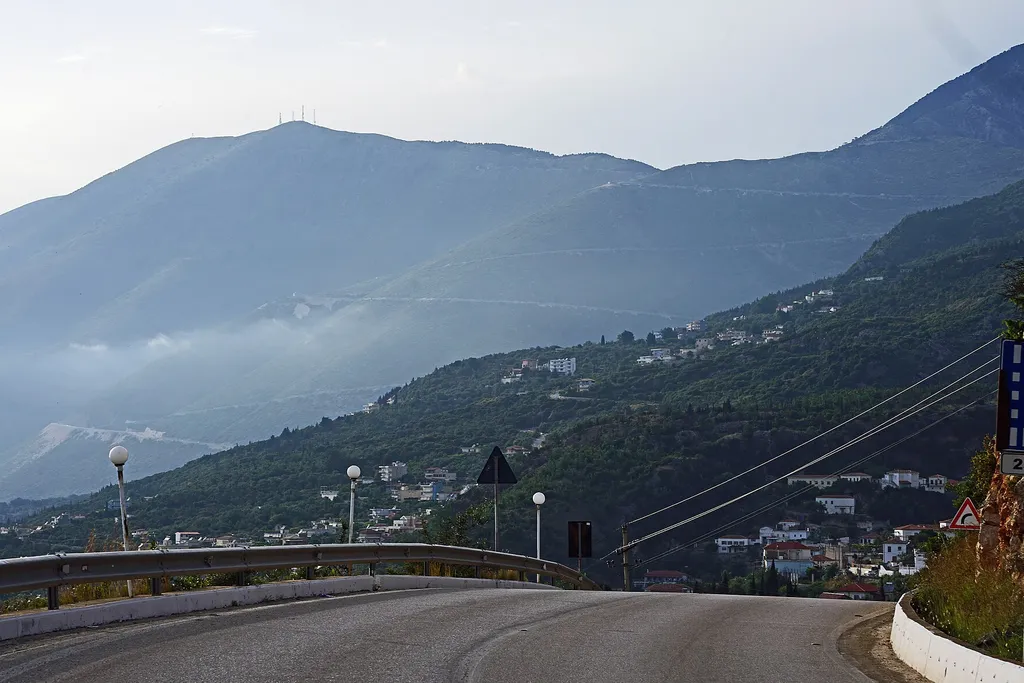
Drive the road, and let the road organise the trip. Come over the Llogara Pass slowly and stop at the top, where the whole coast explains itself in one view. Choose one base by character — Dhermi for the social north, Himare for the settled middle, Qeparo or Borsh for the quiet, Sarande for the working south, Ksamil for the sea taken at the right season — and day-trip the rest rather than sleeping everywhere. Swim in the mornings, walk up to one old village in the cool of the day, and give half a day to Butrint, the ancient city waiting at the end of the road. Time it for the shoulders if you can; if you cannot, come in the peak with your eyes open and your base chosen well, and the coast will still do its work.
What to leave behind is the beach-list habit. The Riviera is not a set of bays to be collected and compared; it is a single mountain coast of distinct places, and its pleasures are cumulative — the same road at different hours, the same sea from different villages, evenings that belong to the town you chose. Our round-up of the best places to visit in Albania puts this coast in the country’s wider picture; this guide’s closing advice is simpler. Pick the place that matches the trip you actually want, stay long enough for it to stop being a stop, and let the SH8 do what it has always done — carry you slowly along one of the Mediterranean’s last great coastal roads.