
Top Places to Visit in Mersin: Castles and Ancient Sites
The best places to visit in Mersin repay a journey taken in order, from east to west, because this is a coastline where geography explains history at almost every stop. Begin at Tarsus, the ancient inland town where a river, a road and a mountain pass meet, then move to the Roman port of Soli Pompeiopolis, the island castle at Kızkalesi, the sinkhole shrines of Narlıkuyu, the hilltop temples of Uzuncaburç, the castle town of Silifke, and finally the great seaside fortress of Mamure Castle at Anamur. Follow this route along the D-400 coastal highway and each place makes the next one clearer: a Roman road leads to a Roman harbour, a Byzantine island castle echoes a later Seljuk seaside fortress, and a mountain monastery explains why so many of these sites sit exactly where river, road and sea meet. The Taurus Mountains rise almost directly behind the shore along much of this coast, so settlement was always squeezed into a narrow strip, and control of a harbour, a river mouth or a pass mattered far more than control of empty land. That is why castles recur here, why ports were refounded after sack and earthquake, and why a traveller who drives the road in sequence will understand Mersin far better than a traveller who visits one famous castle in isolation. This guide therefore gives the history of each place, what survives today, and the order to see them in, so that the journey itself becomes the explanation.
This is deliberately a places guide, not a general activities guide, and that distinction matters for planning. Each section below treats its place in its own right: its foundation and rebuilding, its significance, what you can actually see on the ground, and the practical visiting context that helps you judge how long to stay and what to combine it with. Where a fuller discussion of swimming, walking, boat trips, food or a day-by-day activity plan would naturally arise, this guide points you to its companion, Top Things to Do in Mersin, rather than repeating that activity detail here, so the two guides stay useful side by side instead of duplicating each other. You do not need to read them in any particular order, but if you are deciding how to spend an afternoon at Kızkalesi, how to approach the Narlıkuyu sinkholes, or how to shape a coastal day trip, the activities guide is the natural next step, while this guide remains the place to return to when you want to know why a castle stands on that island, why a temple stands on that hill, or why a Roman port was rebuilt under a new name. Practical details that change frequently, such as opening hours, restoration closures and boat services, are not stated as fixed facts here; check the official site before visiting, and confirm prices before booking, because seasonal and restoration changes are common across these sites.
At a Glance
| Order | Place | Why it matters |
|---|---|---|
| 1 | Tarsus | St. Paul’s birthplace; Roman gate, road and waterfall town |
| 2 | Soli Pompeiopolis | Roman port refounded by Pompey in 67 BC; colonnaded street |
| 3 | Mersin centre and old town | 19th-century port city; museums and Grand Mosque |
| 4 | Kızkalesi (Korykos) | Shore castle plus island Maiden’s Castle; sandy beach |
| 5 | Narlıkuyu: Cennet and Cehennem | Heaven and Hell sinkholes; 5th-century chapel |
| 6 | Uzuncaburç (Olba) | Temple of Zeus; Hellenistic and Roman hill city |
| 7 | Silifke and Silifke Castle | Hilltop castle over the Göksu River; nearby Kanlıdivane |
| 8 | Mamure Castle and Anemurium | 23,500 sq m seaside fortress; Roman city beside it |
Check the official site before visiting for current opening hours, restoration work and access, as these change and are not fixed year-round.
The History of Mersin in One Page
Mersin’s coast, ancient Cilicia, was settled by peoples who needed both a harbour and a mountain pass, because the Taurus Mountains rise almost directly behind the shore and only a few river valleys and passes controlled movement between Anatolia and the Levant. Greek colonists founded Soli in the 7th century BC, establishing a trading port that could serve inland routes as well as seaborne trade, and the coast’s prosperity thereafter depended on keeping that narrow corridor open to merchants, armies and pilgrims alike. Rome reorganised the coast after Pompey’s campaign against the Cilician pirates in 67 BC, a campaign that matters to this guide because it explains the refounding of Soli as Pompeiopolis and the Roman investment in harbours, roads and civic buildings that still shape the visible ruins. Byzantium later fortified the same coast against Arab fleets, the Armenian Kingdom of Cilicia rebuilt its castles as a Christian kingdom holding a strategic shoreline, and Seljuk and Ottoman rulers then held the same strongpoints for the same reason: whoever held the castles held the coast road, and whoever held the coast road could tax, protect or interrupt the trade passing along it. The modern city of Mersin, which expanded rapidly after 1923 as a republican port, sits in the middle of that chain, which is why this guide starts east at Tarsus and ends west at Anamur. You are travelling through the same sequence of harbours and fortresses that traders and armies used for two thousand years, and the order is not arbitrary decoration; it is the historical logic of the coast itself. This east-to-west reading also helps with practical route planning, because it shows why Tarsus and Soli belong on the first day, why Mersin city works as a middle base, and why the western castles should not be attempted as a rushed day trip from the east.
Understanding that logic changes how each individual site should be read, because almost none of these places belongs to a single period. A castle wall may contain Byzantine masonry at its base, Armenian rebuilding above it and Ottoman repair at the top, while a Roman port may preserve a Hellenistic foundation, a Hadrianic expansion and a Byzantine church built from reused columns. At Soli Pompeiopolis, for example, the story is not simply Roman, but Greek foundation, Armenian sack, Roman refounding, imperial expansion and earthquake destruction, each layer explaining why the next layer took the form it did. At Kızkalesi and Mamure, the same pattern repeats in fortress form: an island or shoreline strongpoint that was valuable to every power precisely because the coastline offered so few safe harbours and so few defensible positions. Sacred places follow a similar pattern of reuse and continuity, from pagan temples and fortune shrines at Narlıkuyu to a Christian chapel inside a sinkhole and a mountain monastery at Alahan, showing how holy geography often survived changes of religion even when political control changed completely. Keeping that long view in mind will help you avoid the common mistake of treating each ruin as a single moment frozen in time; instead, look for rebuilding, reuse and adaptation, and the province will begin to read as one continuous story rather than a disconnected list of stops. Look, for example, at how a Byzantine wall may reuse Roman columns, how an Armenian inscription may sit beside an Ottoman repair, and how a modern museum label may explain all three layers at once, turning a single stone into evidence of continuity rather than a mystery to be solved in isolation when you visit.
1. Tarsus: Cleopatra’s Gate, St. Paul’s Well and the Roman Road
Tarsus is the oldest continuously significant town on this route and the birthplace of St. Paul, the apostle whose letters shaped early Christianity, and that religious significance alone would justify a visit, even before its Roman and later layers are considered. Its Roman layer survives most clearly at Cleopatra’s Gate, a stone arch that once formed part of the city wall and is traditionally linked to Cleopatra’s meeting with Mark Antony in 41 BC, a tradition that should be understood as local historical memory rather than a precisely documented event, but one that captures Tarsus’s importance as a meeting place of east and west in the late Roman Republic. Nearby, St. Paul’s Well is a modest, deep shaft in the old quarter, valued less for architectural grandeur than for its association with the town’s most famous son and for the pilgrimage tradition that has grown around it. A stretch of Roman road with basalt paving shows the engineering of the city’s main thoroughfare, its heavy stone blocks and straight alignment demonstrating how Roman urban planning imposed order on a much older settlement. The Tarsus Museum gathers finds from the town’s Roman, Byzantine and later periods, providing the context that makes scattered street-level remains intelligible, while the Grand Mosque and old bazaar lanes show its later Islamic and Ottoman town life, with commercial streets, religious buildings and domestic architecture layered over the ancient grid. Visit in the morning, when the old streets are quiet, and allow time for the town’s waterfall on the Berdan River as a separate, shaded stop. That layered character is also why Tarsus rewards unhurried walking, since a single street can pass a Roman fragment, an Ottoman house and a modern shop within a few minutes, and each of those layers helps explain how the town survived as a living place rather than becoming only an archaeological site.
Tarsus works best as a slow morning rather than a rushed photo stop, because its interest lies in the accumulation of layers in a living town rather than in a single enclosed archaeological park. Start with the old quarter on foot, where the scale is human and the street pattern still suggests an ancient city adapted over centuries, then move between the gate, the well and the Roman road without expecting each site to be large or spectacular on its own. The museum is the key to joining those fragments together, since its objects show the trade, religion and daily life that once filled the streets you are walking, from Roman pottery and sculpture to later Ottoman material. The Grand Mosque and bazaar then show continuity rather than rupture: Tarsus did not end with Rome, but continued as a commercial and religious centre under Byzantine, Seljuk and Ottoman rule, and its present-day market streets are part of that same story. Practical planning should allow for heat in summer, for the waterfall as a cooler break, and for the fact that Tarsus is inland from the main coastal resorts, so it pairs naturally with a Soli visit on the same day before returning to the coast. Check the official site before visiting for current museum hours and any restoration work, and confirm prices before booking any guided walk, since local arrangements change seasonally and are not fixed year-round. If you are travelling with limited time, prioritise the museum and the old quarter together, because the museum gives the fragments their meaning, while the streets give the museum objects a real urban setting, and the combination is far more memorable than either part visited alone in a hurry.
2. Soli Pompeiopolis: The Port Pompey Refounded in 67 BC
Fourteen kilometres west of Mersin city, Soli Pompeiopolis is the route’s great Roman port story, and it repays attention precisely because its rise, fall and refounding explain so much about Cilicia’s place in the ancient Mediterranean. Founded by Greek colonists from Cyprus in the 7th century BC, Soli flourished under Hellenistic kings as a trading port linking Cyprus, the Levant and inland Anatolia, benefiting from a harbour that could serve both coastal shipping and the routes leading through the Taurus foothills. That prosperity was interrupted when the city was sacked and depopulated by Tigranes II of Armenia in 83 BC, a reminder that Hellenistic kingdoms fought over these ports as prizes, and it was then revived in 67 BC by the Roman general Pompey the Great, who settled former Cilician pirates here as colonists and renamed the city Pompeiopolis after himself. Pompey’s settlement was both practical and political: it removed pirates from the sea by giving them land and a city, while also creating a loyal Roman community on a strategically vital coast. The port that followed, expanded under Hadrian, whose visit is dated AD 129/30, and completed under Antoninus Pius, became one of the eastern Mediterranean’s important harbours, with a two-storey harbour structure and a long colonnaded avenue, probably 2nd century AD, running from the city gate to the sea. An earthquake in AD 525 destroyed Pompeiopolis, and it never regained its former scale, a fate shared by many ancient ports whose harbours silted or whose trade routes shifted after disaster. The Hadrianic phase is especially important for visitors, because it shows that Pompeiopolis was not frozen at its refounding, but continued to attract imperial investment, civic building and harbour improvement long after Pompey, as successive emperors recognised the strategic and commercial value of this Cilician port.
What you see today is the harbour basin, now largely silted, its two curving moles still traceable, and the standing columns of the colonnaded street, some with statue consoles that once held imperial and civic figures, standing as a reminder that this was a ceremonial as well as a commercial approach to the sea. Excavation continues, and the site is best read as a single composition, harbour, street and city, rather than as isolated columns photographed one by one, because the avenue was designed to connect the city gate to the waterfront in one impressive vista. Walk from the inland end toward the sea if you can, so that you experience the intended sequence, and look for the consoles and column bases that show how sculpture and architecture worked together to display civic pride and imperial loyalty. The harbour moles, even in their silted state, help you imagine the scale of shipping that once used this port, while the absence of a fully preserved city plan is itself instructive: earthquakes, silting, stone robbing and modern development have all shaped what survives. For the port’s history and Hadrianic expansion, see: Soli Pompeiopolis — Following Hadrian. Check the official site before visiting for current access and excavation closures, and allow an unhurried hour here rather than a brief stop, because the site’s meaning emerges from walking its full length. Bring water and sun protection for this open site, allow time to trace the harbour moles as well as the columns, and remember that excavation may change access to particular areas, so check the official site before visiting rather than assuming every part of the site will be open on the day you arrive.
3. Mersin Centre and Old Town: Atatürk House, Grand Mosque and the Museum
Mersin city itself is a 19th- and 20th-century port town, and its centre is worth half a day between the ancient sites, not because it rivals Tarsus or Mamure for antiquity, but because it explains how a modern Mediterranean port grew from the same coastline that produced those ancient cities. The Atatürk House Museum, in a late 19th-century merchant’s house, preserves the domestic world of the port’s prosperous era and Atatürk’s visits to the city, showing through furniture, photographs and personal objects how Mersin’s merchant families lived when cotton, trade and shipping were transforming a small coastal settlement into a significant port. The Grand Mosque (Ulu Camii), built in the Ottoman period, anchors the old commercial quarter, and its position near market streets is itself a lesson in Ottoman urban geography, where mosque, market and port were functionally linked. The Mersin Archaeological Museum provides the essential context for the whole route, with artefacts from Soli, Korykos, Olba and the other sites in this guide, allowing you to see small finds, inscriptions and sculptures that cannot survive outdoors at the sites themselves. The seafront Atatürk Park and the marina promenade give the centre its modern, Mediterranean feel, with palm-lined walks, sea views and a working harbour atmosphere that contrasts with the enclosed quiet of the ancient sites. Treat this stop as your orientation and museum day, not as a rival to the ancient cities, because it explains them. The Archaeological Museum is particularly valuable before the western journey, because its displays from Soli, Korykos and Olba introduce the pottery, sculpture and inscriptions you will later meet outdoors, making the open-air ruins easier to read and far more rewarding when you reach them in person.
Planning Mersin centre as an orientation stop also helps with the practical shape of the whole journey, since this is where transport, accommodation and museum context come together most conveniently. If you visit the Archaeological Museum before heading west to Kızkalesi, Narlıkuyu and Silifke, the objects from those sites will already be familiar when you reach them, and you will recognise types of pottery, sculpture and architectural fragments that might otherwise pass unnoticed. The old town’s merchant houses, meanwhile, show a different kind of heritage from the castles and temples: not monumental antiquity, but the 19th-century commercial architecture of a port that served inland cotton and agricultural trade, with houses built for merchants who looked outward to the Mediterranean. That commercial history continues today in the port, the marina and the promenade, so a walk from the museum quarter to the seafront gives a sense of continuity from ancient harbour to modern port city. For activity planning in the centre itself, including marina walks and seafront time, the natural companion is Top Things to Do in Mersin, which covers what to do here without duplicating the historical account given in this guide. Check the official site before visiting for museum hours, and confirm prices before booking any accommodation or tour in the centre, since both vary by season. A short seafront walk after the museums also helps you place the modern port in the same story, linking the harbour you can see today with the ancient harbours described in the museum displays. A half day here also gives a useful rest point between the longer ancient-site days, since the centre offers shaded museum rooms, seafront walks, cafes and transport connections in one compact area, allowing you to plan the next coastal stage without rushing between distant sites in the heat of the afternoon.
4. Kızkalesi (Korykos): The Shore Castle and the Maiden’s Castle
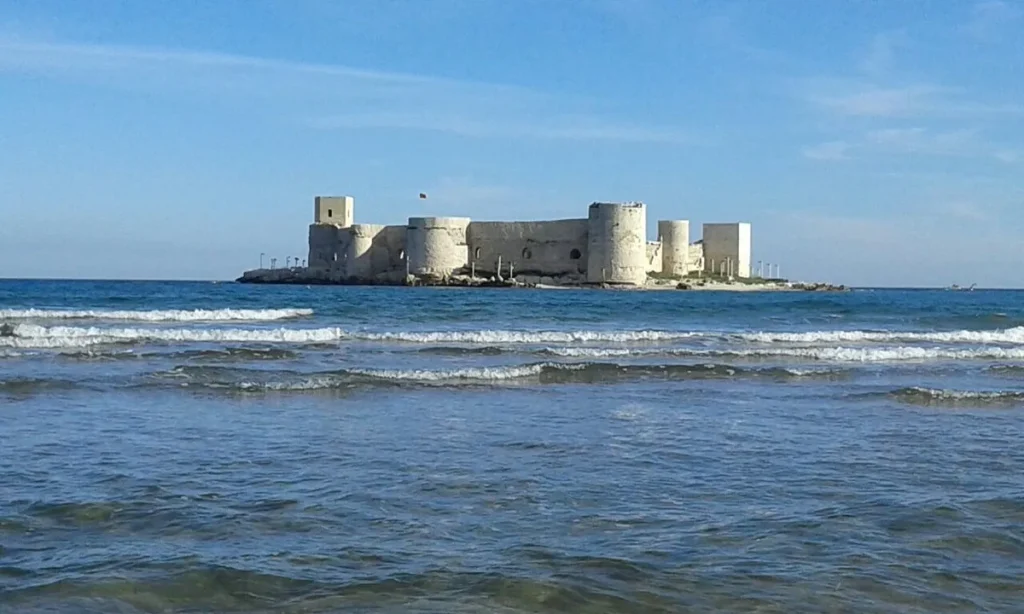
Kızkalesi, about 60 kilometres west of Mersin city on the road to Silifke, is the ancient city of Korykos, now a beach town dominated by two castles that together explain why this stretch of coast was so fiercely contested. The shore castle stands on the headland, guarding the landward approach and the beach, while the Maiden’s Castle (Kızkalesi) itself sits on a small island about 200 metres offshore, reached by small boat when the sea allows, guarding the seaward approach and completing a defensive pair that could control both land and sea. The island fortress is believed to have been built in the Byzantine period and developed further under the Armenian Kingdom of Cilicia, before the Ottomans captured it in 1471, a sequence that mirrors the wider history of the Cilician coast, where Byzantine, Armenian and Ottoman powers successively held the same strongpoints. A local legend, that a king built the island castle to protect his daughter from a prophesied snakebite, only for the prophecy to follow her there, gives the castle its Maiden’s name, and it is still told by boatmen today, showing how folklore attaches itself to striking island sites and helps keep them in popular memory. The sandy beach in front of the castles is one of the finest on this coast, so plan this as a combined castle-and-swim stop, with the shore castle and town providing the historical frame and the beach providing the reason to linger. Further context: The historic sites in Mersin — Culture Trip. The twin-castle arrangement also explains the town’s modern layout, because the beach, the shore castle and the boat departure point all cluster around the same headland, so visitors can move naturally between historical viewing, swimming and a boat trip without needing separate transport for each part of the visit.
What makes Kızkalesi especially rewarding as a place, rather than simply as a photograph, is the relationship between its three elements: ancient city, shore castle and island castle, set against a working beach town. Korykos was not only a fortress, but a city with churches, tombs and civic buildings, and traces of that wider settlement help you understand why a castle alone was never enough; a port town needed warehouses, churches, houses and a harbour as well as walls. The shore castle, accessible on foot, gives the best sense of the landward defences and of the view along the coast toward Silifke, while the island castle, seen from the beach or visited by boat, gives the seaward perspective that explains its isolation and its legend. Boat services are seasonal and weather-dependent, so the island visit should be treated as a bonus rather than a guarantee, and the shore castle and beach can be visited independently even when the sea is too rough for a crossing. Check the official site before visiting for current boat services and castle access, and confirm prices before booking a boat, since operators and schedules change. If you want to shape the swimming, boat and beach part of the day in more detail, Top Things to Do in Mersin covers those activities, while this section keeps its focus on Korykos as a historical place in its own right. If the island boat is not running, do not treat the visit as incomplete, because the shore castle, the beach view of the island, and the remains of ancient Korykos together still give a full sense of this place, and the island itself is best appreciated from the shore when the sea is rough or the service is paused.
5. Narlıkuyu: Cennet and Cehennem Sinkholes and the Three Graces Mosaic
A short drive west of Kızkalesi, Narlıkuyu is a small fishing bay whose importance is geological and mythological as much as historical, and that combination is exactly what makes it unlike any other stop on this route. The Cennet (Heaven) sinkhole, about 250 by 110 metres and 70 metres deep, can be descended by roughly 300 steps to a 5th-century monastery chapel dedicated to the Virgin Mary, built by a monk named Paulus, beside an underground stream that flows to the sea at Narlıkuyu, a descent that moves you physically from sunlit cliffs into a cooler, enclosed world where water, rock and worship meet. The neighbouring Cehennem (Hell) sinkhole is about 128 metres deep, with a smaller opening and no public descent, and its inaccessibility is part of its meaning: Heaven could be entered and inhabited, while Hell could only be viewed from above, a contrast that ancient visitors would have understood immediately. In myth, Zeus held the monster Typhon here before imprisoning him under Mount Etna, linking this Cilician landscape to the wider Greek mythological world and explaining why a dramatic natural feature attracted sacred associations long before Christianity arrived. On the rim of Cennet, remains of a temple to Tyche, goddess of fortune, mark the site’s older pagan sacredness, showing that the sinkhole was already a holy place before the chapel was built. In Narlıkuyu village itself, the tiny Mosaic Museum preserves the Three Graces mosaic, Aglaia, Euphrosyne and Thalia, daughters of Zeus, from the floor of a 4th-century Roman bath, a work of domestic luxury that contrasts with the wild sinkhole landscape nearby. Visit the sinkholes first, then the museum, then lunch by the bay. The underground stream at the bottom of Cennet adds another layer to the visit, because it connects the sinkhole to the sea at Narlıkuyu itself, reminding visitors that this dramatic landscape is part of a living karst system, not a dry monument.
The practical experience of Narlıkuyu deserves as much attention as its mythology, because the site rewards a particular order and a realistic sense of physical effort. The descent into Cennet is steep and involves many steps, so comfortable footwear, water and sun protection matter, especially in summer, and visitors with limited mobility should check current access arrangements before attempting the descent rather than assuming it is suitable for everyone. The chapel at the bottom, modest in scale but remarkable in setting, shows how early Christian monks sought out dramatic natural places for retreat and worship, using the sinkhole’s enclosure as a natural monastery wall. Cehennem, viewed from its rim, is best appreciated as a geological counterpart rather than as a second descent, and the contrast between the two sinkholes, one entered and one only observed, helps explain their Heaven and Hell names far better than any signboard alone. The Three Graces mosaic, small and easily missed if you head straight back to the coast road, is worth a deliberate detour into the village, because it connects Narlıkuyu to Roman bathing culture and to the artistic world of the 4th century, when a bath floor could carry mythological figures as everyday decoration. After the sinkholes and museum, the fishing bay itself provides a natural pause, with restaurants and a harbour atmosphere that make Narlıkuyu a lunch stop as well as a sightseeing stop. Check the official site before visiting for step access, opening hours and any safety closures, since sinkhole sites can be affected by weather and maintenance work. Photography here also rewards patience, since the light inside Cennet changes as the sun moves across its opening, while the rim views of Cehennem are clearest in bright daylight, so allow enough time to experience both sinkholes rather than rushing through them as a single quick stop on the coastal road.
6. Uzuncaburç (Olba): Temple of Zeus and a Hill City
Inland from Silifke, Uzuncaburç preserves Olba, a city of the Roman province of Isauria that began as a Hellenistic temple-state, and that origin is the key to understanding why a major temple stands on this hilltop rather than on the coast. Its signature monument is the Temple of Zeus, whose tall standing columns dominate the site, alongside a colonnaded street, a theatre, aqueduct remains and rock-cut tombs in the valley below, a full civic assemblage that shows Olba was not merely a sanctuary but a functioning town. Olba’s priests once ruled a wide territory from this hilltop, exercising both religious and political authority in a region where temple-states could control land, trade and local allegiance, and the city’s later Roman rebuilding shows how a local cult centre became a full civic town integrated into the Roman provincial system. The temple’s prominence, visible from a distance across the Taurus foothills, was deliberate: it announced the power of Zeus Olbios and of the priestly rulers who served him, while also serving as a landmark for travellers moving between coast and interior. The theatre, street and aqueduct show the Roman phase of that development, when civic amenities, water supply and public entertainment were added to a religious centre, transforming it into a town that could sustain a permanent population. The site is quieter than Kızkalesi or the caves, which is part of its appeal: you can walk the street and temple platform without crowds, and the views over the surrounding Taurus foothills explain why the city was built here, on a defensible height with water, farmland and road connections nearby. Combine Uzuncaburç with Kanlıdivane, the sinkhole city nearby, in a single inland loop from Silifke.
Uzuncaburç rewards a slower, more exploratory visit than the coastal castles, because its remains are spread across a hillside and valley rather than concentrated in a single fortress or beachfront. Begin at the Temple of Zeus platform, where the standing columns give the best sense of the temple’s original scale and of the craftsmanship involved in building a major sanctuary on a hilltop, then follow the colonnaded street to understand how the town was laid out and how public space connected temple, theatre and residential areas. The theatre, even in ruined form, shows the civic ambitions of Roman Olba, while the aqueduct remains explain how water was brought to a hill city that could not rely solely on local springs. The rock-cut tombs in the valley below add a funerary dimension, showing how Olba’s inhabitants buried their dead in the landscape around the city and how tomb architecture reflected social status and local tradition. Because the site is inland and elevated, it can be cooler and windier than the coast, and the light on the temple columns changes dramatically through the day, so morning or late afternoon visits are often the most rewarding for both walking and photography. Check the official site before visiting for current access and road conditions, since the inland route from Silifke involves rural roads that may be affected by seasonal work. For a broader inland and Central Anatolian comparison, travellers often pair this kind of temple-city visit with Things to Do in Kayseri, where Seljuk and earlier layers similarly shape a historic inland city, though the two regions should not be confused with each other. The quieter character of Uzuncaburç is itself a practical advantage, because it allows unhurried walking, photography and reflection and that slower pace suits a hill city whose interest lies in its street plan and temple platform rather than in a single dramatic fortress view.
7. Silifke and Silifke Castle: Overlooking the Göksu River
Silifke, ancient Seleucia ad Calycadnum, sits where the Göksu River meets the coastal plain, and its hilltop castle watches both river and road, a position that explains its continuous importance from antiquity to the Ottoman period. The castle’s successive Byzantine, Armenian, Seljuk and Ottoman phases are visible in its walls and towers, where different masonry styles, tower shapes and repair work record successive rebuildings by powers that each needed to hold this river crossing and coastal junction. The climb rewards you with a panorama over the town, the river valley and the road west toward Anamur, a view that is itself a historical lesson, because it shows the castle’s field of vision and the routes it was built to control. In the town below, the Göksu River, the old stone bridge area and the small museum make a pleasant low-key stop, offering a contrast to the monumental scale of Mamure or Kızkalesi: Silifke is a working town as well as a historic one, with markets, riverside walks and everyday life continuing around its ancient remains. Nearby Kanlıdivane, an ancient city built around a huge sinkhole, with Hellenistic towers, churches and rock tombs, and a legend that criminals were thrown into the pit, is the essential add-on, because it combines the sinkhole geology seen at Narlıkuyu with a full urban settlement built around that dramatic natural feature. Silifke works best as an overnight or lunch base between Kızkalesi and Mamure Castle, breaking the long coastal drive and giving you a place to rest before the final westward stretch. The river crossing also explains why Silifke developed as a market and administrative town as well as a fortress, because travellers, goods and armies all needed to cross the Göksu here, and the castle, bridge area and town grew together around that single practical necessity over many centuries.
Using Silifke as a base also makes practical sense for the inland loop that includes Uzuncaburç and Kanlıdivane, since both are most conveniently reached from here rather than from the coastal resorts. A morning climb to the castle, followed by a riverside walk and museum visit, gives a balanced introduction to the town, while an afternoon inland loop to Kanlıdivane and Uzuncaburç shows how Silifke’s territory extended from river plain to hill city and sinkhole settlement. The castle climb itself should be planned with care in summer heat, with water and sun protection, and visitors should check current access before assuming all towers and ramparts are open, since restoration work can close sections without long notice. The Göksu River, which gave ancient Seleucia its suffix ad Calycadnum, remains central to Silifke’s identity, watering the plain, shaping the town’s layout and providing the river crossing that the castle guarded. That riverine character distinguishes Silifke from the purely coastal castles: here, control meant controlling both a coast road and a river valley leading inland, a dual role that the panorama from the castle makes immediately clear. Check the official site before visiting for castle hours and any closures, and confirm prices before booking accommodation in Silifke, since the town offers a range of options that vary by season and by proximity to the river and castle. Staying overnight also avoids a rushed return drive, giving you time for the castle, the river walk and the inland loop without compressing them into a single hurried afternoon. Evening light from the castle is often particularly rewarding, because the panorama over town, river and valley softens as the day cools, and a late-afternoon climb, followed by a riverside meal, gives a more relaxed end to the day than a hurried midday visit in summer heat.
8. Mamure Castle and Anemurium: The Great Fortress at Anamur
The route ends at its grandest fortress, and that ending is deliberate, because Mamure Castle shows the Cilician castle tradition at its largest and best-preserved scale. Mamure Castle (Mamure Kalesi), on the beach east of Anamur town, covers about 23,500 square metres and is one of Turkey’s largest and best-preserved castles, a figure that becomes tangible only when you walk its circuit. Its exact foundation date is uncertain, but it is believed to have been built by the Romans in the 3rd or 4th century, on or beside an earlier structure, a dating that reflects the difficulty of separating Roman foundations from later rebuildings in a fortress that was continuously maintained. The Armenian Kingdom of Cilicia rebuilt it as a stronghold against pirates, the Seljuk Turks enlarged it, and it changed hands repeatedly until the Ottoman Empire annexed it in 1469, a sequence that again shows the same strongpoint passing between powers that each valued it for the same reason: control of the coast road and protection against seaborne attack. Walk its ramparts and towers for views along the shore, and note how the castle’s moat, walls and inner courtyards were designed for a garrison that had to hold the coast road itself, not merely to impress visitors, with defensive depth, protected water and storage that allowed it to withstand siege. The beach setting, unusual for a fortress of this size, is part of its appeal, because the castle rises directly from sand and sea rather than from a remote hilltop, making its defensive logic visible in a single view. The scale of Mamure is best judged by walking its full circuit rather than viewing it from the beach alone, because only the walk reveals the courtyards, towers and moat as a working defensive system, and that sense of enclosed military space is what distinguishes a great fortress from a picturesque ruin.
Beside the castle lies Anemurium, the Roman city whose ruins, baths, theatre, necropolis and aqueducts, spread along the shore, turn a castle visit into a full ancient city visit as well. Together, castle and city make Anamur a full day in itself, and a fitting finale: a Roman port, a medieval fortress and a modern fishing town in one view, with each layer visible without having to travel onward to another site. The baths show Roman urban life and its emphasis on public bathing and social gathering, the theatre shows civic entertainment and assembly, the necropolis shows funerary customs and the scale of the city’s population, and the aqueducts show the engineering needed to supply water to a coastal city. Walking from castle to city also clarifies the relationship between military and civilian settlement: the fortress protected the road and harbour, while the city provided the population, trade and resources that made that protection worthwhile. For the Anamur-to-Kızkalesi coastline, see: Mediterranean Turkey guide — Mersin, Adana and Hatay, and for Mamure’s scale and dating: Top 5 beautiful castles in Turkey — Mamure Castle. Check the official site before visiting for castle hours and restoration closures, and confirm prices before booking accommodation or transport in Anamur, since this western end of the route is more remote than Mersin city and services are more seasonal. Anamur itself deserves an overnight stay if your schedule allows, because a full day for castle and Roman city, followed by a relaxed evening in the fishing town, gives the western finale the time it deserves, rather than compressing the largest fortress on the route into a brief stop before a long drive back east.
Optional Extension: Alahan Monastery in Mut
If you have an extra day, detour inland to Alahan Monastery near Mut, a 5th- to 6th-century Byzantine complex of churches, baptistery and monks’ quarters set in a dramatic mountain gorge on the road between Silifke and Karaman. Its carved portals and remote setting make it one of the finest early Christian sites in southern Turkey, and it pairs naturally with a Silifke base, since the inland road from Silifke toward Mut is the most logical approach for travellers already following the coastal route westward. The monastery consists of two main churches, traditionally called the East and West Churches, together with a baptistery, monks’ cells and other monastic buildings arranged across a terraced hillside, showing how a monastic community organised worship, baptism, residence and work in a single mountain complex. The carved decoration, particularly on portals and architectural sculpture, is among the finest surviving early Byzantine work in the region, with motifs that link Alahan to wider Mediterranean artistic traditions while retaining a distinctly local character. Its gorge setting is not incidental scenery, but part of its monastic logic: early Christian monks sought remote, dramatic landscapes for retreat, prayer and separation from urban life, and the steep valley, with its views and its isolation, provided exactly that environment. The site’s relative remoteness has also helped preserve it, since it has not been absorbed into a modern town in the way that Tarsus or Silifke have, allowing visitors to experience something closer to its original mountain solitude. The two churches at Alahan should be compared directly during your visit, because their different plans, decoration and states of preservation show how monastic building developed over time, and how a single community could expand, rebuild and adapt its churches while remaining in the same mountain setting for generations.
Planning Alahan as an extension requires more care than the coastal stops, because the mountain road is winding and the site is inland from the main D-400 route. Allow a full day for the detour from Silifke, including driving time, walking around the terraced complex, and return, rather than treating it as a brief add-on to a coastal day that is already full. The walk around the monastery involves uneven ground and steps between terraces, so comfortable footwear is essential, and summer heat in the gorge can be intense despite the altitude, making water, sun protection and an early start advisable. Because Alahan is less visited than Kızkalesi or Mamure, facilities nearby are more limited, so food, fuel and water should be planned in advance, and accommodation is best arranged back in Silifke or Mut rather than assumed at the site itself. Check the official site before visiting for road and access conditions, as the mountain road is winding and can be affected by seasonal maintenance or weather. For travellers who enjoy early Christian and Byzantine sites, Alahan also provides a useful contrast to the sinkhole chapel at Narlıkuyu: one is a chapel inside a natural wonder, the other is a full monastic complex built into a mountain gorge, and together they show two very different ways in which early Christianity inhabited the Cilician landscape. Confirm prices before booking any transport for this detour, since private transport is often more practical than public transport for this inland route. Because Alahan is remote, carry water, check fuel and mobile coverage before leaving Silifke or Mut, and allow a margin for the winding return road, since a monastery visit that is rushed for transport reasons loses the quiet and solitude that are central to understanding why monks chose this gorge in the first place.
Practical Guide: Visit Order, Getting There and Best Time
| Plan | Detail |
|---|---|
| Recommended order | Tarsus → Soli Pompeiopolis → Mersin centre → Kızkalesi → Narlıkuyu → Uzuncaburç → Silifke → Mamure Castle / Anemurium |
| 3-day route | Day 1: Tarsus and Soli. Day 2: Mersin centre and Kızkalesi. Day 3: Narlıkuyu, Uzuncaburç and Silifke. |
| 5–6-day route | Add Alahan Monastery and a full Anamur day, with beach time at Kızkalesi and Anamur. |
| Getting there | Çukurova International Airport (COV), opened 10 August 2024 near Tarsus, about 45 km from Mersin city. Dolmuş minibuses run along the D-400 to Kızkalesi, Silifke and Anamur; a rental car gives more freedom for Uzuncaburç and Alahan. |
| Best time | Spring and autumn for walking ancient sites without summer heat; summer for combining sites with swimming; winter is mild but check site hours. |
Planning help for durations: One city, three days — Mersin (Turkish Airlines). You may also like our activity-focused companion guide: Top Things to Do in Mersin, and our Central Anatolia guide: Things to Do in Kayseri.
Conclusion
Seen in order, Mersin’s places tell a single story: harbours founded, sacked and refounded; castles rebuilt by each new power to guard the same road; and sacred places, a sinkhole chapel, a hilltop temple, a mountain monastery, that outlasted the empires around them. That story is visible most clearly when the journey is taken westward, because the sequence itself mirrors the historical movement of trade, armies and pilgrims along the Cilician coast, from the inland town of Tarsus through the Roman port of Soli, the modern port city of Mersin, the twin castles of Kızkalesi, the sacred sinkholes of Narlıkuyu, the hill city of Uzuncaburç, the river town of Silifke, and finally the great fortress and Roman city at Anamur. Each place adds a layer that the previous place prepared you to understand: Tarsus shows an ancient town that never stopped being lived in, Soli shows a port that was deliberately refounded by Rome, Mersin centre shows a modern port explaining its ancient neighbours, Kızkalesi shows defence by land and sea in a single view, Narlıkuyu shows nature turned sacred, Uzuncaburç shows a temple that became a town, Silifke shows a river crossing guarded by a castle, and Mamure with Anemurium shows fortress and city together at the end of the road. No single site, however impressive, carries that full narrative on its own, which is why the order matters as much as the individual destinations. The province rewards travellers who slow down enough to notice rebuilding in castle walls, reuse in temple columns, and continuity in market streets. That narrative also helps you choose where to linger on a return visit, because you will already know which places rewarded slow walking, which castles rewarded a full circuit, and which sacred sites rewarded quiet time, rather than trying to give equal time to every stop on a first journey through the province.
Do not rush the westward journey, because rushing turns a historical route into a checklist and loses exactly what makes Mersin distinctive. Give Tarsus a morning, Soli an unhurried hour, Kızkalesi a swim, and Mamure a sunset, and the province will feel less like a list of ruins and more like a coastline you have actually travelled, with memories attached to specific views, walks and descents rather than to names on a map. Allow extra time for the inland detours to Uzuncaburç and, if you have a further day, to Alahan Monastery, since those quieter sites provide the contrast that makes the busy coastal castles more meaningful. Use the companion activities guide when you need to plan swimming, walking or food in detail, but return to this places guide when you want to remember why each place stands where it does and what it meant to the people who built, rebuilt and lived in it. Before you travel, check the official site before visiting for current hours and closures at each site, and confirm prices before booking transport, accommodation or boat services, since the practical details of this route change with seasons and restoration work. Travelled in order, with that preparation, Mersin offers one of Turkey’s clearest lessons in how geography, trade and power shape a coastline over two thousand years, and it leaves a traveller with a route, not just a set of photographs. In the end, Mersin is best remembered not as a collection of isolated monuments, but as a coastline travelled in order, where each harbour, castle, temple and monastery gains meaning from the place before it, and where the road itself, the D-400, becomes part of the historical experience you take home.
FAQs
What is the best order to visit places in Mersin?
East to west: Tarsus, Soli Pompeiopolis, Mersin centre, Kızkalesi, Narlıkuyu, Uzuncaburç, Silifke, then Mamure Castle and Anemurium. This follows the D-400 and the historical sequence of harbours and castles.
When was Mamure Castle built?
Its exact construction date is uncertain, but it is believed to have been built by the Romans in the 3rd or 4th century, later rebuilt by the Armenian Kingdom of Cilicia, enlarged by the Seljuks, and annexed by the Ottomans in 1469.
When was Soli Pompeiopolis refounded?
In 67 BC, when Pompey the Great settled former Cilician pirates there as colonists and renamed Soli as Pompeiopolis. The city was destroyed by an earthquake in AD 525.
Can you go inside Kızkalesi Castle?
The island castle is reached by small boat when the sea is calm; check the official site before visiting for current boat services, as they are seasonal and weather-dependent. The shore castle and beach can be visited independently.
How many days do you need for Mersin’s historic places?
Three days cover Tarsus, Soli, Mersin centre, Kızkalesi, Narlıkuyu and Silifke. Five to six days add Uzuncaburç, Alahan Monastery and a full Anamur day at a relaxed pace.
Is Mersin good for history lovers?
Yes. Few Turkish provinces pack so many layers — Greek, Roman, Byzantine, Seljuk and Ottoman — into a single coastal road, with temples, castles, sinkhole shrines and a mountain monastery all within a few days’ travel.