History of Morocco – From Roman Volubilis to the Living Kingdom, the Story Behind the Stones
Morocco’s past is easier to read than most countries’, because its rulers kept building in the same few cities and almost nothing was ever thrown away. Stand in Fes and you are inside a city founded in the ninth century, enlarged by sultans in the fourteenth, and still doing the same work — tanning, trading, teaching — in streets that follow their medieval lines. Stand in Marrakech and the minaret that dominates the skyline was raised by one dynasty on the foundations of another, in a city that a third dynasty founded and a fourth made splendid. Rabat holds a Roman town, a Marinid royal cemetery and the stump of an Almohad minaret inside one modern capital. The layering is the story, and unlike many countries, Morocco lets you read it in a single trip, city by city, without a museum glass case between you and the evidence.
That is what this page does. It tells Morocco’s past in the order a traveller meets it, as one continuous story: the Amazigh (Berber) kingdoms and the Roman province that left Volubilis in stone, the arrival of Islam and the Idrisid founding of Fes, then the great dynasties in sequence — Almoravid, Almohad, Marinid, Saadian and Alaouite — each of which ruled from a capital you can still walk, and each of which left one building that explains it better than any chronicle. After the dynasties come the protectorate years, when France and Spain divided the country between them, and independence in 1956, which restored a kingdom that, unusually, had never entirely gone away. Our Morocco travel guide covers the practical shape of a first trip; this page is its companion, the story underneath the sights.
One honest note on dates before the story starts. Morocco’s early chronology comes from archaeology, Roman authors and much later court histories, and some of its most repeated dates are traditional rather than proven — the founding years of Fes and Marrakech are the famous examples, and they are hedged in their sections below rather than printed as certainty. The dates this article leans on hardest are the fixed points no serious account disputes: the Roman annexation of Mauretania in 40 CE, the Battle of the Three Kings in 1578, the Treaty of Fes in 1912 and independence on 2 March 1956. Everything between those anchors is given in the broad shape the evidence supports, and where rival accounts give rival years, this article says so instead of quietly picking one.
Timeline at a Glance
Here is the whole story on one screen before it is told properly. Eleven eras, each with a place where it still stands. If you remember one thing from this page, remember the pattern — Morocco’s history is a relay, in which each dynasty took the capital, the craftsmen and the trade routes of the one before it, and built its own layer on top rather than clearing the ground.
| Era | Dates | Where you see it today |
|---|---|---|
| Amazigh kingdoms and the ancient coast | From around the 8th century BCE | Lixus, Tangier, Volubilis |
| Roman Mauretania | 40 CE to the 5th century | Volubilis |
| The arrival of Islam | 7th to 8th century | Moulay Idriss Zerhoun, Fes |
| The Idrisids | 788 to 974 | Fes el-Bali, Moulay Idriss Zerhoun |
| The Almoravids | Around 1040 to 1147 | Marrakech, the Almoravid Koubba |
| The Almohads | Around 1121 to 1269 | Koutoubia in Marrakech, Hassan Tower in Rabat, Tinmal |
| The Marinids | 1248 to 1465 | Fes madrasas, Chellah in Rabat |
| The Saadians | 1549 to 1659 | Saadian Tombs and El Badi Palace, Marrakech |
| The Alaouites | From 1666 to today | Meknes, the royal cities |
| The protectorate | 1912 to 1956 | Casablanca, Rabat’s ville nouvelle |
| Independence and the modern kingdom | 1956 to today | Rabat, Mausoleum of Mohammed V |
Read the table downwards and you are also reading a map. The ancient story belongs to the north — the Loukkos and Sebou plains, the coast at Tangier and Larache, the Roman city at Volubilis. The medieval story splits between two capitals that take turns for six hundred years: Fes in the north, founded first and always the city of scholars, and Marrakech in the south, founded later and always the city of sultans and armies. The modern story gathers in Rabat and Casablanca, the twin capitals — one political, one commercial — that the protectorate built side by side. A trip that crosses even three rows of this table, Fes plus Marrakech plus Volubilis, say, will show you the relay working, and the sections that follow explain what to look for in each place. Most of the country’s famous sights are, in the end, addresses in this table.
Before the Dynasties – Phoenicians, Carthage and Rome
People have lived in Morocco for as long as people have lived anywhere. Fossil remains found at Jebel Irhoud, in the hills west of Marrakech, were dated in 2017 to around 300,000 years ago and are among the oldest known remains of Homo sapiens anywhere in the world — a finding that moved one of humanity’s starting points to Moroccan ground. The peoples who followed, ancestors of the Amazigh (Berber) populations who still form much of Morocco’s identity, left rock art in the Sahara and stone monuments in the hills, and by the time outside sailors arrived they had farmed the northern plains for centuries. Morocco’s recorded history begins, as it does for much of the Mediterranean, with traders from the east: Phoenician sailors from what is now Lebanon were working the Atlantic coast by roughly the eighth century BCE, founding trading posts at places whose names still survive in altered form — Lixus near modern Larache, Tingis at Tangier, Mogador on the island off Essaouira.
The Phoenicians’ heir was Carthage, the great trading city in modern Tunisia, which took over the Moroccan coastal posts from around the fifth century BCE and traded inland with Amazigh kingdoms whose kings grew rich and confident on the exchange. Those kingdoms — Mauretania is the name history kept — were real states, minting coins and dealing with Rome as neighbours before they dealt with it as subjects. King Juba II, raised in Rome and installed on the Mauretanian throne in 25 BCE, was a scholar-king who wrote books in Greek and rebuilt his capital in Roman style; his son Ptolemy was less fortunate, summoned to Rome and executed by the emperor Caligula in 40 CE, after which Rome annexed the kingdom outright. The northern strip became the province of Mauretania Tingitana, and its greatest surviving monument is the city the province enriched: Volubilis, on a fertile plateau above the Zerhoun hills.
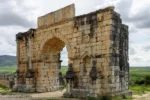
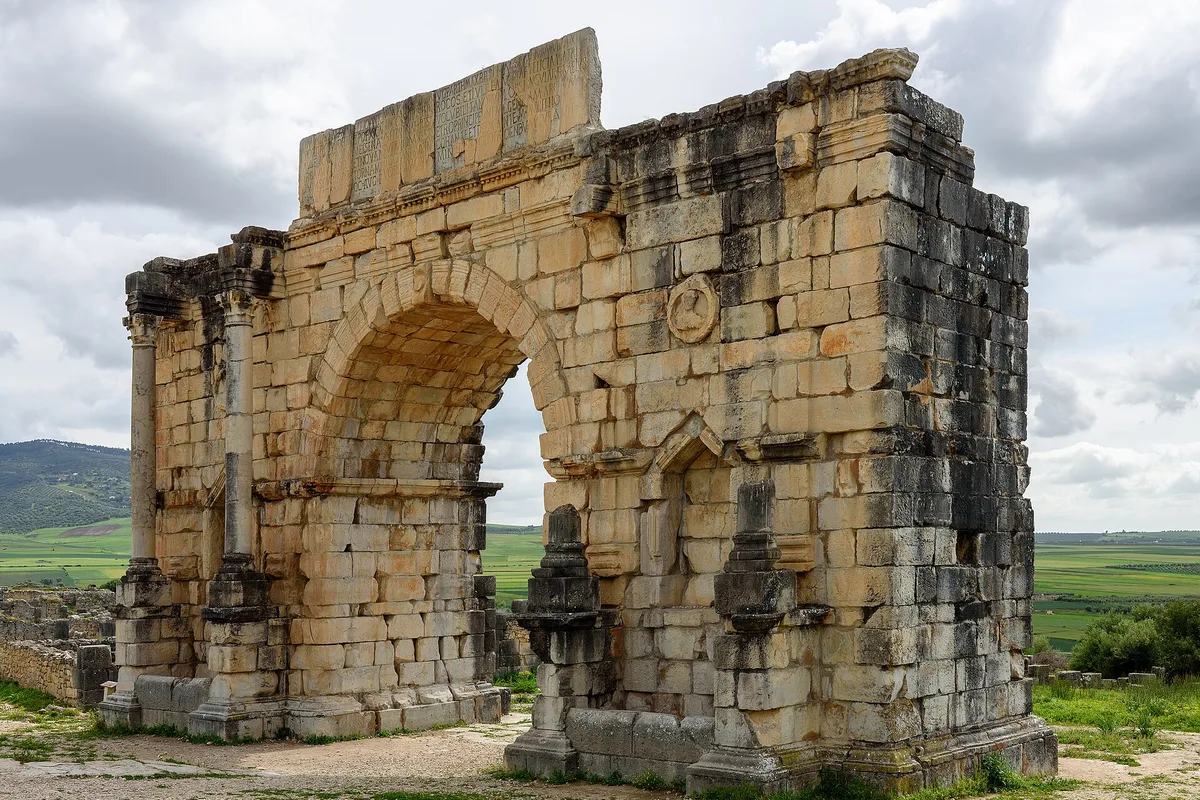
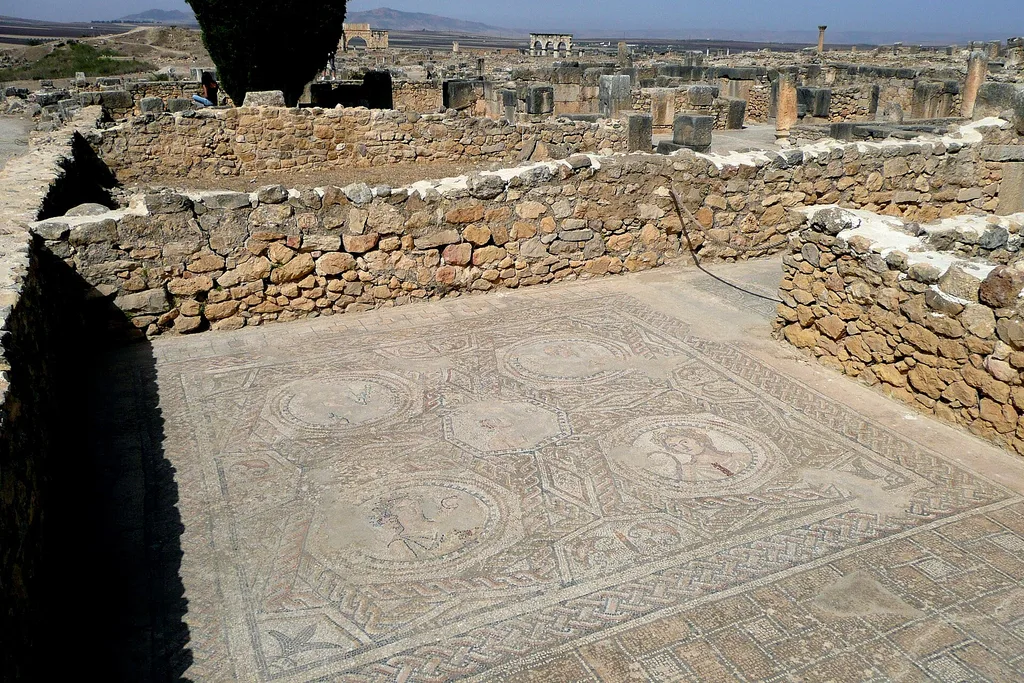
Volubilis is where Roman Morocco can still be walked. It had been an Amazigh and Carthaginian town before Rome, and under the empire it grew wealthy on the two exports the plain below still produces — olive oil and grain — shipped north through Tangier. Its grand houses were floored with mosaics of a quality that would not disgrace Italy: gods, seasons, wild animals and the labours of Hercules, several of them still in the rooms they were made for. The city raised its triumphal Arch of Caracalla in 216-217 CE, built a basilica and a Capitoline temple on its forum, and lined its main street with shops and oil presses. When Rome thinned its hold on the far province in the late third century, withdrawing its administration towards the coast, Volubilis did not die with the empire that had enriched it. Its people stayed, spoke a Latin that slowly became something else, and were still there half a millennium later — which is why the next chapter of this story begins, of all places, in the same streets.
The Vandals crossed into North Africa in the fifth century and Byzantine armies recovered the coastal fringe in the sixth, but imperial control of the Moroccan interior was by then more claim than fact, and the plains and mountains belonged in practice to Amazigh confederations and local rulers. That fragmentation is the world Islam arrived in during the late seventh and early eighth centuries, as Arab armies pushed west along the coast. The conquest was neither instant nor simple — it took decades, met serious Amazigh resistance, and produced, in the great Berber Revolt of 740, an early and successful rejection of rule from Damascus. Morocco accepted the new faith and kept its independence from the eastern caliphate at the same time, and that combination — Islamic, but ruled from home — is the founding condition of everything that follows.
The Idrisids – Fes and the First Moroccan State
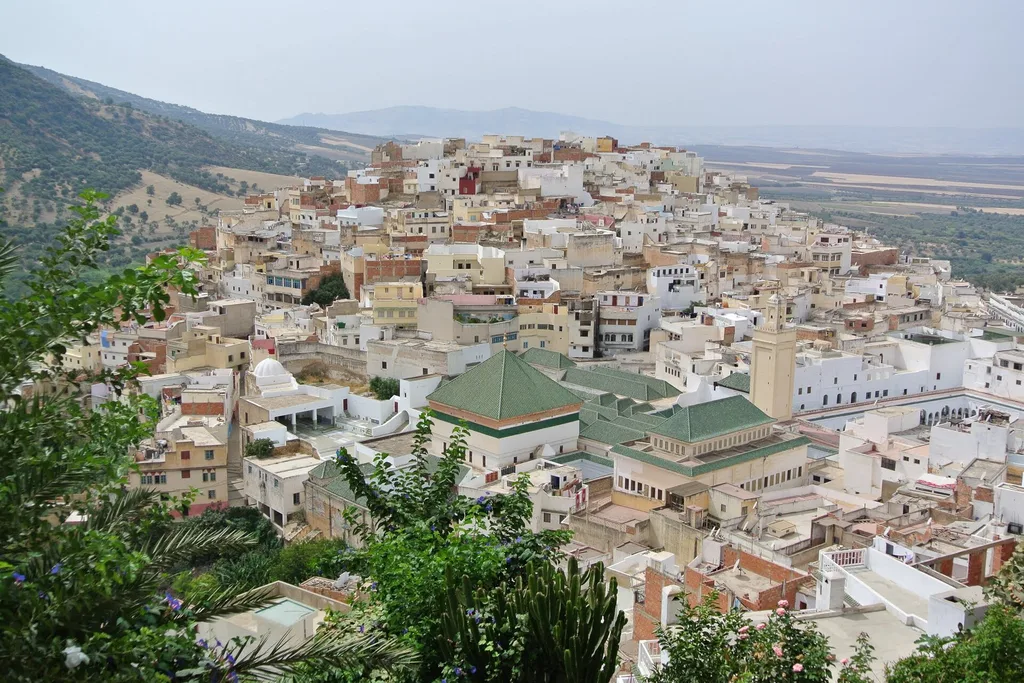
The Moroccan state begins with a refugee. Idris ibn Abdallah, a descendant of the Prophet Muhammad fleeing a failed revolt against the caliphs in the east, reached Morocco in 788 and was welcomed at Walila — Roman Volubilis — by the Amazigh tribe of the Awraba, who proclaimed him their leader. It was a shrewd alliance on both sides: the tribes gained a leader whose descent gave him authority no local chief could match, and Idris gained a base from which, in a few campaigning seasons, he brought much of northern Morocco under his rule. He died in 791 — later tradition says poisoned by an agent of the caliph in Baghdad, a story repeated often enough to be worth repeating as tradition rather than fact — and he was buried in the hills above Volubilis, where the whitewashed town of Moulay Idriss Zerhoun later grew around his tomb and remains one of the holiest places in Morocco.
His son, Idris II, born after his father’s death, is the dynasty’s real builder, and his monument is a city. Tradition dates his founding of Fes to 808 or 809, on the bank of the river opposite a smaller settlement his father had planted two decades earlier; the exact years are among the honest uncertainties of Moroccan history, but the sequence is not in doubt. Fes was placed with care, in a bowl of hills on the route between the Atlantic plains and the Taza corridor to the east, with water running through it — a craftsman’s and merchant’s site as much as a soldier’s. Settlers arrived from Córdoba and from Kairouan in modern Tunisia, each community giving its bank of the river its character, and the two banks give Fes its enduring double name and double nature: Fes el-Bali, the old city, is the oldest continuously inhabited urban fabric in Morocco, a medina of thousands of lanes that still runs on the Idrisid street plan underneath nine centuries of rebuilding.
The dynasty’s most famous foundation came a generation later and was not a sultan’s work at all. In 859 a wealthy woman of Fes, Fatima al-Fihri, spent her inheritance founding the mosque and teaching institution of al-Qarawiyyin, which grew over the following centuries into one of the great centres of learning of the Islamic world. Al-Qarawiyyin is often described as the oldest continuously operating university in the world, a status recognised by UNESCO and Guinness World Records; the careful version is that it is the oldest existing educational institution in continuous use, founded as a mosque school and acquiring its university character over time — either way, its library and its students have been part of Fes for more than eleven and a half centuries, and the Idrisid city is still organised around it.
The Idrisid state did not last as a single kingdom. After Idris II’s death in 828 his realm was divided among his sons, in the Moroccan pattern that repeats through this whole story, and through the tenth century the family’s branches were squeezed between the rival caliphates of Córdoba and the Fatimids in the east, until Idrisid power faded entirely by 974. But the dynasty had done the two things that made Morocco a country rather than a province of somebody else’s empire: it had given the territory a ruling house of its own, rooted in descent from the Prophet and therefore able to command loyalty in a way no governor sent from abroad could, and it had founded the city that would be Morocco’s religious and intellectual capital for the next thousand years. Every later dynasty in this article rules in the Idrisids’ shadow, claims their inheritance, and builds in their city.
The Almoravids – The Desert Empire That Founded Marrakech
The next empire came out of the desert. In the 1040s, among the Sanhaja Amazigh of the western Sahara — veiled camel-herders who controlled the gold routes between West Africa and the Mediterranean — a religious reform movement took hold under the scholar Abdallah ibn Yasin and hardened into an army. Its followers called themselves al-Murabitun, the Almoravids, and under their military leader Yusuf ibn Tashufin they did in one generation what no Moroccan power had done before: they united Morocco, pushed east into Algeria, crossed into Spain in 1086 to check the Christian advance at Zallaqa, and built an empire that ran from the Senegal river to the Ebro. Morocco, which had spent three centuries as a contested edge of other people’s states, was suddenly the capital province of an empire of its own.
An empire needs a capital, and the Almoravids built one from nothing. Marrakech — tradition and most modern accounts date its founding to around 1070, though some sources argue for 1062, and the honest answer is that the city rose in those years rather than in one documented moment — was planted on the Haouz plain where the desert routes met the road north, under the snow line of the High Atlas. It was a camp that became a city: walls of red earth that gave Marrakech its enduring colour and its enduring nickname, palm groves watered from the mountains, and a governor’s fortress, the Kasbah, at its southern edge. Fes was taken and held, and the two cities became the twin poles the country still has — Fes the older, learned, northern capital; Marrakech the newer, military, southern one, closer to the desert trade that paid for everything.
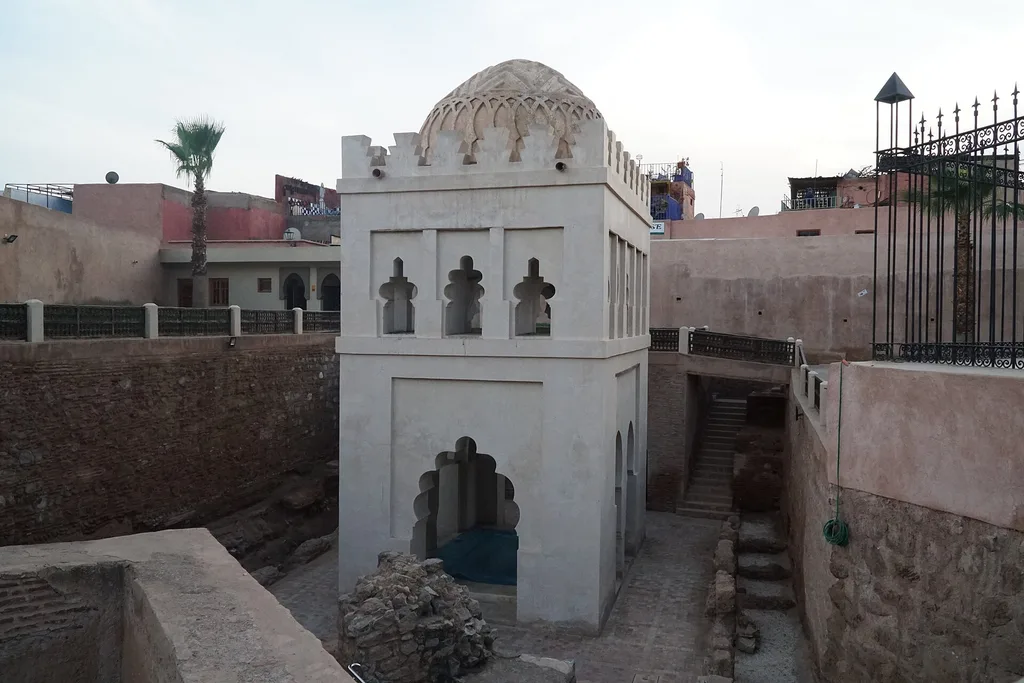
Of the Almoravids’ own building in Marrakech, almost nothing survives, and the reason is in the next section: their successors demolished as a matter of doctrine. The single exception is the monument in the photograph above, the Almoravid Koubba, a small domed pavilion of the early twelfth century that stood beside the dynasty’s mosque and survived by being buried and forgotten under later building until excavations uncovered it in the twentieth century. It is worth seeking out precisely because it is small. Inside its modest dome is a riot of carving — pine cones, palms, shells and calligraphy worked in plaster of a sophistication that gives the lie to the Almoravids’ austere reputation. The men who rode out of the Sahara as puritan reformers became, within two generations, patrons of the most refined art in the western Islamic world, much of it made by craftsmen brought from Córdoba, and the Koubba is where that transformation can still be seen.
The empire their grandchildren inherited was overstretched and slowing, taxed by holding Spain and Africa at once, and challenged at home by a new reform movement gathering in the High Atlas that regarded the Almoravids as having gone soft in exactly the ways the Koubba shows. Marrakech fell in 1147 after a long siege, the last Almoravid ruler was killed, and the dynasty ended the way it had begun, at the hands of men from the mountains who believed the faith needed purifying. The Almoravids’ century had set the template every later Moroccan empire would follow, though: a movement from the desert or the mountains, a new capital or a captured one, an empire reaching into Spain and the Sahara, and then the slow luxury of power and the challenger already gathering at the edge of the map.
The Almohads – An Empire Ruled From Marrakech
The challengers were the Almohads, and they began, as the Almoravids had, with a teacher. Ibn Tumart, a Masmuda Amazigh from the High Atlas who had studied in the east, came home preaching a strict doctrine of the unity of God, gathered the mountain tribes around him, and from the fortified village of Tinmal — high in the Atlas, where the mosque he founded still stands — launched a revolt against the Almoravids he declared impious. He died around 1130, but his successor Abd al-Mumin turned the movement into an empire with a general’s patience: Tlemcen, then city after city across the Maghreb, Marrakech itself in 1147, then Spain, then east as far as Tripoli. By the 1160s the Almohad caliphate was the largest state in the western Islamic world, ruling from Marrakech an empire that included modern Morocco, Algeria, Tunisia, Libya and half of Iberia.
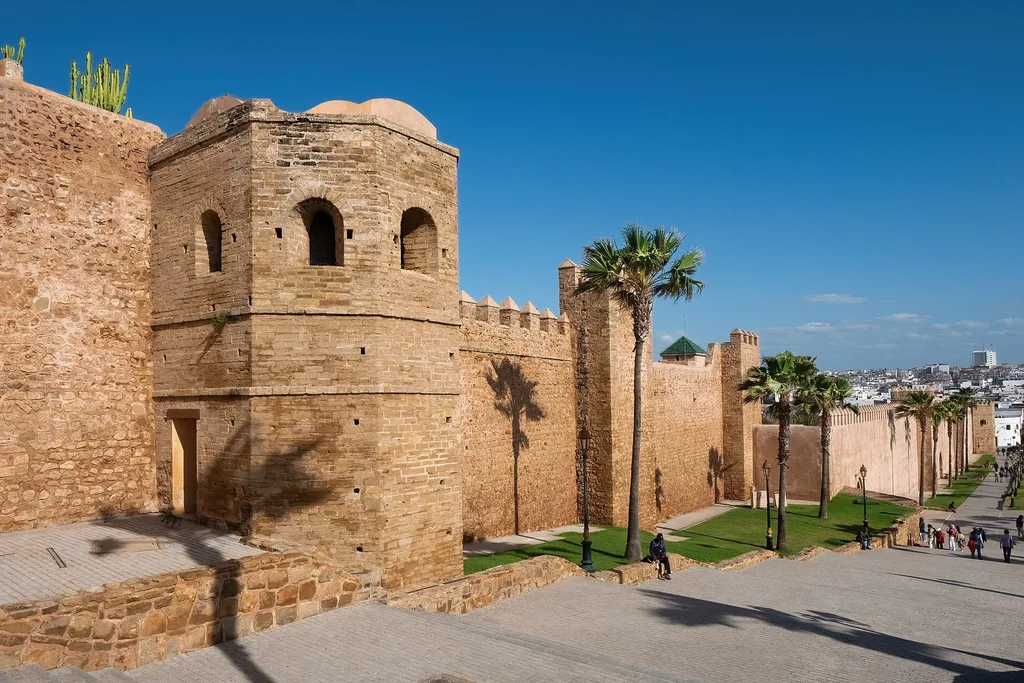
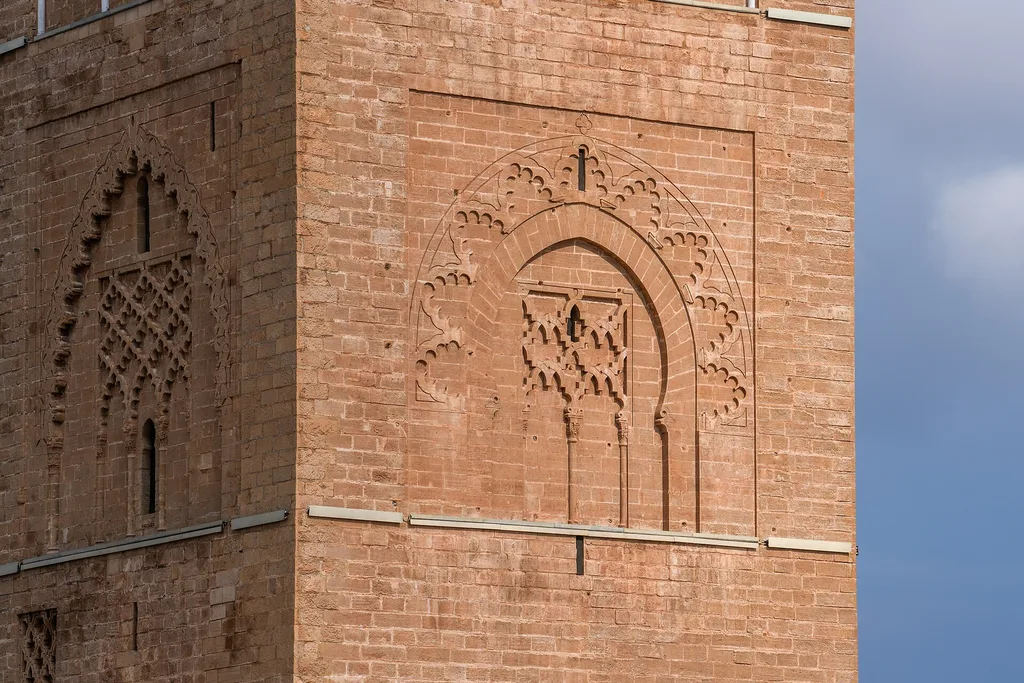
The Almohads built to match, and their buildings are the ones that still set Morocco’s silhouette. In Marrakech, on the site of the Almoravid palace mosque they had demolished, they raised the Koutoubia — its minaret, a square sandstone tower of perfect proportion finished in the 1190s under the caliph Yaqub al-Mansur, became the pattern for minarets across the Maghreb and, through its near-twin in Seville, the Giralda, for towers in Spain too. In Rabat, which al-Mansur refounded as a fortress-city on the Bou Regreg, he began in 1195 a mosque intended to be among the largest in the world, its minaret the tower in the photograph above. He died in 1199 with the mosque unfinished, and it was never completed: the Hassan Tower is a stump a little over half its intended height, standing over a field of broken columns, and it is the single most eloquent monument in Morocco to the truth that empires stop mid-sentence. The Almohads also gave Rabat the great gate and walls of the Kasbah of the Udayas, in the city where this article began.
Almohad Marrakech was more than a garrison. Its court drew scholars and builders from across the empire, its gardens — the Menara’s reservoir and pavilion belong to this age in origin — watered the plain, and its walls were rebuilt in the rammed earth that still encloses the medina. But the empire’s Spanish half was its weakness. In 1212 a coalition of Christian kingdoms destroyed the Almohad army at Las Navas de Tolosa, and although historians argue about how decisive a single battle can be, the Almohad position in Iberia never recovered; city by city, over the following decades, al-Andalus shrank to Granada. At home the caliphate fragmented among governors and cousins, exactly as the Idrisid kingdom had, and by the 1240s real power in the north had passed to a new Amazigh confederation, the Marinids, who took Fes in 1248 and finally Marrakech in 1269.
For the traveller, the Almohad century is the easiest medieval layer to read, because its buildings were too big to bury. The Koutoubia still organises Marrakech — everything in the medina is oriented by it — and the Hassan Tower still organises Rabat, sharing its esplanade, across eight centuries, with the mausoleum of the modern kingdom’s founder. The Almohads also fixed a habit Morocco never lost: each new dynasty presents itself as a religious correction of the last, rules an empire larger than Morocco itself, and leaves its most honest monument in the form of the building it could not finish or the capital it could not keep.
The Marinids – Fes and the Age of the Madrasas
The Marinids were Zenata Amazigh from the eastern steppes who rose as Almohad power crumbled, took Fes in 1248, and ruled Morocco — with one dynastic interruption — until 1465. They were the last of the great medieval Amazigh dynasties, and they made a different choice from their predecessors. The Almoravids and Almohads had spent Morocco’s wealth on empire; the Marinids, whose attempts to rebuild that empire in Spain and Algeria mostly failed, spent it on Fes. Under a line of sultans who understood that legitimacy could be built as well as fought for, fourteenth-century Fes became the intellectual capital of the Maghreb — the city of al-Qarawiyyin enlarged and endowed, of astronomers and jurists and historians, and of the most beautiful small buildings in Morocco: the madrasas.
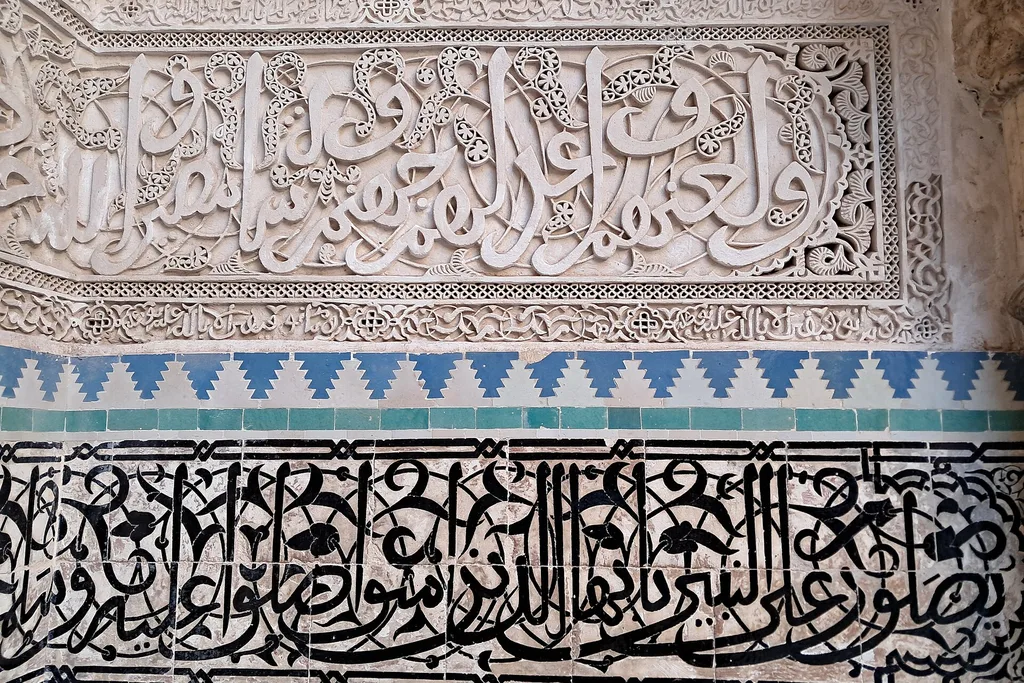
A madrasa is a college — part school, part hostel, part monument — and the Marinids built them as other dynasties built palaces. The Attarine Madrasa, raised in 1323-1325 beside al-Qarawiyyin by the sultan Abu Said Uthman II, packs into one small courtyard the full grammar of Moroccan ornament: zellij tilework in geometric stars at the base, carved stucco in flowing calligraphy above it, and carved and painted cedar at the top, the three crafts stacked in a deliberate order from earth to heaven. The Bou Inania Madrasa, built a generation later in 1351-1356 by Abu Inan, is grander still — unusually, it doubles as a mosque, with its own minaret, so that teaching and prayer share one courtyard. These are not ruins. Their tilework is intact, their proportions are exact, and a visitor standing in the Attarine’s courtyard is standing in the most refined interior the medieval Maghreb produced, in the form its makers intended.
The Marinids built beyond Fes too, and one of their works shows their other face. Across the river from Rabat’s kasbah, on the walled hill of Chellah — already ancient as the Roman town of Sala — the Marinid sultan Abu Yusuf Yaqub built in the 1280s a royal necropolis: a fortified garden of tombs, a mosque and a madrasa, where the dynasty’s sultans were buried among orange trees and storks. Chellah, where the reading-the-sites section of this article will return, is the Marinids at rest, and it pairs with the Fes madrasas as the dynasty at work. In 1331-1332 the Marinid palace-city of Fes el-Jdid, “New Fes”, with its great Jewish quarter, the first mellah in Morocco, extended the capital westward; the two Feses, old and new, face each other across the valley to this day.
The dynasty declined the way Moroccan dynasties do — succession quarrels, shrinking revenues, power passing to viziers from the Wattasid family, who first ruled through the Marinids and then replaced them in 1472. The Wattasid century that followed is the one era in this article without a monument every traveller sees, and that absence is itself the record: a defensive age in which Portugal seized the Atlantic ports one by one — Ceuta had already fallen in 1415, before the Marinids were even gone — and Morocco’s energies turned to survival. When the end came, it came from the south, from sharifian families of the Draa valley whose descent from the Prophet let them do what the Wattasids could not: rally the country against the Portuguese and the looming Ottomans alike. Those families were the Saadians.
The Saadians – Tombs, Sugar and the Battle of the Three Kings
The Saadians rose in the Draa valley, in the palm oases south of the Atlas, claiming descent from the Prophet and gathering support first against the Portuguese enclaves on the coast and then against the failing Wattasids. They took Marrakech in 1549 and Fes in 1554, and made Marrakech a capital again. Their century is the most dramatic in Moroccan history, because it contains the day Morocco defeated a European crusade so completely that three kings died of it. In 1578 the young Portuguese king Sebastian landed with an army — encouraged by a deposed Moroccan sultan who had promised him the throne — and met the Saadian forces at Wadi al-Makhazin, near Ksar el-Kebir, on 4 August. By the day’s end Sebastian was dead, the Moroccan sultan Abd al-Malik was dead, and the sultan who had invited the invasion was dead too, drowned in the river: the Battle of the Three Kings, still the most famous date in Morocco’s military past. Portugal, left kingless, was absorbed by Spain within two years; Morocco was never again seriously threatened with conquest from Europe until the age of steam.
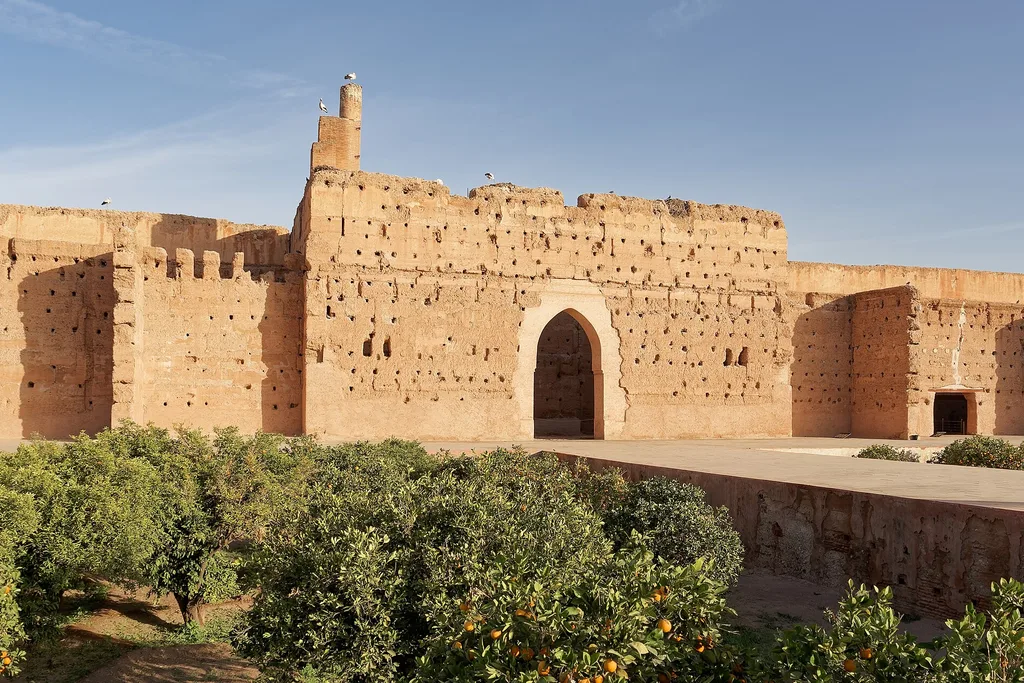
The victor’s brother, Ahmad al-Mansur — “the Victorious” — reigned until 1603 and spent the winnings on Marrakech. Portuguese ransoms, the sugar of the Souss plain and, after 1591, the gold of an audacious military expedition across the Sahara that seized Timbuktu and the Songhai empire’s trade, filled his treasury, and he built as if determined to outspend it. His El Badi Palace — “the Incomparable” — took twenty-five years to raise, was surfaced in Italian marble traded weight-for-weight, the chroniclers liked to say, against Moroccan sugar, and was counted among the wonders of its age. His family’s tombs, the Saadian Tombs, hid a courtyard of Carrara marble and gilded cedar of a delicacy that matches the palace’s scale with intimacy instead. Both monuments stand in the Marrakech kasbah, a few streets from each other, and together they are the Saadian century complete: appetite, wealth and taste at imperial scale.
The ending was swift. Al-Mansur died of plague in 1603, his sons fought a civil war over the succession in the familiar pattern, and Moroccan unity dissolved for sixty years into rival courts, saintly republics — including, for a generation, a corsair republic at Salé, run substantially by Moriscos expelled from Spain, which treated with European states as an independent power — and local strongmen. The El Badi Palace was stripped by a later sultan for building materials, its marble carried off to another capital, leaving the immense bare walls in the photograph above. The Saadian Tombs survived only because that same sultan, respecting the dead more than the palace, sealed them up instead: walled off and forgotten, they were rediscovered from the air in 1917, which is why their gilding is intact in a way nothing else of the palace century is. Morocco’s pattern had completed another full turn — unity, empire, splendour, succession war — and the reunifiers, when they came, came from the same sharifian south-east as the Saadians had.
The Alaouites – Moulay Ismail’s Meknes and the Long Kingdom
The reunifiers were the Alaouites, another sharifian family, from the Tafilalt oases around Sijilmasa, the old desert-edge trading city. Moulay Rashid fought his way to the throne in the 1660s, taking Fes in 1666 — the date from which the dynasty’s rule is usually counted — and his half-brother and successor Moulay Ismail, who reigned from 1672 to 1727, is the towering figure of the dynasty and one of the great state-builders of Moroccan history. Contemporaries in Europe compared him to his exact contemporary Louis XIV of France, and the comparison holds in one respect above all: both men understood power as building, and both built a capital as its demonstration. Moulay Ismail’s chosen capital was Meknes, until then a modest town between Fes and the Atlantic plains, and over fifty years he turned it into an imperial city on a scale Morocco had never seen.
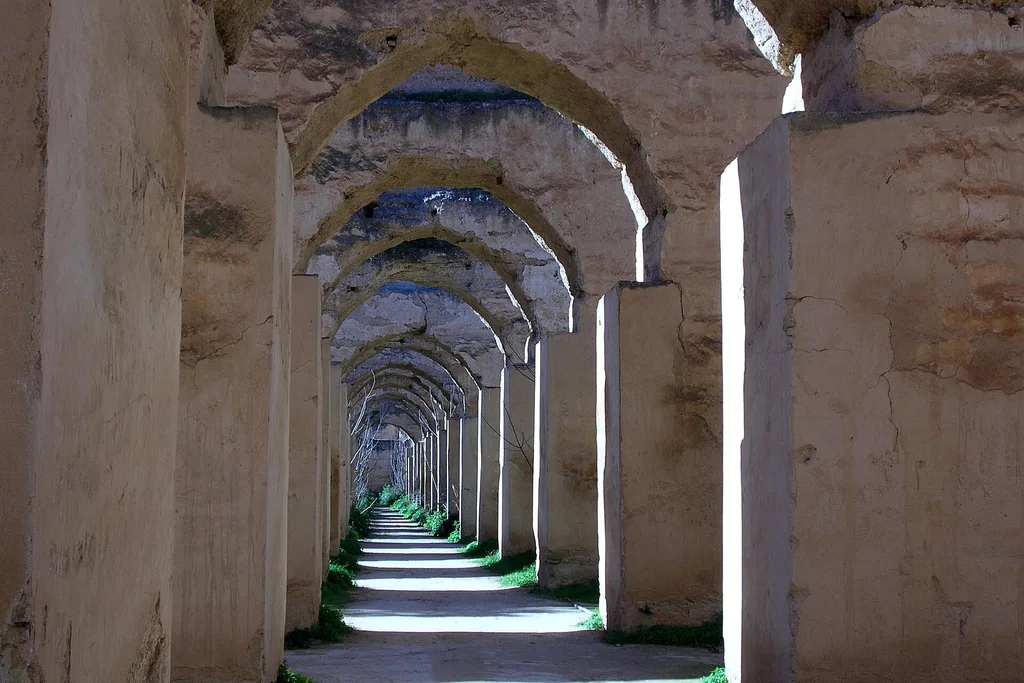
The photograph above shows what that meant in practice — not a palace, but logistics. The Heri es-Souani, the royal granaries and stables of Meknes, is a vaulted stone complex of silos and stabling built to store grain for the court and horses for the army in quantities that assumed siege, drought and campaign all at once. Around it rose the rest of the machine: reservoirs, barracks for the Black Guard — the army of sub-Saharan soldiers and their descendants that Moulay Ismail raised as a force loyal to the sultan alone — audience halls, prisons, gardens, and palace after palace inside miles of wall. The great gate of Bab Mansour, finished in 1732, five years after his death, is the ceremonial face of the same project. Meknes today is the quietest of Morocco’s imperial cities, and that quiet is the best way to feel the scale of what was attempted there: a Versailles of rammed earth and tile, built by a sultan who corresponded with kings, held European ambassadors waiting for months, and projected Moroccan power from the Senegal to the borders of Ottoman Algeria.
The dynasty Moulay Ismail consolidated has ruled Morocco ever since — the same family on the throne for more than three and a half centuries, which makes the Alaouites one of the longest-reigning dynasties in the world. It was an Alaouite sultan, Mohammed ben Abdallah, who founded the modern port of Essaouira in 1764, laying out its grid and its sea defences with a French engineer’s help, and under the same sultan Morocco became, in December 1777, one of the first countries to recognise the independence of the United States — a relationship formalised in a treaty of 1786 that is still in force. The nineteenth century pressed harder. France’s conquest of neighbouring Algeria brought war in 1844, when a French army destroyed the Moroccan forces at Isly; Spain fought and won a war in 1859-1860 and took Tetouan for a time; European merchants and consuls acquired privileges that hollowed out the sultan’s authority from inside, and the great powers managed their rivalries over Morocco at conferences in Madrid in 1880 and Algeciras in 1906 rather than in Morocco itself.
What is remarkable, read against the earlier sections, is that the kingdom survived the century at all. Spain and France partitioned the Ottoman empire’s Arab provinces between them after the First World War, and Algeria had been French since 1830; Morocco, dynastically continuous and diplomatically played off between rivals, reached 1912 diminished, indebted and penetrated — but still a kingdom, with a sultan whose religious authority over his people no European power could replicate or replace. That fact shaped everything about the strange half-century that followed, in which Morocco was ruled by foreigners in the name of its own king.
The Protectorate – Morocco Divided, 1912 to 1956
The end of the old order came quickly. With French troops already in the east and the sultan’s authority collapsing, the Treaty of Fes, signed on 30 March 1912, made Morocco a French protectorate; a second treaty later that year assigned Spain a northern zone along the Mediterranean, around Tetouan and the Rif, and a southern strip by the Sahara, while Tangier was later made an international zone administered jointly by the European powers. The legal fiction of the protectorate mattered, and distinguishes Morocco’s experience from Algeria’s outright annexation: the sultan remained head of state, laws issued in his name, and France ruled — in theory — through him. The first Resident-General, Hubert Lyautey, who served until 1925, built his administration on that fiction, professing respect for Moroccan institutions while transferring every real decision to French officials. In practice, the protectorates were colonial states, run for European settlers and European strategy, and Moroccans who resisted them were fought in wars of “pacification” that lasted into the 1930s.
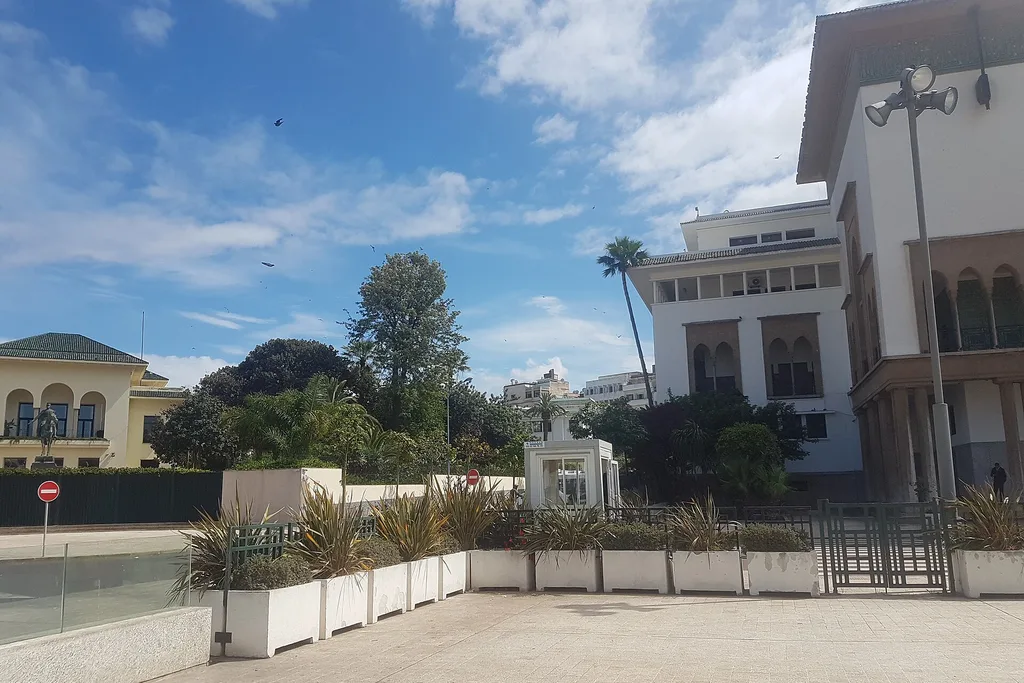
The resistance began at once and produced the era’s most remarkable Moroccan figure. In the Spanish zone, Muhammad ibn Abd el-Krim, a Rifian scholar turned commander, destroyed a Spanish army at Annual in 1921, proclaimed a Rif Republic, and held off Spain for years; it took a combined Franco-Spanish campaign with overwhelming forces to defeat him in 1926. In the French zone, armed resistance continued in the Atlas and the south for years after the cities submitted. The protectorate’s other legacy is written in concrete. Casablanca, a modest port in 1912, was built into the commercial capital of the country — its port, its boulevards, and its administrative square, the Mohammed V Square in the photograph above, where French architects wrapped modern civic buildings in Moroccan tile and carved plaster in a deliberate hybrid style. In Rabat, chosen as the administrative capital, a European ville nouvelle rose beside the medina, and the same dual pattern — historic Moroccan city preserved in outline, modern European city built alongside — was repeated in Fes, Marrakech and Meknes. Much of what a traveller uses in Morocco today, from the railway to the layout of the new towns, is protectorate work.
The protectorate ended because the fiction at its centre turned against its inventors. The sultan in whose name France ruled, Mohammed V, became in the 1940s the focus of the nationalist movement — cautiously at first, then openly, most famously in a speech at Tangier in 1947 that aligned the throne with the demand for independence. France’s answer, in 1953, was to depose and exile him, first to Corsica and then to Madagascar, replacing him with a pliable relative. It was the decisive error of the protectorate: the exiled sultan became a national symbol precisely because he was absent — his portrait appeared, Moroccans said, in the moon — and unrest rose until France, facing a deteriorating position and war in Algeria, reversed itself. Mohammed V returned in triumph in November 1955, negotiated the end of the protectorate, and on 2 March 1956 France recognised Moroccan independence; Spain surrendered its northern zone the following month, keeping only the coastal enclaves of Ceuta and Melilla, which it holds to this day. Morocco had been divided for forty-four years. The kingdom that emerged in 1956 was the same one, in dynasty and in law, that had signed the treaty of 1912 — restored rather than invented.
Independence and the Modern Kingdom
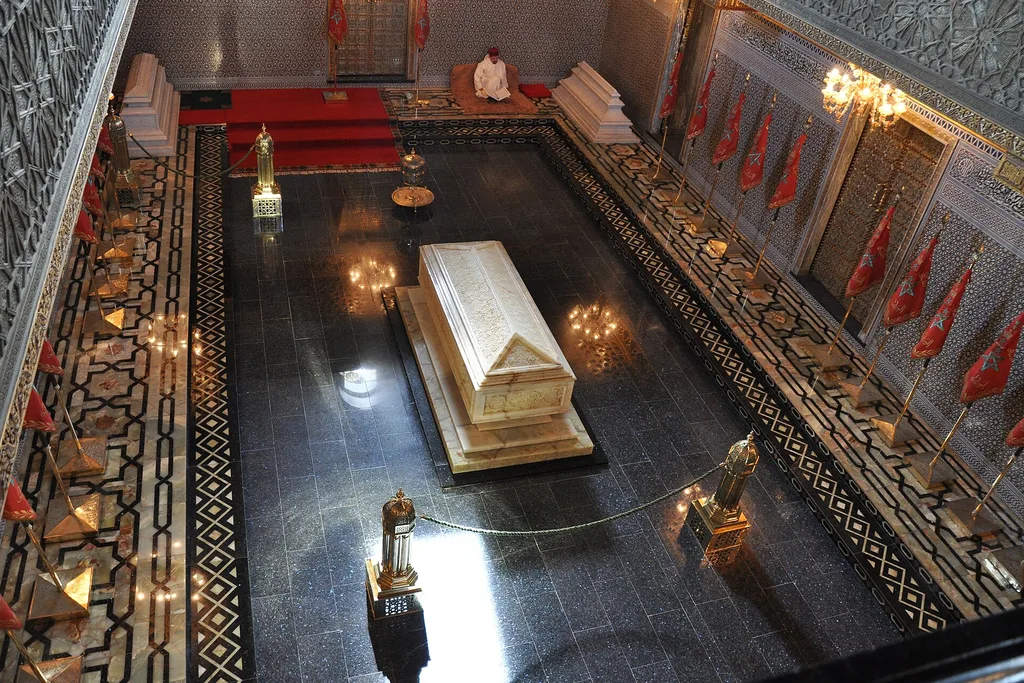
Mohammed V, who took the title of king in 1957, died suddenly in 1961 after minor surgery, and Morocco buried him in a mausoleum in Rabat that deserves the traveller’s attention as carefully as any medieval monument in this article. The Mausoleum of Mohammed V stands on the same esplanade as the Almohad Hassan Tower — the unfinished twelfth-century minaret and the twentieth-century royal tomb facing each other across the columns of the mosque that was never built — and it was designed, deliberately, in the full classical grammar of Moroccan craft: zellij, carved plaster and cedar, executed by hundreds of traditional master craftsmen. A Quran reader sits by the sarcophagus in the chamber in the photograph above. The pairing on that esplanade is the modern kingdom’s own account of itself: the Alaouite monarchy presenting its independence not as a break with the dynasties in this article, but as their continuation.
His son Hassan II reigned from 1961 to 1999 through the most contested decades of modern Moroccan history — years of political tension and repression that Moroccans call the Years of Lead, two attempted coups in the early 1970s that the king survived narrowly, and, in 1975, the Green March, when hundreds of thousands of Moroccan civilians marched into the former Spanish Sahara as Spain withdrew; Morocco has administered most of that territory since, and its final status remains internationally disputed, a question this article records without adjudicating. Hassan II’s own great building was the Hassan II Mosque in Casablanca, completed in 1993 on a promontory over the Atlantic — one of the largest mosques in the world, built, like the mausoleum, by Morocco’s traditional crafts at monumental scale, and the clearest sign that the dynasty-building habit described in every section above is not a medieval survival but a living practice.
Mohammed VI, who succeeded in 1999, has reigned over a Morocco of new ports, motorways, high-speed rail — the first in Africa — and continued argument about the pace of political reform, which produced a new constitution in 2011 in the wake of the Arab Spring protests. For the traveller, though, the striking thing about the modern kingdom is how legible its past remains inside it. The king is an Alaouite, as sultans have been since the 1660s; the capital is Rabat, as the Almohads made it and the protectorate remade it; the medinas of Fes and Marrakech are Idrisid and Almoravid foundations still trading. Morocco was never dissolved into anybody else’s state — not Rome’s successor empires, not the Ottomans, who never took it, and not France’s — and that unbroken thread, dynasty by dynasty, is exactly what you can see in its cities once you know the order to look in. Our 7-day Morocco itinerary is built to cross as many of the table’s rows as a week allows.
Reading the Sites With This Story – Five Places, Five Eras
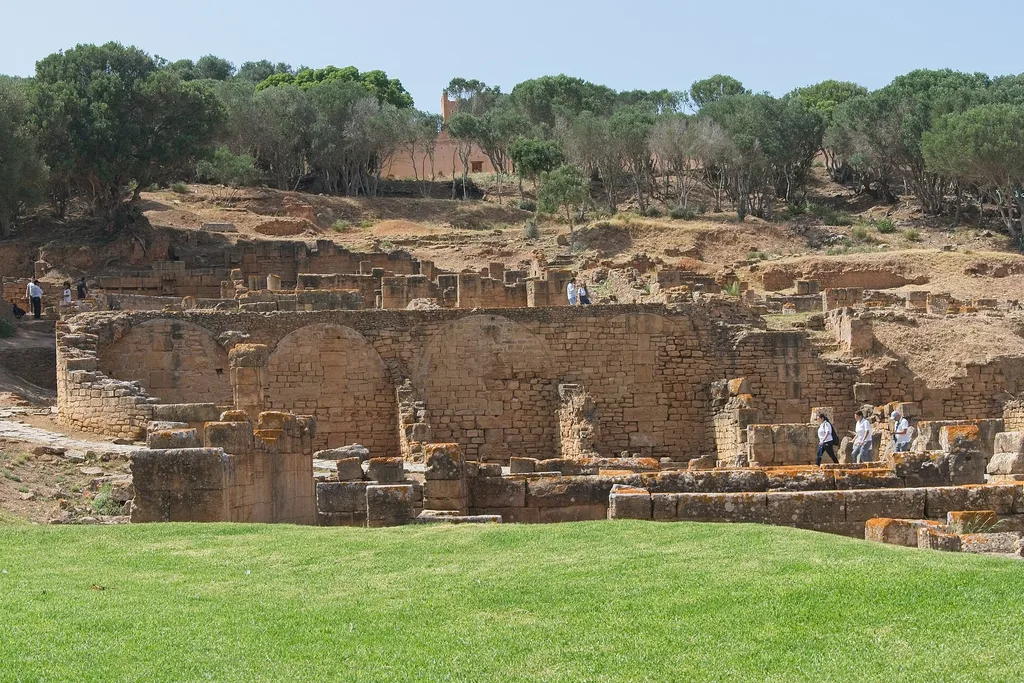
History earns its place in a trip when it changes what your eyes do at a site, so here is the whole story translated back into five places most travellers will actually stand in. At Volubilis, read the mosaics before you read the labels. They are floors of private houses, not temples — this was a working provincial city that made its money from olive oil, and its arch thanks an emperor for tax privileges, not for a victory. Read it as a business town that Rome enriched and that outlived Rome, and the Idrisid chapter starting in its streets will make sense. At Fes, read the medina as an Idrisid foundation with Marinid jewels set into it: the plan, the river, the two banks and al-Qarawiyyin are the ninth century; the madrasas you will queue for are the fourteenth, paid for by the dynasty that decided learning, not empire, was the monument it wanted.
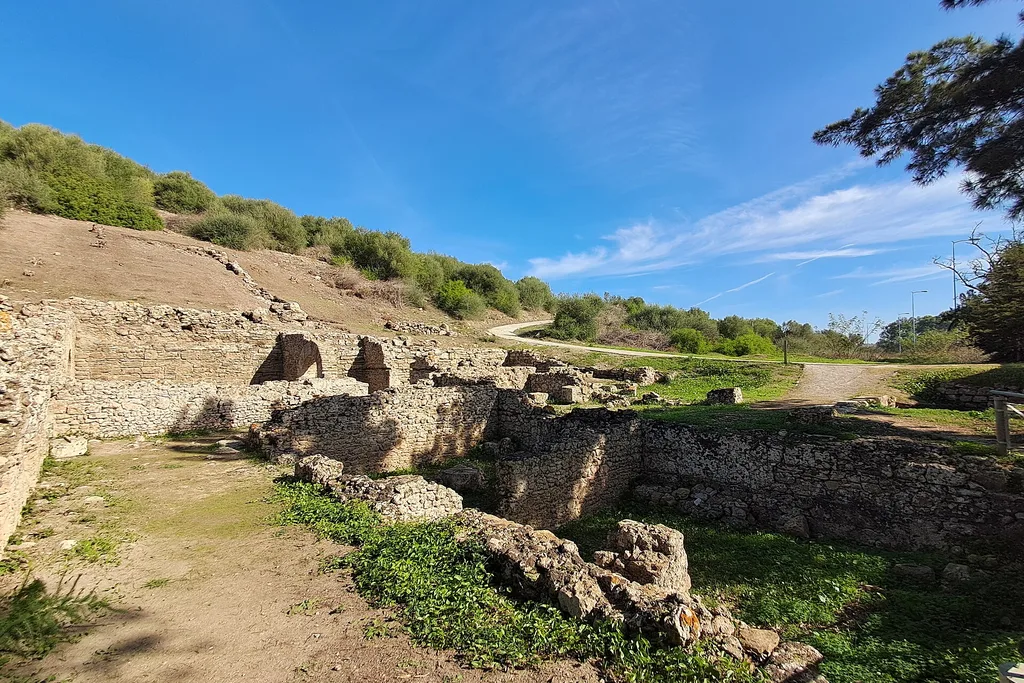
At Marrakech, read the skyline. The Koutoubia is Almohad, built by the conquerors who demolished the Almoravid mosque beneath its site; the one surviving fragment of the founders is the little Koubba across the medina, and the two together tell the city’s founding story better than either does alone. Then read the kasbah quarter as the Saadian layer — tombs hidden for three centuries, a palace stripped to its walls — and remember that the red walls around all of it are the Almoravid city’s own material, renewed by every dynasty since. At Rabat, read the esplanade: an Almohad tower never finished, a modern royal mausoleum finished to the last tile, and between them eight centuries in which the same ground kept being chosen for the same purpose. And at Chellah, in the photograph above, read the layers in a single glance — Roman walls below, a Marinid mosque and royal tombs above, storks nesting on both — because Chellah is the one site in Morocco where two of this article’s eras share a frame without either disturbing the other.
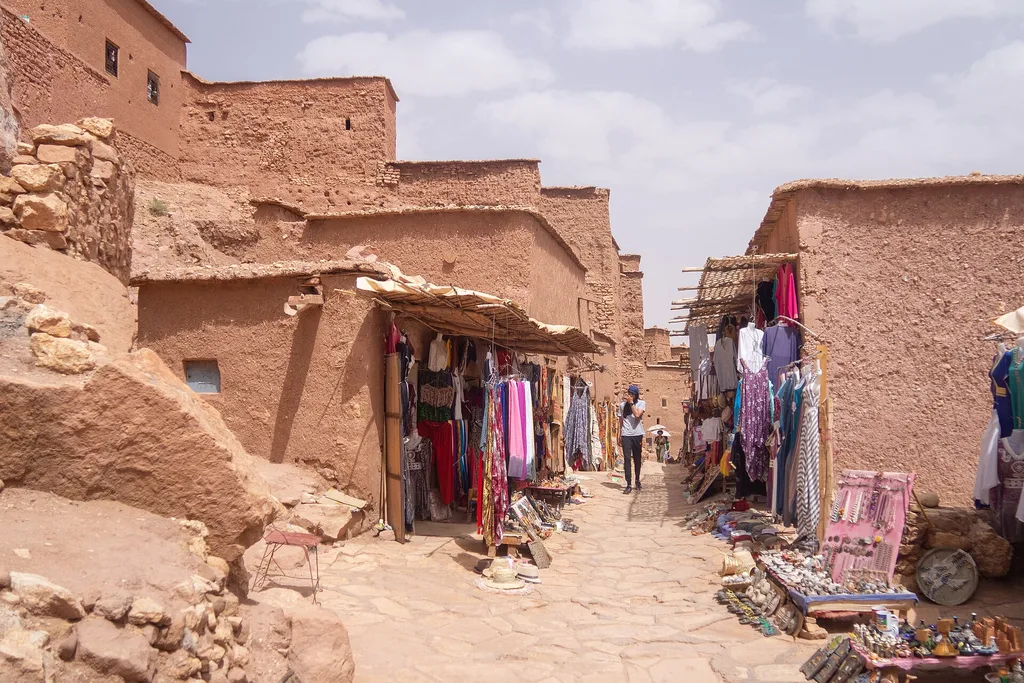
If your route runs further, the same reading works at the edges of the map. Meknes is the Alaouite chapter standing open: read the granaries before the gates, because Moulay Ismail’s genius was supply, and the stables explain the palaces. Essaouira is the eighteenth-century chapter — an Alaouite sultan’s planned port on a Phoenician island anchorage, its sea defences built to European designs in Moroccan stone. And in the south, the ksar of Ait Benhaddou reads as the caravan age in one village: an earthen fortress-town on the route between Marrakech and the Sahara, rebuilt by each generation in the same mudbrick, which is why no dynasty in this article owns it and all of them used it. Pull the five places together and the pattern of the whole article stands in one itinerary: a Roman business city, an Idrisid university town, an Almoravid foundation under an Almohad tower, an Almohad stump facing a modern tomb, and a Roman ruin gardened by Marinid kings. That is Morocco’s history as a trip, and it is a trip worth taking slowly. Our Morocco travel guide puts the places in route order; this page is the commentary to carry into them.
Questions Travellers Ask About Morocco’s Past
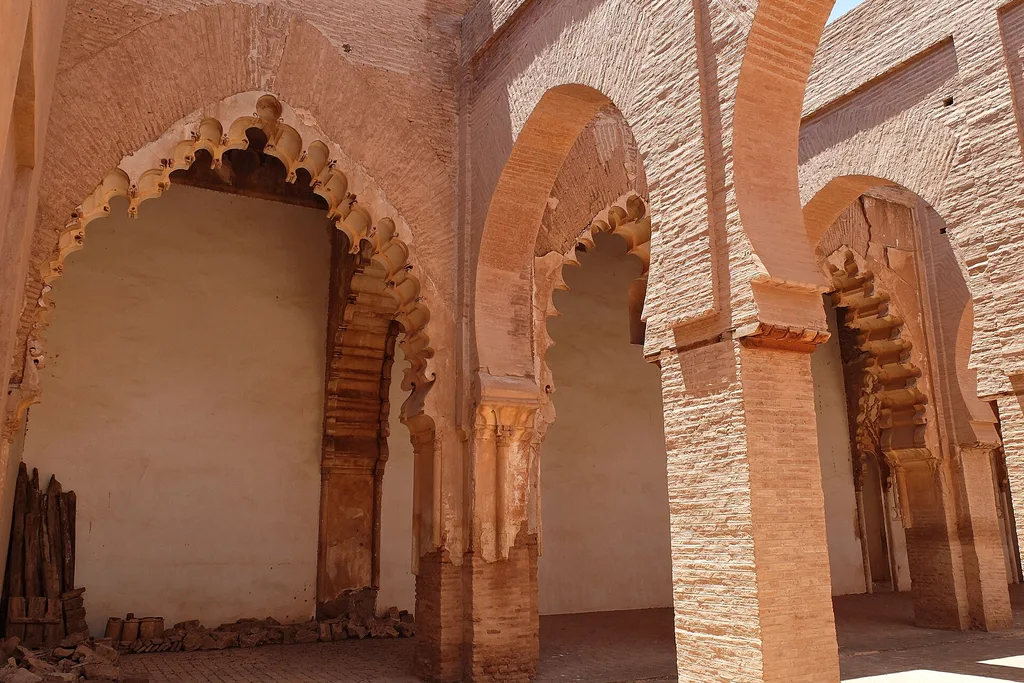
Which is Morocco’s oldest city, Fes or Marrakech? Fes, by nearly three centuries — founded under the Idrisids in the years around 800, while Marrakech rose under the Almoravids around 1070. But “oldest” needs care: Tangier and Lixus are far older as settlements, with Phoenician-era roots, and Volubilis is older still as a town site. Fes’s claim is different and stronger: it is the oldest Moroccan royal city still functioning as one, on streets that follow its founding plan.
Why do Fes and Marrakech both feel like capitals? Because for six hundred years they took turns being one. Fes was the Idrisid capital and the Marinids’ seat; Marrakech was founded by the Almoravids, held by the Almohads and refounded as capital by the Saadians; the Alaouites moved between Fes, Meknes and Marrakech as politics required. Each dynasty built in the city it favoured, which is why both cities hold a near-complete set of royal monuments — and why Rabat, the modern capital, is the third layer, not a replacement.
Did the Ottomans ever rule Morocco? No — and Morocco is the great exception in North Africa. Algeria, Tunisia and Libya all became Ottoman provinces; Morocco, under the Saadians and then the Alaouites, fought Ottoman pressure from the east to a standstill in the sixteenth century and kept its independence. It is one reason the Alaouite monarchy’s claim to continuity carries such weight: the country was never absorbed into any later empire, Ottoman or European, in the way its neighbours were.
Is al-Qarawiyyin really the world’s oldest university? It is recognised by UNESCO and Guinness World Records as the oldest existing educational institution in continuous operation, founded in 859 — centuries before Bologna or Oxford. The honest qualification is that it began as a mosque and teaching foundation and developed the character of a university over time, rather than being chartered as one on a single date. Either way, when you pass its gates in Fes el-Bali you are passing an institution that has been teaching, in some form, for over eleven and a half centuries.
Why is the Hassan Tower unfinished? Because its builder died. The caliph Yaqub al-Mansur began the mosque in 1195 as a statement of empire; work stopped at his death in 1199 and no successor completed it — partly from cost, partly because the empire’s fortunes turned. What remains — the tower at a little over half its intended height and the stubs of two hundred columns — was further shaken by the 1755 Lisbon earthquake, which damaged the site heavily. Morocco kept the stump as the emblem of Rabat rather than clearing it, which is why an unfinished building is one of the country’s most famous monuments.
How long has the current royal family ruled? Since the 1660s. The Alaouites took Fes in 1666, Moulay Ismail consolidated the kingdom in a reign that lasted to 1727, and every Moroccan sovereign since — through the protectorate, when the dynasty reigned while France ruled, and through independence, when it resumed ruling — has belonged to the same family. It is among the longest continuous dynastic runs anywhere in the world, and it is why Moroccan history reads less like a sequence of states than like one long reign with chapters.
The Story in One Walk
The shortest true summary of Morocco’s past is that it is a relay run in the same few cities. A Roman oil town that outlived Rome and handed its streets to the founder of the first dynasty. A refugee prince whose great-grandson’s city is still the country’s mind. Desert reformers who founded a red city on the plain and filled an empire from Senegal to Spain, and mountain reformers who took it from them and raised the minaret the whole Maghreb copied. Scholars’ sultans who spent the surplus on colleges instead of conquests. A sharifian house that beat a crusade, built a palace called the Incomparable, and lost both to its own succession. And the family that followed, which built a capital out of granaries, recognised a republic across the Atlantic before almost anyone, survived the century of empires, lent its name to a protectorate it did not control, and took the country back in 1956 with the same throne it had never left.
So read the sites in their order when you go. Start, if you can, with a mosaic floor in Volubilis, where the oil money of Rome is still in the stone, and with the white town on the hill above it where the first dynasty is buried. Stand under the Koutoubia knowing the founders’ mosque lies beneath it, and in the Attarine’s courtyard knowing the dynasty that built it chose books over battles. Stand on the Rabat esplanade last, between the tower that was never finished and the tomb that was finished to the final tile, and you will have the whole argument of this page in one view: Morocco’s history is not a ruin behind it. It is the ground plan underneath it, dynasty on dynasty, and the present city is simply the latest layer being built.