Most people meet Antalya through a transfer window. The flight lands, the coach turns east or west along the coast, and the city shrinks to a name on the airport sign — the place the resort happens to be near. That is a waste of one of the Mediterranean’s most complete small cities. Antalya has a walled old town standing on cliffs above a Roman harbour, two entirely different urban beaches, a river that falls into the sea off a cliff, and four ancient cities close enough to visit on day trips without heroic effort. It also has the warm, workable sprawl of a real provincial capital, with trams, markets and neighbourhoods that exist for the people who live in them. That combination — resort coast outside, real city inside — is exactly what this antalya travel guide sets out to plan.
The mistake is to treat it as a checklist. Antalya’s parts are spread along some fifteen kilometres of coast, and the trip works when the days are built the way the city is built: the old town and its harbour in one piece, each beach given its own day and its own logic, the waterfalls slotted where they actually sit, and the ancient cities chosen rather than collected. Three days covers the city itself honestly. Four or five turns it into what it does best — a base, from which Perge, Aspendos, Side and Termessos are each a single, unhurried expedition.
This guide is organised that way, and it follows the house rule of printing nothing that rots: no ticket prices, no fares, no exchange-rate maths dressed up as a budget. Where a figure can change — and in Türkiye, figures change — we describe the arrangement and point you to the source that settles it. One change matters more than all the others, and it is flagged where it belongs below: the Antalya Museum, for decades the city’s great indoor sight, is closed and being rebuilt. Plan around that fact, not around the older guides that have not caught up with it. If Antalya is one stop on a longer Turkish trip, the planning logic here pairs with our Istanbul travel guide, which works the same way for the bigger city at the other end of the domestic flight.
At a Glance
Short on time? Here is the whole antalya travel guide argument on one screen.
| Question | Short answer |
|---|---|
| How long do I need? | 3 days for the city itself; 4–5 to add day trips to the ancient cities |
| What is the shape of a trip? | One day in Kaleiçi, one day per beach world, waterfalls fitted around them, ruins as separate day trips |
| Which beach? | Konyaaltı for the city beach with a mountain backdrop; Lara for sand and the resort strip |
| What is closed that guides still recommend? | The Antalya Museum — closed since July 2025 for a complete rebuild; check muze.gov.tr before planning around it |
| How do I get around? | AntRay trams and city buses on an AntalyaKart; the centre and old town on foot |
| Is there a train station? | No — Antalya is reached by air and road; intercity travel runs through the airport and the otogar (bus station) |
| What is the one planning rule? | Treat Antalya as a base, not a stopover — its day trips are the equal of its own sights |
Kaleiçi – The Old Town on the Cliffs
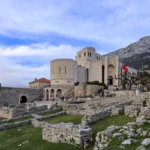
Kaleiçi — the name simply means “inside the castle” — is the old walled quarter at the city’s centre, standing on the flat top of the cliffs with the sea directly below. Antalya began here as Attaleia, a harbour city founded under Attalus II of Pergamon in the second century BC, and every power since has left a layer inside the walls: Roman engineering, Byzantine churches, Seljuk mosques, and street upon street of Ottoman houses, their upper floors jettied out over lanes too narrow for cars and mostly closed to them. The result is not a museum quarter. It is a working, lived-in old town of small hotels, family restaurants, carpet shops, cats and courtyard cafés, protected as a conservation area and all the better for being slightly scruffy at the edges.
The way to take Kaleiçi is slowly and on foot, letting it be confusing. The lanes kink, dead-end and double back, and the landmarks — the fluted minaret, the clock tower at Kalekapısı, the broken minaret, the harbour below — keep reappearing from new angles, which is how the quarter teaches you its map. Give it a full day rather than a morning: the old town in the early hours, when the lanes are empty and the light comes across the water, is a different place from the same streets at midnight, when the bars around the harbour are full and the restaurants spill onto the cobbles. Both are the real Kaleiçi.
Its sights are individually small and collectively superb, and the three that follow are the ones to build the day around. Everything else — the restored Ottoman mansions, the little mosques, the wall fragments and Roman masonry recycled into garden walls — is found by wandering between them, which is precisely the point of staying here rather than visiting. If you sleep anywhere else in Antalya, come to Kaleiçi at least twice: once for the archaeology in daylight, and once in the evening, when the cliff-top restaurants fill and the harbour lights come on below.
Hadrian’s Gate – The City’s Marble Front Door
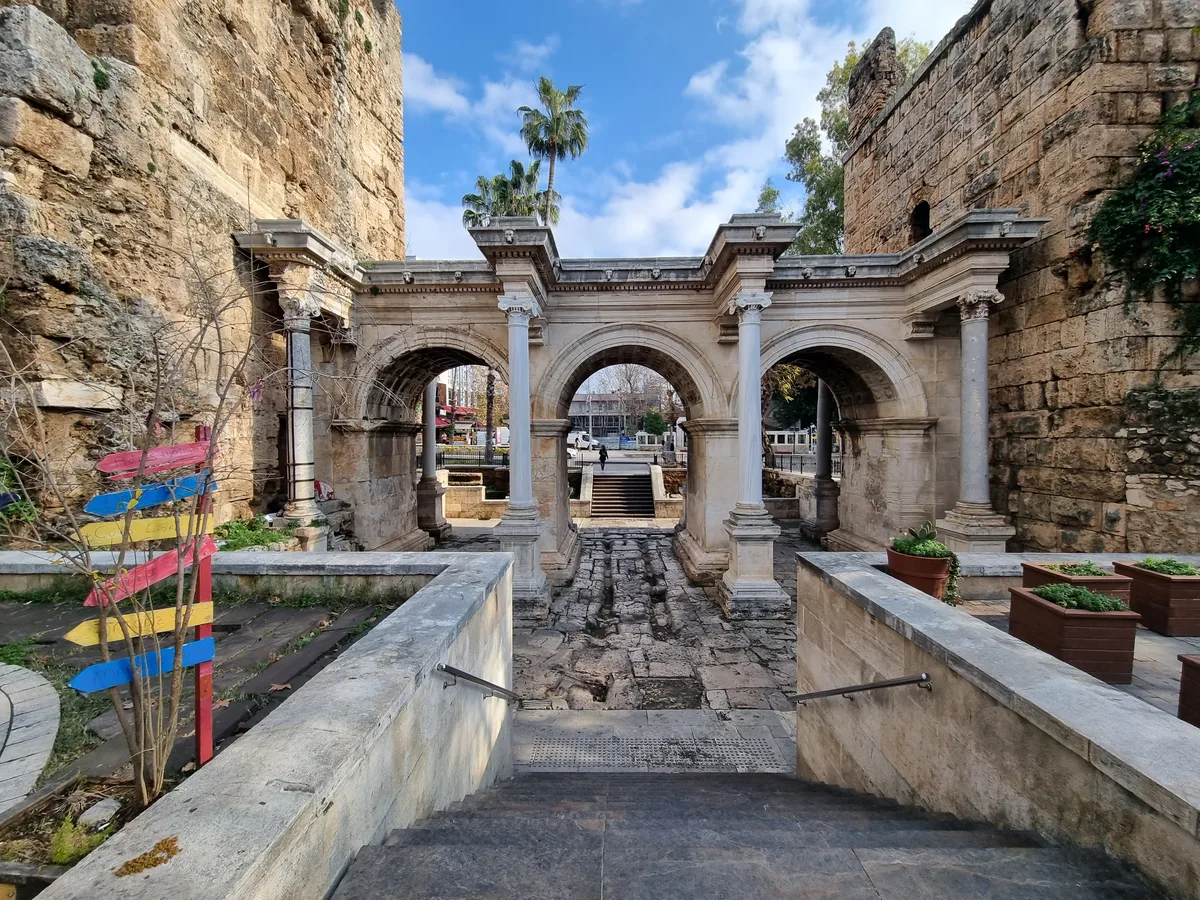
At the eastern edge of the old town, where the modern shopping street of Işıklar meets the walls, stands the most beautiful survivor of Roman Antalya: a triple-arched marble gateway raised for the emperor Hadrian’s visit to the city in AD 130. It is generally described as the only gate of the ancient city walls to survive into the modern era — the rest of the circuit came down as the city grew — and it survived partly by luck, walled up and forgotten for centuries inside later fortifications, which kept its carved marble out of the weather and the lime kilns.
Walk through it slowly, in both directions. From the modern street it reads as a monument; from the old-town side it works as what it always was, a doorway — the worn ancient street runs beneath the arches, and the two flanking towers of the city wall, from different periods, frame it like bookends. The carving repays a close look: this was an imperial billboard as much as a gate, built to be read by everyone entering the harbour city from the landward side. Look down as you pass through, too — the paving under the arches is grooved and polished by centuries of wheels and feet, the city’s traffic written into its own doorstep.
In planning terms the gate is the natural front door to a Kaleiçi day. Enter here in the morning, when the tour groups have not yet built up, take one photograph from each side, and then let the lanes take over — the old town’s main east-west threads all lead downhill from this point towards the harbour. It needs no ticket, no timing strategy and no more than fifteen minutes of your day; its job in the trip is ceremonial, and it does it perfectly.
The Yivli Minare and the Broken Minaret
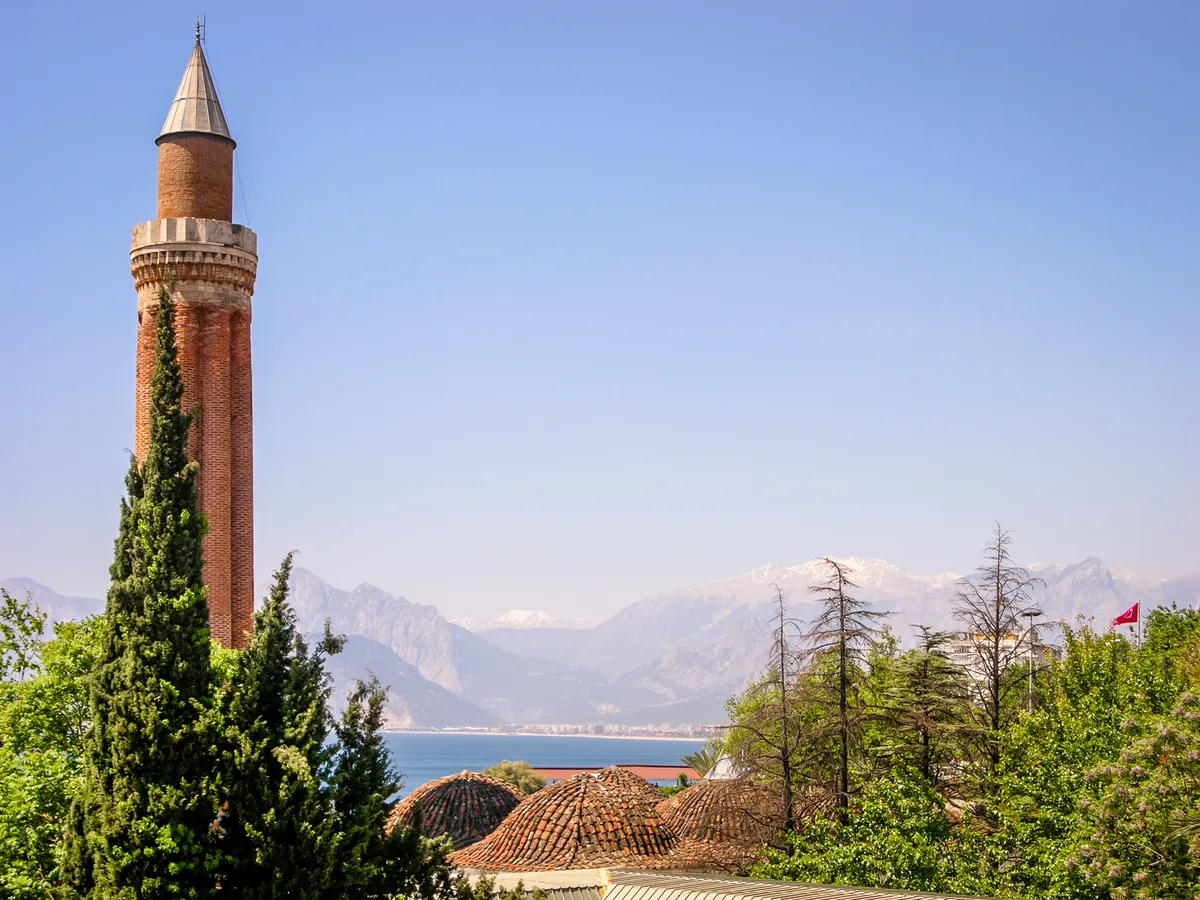
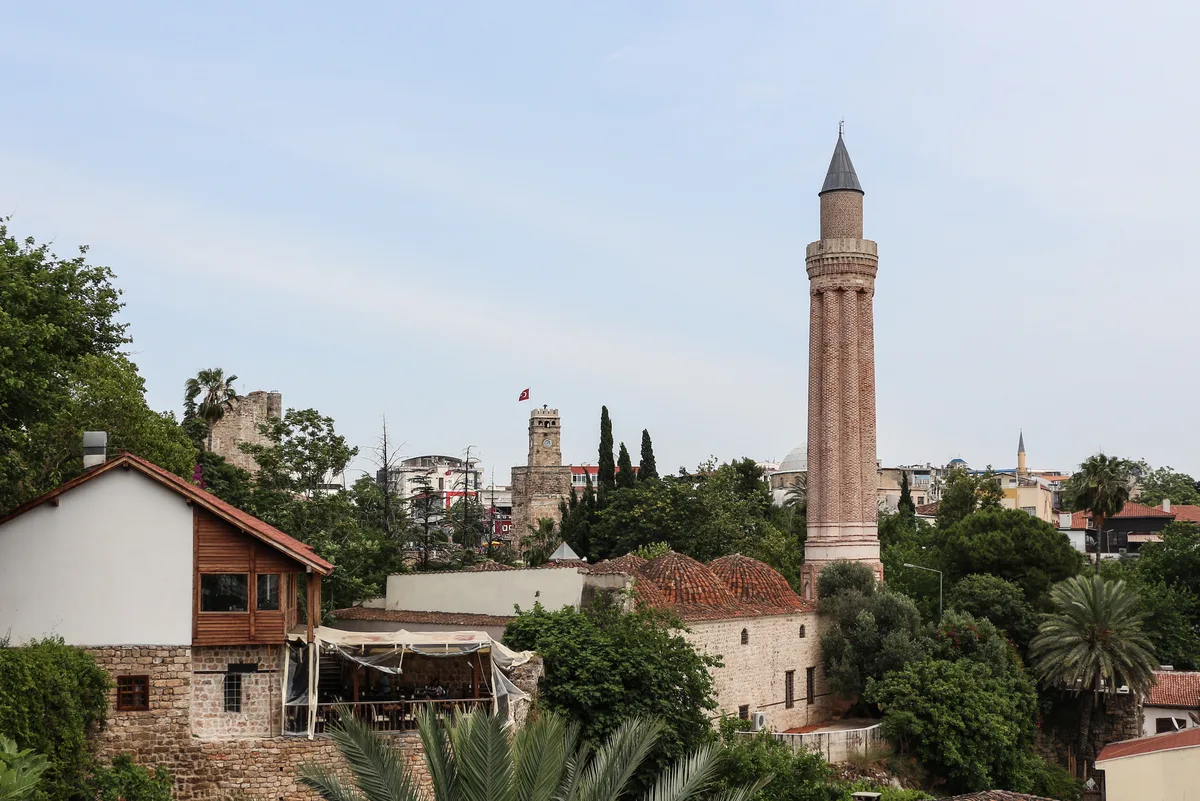
Antalya’s symbol is not a Roman ruin but a Seljuk minaret. The Yivli Minare — the “fluted minaret” — rises from the centre of Kaleiçi on a square stone base: a brick shaft cut with eight flutes, once faced in turquoise tile, built in the thirteenth century under the Seljuk sultan Alaaddin Keykubad I as part of the mosque complex below it. It is visible from almost everywhere in the old town and from half the modern centre, which makes it the quarter’s compass — when the lanes confuse you, walk towards or away from the minaret according to taste, and the map reassembles itself.
The complex around it rewards a pause rather than a visit in the museum sense: the mosque it serves — raised in the same Seljuk rebuilding, by most accounts within the shell of an earlier Byzantine church, which is why its plan sits at an angle to the street — the adjoining madrasa remains, and a Mevlevi lodge among the cluster of old buildings at the old town’s high point, a short walk from the clock tower at Kalekapısı, itself a surviving tower of the city walls turned timekeeper. Come in the late afternoon if you can, when the brick takes the low sun and the Taurus range across the bay turns from grey to rose behind it.
A few lanes away stands the old town’s strangest landmark, the Kesik Minare, the Broken Minaret: a building that began as a Roman temple, became a Byzantine church and then a mosque, and lost its wooden roof and the top of its minaret to a nineteenth-century fire, leaving the truncated stump that gave it its name. Between the two minarets — one the city’s polished emblem, one its scarred survivor — you have Antalya’s whole history in a ten-minute walk, and neither asks anything of you but looking up.
Hıdırlık Tower and the Roman Harbour
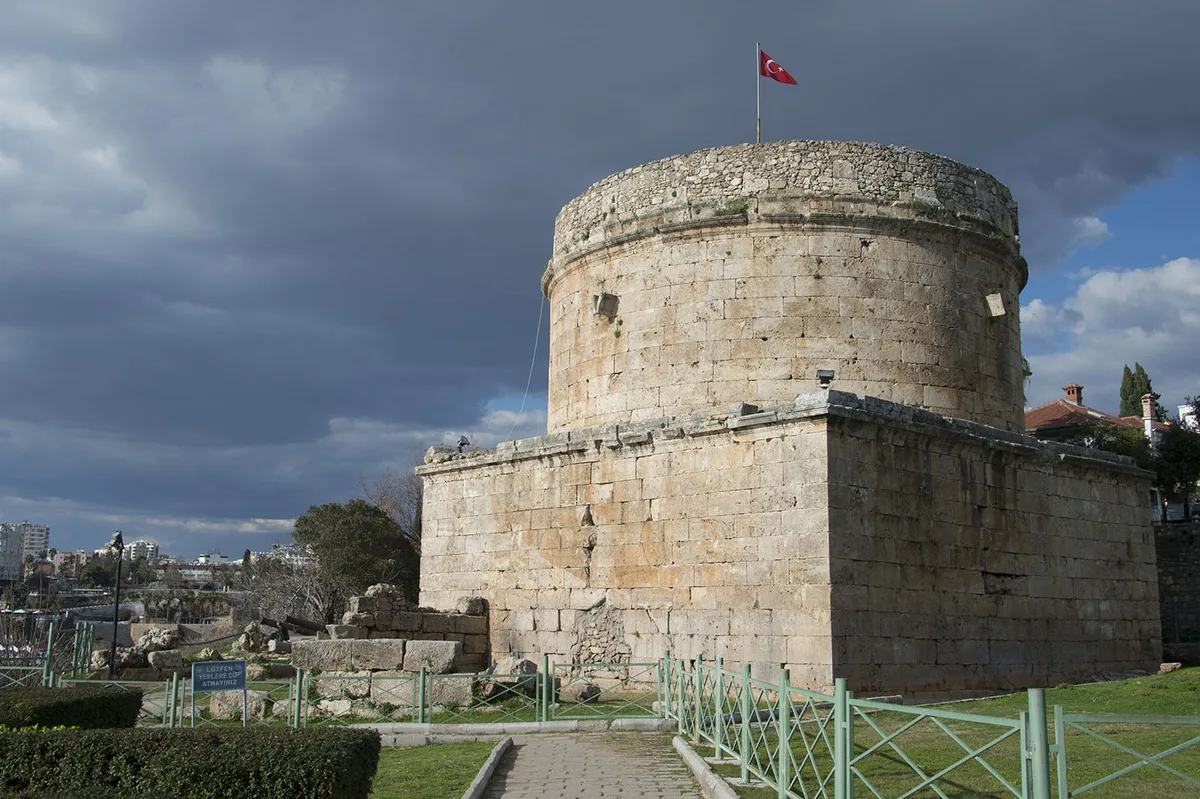
At the southwestern corner of the old town, where the walls meet the cliff edge above the water, stands a building nobody has ever fully explained: a heavy square stone base carrying a great round drum, Roman work of roughly the second century AD. The Hıdırlık Tower has been called a mausoleum, a lighthouse and a harbour fortification, and may have served as more than one of them across its long life; what is certain is its position, commanding the approach to the harbour below, and its sheer durability — it is the old town’s oldest substantially intact building, and its bulk closes the Kaleiçi skyline the way the minaret crowns it.
From the tower, the quarter’s second half opens below you. Antalya’s harbour is Roman in origin, a small natural cove hardened with breakwaters, and it still works: the fishing boats and the tour fleet crowd the quay at the bottom of the cliffs, ringed by the old walls and the restaurants under them. The descent is part of the experience — steep lanes and steps wind down through the cliff, and a modern panoramic lift near the centre of the cliff face does the same journey for those who would rather ride. Either way, arrive at the water. The harbour is where Kaleiçi stops being picturesque and becomes a port again.
Plan the two together as the old-town day’s second act: tower and cliff-top park in the late afternoon, the walk or lift down as the heat breaks, and dinner at the harbour as the boats come in. The cliff-top gardens around the tower are one of the city’s favourite evening promenades, and on a clear day the view runs west along the whole bay to the Beydağları mountains — the backdrop that makes sense of every photograph of this coast.
Konyaaltı – The City’s Own Beach
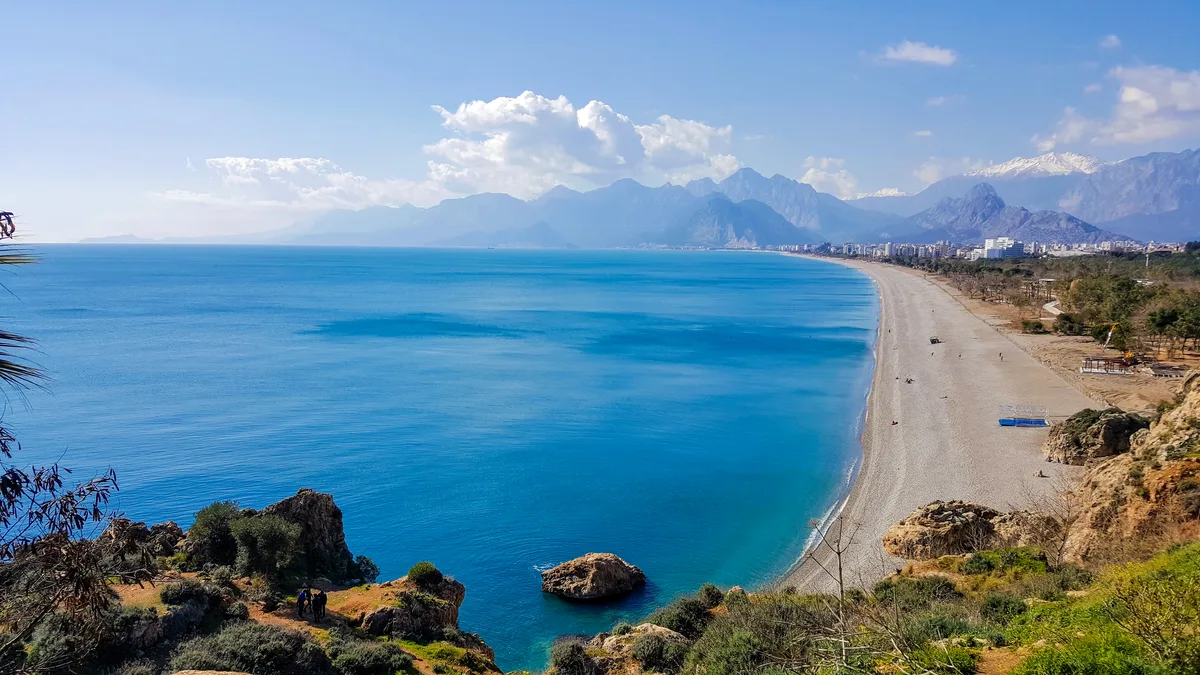
West of the centre, the cliff-top city gives way to Antalya’s great democratic pleasure ground: Konyaaltı, a long sweep of shingle beach running for kilometres along a landscaped seafront park towards the foothills. This is the beach the city itself uses. The promenade behind it is a linear park of lawns, cafés, playgrounds and exercise stations; the tram and the cliff-top road run along its edge; and the whole composition is backed by the Beydağları, the coastal wall of the Taurus, which on winter and spring mornings carries snow above the swimmers. Few city beaches anywhere offer a backdrop on this scale, and Antalyalis treat the seafront the way Mediterranean cities have always treated their lungomare — as the default place to walk, sit, fish, drink tea and watch the day end.
The honest trade is under your feet. Konyaaltı is shingle, not sand: pebbles at the waterline, a shelf that deepens fairly quickly, and a beach that rewards swim shoes and chooses its swimmers. In return you get water of a clarity sand rarely allows, space even in high season — the beach is long enough to absorb the city — and a full public infrastructure of showers, changing cabins, lifeguarded sections and beach clubs for those who want a lounger and service rather than a towel on the stones. Both styles coexist along the shore; walk a few hundred metres and the character shifts.
Konyaaltı suits the independent traveller best: anyone basing in the centre or the residential districts behind the beach, swimming in the morning, sightseeing in the afternoon, and eating where the city eats at night. It pairs naturally with the old town — the tram along the cliff top links them in minutes — and its western end, where the beach runs out towards the port and the hills, grows quieter and wilder. A large commercial aquarium complex sits just inland from the beach park, marketed on the length of its tunnel tank; it fills a rainy or fiercely hot afternoon for families, but it is an optional extra, not a reason to come. Come to Konyaaltı for the sea, the mountains and the promenade at dusk, and it will not disappoint you.
Lara – Sand, Space and the Resort Strip
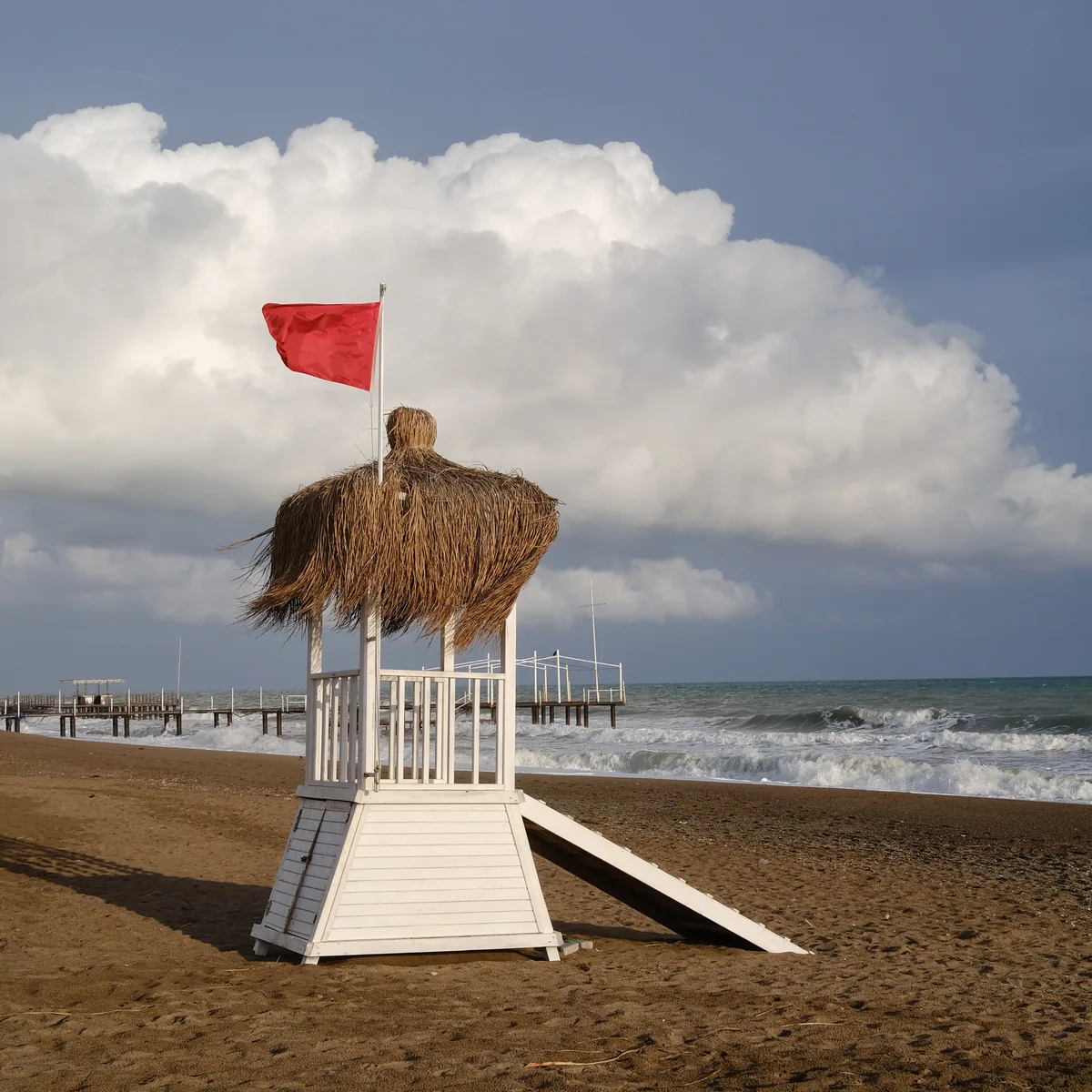
East of the centre the coastline changes character completely. The cliffs flatten, the shore turns to sand, and Antalya becomes Lara: a long, broad beach backed first by public parkland and then, further east towards Kundu, by one of the densest concentrations of large resort hotels in the Mediterranean. This is the Antalya of the brochures — themed mega-hotels with water parks, private beach frontage, piers reaching into the surf and an all-inclusive economy in which many guests, happily, barely leave the grounds for a week.
Lara’s sand is real but not postcard-white: it is the darker, mineral sand of this coast, hot underfoot at midday, shelving gently into water that warms early and stays warm late in the season. At its western end, nearest the city, the municipal beach areas offer the public version — serviced sections with the usual facilities alongside free stretches — and the sand-sculpture exhibition that sets up near the beach in season is one of the strip’s more charming eccentricities. The further east you go, the more the beach belongs to the hotels and their guests, each with its own jetty, cabanas and animation programme.
Choose Lara for what it is. For a family week built around a resort — children in the pools, the beach at the garden gate, entertainment laid on and logistics at zero — it does its job superbly, and the airport is close. For a traveller who wants Antalya itself, Lara is a compromise: the old town is a real journey west, the strip has no centre of its own, and the city can shrink to a day trip. The two beaches are not rivals so much as answers to different questions — Konyaaltı is a city’s beach that visitors may share; Lara is a holiday industry with a city attached. Decide which holiday you are taking, and the choice makes itself.
The Düden Waterfalls – One River, Two Falls
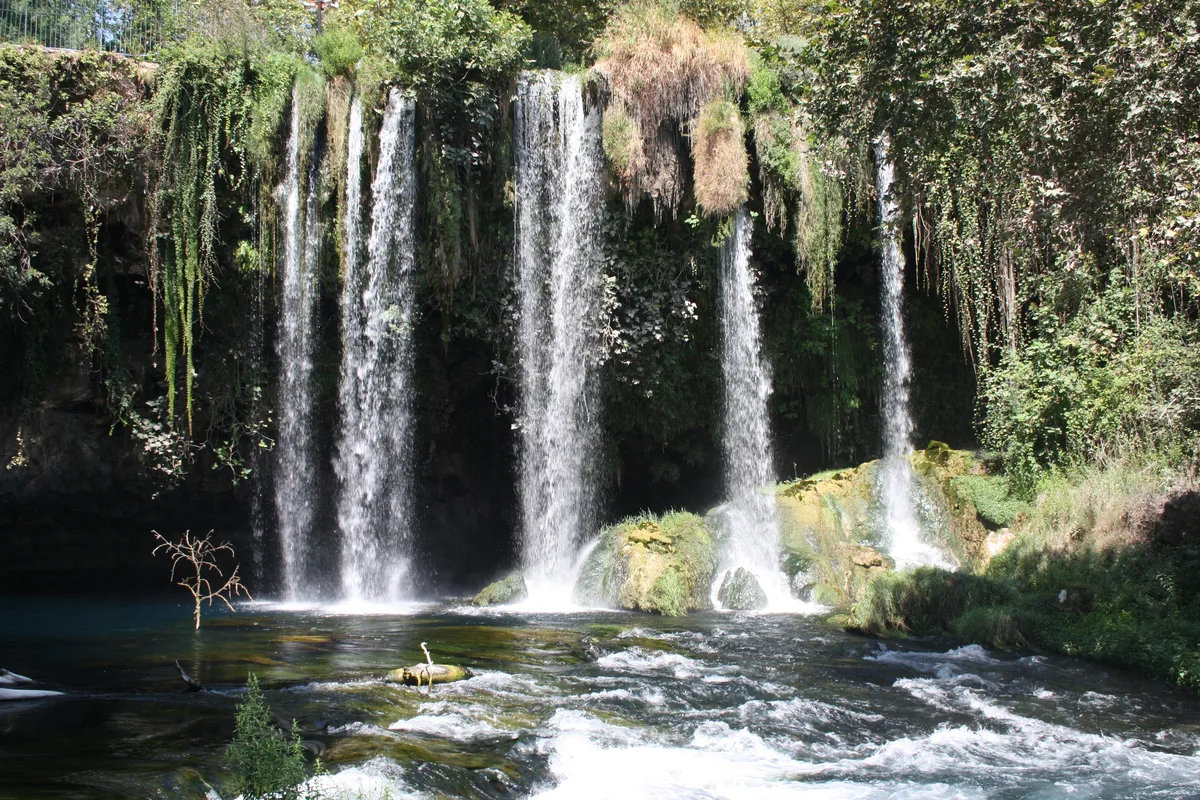
The Düden river comes out of the Taurus foothills, crosses the plain north of the city, and reaches the sea in the most dramatic way available to it — twice. The two waterfalls that share its name are different experiences in different parts of the city, and a good Antalya plan takes in both without confusing them.
The Upper Düden, in its green park in the Kepez district north of the centre, is the intimate one: the river slides over a vine-hung cliff into a clear pool, in a bowl of shade and picnic lawns that feels a world away from the coast. Its party trick is the cave that runs behind the falling water, letting you stand inside the cliff and look out through the curtain — a small, wet, memorable piece of theatre. It suits a morning, combines with nothing else in particular, and is best after rain or in spring, when the flow is at its strongest.
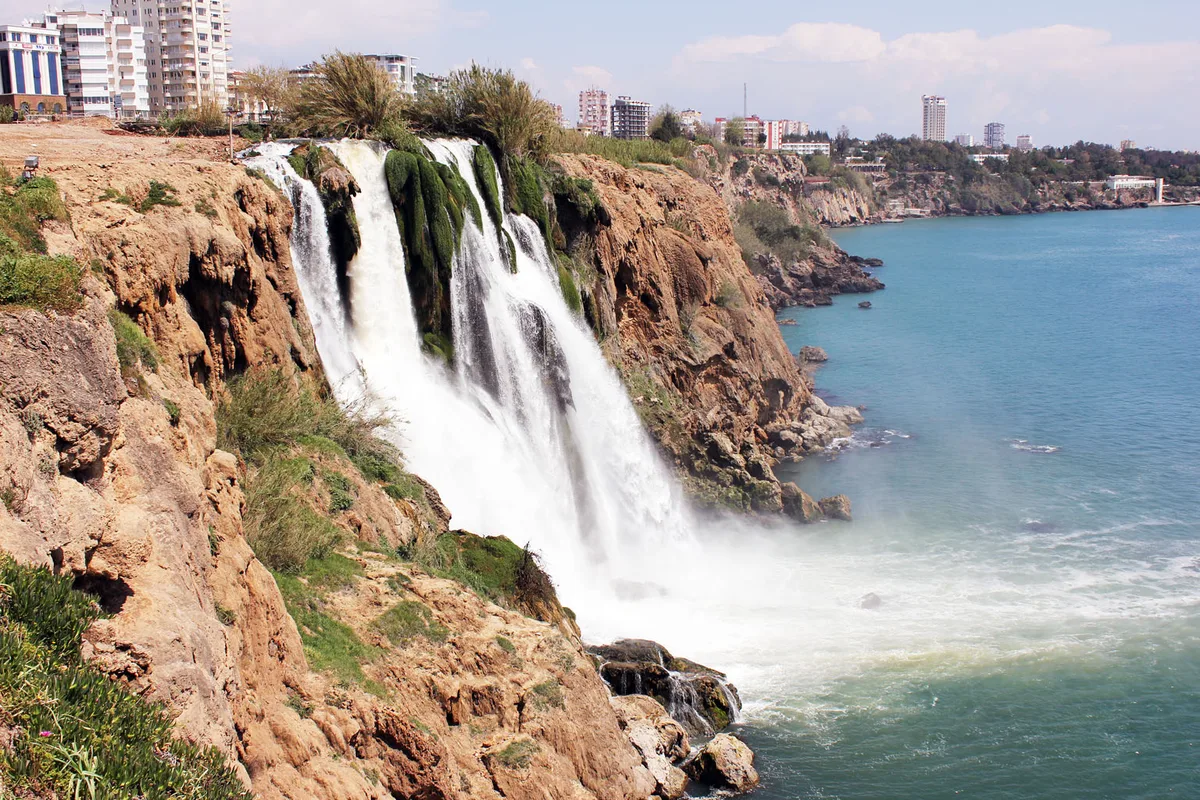
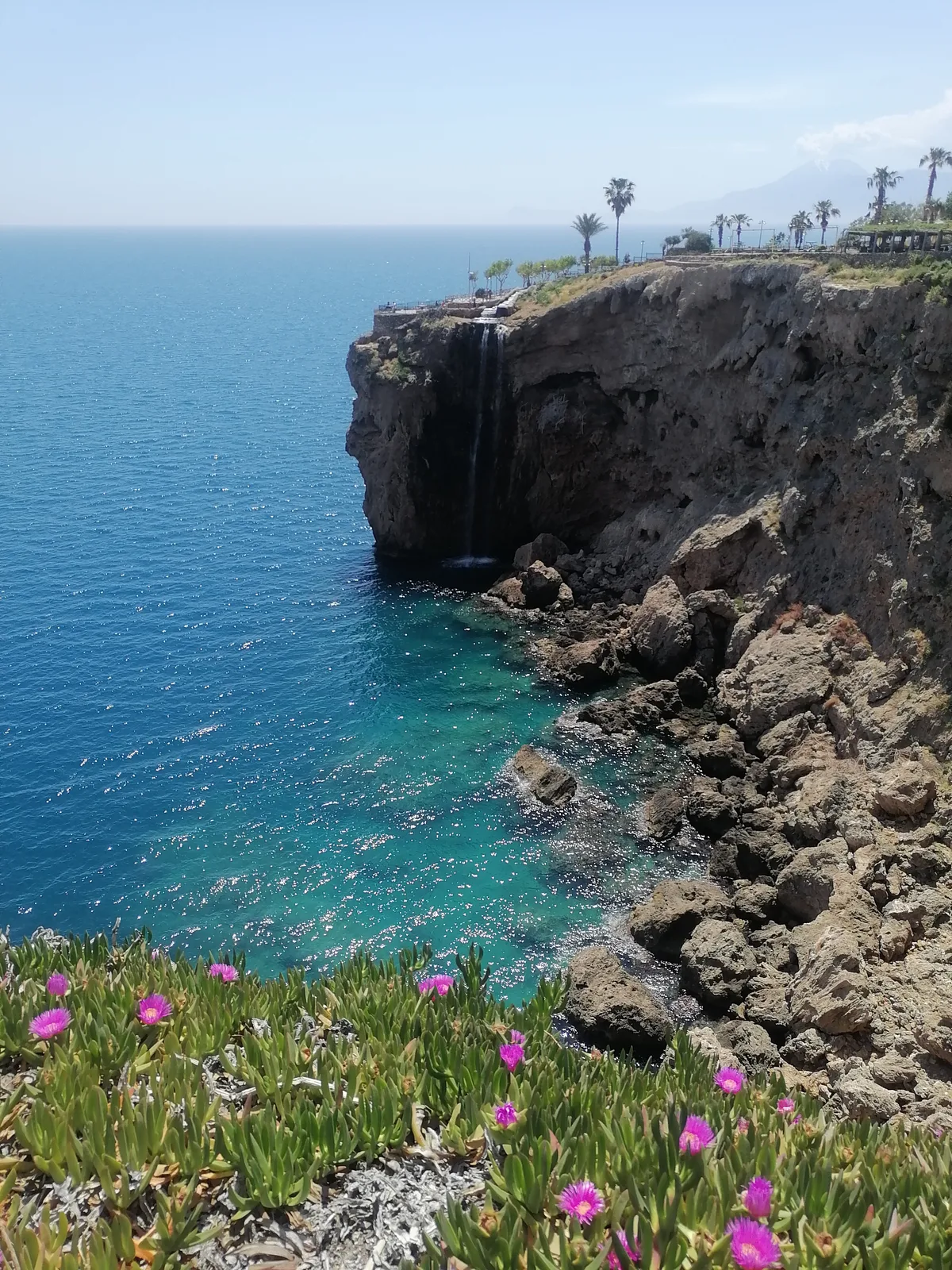
The Lower Düden — also called Karpuzkaldıran — is the spectacle: east of the old town, where the cliffs run towards Lara, the whole river pours off the cliff edge, roughly forty metres down, straight into the Mediterranean. The falls are fenced into a clifftop park with viewing terraces, and the classic photograph — white water, brown cliff, blue sea — is exactly what you get. Flow varies with the season and the river’s working life upstream, so the falls roar in spring and thin in late summer; even reduced, the sight of a river ending in mid-air earns the trip. The boat trips from the old harbour sail out to view it from the water, which gives you the second, better angle. Neither fall needs a tour: both sit within the city’s own transport web, and together they make the ideal half-day counterweight to a beach morning.
The Antalya Museum – The Closure to Plan Around
Read this section before you build any day around a museum, because the situation has changed completely and much of what ranks for Antalya has not caught up. The Antalya Museum — the great archaeological collection at the western end of the cliff-top road, holder of the Roman statues of Perge and the sarcophagi of Pamphylia, for fifty years the city’s essential indoor sight — is closed. Following a seismic safety assessment of its 1970s building, the museum shut its doors in July 2025, its collection of Roman marble and Lycian stone was moved into secure storage, the old building was demolished, and a new, larger museum is being built on the same site.
Press reports quoting officials speak of completion targeted for the end of 2026, but that is a construction estimate, not a reopening date. As of this antalya travel guide’s last check on 31 Oct 2026, the museum’s official listing on the Ministry of Culture and Tourism’s portal, muze.gov.tr, marks it closed to visits, with no confirmed date to plan against.
What this means in practice is simple. Do not schedule the museum day that older guides prescribe, do not be sold it as part of a city tour without asking the question, and do check the official listing in the week you travel — if the new building has opened, it will immediately become the city’s headline sight again, because the collection itself is superb. Until then, Antalya’s archaeology is best read where it stands: the day-trip sites below are, in effect, the museum’s galleries returned to their landscapes, and Perge without its statues in a glass case is arguably the richer experience anyway.
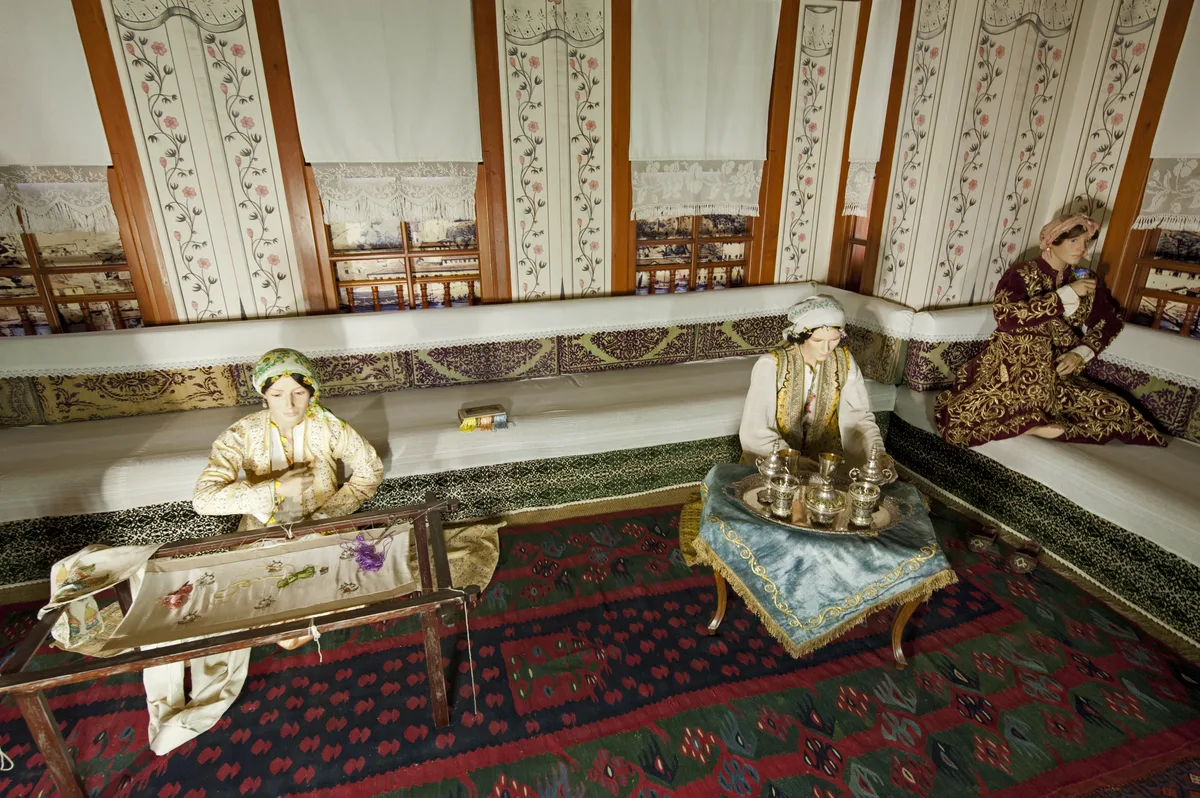
For indoor hours in the meantime, the city offers smaller consolations. In the old town, the Kaleiçi Museum — a restored Ottoman mansion paired with a former Greek Orthodox church, run by the Suna & İnan Kıraç foundation — shows how the quarter’s families lived a century ago: period rooms, photographs and the texture of daily life rather than emperors and gods. It is modest, charming and exactly the right scale for its streets. Near the centre stands the small Atatürk House Museum, preserving the house where Atatürk stayed on his visits to the city in the 1930s. Neither replaces the great collection; together they fill a wet afternoon honestly, and the old town around them does the rest.
Day Trips – Perge, Aspendos, Side and Termessos
Antalya’s greatest luxury is its hinterland. Four major ancient cities stand within day-trip range, each with a different character, and the honest advice is to choose by appetite rather than collect all four. Distances on this coast are routinely exaggerated and understated by rival guides in the same paragraph, so what follows gives you the planning shape — direction, journey character, what the site asks of you — and leaves the stopwatch at home. None of these sites prints its prices here; all are state-run antiquities, and their current terms sit with the official museum channels.
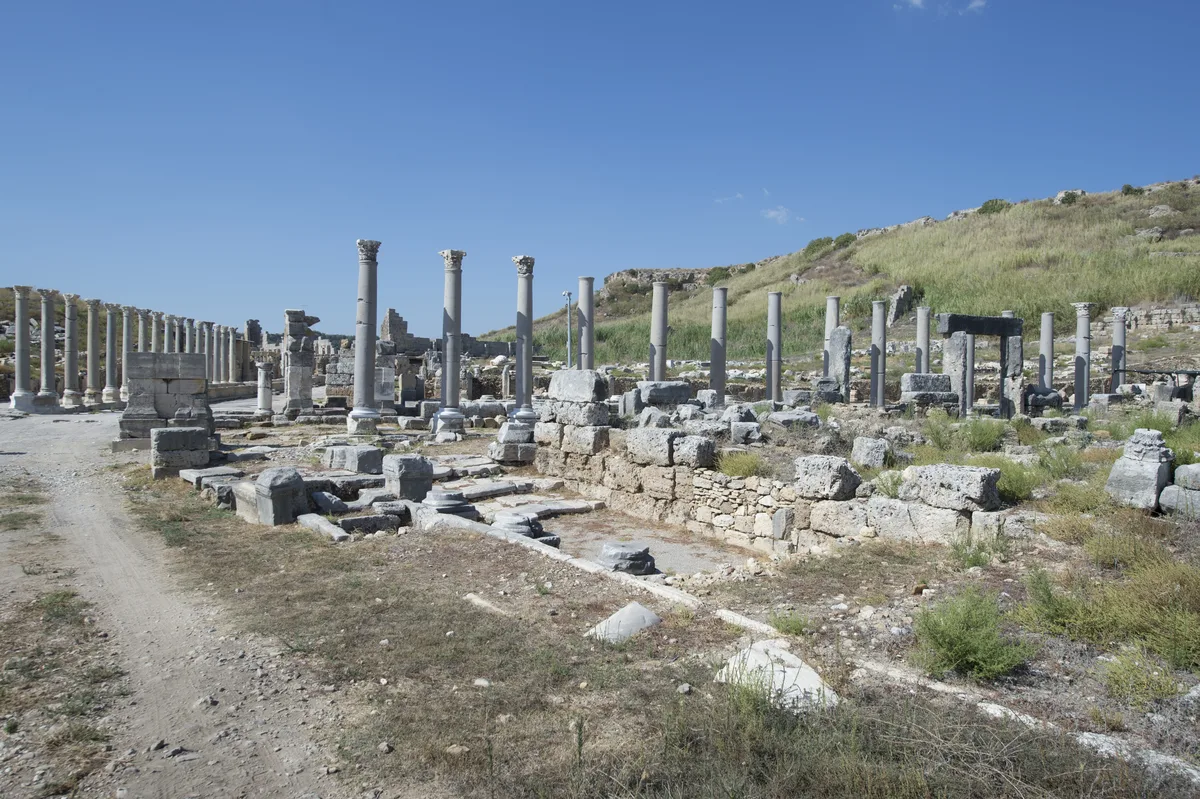
Perge – the easy masterpiece. East of the city in the Aksu district — close enough that the airport tram line runs out in its direction, with a short local hop at the far end — Perge was the capital of ancient Pamphylia and preserves the full Roman city kit at generous scale: twin Hellenistic gate towers, a vast colonnaded main street with its water channel still running down the middle, baths, an agora, and a stadium often described as among the best preserved in Türkiye. It is also, for many, the strongest argument against mourning the closed museum: the statues in those galleries came from these streets. The quality is formally recognised, too — Perge has been carried on UNESCO’s Tentative List since 2009. Perge asks for flat shoes, water and half a day at an unhurried pace, and it combines naturally with Aspendos into the classic full day — the two stand in the same eastern corridor.
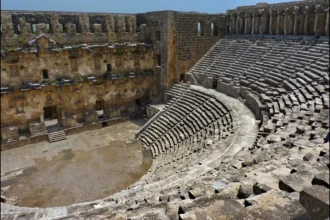
Aspendos – the theatre that still works. Further east along the same corridor, Aspendos is a one-wonder city, and the wonder is sufficient: a Roman theatre of the second century AD, attributed to the architect Zeno and built under Marcus Aurelius, whose stage building survives almost entire — the most complete in the ancient world by near-universal agreement. The theatre and its great aqueduct together stand on UNESCO’s Tentative List. It is not a ruin in the usual sense but a working venue: the state opera and ballet festival has performed here in summer for decades, and sitting in those seats for a concert is one of Türkiye’s great evenings. Around it, the acropolis hill, the stadium and the long arched line of the aqueduct repay an extra hour. If you make only one day trip from Antalya, the Perge–Aspendos pairing is the one this antalya travel guide puts first — and most travellers who take it come back agreeing.
Side – ruins inside a resort. East again, roughly the longest of the four journeys, Side occupies a small flat peninsula with a modern resort town wrapped around an ancient city. The Temple of Apollo stands at the harbour point where every sunset photograph is taken; the great theatre rises behind the agora; temples, baths and colonnaded streets thread through the hotels and restaurants. Side asks nothing physically and offers a different bargain from the others: swimming, lunch and antiquity in the same small compass, at the price of crowds and a certain theme-park polish in high season. It suits travellers who want their ruins with a beach attached, and families above all.
Termessos – the mountain city nobody took. Northwest, in the national park of Güllük Dağı, Termessos is the connoisseur’s choice: a Pisidian city on a high shoulder of the mountains — around a thousand metres up — which Alexander the Great famously failed to take and chose to bypass, and which earthquakes, not conquerors, eventually emptied. Its theatre hangs over a void with the peaks beyond; its streets, gymnasium and necropolis lie scattered through pine forest, largely unexcavated. Termessos asks for legs: the paths are rough, the site is sprawling and unshaded in parts, there is little infrastructure, and getting there means a mountain road with a walk at the end of it. In return it gives the strongest sense of discovery within reach of the city. Take water, take food, start early, and give it the full day it demands.
Boat Trips from the Old Harbour
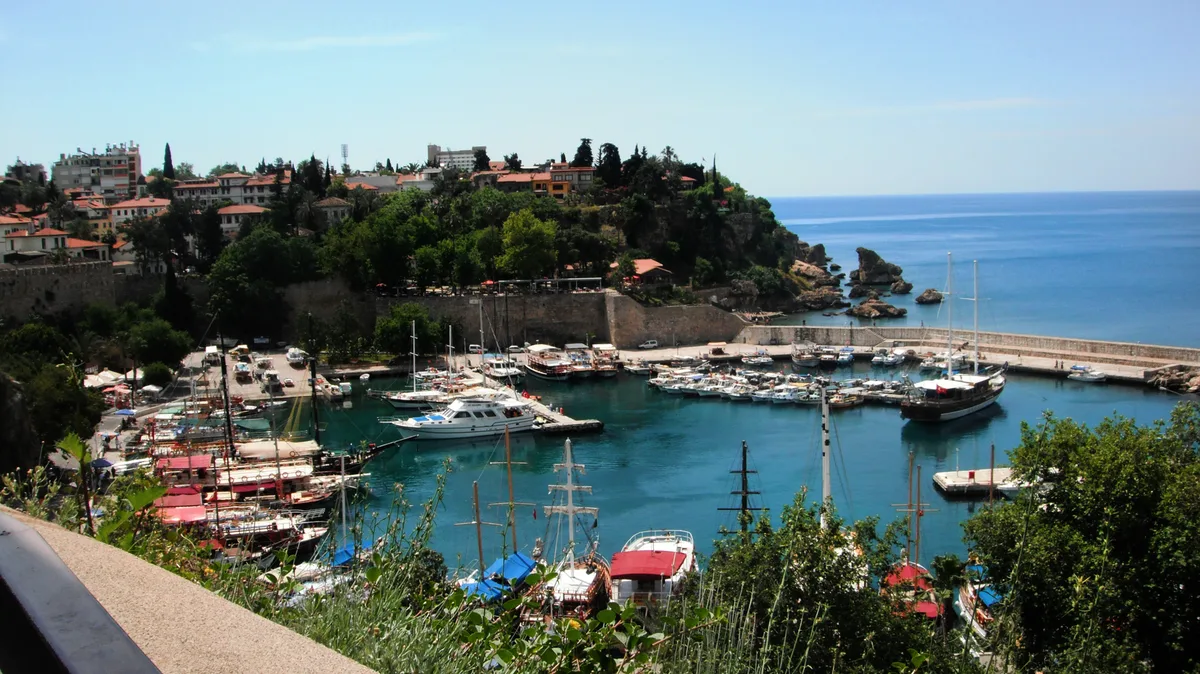
The fleet you saw from the cliff top is not decoration. Kaleiçi’s harbour is a working departure point, and a boat trip is the one Antalya experience that rearranges the city’s geography for you: the cliffs, the walls and the old town read completely differently from the water, and the Lower Düden — impressive from its clifftop park — is genuinely spectacular from below, where the whole river lands in the sea in front of you.
The offer comes in two shapes. Short trips, typically an hour or so, run along the cliff coast to the waterfall and back: simple, scenic, and the right choice for most visitors. Longer day cruises head out along the coast — west towards the coves and islands in the Kemer direction is the usual pattern — with swimming stops and lunch as part of the package. The boats themselves range from modest wooden craft to the large, pirate-themed party ships that divide opinion and fill the harbour’s outer moorings; choose by the noise level you want, because the difference is audible from the quay.
However, the mechanism matters more than the menu. Trips are sold at the harbour itself, by the boats and their touts, and the sensible routine is always the same: agree the route, the duration, what is included and the return time before any money moves, and be at the boat a little before departure. Prices are deliberately not printed in this antalya travel guide — they are negotiated, seasonal and stale within weeks — but the structure is stable: short trips are a small purchase, day cruises a bigger one, and the cliff coast justifies either. In rough weather, believe the harbour, not the holiday: the winter sea here is a serious Mediterranean sea, and a cancelled sailing is a favour, not a disappointment.
Getting to Antalya
Antalya is a flight city. Its international airport, east of the centre, is one of Türkiye’s busiest, with dense domestic services from both Istanbul airports and seasonal direct flights from across Europe layered on top. For most visitors the journey is therefore simple: fly in, and be at the sea within the hour. What happens between the arrivals hall and the hotel decides the tone of the first evening, however, and Antalya gives you more good options than most resort cities.
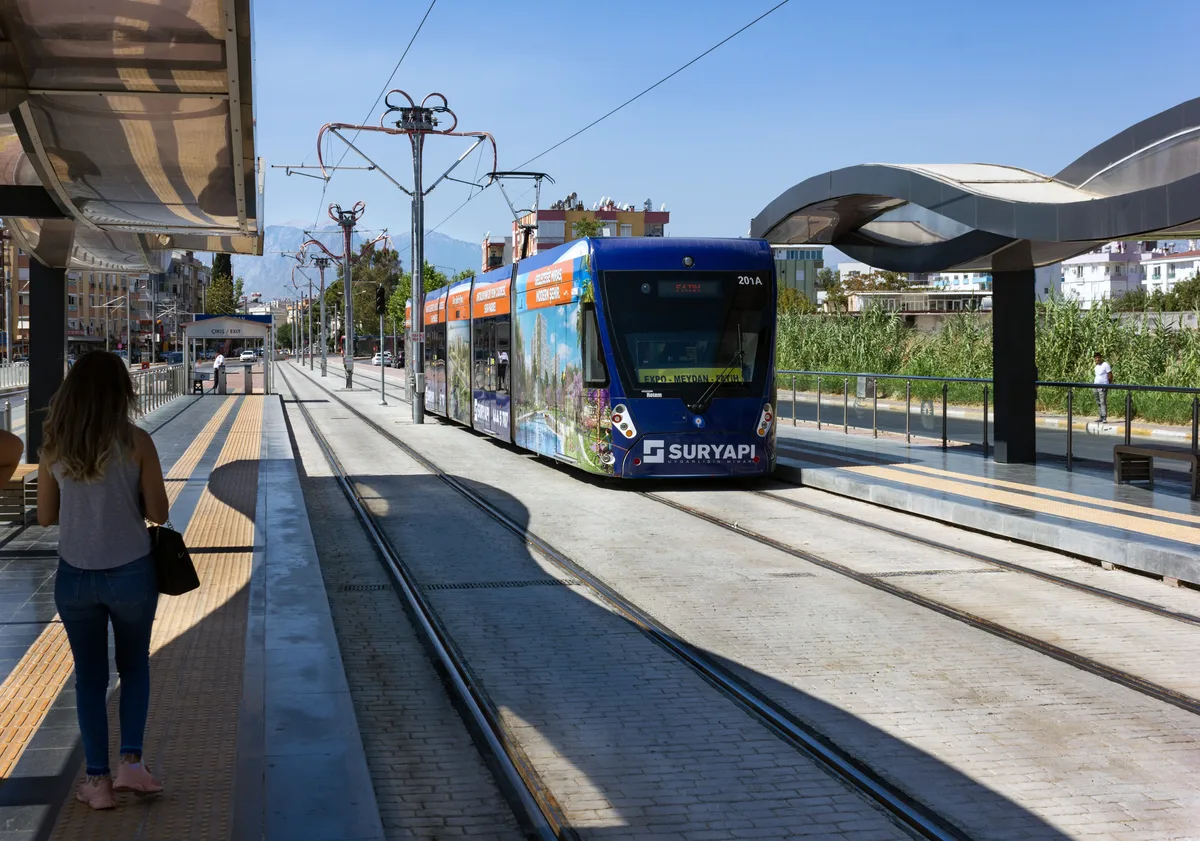
The civilised one is the tram. The AntRay light-rail line reaches the airport and runs into the city through Meydan to the centre — a fixed, traffic-proof ride that drops you within walking distance of the old town gates, which is why this antalya travel guide starts journeys at a tram platform rather than a taxi rank. Airport shuttle buses serve the otogar and city districts for those based further out; taxis wait in ranks outside the terminals and are a reasonable purchase for Lara’s strip, which the tram does not reach, or for anyone arriving exhausted in the small hours; and the big resort hotels run their own transfer machinery for booked guests. As ever on this site, no fares are printed — the choice between tram, bus, taxi and transfer is a judgement about luggage, hour and district, not about a tariff that will have changed by the time you land.
The road alternative matters for travellers already inside Türkiye. The otogar, the intercity bus station on the western side of the city and served by the tram system, connects Antalya with the whole country — Izmir, Ankara, Cappadocia’s towns and the coast in both directions — on the long-distance coaches that remain the backbone of Turkish travel. What Antalya does not have is a railway station: the rails never reached this coast, and no itinerary should be built around a train that does not exist. Fly, or ride the bus, and plan accordingly.
Getting Around Antalya
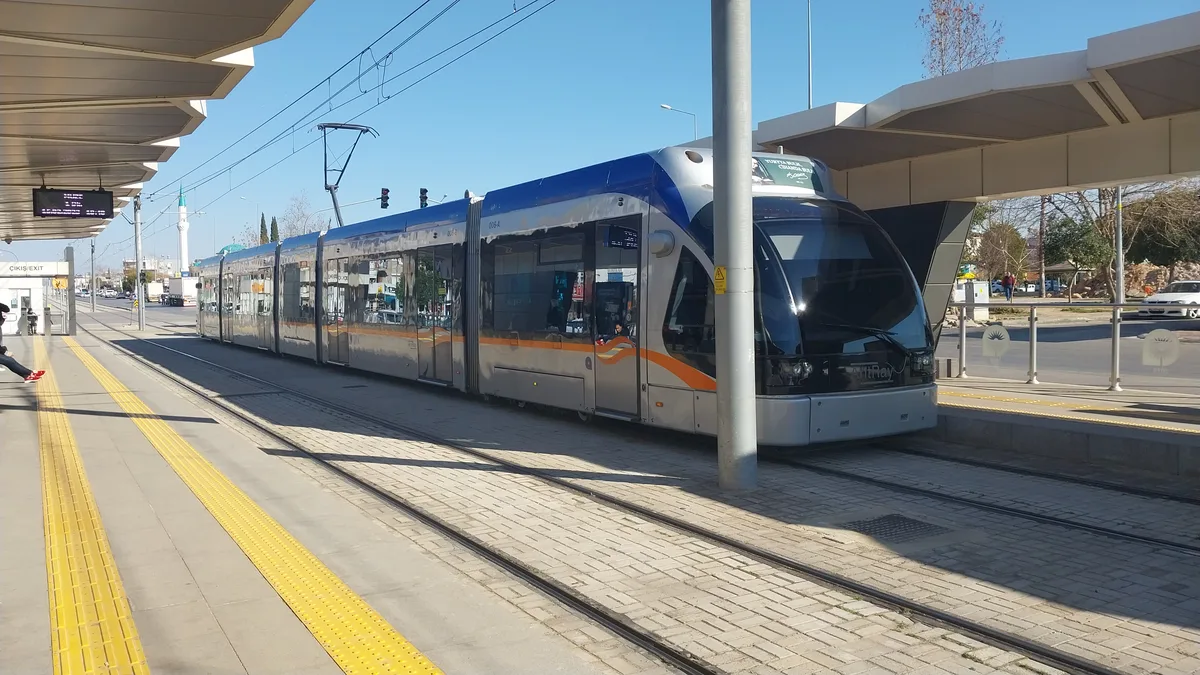
Within the city, the transport system has a clear spine, and it is the same AntRay network you arrived on. One line crosses the city from the northwest through the centre and Meydan, dividing beyond for the airport and the Expo grounds towards Perge’s district; another links the otogar and the northern suburbs to the centre and the museum road in the west; and a short heritage tram trundles along the cliff-top boulevard between the museum end of town and the eastern districts, slow, scenic and genuinely useful for the Konyaaltı end of the cliffs. Between them, the trams cover nearly everything in this guide except Lara’s beach and Termessos.
The whole system, trams and city buses alike, runs on the reloadable AntalyaKart, bought and topped up at stations and kiosks; get one on arrival and the city becomes a single network. City buses fill the gaps the rails leave — out to the Upper Düden, along the Konyaaltı shore, east towards Lara — and the dolmuş minibuses serve the outlying districts on their set routes for those staying further afield. Taxis are plentiful and metered; the standing advice is unglamorous and effective — agree that the meter runs before the car moves, and let the tram beat the traffic whenever the tram can, because at the hours that matter it always does.
Above all, walk. The centre’s geography rewards it: Kaleiçi is a pedestrian quarter by design, the cliff-top parks connect the old town to Konyaaltı in one long green promenade, and the distances between the centre’s sights are measured in minutes, not journeys. The traveller who walks the falez in the evening, rides the tram to the beach in the morning and saves the bus for the waterfalls has understood Antalya’s transport perfectly — it is a system for a city that was never as sprawling as its map suggests.
When to Go
Antalya’s climate is the classic Mediterranean bargain: a long, hot, dry summer against a mild but genuinely wet winter, and the whole art of timing a trip is choosing where on that see-saw you want to sit. The calendar in this antalya travel guide is deliberately qualitative, because the pattern matters more than any single year’s numbers — and because the city’s two great variables, heat and rain, arrive in character rather than on schedule.
Spring is the connoisseurs’ season. From March into June the city greens, the cliff parks flower, the waterfalls run at their strongest after the winter rains, and the sea warms from bracing to welcoming; sightseeing days are long and kind, and the ancient sites are at their greenest. Autumn runs the same trick in reverse and adds the warmest sea of the year: September and October are the consensus sweet spot, hot enough for the beach, cool enough for Perge, with the Taurus sometimes showing its first snow above the swimmers late in the season — the photograph that defines this coast.
Summer, by contrast, is a beach climate with a city attached. July and August bring daytime heat well into the thirties and humidity to match; the correct response is the local one — swim early, sightsee in the first and last hours, retreat to shade and long lunches in between, and let the evenings, when the whole city comes out onto the promenade, carry the day. Winter is the quiet bargain: mild between its storms, empty of crowds, and the wettest season of the year — December is among the rainiest months in the official climate record for the city — so pack for rain, expect some grey days at sea, and take in exchange the old town at its most local and the ruins at their most solitary. There is no wrong month; there are only wrong expectations.
Where to Stay in Antalya
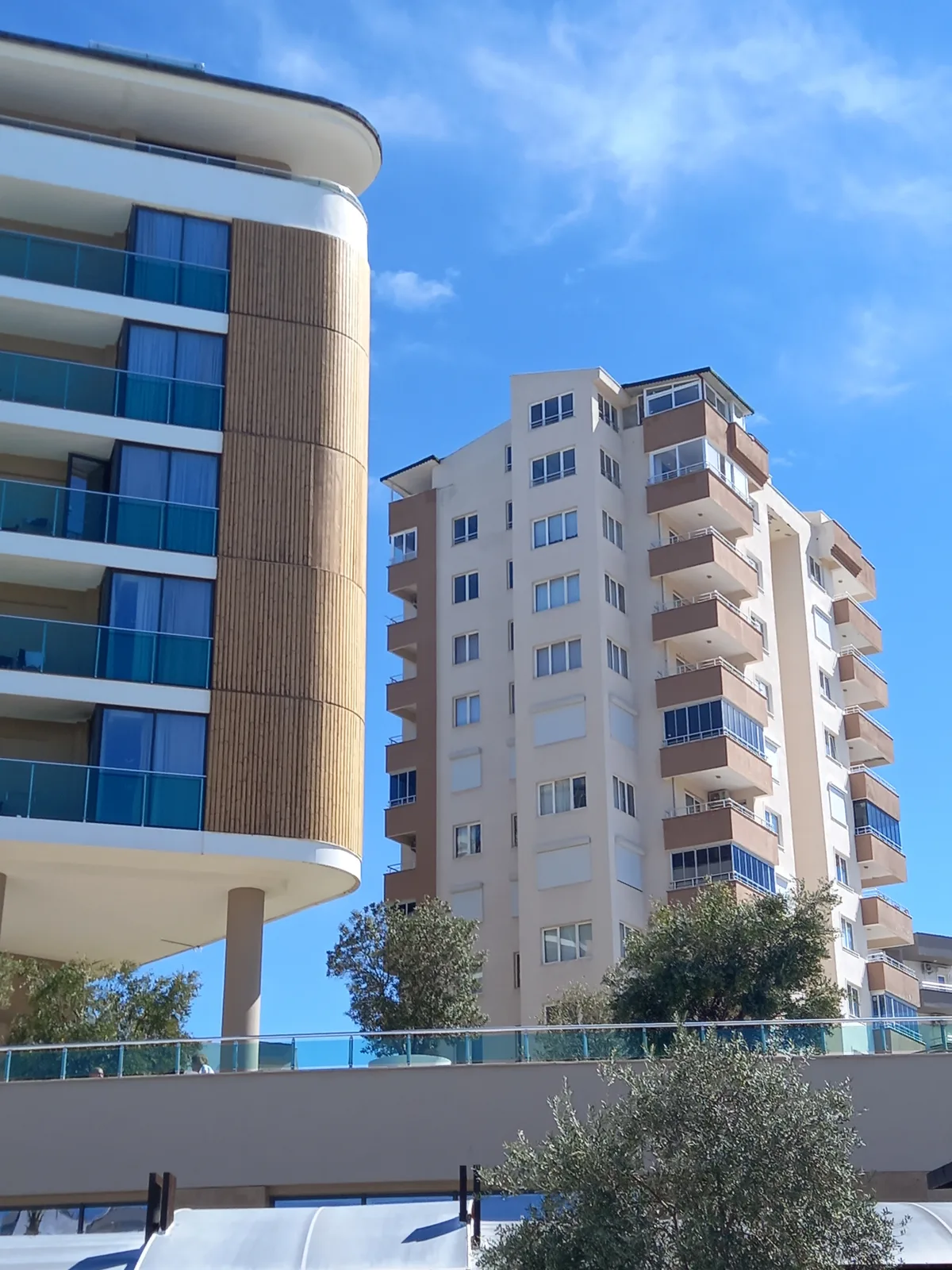
Antalya’s districts answer the where-to-stay question almost too neatly, because each base is a different holiday. Choose by the trip you planned in the sections above — not by star counts, and emphatically not by price tables that date faster than this page can be read.
Kaleiçi is the base this guide recommends to most first-time visitors. The old town’s Ottoman houses have become small hotels and pensions — courtyard pools, roof terraces, breakfasts under orange trees — and staying inside the walls puts the harbour, the gates and the evening restaurants at your door, with the tram a short walk uphill for the beaches. The honest caveats are part of the choice: the lanes are largely car-free, which means a walk with luggage at both ends; the streets around the harbour bars are lively late, so light sleepers should pick their lane with care; and rooms in converted houses vary in size in ways chain hotels never do. Character has a price in logistics, and here it is worth paying.
Konyaaltı and its inland districts suit the traveller splitting days between beach and city: modern mid-range hotels and apartments along and behind the shore, a local rather than touristic restaurant scene, the beach park across the road and the old town a tram ride east. The city centre around Işıklar and Muratpaşa is the practical base — business-grade hotels, the main shopping streets, the tram at the corner — unglamorous, efficient and often the best-connected choice in winter. Lara and Kundu, finally, are the resort decision: large all-inclusive hotels with the beach at the garden gate and everything provided, ideal for a family week that treats the city as an excursion, and the wrong answer entirely for a traveller whose heart is set on Kaleiçi mornings. Match the base to the days, and Antalya feels easy; mismatch them, and no hotel quality will rescue the geometry.
What to Eat – Piyaz Above All
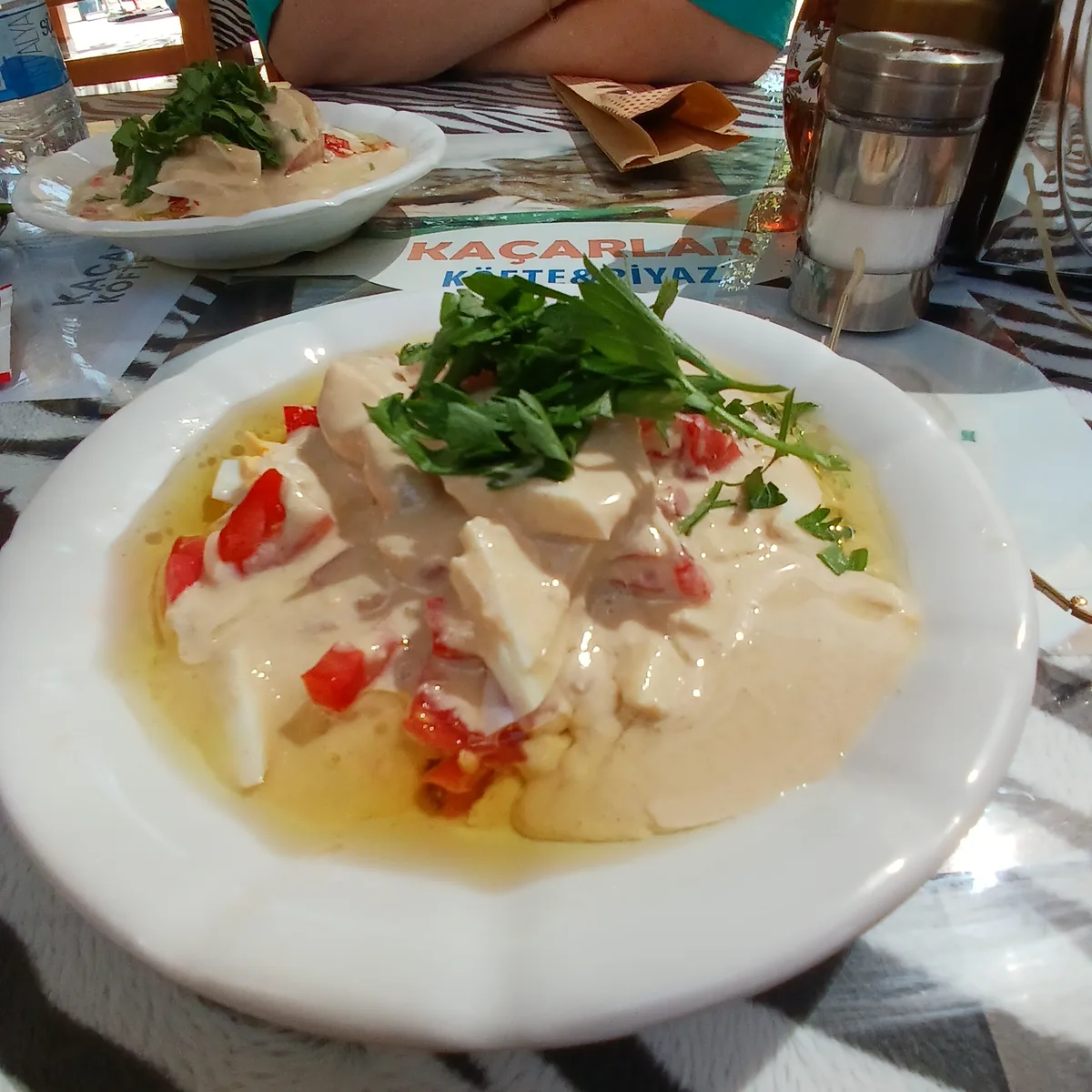
Every Turkish city claims a dish; Antalya’s claim is genuinely distinctive. Order piyaz here and you do not get the plain bean salad served elsewhere in the country: Antalya piyazı comes dressed in a sauce of tahini — sesame paste loosened with lemon and garlic, poured over the white beans, and finished with chopped egg, tomato and parsley. It is rich, sharp and wholly unlike its namesakes, and it exists for one purpose: to stand beside the city’s other staple, şiş köfte, small grilled meatballs served on pide, in the plain grill houses where the combination has been lunch for generations. Find a köfte-piyaz counter full of local workers at midday and you have found the real thing; nothing in the resort buffets will introduce you.
Around that centrepiece, the regional table builds itself. Hibeş — tahini again, this time whipped with lemon, cumin and chilli into a fierce dip — opens meals; grilled fish and seafood anchor the harbour-side evenings, though the old town’s restaurant lanes reward the same scepticism you would apply anywhere touristic; and the market districts feed everyone else, from soup houses and pide ovens to the pastry shops. Antalya province grows much of what Turkey eats in winter — the greenhouse plain behind the coast sees to that — and the citrus that made the city famous arrives as bitter-orange and citrus jams on the breakfast table, alongside the full serpme spread of cheeses, olives, eggs and warm bread.
For dessert, look for yanık dondurma, the region’s “burnt” ice cream, its milk caramelised to a deep, almost smoky sweetness, and for kabak desserts and tahini appearing wherever sweetness is taken seriously — sesame is the flavour signature of this coast, in the bean salad as much as in the pudding. Eat the piyaz first, though. Travellers remember cities by single dishes, and Antalya has arranged for its own to be unforgettable.
The Honest Downsides – What Every Antalya Travel Guide Should Admit
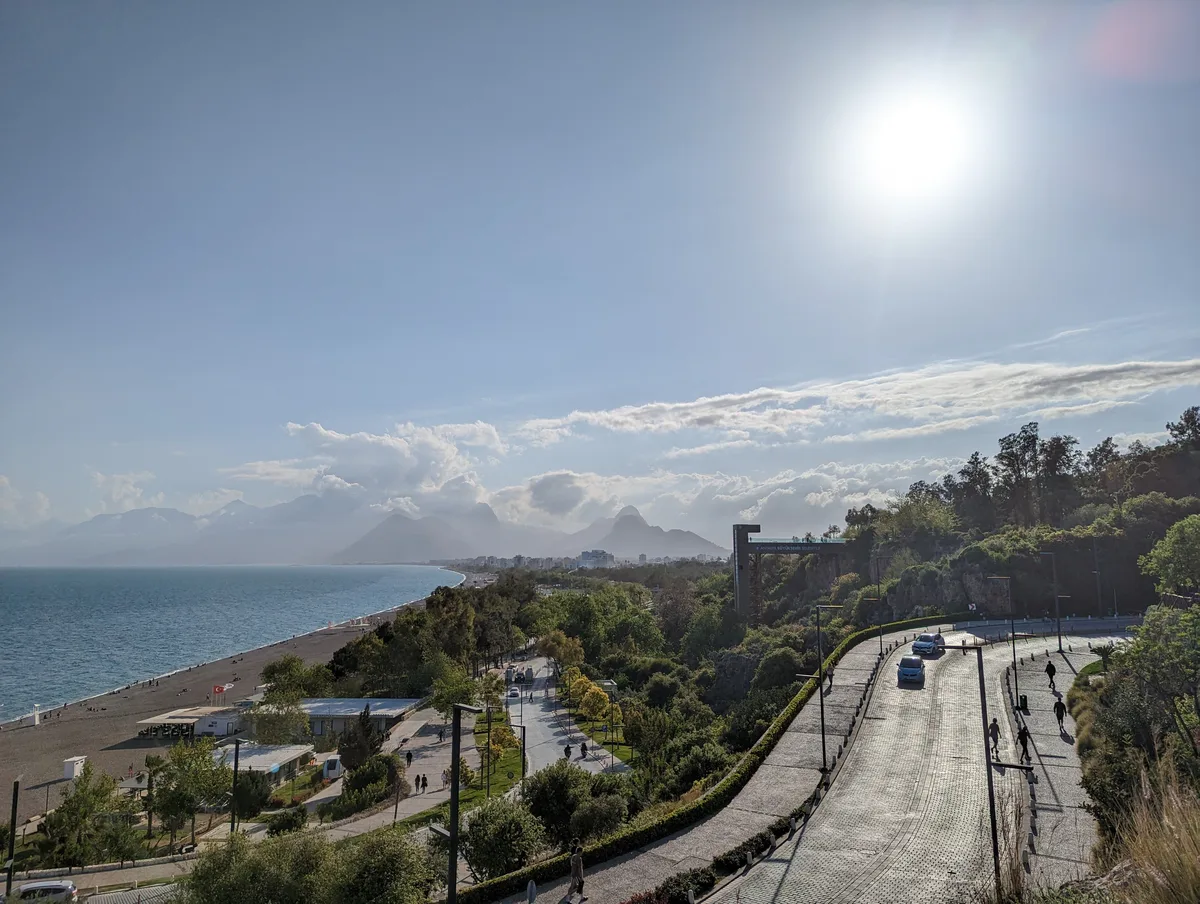
An honest antalya travel guide admits what the brochures leave out, so here it is in one place. None of it is a reason not to come; all of it is a reason to plan with your eyes open.
- The summer heat is a physical fact, not a mood. July and August combine high temperatures with real humidity, and the ancient sites offer almost no shade. Travellers who ignore this and walk Perge at noon have a miserable day and blame the city. Sightsee early, swim in the middle of the day, and treat the afternoon siesta as part of the itinerary rather than a failure of will.
- Konyaaltı is pebbles. The water is superb and the beach is beloved, but it is shingle that shelves into depth, and small children and tender feet will have views. Swim shoes transform it; Lara’s sand is the alternative, with its own compromises listed below.
- Lara’s strip is a bubble. The resorts are excellent at what they do, but the strip has no urban life of its own, the city is a genuine journey away, and a week can pass in which “Antalya” means a pool deck and a pier. That is a legitimate holiday — just choose it knowingly.
- The old town sells as hard as it charms. Harbour boat touts, restaurant hustlers on the busiest lanes and carpet-shop courtship rituals are all part of Kaleiçi’s economy. The defence is cheerful clarity: agree prices and terms before boats, meals and purchases, and walk on without heat when the answer is no.
- Headline sights can be closed. The museum rebuild is the standing example, but the general rule travels: any specific sight matters enough to verify before you build a day on it — check the official listing, as this guide does with muze.gov.tr, rather than a stranger’s itinerary from three summers ago.
- Distances deceive. The airport feels close, Lara feels adjacent, Side feels like a suburb — and the map is lying in each case, because the city runs long and thin along its coast. Build transfer time into the days, especially the last one.
Antalya Travel Guide – Frequently Asked Questions
How many days do I need in Antalya?
Three full days cover the city itself without rushing: one for Kaleiçi and its harbour, one divided between a beach and the waterfalls, and one for the second beach or a first taste of the ruins. Four or five days is the better answer, however, because Antalya’s day trips are the equal of its own sights — add Perge and Aspendos as one day, and Side or Termessos as another, and the trip feels complete rather than sampled.
Is Antalya just a resort town?
No — and this is the misunderstanding the whole city suffers from. The resorts are real, and Lara’s strip is a holiday industry of genuine scale, but they stand beside a working provincial capital with a two-thousand-year-old harbour quarter, a tram network, markets and neighbourhoods that exist for residents. The traveller who never leaves a resort has visited a resort. The city was there the whole time, a short ride west.
Should I choose Konyaaltı or Lara?
Choose by the holiday, not the sand. Konyaaltı is the city’s beach: shingle rather than sand, superb water, a public promenade, and the old town minutes away — the base for travellers mixing swimming with sightseeing. Lara is the resort beach: broad sand, gentler entry into the water, and big hotels providing everything on site — the base for a self-contained family week. That is the division this antalya travel guide is built on, and most disappointed visitors are simply people who booked the other one’s holiday.
Is the Antalya Museum open?
No. It closed in July 2025 after a seismic assessment of its old building; the collection went into storage, the building was demolished, and a new museum is being built on the same site, with officials quoted in the press speaking of completion targeted for the end of 2026 — an estimate, not a date. Check the museum’s official listing on muze.gov.tr in the week you travel; until it reopens, read the region’s archaeology at Perge, Aspendos and Side instead, and give the small Kaleiçi Museum an hour for the old town’s domestic history.
How do I get from the airport into the city?
You have four honest options, and the right one depends on your district and your luggage. The AntRay tram runs from the airport into the centre and is the fixed-price, traffic-proof route to the old town side of the city. Airport shuttle buses serve the bus station and districts. Taxis wait at the terminals and make most sense for Lara, which the tram does not reach. And if you have booked a resort package, a hotel transfer is usually part of the machinery. No fares are printed here because they change; the structure of the choice does not.
Do I need a car in Antalya?
For the city itself, no — trams, buses and your feet cover everything in this guide, and a car inside Kaleiçi’s lanes is an encumbrance, not an asset. For the day trips, it is a judgement call: Perge and Aspendos are reachable by tram-and-bus combinations and by organised tours, Side by bus, but Termessos — a mountain road with a walk at the end — is the one destination where a car, or a tour built around it, changes the day from expedition to pleasure. Hire for the mountain day if you hire at all.
Can I swim in Antalya in winter?
You can, and a few hardy people do — the sea stays comparatively mild while the air is cool — but manage the expectation: winter is the city’s wet season, the sea is often rough, lifeguarded services are a summer arrangement, and the beaches belong to walkers, fishermen and storm-watchers. Winter Antalya is for the old town, the ruins in their green season and the waterfalls at full flow. The swimming belongs to the long season on either side of it, roughly late spring to late autumn in most years.
The Short Version – This Antalya Travel Guide on One Screen
Base yourself in Kaleiçi, or within a tram ride of it. Give the old town a full day — Hadrian’s Gate, the fluted minaret, the Hıdırlık Tower, the harbour at dinner time — and let its lanes, not a checklist, fill the hours between. Take Konyaaltı for the city’s beach and Lara for the resort one, and do not confuse their jobs. See both Düden falls, the parkland upper and the great lower drop into the sea. Build no plan around the Antalya Museum until its official listing says it has reopened, and spend the day you save on Perge and Aspendos, the finest one-two of Roman cities on this coast; add Side for ruins with a swim, or Termessos if your legs and your curiosity both run uphill. Eat piyaz where the workers eat it. Swim early, sightsee in the kind hours, and let the evenings happen on the cliff-top promenade.
That is the whole of this antalya travel guide, and it is enough for a very good trip. Travellers stringing Türkiye together should pair it with our Istanbul travel guide at one end of the flight and the Cappadocia travel guide at the other — three bases, three completely different countries inside one. Antalya’s own role in that trio is the generous one: the warm coast, the old harbour town, and a ring of ancient cities close enough to touch. It deserves more than the view from a transfer coach. Give it the days, and it will give you the Mediterranean as it was — a sea with cities on it, still working.