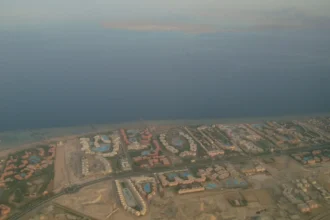
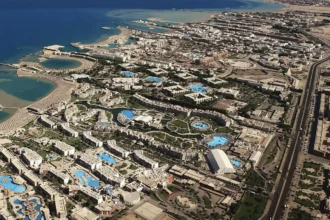
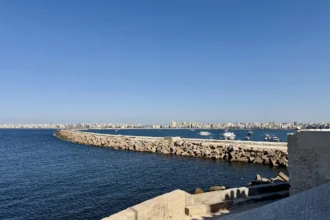
Choosing where to stay in Dahab matters more than choosing a single hotel, because this small Sinai town is really a string of distinct neighbourhoods along the Gulf of Aqaba, and the neighbourhood you pick will shape your days far more than the thread count of any one room. Stay in Lighthouse or Masbat and you are on the promenade, steps from cafés, dive centres and the reef, with dinner, a morning coffee and a dive briefing all within a short walk. Choose Laguna and you trade bustle for sand, wind and space, with pools, beach bars and wind-sport schools on site but a taxi ride back to the widest choice of restaurants. Choose Medina and you live closer to everyday Dahab, in apartments and small hotels where kitchens, washing facilities and a weekly rent matter more than a lobby. Choose Blue Hole Road and you put yourself first at the famous dive sites and last to leave, at the cost of quiet evenings and a planned ride back to town. Choose Assalah and you step into the town’s original Bedouin village life, simpler and often cheaper, but without resort polish. This guide compares those areas by feel, budget and traveller type, so you can pick the base that fits how you actually plan to spend your days — not just the room with the nicest photos. The rule that runs through the whole guide is simple: pick the area first and the room second, because a beautiful room in the wrong area will still leave you commuting to the reef, the lagoon or the restaurants every day, while a modest room in the right area puts everything you came for within walking distance.
That area-first rule matters in Dahab more than in most Red Sea towns because Dahab never grew as one large resort block. It grew as a string of settlements along the shore, each with its own character, and the distances between them, while short by car, are long enough on foot in summer heat to change how a day feels. A first-timer who books Laguna expecting promenade nightlife will spend evenings arranging taxis, just as a windsurfer who books Masbat expecting to step onto a sandy lagoon will spend mornings commuting south. A diver who books Blue Hole Road for a single romantic night will find seclusion where they wanted restaurants, and a family who books a reef-front room in Masbat expecting sand for small children will find rock and reef shoes instead of a beach. None of those choices is wrong in itself; each is wrong only for the wrong trip. This guide therefore treats each area on its own terms — what it is good for, what it costs you in convenience, and what to check before you book — and it deliberately keeps the focus on staying, not on sightseeing. For what to do once you have chosen your base, our companion guides to things to do in Dahab, tourist attractions in Dahab and places to visit in Dahab cover the reefs, dives and day trips in full, while our general Egypt travel guide fits Dahab into a wider Cairo, Luxor and Aswan route. Prices, availability and facilities change by season, so check the official site before visiting or booking, and confirm what is included, because breakfast, airport transfer, dive-centre access and cancellation terms vary widely between properties.
At a Glance
| Area | Best for | Stay types | Trade-off to know |
|---|---|---|---|
| Lighthouse / Masbat | First-timers, divers, solo travellers, couples | Boutique hotels, guesthouses, dive hotels, apartments | Busiest at night; reef shoes help on rocky shore entries |
| Medina | Long stays, families wanting local life, self-catering | Apartments, small hotels, houses | Less beachfront buzz; a short walk to the promenade |
| Laguna | Windsurfers, kitesurfers, families, couples seeking quiet | Resorts, wind-sport hotels, apartments | Quieter evenings; further from central restaurants |
| Blue Hole Road | Divers and freedivers, seclusion seekers | Resorts, camps, dive lodges | Remote after dark; plan transport in advance |
| Assalah | Culture lovers, budget travellers | Guesthouses, camps, simple hotels | More traditional and residential; fewer resort facilities |
Prices, availability and facilities change by season. Check the official site before visiting or booking, and confirm what is included — breakfast, airport transfer, dive-centre access and cancellation terms vary widely.
A Short History of Staying in Dahab
Dahab — Arabic for “gold”, a name linked in local accounts to its golden sands and to sunset light on the bay — began as a Bedouin fishing settlement of the Muzeina tribe, whose members moved seasonally between mountain wadis and the coast, fishing the Gulf of Aqaba, herding in the interior, and trading along routes that linked Sinai’s coast with its mountains. For generations the settlement was small, low-rise and shaped by that seasonal life, with houses built from local stone and palm, boats pulled up on the shore, and a social life organised around families and the sea rather than around visitors. That changed, gradually rather than suddenly, in the late twentieth century, after Sinai returned to Egypt in 1982, when backpackers and divers began to discover a town that offered warm water, accessible reefs and a far quieter atmosphere than the large resorts further south. Small guesthouses, camps and dive hotels grew up around the shore rather than in one large resort block, often run by local families or by long-staying divers who had fallen for the place, and the town’s accommodation still carries that history in its shape: low buildings, walkable distances, courtyards and rooftops rather than tower blocks, and a promenade where the same cafés, dive centres and small hotels have served travellers for years. Even where larger resorts have since opened around Laguna and Blue Hole Road, the centre of Dahab has kept its small scale, and that is no accident — it is the direct legacy of a fishing village that became a diving town without ever quite becoming a resort city. That restraint is visible in the skyline, in the absence of tower blocks, and in the way new building still tends to follow the shore in low, modest lines rather than rising above it.
That history still shapes accommodation today in practical ways a first-time booker should understand, because it explains both Dahab’s charm and its quirks. Much of the best lodging is low-rise, locally run and walkable, which means character, personal service and a host who knows the dive centres and the taxi drivers by name, but it also means variation: a guesthouse room may have a sea view and a shared rooftop, a camp may have a simple husha rather than a sealed room, and a small hotel may have excellent breakfast but no lift, no pool and limited reception hours. Travellers who arrive expecting chain-hotel consistency in the centre will be disappointed, while travellers who arrive expecting Dahab’s own style will find it exactly right. If you want the old Dahab feeling, stay small and central, in Lighthouse, Masbat or Assalah, where you can walk to the reef, eat where residents eat, and watch the town wake up from a rooftop. If you want pools, sandy beach and wind-sport schools on site, stay south in Laguna, where the larger resorts were built for exactly that purpose. Neither choice is more authentic than the other; they are simply two different Dahabs, the fishing-village town and the wind-sport resort, and the history of the place explains why both exist side by side. Understanding that split before you book is the difference between a stay that feels like Dahab and a stay that feels like a compromise, because the town rewards visitors who choose the version of it that matches their trip. A visitor who books with that split in mind will rarely be disappointed, because the town itself will confirm the choice every day, in the walk to the reef, the quiet of the street at night, and the ease of the morning routine.
Lighthouse and Masbat: The Classic First-Timer Base
Lighthouse is the heart of tourist Dahab, and Masbat is its promenade, the long waterfront walk that runs along Masbat Bay past restaurants, cafés, dive centres and small shops, with Lighthouse Reef just offshore. This is the easiest place to arrive without a plan, because you can walk to a dive briefing, a snorkel entry, dinner and a morning coffee without a taxi, and because the concentration of dive centres means a first-timer can compare courses, rent gear, book a day trip to the Blue Hole and find a buddy without leaving the promenade. Boutique hotels and guesthouses here tend to be intimate, often with a courtyard, a rooftop terrace or a sea-facing room, and several dive hotels put the reef and the dive shop literally across the road, so a diver can kit up, walk to the entry point and be in the water within minutes of leaving the room. Couples like the sea views and the evening dining, with tables set close to the water and a choice of cuisines that no other part of town matches. Solo travellers like the social, walkable scene, because the promenade is a place to meet other divers, join a group trip, share a taxi to a site, or simply sit with a coffee and watch the town pass. For a first visit, no other area removes as much friction, and that ease is worth paying for, especially if your trip is short and every day counts. For a diver on a three-night trip, that ease is the difference between five dives and three, and for a couple on a short break, it is the difference between relaxed evenings on the promenade and evenings spent arranging transport back from a distant resort.
The compromise is noise and foot traffic in the evening, and a shoreline that is more reef and rock than soft sand, and both points deserve honest weight before you book. The promenade that is so convenient by day is lively at night, with restaurants, music and passers-by, so light sleepers should look for a room set back from the waterfront, on an upper floor or on a side lane, rather than a room directly above a restaurant. The shore itself rewards preparation: Lighthouse Reef is a superb house reef for snorkelling and diving, but entries are over rock and coral, so reef shoes are not an optional extra but a practical necessity, and swimmers should expect to enter the water at marked points rather than wading in anywhere. Families with very small children who want to paddle on sand will be happier in Laguna, and that is a trade-off worth making consciously rather than discovering on arrival. When choosing a dive hotel, look for a hotel with its own dive centre only if you actually plan to dive with it, because a centre you never use adds nothing, while a good independent centre on the same promenade may suit you better. Stay here if: it is your first visit, you plan to dive or snorkel daily, or you do not want to hire transport. Look for: a room set back from the promenade if you are a light sleeper, a sea-facing room if evening views matter to you, and a clear statement of what is included, because breakfast, transfers and dive packages vary widely even between neighbouring properties. Ask what a dive package actually includes, whether gear rental is extra, and whether the centre runs its own boats or books places on others.
Medina: Local Life and Longer Stays
Medina, inland and south-west of the central promenade, is Dahab’s residential quarter — the area competitor guides describe as home to apartments and everyday services, a short walk from the main beach, and the place where the town’s daily life is most visible. This is the practical choice for a week or more, because self-catering apartments, houses and small hotels are common here, kitchens and washing facilities matter more than a lobby, and you will shop and eat where residents do, at local bakeries, vegetable stalls and small restaurants that charge local prices rather than promenade prices. Families and remote workers often prefer Medina because it is quieter and usually better value than a beachfront room, while still keeping the promenade within walking distance, so a morning swim or an evening meal out is a walk, not a taxi ride, but the night itself is spent in a quieter street. The difference from Masbat is one of rhythm: Medina wakes to school runs and shop openings rather than dive briefings, its evenings are residential rather than touristic, and its streets, while not picturesque in the postcard sense, give a truer sense of how Dahab lives when the visitors have gone home. For a long stay, that rhythm is restorative, because it turns a holiday into a temporary home, with a regular café, a regular shopkeeper and a regular walk to the sea. Over a fortnight that routine becomes the holiday itself, because the town stops feeling like a destination and starts feeling like a neighbourhood you happen to be visiting, with familiar faces, familiar food, and a familiar route to the water each morning. That familiarity is the real luxury of a long stay.
Medina is less suited to a single romantic night when you want to step straight from your room onto the reef, and it is also less suited to a traveller who wants resort facilities, a pool or a beachfront restaurant on site, because those are precisely the things Medina trades away for space, quiet and value. The checks before booking therefore differ from those in Masbat: exact walking distance to the beach matters, because “a short walk” can mean five minutes or twenty, and in summer heat that difference matters twice over. Whether the building has a lift matters if you have luggage, children or mobility needs, because many apartment buildings are low-rise walk-ups. How reliable the Wi-Fi is matters if you need to work, because speeds and stability vary between buildings and a remote worker should ask for a recent speed test or a trial day rather than trusting a listing claim. Hot water, air-conditioning and a washing machine are the other practical points, because a week-long stay without them becomes a chore. Stay here if: you are staying a week or longer, travelling with children, or want to cook some meals. Check before booking: exact walking distance to the beach, whether the building has a lift, how reliable the Wi-Fi is if you need to work, and what is included in the rent, because cleaning, utilities and airport transfers are not always part of the headline price — confirm prices before booking. Ask about cancellation terms before you pay, and keep a note of what was agreed. in writing, before you travel, for reference. A weekly rent that looks cheap can become less attractive once cleaning, electricity and a transfer are added, so ask for an all-in figure in writing before you commit to a longer stay.
Laguna: Sand, Wind and Space
Laguna, at Dahab’s southern end, is the town’s sandy, wind-exposed lagoon — the base for windsurfing and kitesurfing schools, with shallow water that suits beginners and families, and the one part of Dahab where the shore behaves like a beach in the conventional sense. Larger resorts cluster here, including the well-known JAZ Dahabeya and Swiss Inn Resort Dahab, alongside apartments a short walk from the beach, and the days here feel more resort-like: pools, beach bars and wind-sport centres on site, long open views across sand and water, and a pace set by wind conditions rather than by dive-boat departures. For wind-sport travellers, the advantage is decisive, because staying in Laguna saves a daily commute to the lagoon, puts gear storage, lessons and rescue cover within walking distance, and lets you watch conditions from your room and be on the water when the wind arrives rather than when a taxi does. For families, the advantage is almost as strong, because shallow, sandy water lets small children paddle safely in a way the reef shore in Masbat does not, and because pools, playgrounds and on-site restaurants reduce the logistics of a family day. Evenings are calmer than on the Masbat promenade, which many couples and families prefer after a day on the water, and the open space, with its views across the lagoon to the mountains, gives Laguna a feeling of air and light that the busier centre cannot match. That openness is part of Laguna’s appeal for families too, because children have room to play, parents can watch them from a beach bar, and the day feels spacious rather than crowded, even in the busier months of the year. It is why families return to the same resort year after year.
The trade-off is distance from the centre, and it should be weighed as carefully as the sand. You will walk or take a taxi for the widest choice of restaurants, because Laguna’s own dining, while adequate, cannot match the variety of the Masbat promenade, and a traveller who wants a different restaurant every night will either pay for taxis or settle for repetition. Evenings, while calm, can feel quiet for a solo traveller or a couple who enjoy promenade life, and a long stay in Laguna without a plan for evenings can feel isolated rather than peaceful. If wind sports are the reason for your trip, those costs are worth paying, because the lagoon is the reason you came and the resort is built around it. If wind sports are only a possible activity, Laguna is still a good base, but the daily taxi to town should be budgeted honestly, in both money and time. Stay here if: you are learning or practising windsurfing or kitesurfing, travelling with young children who need sand and shallow water, or want a resort with a pool. Check before booking: whether wind-sport rental and lessons are on site or at a partner centre, how far the nearest shops are, what the taxi fare to the promenade is, and whether the resort’s beach is sandy at your room’s end of the lagoon, because conditions vary along the shore — check the official site before visiting and confirm prices before booking. A resort at the quieter end of the lagoon may offer a calmer beach but a longer walk to shops, so ask exactly where your room sits in relation to the water, the wind-sport centre and the nearest café.
Blue Hole Road: For Divers Who Want to Be Near the Dive
North of town, Blue Hole Road runs toward the famous Blue Hole and Canyon dive sites, along a rocky coast where the desert meets the sea and the town thins out into resorts, camps and dive lodges. Resorts here, such as Tropitel Dahab Oasis, and smaller dive lodges and camps suit divers and freedivers who want to be first at the site and last to leave, and travellers who prefer a quiet, sea-facing base over nightlife. The Safir Dahab Resort is another larger option in the wider resort area. The appeal is specific and powerful: a diver staying on this road can be at the Blue Hole at first light, before the day-trip groups arrive, can return to the same site in the afternoon when conditions change, and can structure days around diving rather than around transport, with gear storage, a dive centre and a sea-facing room all in one place. Freedivers, who value calm mornings, depth access and a quiet base between sessions, find the same advantage, because the road puts them close to the sites that define Dahab’s freediving reputation without the daily commute from town. For a dedicated diving trip, that proximity is not a luxury but the point of the trip, and a base in town, however pleasant, will always involve a ride, a wait and a compromise on timing. A diver based on this road can also build a rhythm that town-based divers cannot, with a dawn dive, a long surface interval at the lodge, and a second dive when the light and the conditions are at their best, rather than when a minibus timetable allows. It is a rhythm built around the sea, not around a schedule.
The trade-off is real and should not be softened: after dark this stretch is quiet, cafés are fewer, and you will need transport for most evenings in town, so a traveller who books here expecting promenade life will be disappointed every night. Do not book here by accident because a photo looked secluded — book here because seclusion is what you want, and because your days are built around diving, reading, swimming and early nights rather than around restaurants and nightlife. On-site dining hours matter more here than anywhere else in Dahab, because a resort restaurant that closes early leaves few alternatives within walking distance, and a traveller who returns late from a dive or a day trip needs to know whether food will still be available. Transfer options matter equally: confirm whether the property offers transfers to town, whether taxis pass regularly, and what a taxi costs, because a base that is cheap by the night can become expensive by the ride. Stay here if: diving or freediving is the main purpose of the trip. Check before booking: transfer options to town, on-site dining hours, whether the dive centre you want to use is on site, and what is included in the room rate, because dive packages, transfers and meals are bundled differently by different properties — confirm prices before booking and check the official site before visiting. Ask also whether the lodge runs its own transfers, whether a taxi can be called reliably at night, and whether the kitchen stays open for divers returning late, because those three answers will shape your evenings more than any photograph of the room. Confirm them before you pay, not after you arrive.
Assalah: The Original Village Feel
Assalah, in the north of town, is where Dahab’s original Bedouin village life is most visible — goats and camels still wander residential lanes, houses are traditional in style, and guesthouses and camps are simpler and often cheaper than central hotels. This is the Dahab that existed before the dive centres, and it still feels like a village rather than a resort: children playing in lanes, neighbours talking outside houses, animals moving freely, and a pace set by daily life rather than by tour schedules. Travellers who want cultural immersion, a slower pace and a budget base often love Assalah, because it offers a direct encounter with the community that founded the town, rather than a version of the town designed for visitors. It also puts you closer to Eel Garden reef, a shore dive and snorkel site that rewards a quiet morning without the crowds of the central reefs, and its northern position gives easy access to the coast road toward the Blue Hole, so a diver based in Assalah can reach the famous sites without crossing the whole town. Guesthouses here tend to be family-run, with personal recommendations, home cooking and a host who knows the town intimately, and camps offer a simpler, social alternative for backpackers and budget travellers who value atmosphere over facilities. That social, simple style suits travellers who spend their days in the water and their evenings talking, and it keeps costs low enough that a longer stay, with more diving and more day trips, becomes affordable without sacrificing the experience itself. A longer, cheaper stay also leaves more budget for the dives, the desert trips and the meals that make the trip memorable.
Assalah is not the place for resort amenities, late-night dining variety or a polished beachfront, so weigh atmosphere against convenience honestly before choosing it for a short first trip. A traveller who arrives expecting a resort will find Assalah lacking, while a traveller who arrives expecting a village will find it exactly right, and the difference is entirely one of expectation. The practical points are those of a residential area: shops and restaurants are fewer and more local, evenings are quiet, and transport to the central promenade, while short, still needs planning, especially after dark. Simple guesthouses and camps vary in facilities, so hot water, air-conditioning, bed configuration and check-in hours should be confirmed directly, because small properties in Dahab vary more than chain resorts do. Assalah suits a second visit, a longer stay, or a first visit by a traveller who has deliberately chosen culture over convenience, and it suits a budget traveller who would rather spend money on diving or day trips than on a room. For a short first trip where every evening matters and where walking to dinner is a priority, Lighthouse and Masbat remain the safer choice, and Assalah is best saved for the return visit when you already know the town and want to know its people. That honesty is not a criticism of Assalah; it is the reason Assalah has kept its character, because it has never tried to be everything to everyone. Its lanes, its animals, its traditional houses and its family guesthouses are the reason it has kept that character, and a visitor who respects the village’s pace will be welcomed into it far more warmly than a visitor who treats it as a cheap alternative to the centre.
Hotels, Hostels, Camps and Apartments: Which Type Fits You?
Resorts suit families and wind-sport travellers who want pools, beach access and meals handled in one place, mainly in Laguna and on Blue Hole Road, and their advantage is completeness: a family can spend a whole day within the property, with a pool for children, a beach for adults, a restaurant for dinner and a wind-sport centre for lessons, without arranging transport or searching for services. That completeness comes at a price, both in money and in distance from town life, because a resort day is a resort day, not a Dahab day, and a traveller who wants to eat at a different promenade café every night will find a resort base inconvenient. Boutique hotels and guesthouses suit couples and first-timers in Lighthouse and Masbat, where character and location matter more than facilities, and where a courtyard, a rooftop terrace, a sea-facing room and a host’s recommendations are worth more than a gym or a spa. Their advantage is intimacy and position, and their limitation is scale: a small hotel cannot offer everything a resort can, and a guesthouse may have no pool, no lift and limited reception hours. Hostels and camps suit backpackers, divers on a budget and social travellers, because they offer dormitories, shared spaces and a community of fellow travellers, and because Dahab’s hostel and camp culture is one of its strengths, with communal meals, shared dive trips and a social scene that solo travellers value highly. Hostels in Dahab also serve as informal noticeboards for dive buddies, shared taxis and day trips, and a solo traveller who stays in one will rarely dive, eat or travel alone unless they choose to, which is a real advantage on a first visit.
Bedouin-style camps (hushas) further north at Ras Abu Galum suit an overnight adventure rather than a town base, and that distinction matters, because a husha — a simple palm-and-stone shelter on the beach — is an experience of sleeping close to the sea under desert stars, not a substitute for a hotel room, and a traveller who books one expecting hotel comfort will be disappointed, while a traveller who books one for a night or two of adventure will remember it for years. Apartments suit long stays, families and self-caterers, especially in Medina and Laguna, because a kitchen, a washing machine and separate bedrooms transform a week-long stay from a hotel bill into a temporary home, and because apartments usually offer better value per night for a family than two hotel rooms. Whichever type you pick, confirm the bed configuration, air-conditioning, hot water and check-in hours directly — small properties in Dahab vary more than chain resorts do — and confirm what is included, because breakfast, cleaning, utilities, airport transfer and cancellation terms are bundled differently by different properties. The type that fits you is the type that matches your trip’s shape: a resort for a family week built around the pool and the lagoon, a boutique hotel for a couple’s first visit built around the promenade, a hostel or camp for a solo diving trip built around community, and an apartment for a long stay built around independence and value. Choose the shape first, and the property second. A traveller who starts from the property rather than the trip shape often ends up with a beautiful room in the wrong place, while a traveller who starts from the trip shape ends up with a base that makes every day easier, from the first dive to the last sunset.
Practical Guide: How to Reach Dahab and When to Stay
| Question | Practical answer |
|---|---|
| Getting there | Most visitors fly to Sharm El Sheikh, about 80–100 km south of Dahab, then take a taxi or bus north. Confirm transfer time and price with your hotel or driver in advance — check the official site before visiting. |
| Best time to stay | March–May and September–November are widely recommended for warm water and comfortable temperatures. Summer is hot but breezy and good for wind sports; winter is milder and often better value. |
| How long to stay | 3–4 nights for a first taste; a week if you want to dive, learn a wind sport and take a desert or Mount Sinai day trip. |
| Getting around | Central Dahab is walkable. Taxis and pick-ups cover Laguna, Blue Hole Road and day-trip starts; agree the fare before you set off. |
| Money and safety | Carry some cash for small cafés, camps and taxis. For diving and wind sports, use licensed centres and follow local safety briefings. |
Most visitors fly to Sharm El Sheikh, about 80–100 km south of Dahab, then take a taxi or bus north, and the transfer is the first practical decision of the trip, because it sets the tone for arrival. Confirm transfer time and price with your hotel or driver in advance, because a pre-arranged transfer removes the negotiation at the airport after a flight, and because a hotel that offers a transfer often knows the road, the checkpoints and the timing better than a driver found on arrival. The journey itself, across desert with Sinai mountains on one side and the Gulf of Aqaba on the other, is part of the experience, and a daytime arrival lets you see the landscape change from resort coast to quiet town, while a night arrival, while perfectly workable, means your first view of Dahab is in darkness. Once in town, central Dahab is walkable, and that walkability is one of its greatest pleasures, because the promenade, the dive centres and the restaurants can all be reached on foot, while taxis and pick-ups cover Laguna, Blue Hole Road and day-trip starts, provided you agree the fare before you set off. For a desert or Mount Sinai day trip, a car or an organised tour is useful, because those journeys involve desert roads, early starts and local knowledge that a town taxi cannot always provide, and a tour that includes a guide, transport and a planned itinerary will serve you better than an improvised drive. An independent overview of Dahab hotels, for comparing areas and property types before you book, is available in Expedia’s Dahab hotels guide and in MyTraveling’s Dahab travel guide, both reused from the source draft.
March–May and September–November are widely recommended for warm water and comfortable temperatures, and those shoulder seasons are the best time to stay for most travellers, because the sea is warm enough for long dives and swims, the air is comfortable for walking the promenade, and the town is busy enough to feel alive without being crowded. Summer is hot but breezy and good for wind sports, because the thermal wind that fills Laguna is strongest in the warmer months, and a windsurfer or kitesurfer who comes in summer will find the conditions they came for, even if a non-windsurfer will find midday heat punishing. Winter is milder and often better value, with cooler evenings, fewer visitors and lower prices, and a winter stay suits a traveller who values quiet, value and comfortable walking over warm-water swimming. How long to stay follows from those seasons: 3–4 nights for a first taste, enough for the promenade, a reef, a dive and a day trip; a week if you want to dive properly, learn a wind sport and take a desert or Mount Sinai day trip without rushing. Money and safety follow the same practical logic: carry some cash for small cafés, camps and taxis, because card machines are not universal in small properties, and for diving and wind sports, use licensed centres and follow local safety briefings, because the sea, the wind and the desert all demand respect. For March–May and September–November, book ahead, especially in Lighthouse and Laguna, because the best rooms fill first, while winter stays are often easier to find and better value — check the official site before visiting for seasonal offers and confirm prices before booking, in writing.
Conclusion
There is no single best place to stay in Dahab — there is a best area for your trip, and that sentence, repeated throughout this guide, is worth returning to at the end because it is the decision that determines everything else. First-timers and divers should start in Lighthouse or Masbat, where the reef, the dive centres and the restaurants are all within walking distance and where a short trip can be enjoyed without transport. Wind-sport lovers and families should look at Laguna, where sand, shallow water, pools and wind-sport schools on site make a family or wind-sport week work without daily commuting. Long-stay travellers should price apartments in Medina, where kitchens, space and local prices turn a week or more into a temporary home rather than a hotel bill. Serious divers should consider Blue Hole Road, where proximity to the famous sites justifies quiet evenings and planned transport. Culture lovers and budget travellers should consider Assalah, where the original village life, simpler guesthouses and lower prices offer a different Dahab, one that rewards a traveller who chooses atmosphere over amenities. Each of those recommendations is a starting point, not a rule, because a couple who love quiet evenings may prefer Laguna even on a first visit, and a family who love diving may prefer Masbat even with small children, provided they bring reef shoes and plan for rock rather than sand. A first-timer who loves quiet evenings may still prefer Laguna, and a family who love diving may still prefer Masbat, and both choices are sound provided they are made knowingly, with reef shoes packed, taxis budgeted, and evenings planned rather than assumed. That informed choice is the whole point of this guide.
Pick the area first, the room second, and Dahab’s slow, sea-and-desert rhythm will do the rest, because Dahab is a town that rewards a well-chosen base with days that unfold without friction: a morning dive from the promenade, a wind-sport afternoon on the lagoon, a quiet evening in a residential street, or a night under desert stars at a camp. The practical checks in this guide — walking distance to the beach, lift access, Wi-Fi reliability, hot water, air-conditioning, bed configuration, check-in hours, transfer prices, dining hours and cancellation terms — are not bureaucratic details but the difference between a stay that works and a stay that frustrates, and a traveller who confirms them before booking will enjoy Dahab far more than a traveller who discovers them on arrival. Book ahead for the shoulder seasons, when the best rooms in Lighthouse and Laguna fill first, and use winter for value and quiet if your dates allow it. Check the official site before visiting for current prices, availability and facilities, because those details change by season and by property, and confirm what is included before you pay. Choose well, and Dahab will give you what it has given travellers for decades: warm water, accessible reefs, wind on the lagoon, mountains behind the town, and a pace of life that slows you down in exactly the way a holiday should. That slowing down is not a side effect of Dahab but its main gift, and it is available in every area, provided the base you choose puts the sea, the reef or the lagoon within easy reach and leaves your evenings free for the promenade, a quiet street, or a campfire under Sinai stars.
FAQs
What is the best area to stay in Dahab for first-time visitors?
Lighthouse and Masbat. You can walk to the reef, dive centres, restaurants and cafés, and you do not need transport for most of your first days.
Where should families stay in Dahab?
Laguna for sandy, shallow water and resort facilities, or Medina for a self-catering apartment with more space. Both are quieter at night than the central promenade.
Is Dahab good for budget travellers?
Yes. Hostels, camps, guesthouses and apartments — especially in Assalah and Medina — keep costs down, and many travellers eat at promenade cafés rather than in resorts. Check the official site before visiting for current rates.
Should divers stay near the Blue Hole?
Only if diving is your main goal. Blue Hole Road puts you close to the site but far from town nightlife; most recreational divers are happy based in Lighthouse and travelling to the site for the day.
Do I need a car in Dahab?
No. Central Dahab is walkable, and taxis cover Laguna and Blue Hole Road. A car or organised tour is useful only for desert and Mount Sinai day trips.
When is the best time to book accommodation in Dahab?
For March–May and September–November, book ahead, especially in Lighthouse and Laguna. Winter stays are often easier to find and better value — check the official site before visiting for seasonal offers.