Tourist attractions in Dahab are, unusually, almost all natural: a sinkhole, a lagoon, a reef named for eels, canyons carved by water and wind, and a protected coastline reachable only by camel, boat or foot. That natural character is what sets Dahab apart from Egypt’s temple cities, because here the sights are not buildings raised by kings but places shaped by geology, by the sea and by desert time, and a visitor who comes expecting monuments will instead find water, rock and light doing the work that temples do elsewhere. The Blue Hole is a hole in the reef floor deeper than most buildings are tall; the Blue Lagoon is a sheet of turquoise water so still it mirrors the mountains; the Coloured Canyon is a narrow passage whose walls change colour with every turn; Eel Garden is a shallow reef where garden eels sway like grass in a current; and Ras Abu Galum is a stretch of coast where the road simply ends and the wild takes over. Each of these places rewards a different kind of attention. The Blue Hole asks for respect for depth, the lagoon asks for stillness, the canyons ask for a slow walk and a look upward, Eel Garden asks for patience and a quiet float, and Ras Abu Galum asks for a full day and a willingness to go without facilities. This guide treats each sight on its own terms — what it is, how it formed or why it matters, and what a visit actually looks like — so you can tell a geological wonder from a sacred mountain and a quiet reef from a world-famous dive site, instead of ticking off names that all sound alike. It is written as an attractions guide, not as a list of things to do or a list of hotels, and that distinction matters throughout.
For activities at these sights — how to dive them, snorkel them, surf them or walk them — see our companion guide to things to do in Dahab, and for where to base yourself near them, see our guide to places to stay in Dahab, which compares Lighthouse and Masbat, Medina, Laguna, Blue Hole Road and Assalah by feel, budget and traveller type. For a fuller route that puts these attractions in order with the town’s other places, see our guide to places to visit in Dahab, and for fitting Dahab into a wider Cairo, Luxor and Aswan journey, see our general Egypt travel guide. The distinction between those guides is deliberate: this article tells you what each attraction is and why it matters, the activities guide tells you how to experience it, the stay guide tells you where to sleep near it, and the places guide tells you how to order a whole visit. Keeping those jobs separate avoids repeating the same diving advice or hotel advice in every article, and it lets this guide spend its space on geology, history and atmosphere, which are the things that actually distinguish one Dahab sight from another. Entry rules, fees and access change by season and by protected-area policy, so check the official site before visiting any protected area or monastery, and confirm prices before booking any safari, boat trip or guided tour, because a guide written months earlier cannot tell you this season’s entry rules or transport arrangements. Planning with that caveat in mind, and booking through reputable local operators, will make the attractions in this guide easier to enjoy and safer to visit, whatever season you choose, and it will leave more time for the sights themselves.
At a Glance
| Attraction | What it is | Why it matters | Reach it by |
|---|---|---|---|
| Blue Hole | Submarine sinkhole over 100 m deep | World-famous dive site; dramatic geology | Road north from town |
| Blue Lagoon | Flat turquoise lagoon in Ras Abu Galum | Kitesurfing, swimming, wild coastline | Camel, boat or coastal walk |
| Coloured Canyon | Narrow sandstone canyon near Nuweiba | Mineral-coloured walls; ancient seabed | Organised 4×4 safari |
| Eel Garden | Shallow reef with garden eels | Easy snorkelling; rich fish life | Walk north along the shore |
| Ras Abu Galum | Protected area declared 1992 | Untouched reefs; Bedouin camps | Camel, boat or foot |
| St Catherine’s Monastery | 6th-century Orthodox monastery | UNESCO site; ancient manuscripts | Day trip, about 2 hours |
Entry rules, fees and access change. Check the official site before visiting any protected area or monastery.
History of Dahab’s Sights: Sea, Desert and Sacred Mountain
Dahab’s sights belong to three histories at once, and a visit that notices only one of them will miss half of what is there. Geologically, the Red Sea reefs and Sinai sandstone were shaped over millions of years — reefs built from shells and coral into limestone, canyons cut by erosion and flash floods, and the Blue Hole formed when a cave roof collapsed as sea levels changed. That deep-time story is visible in the rock itself: the layered sandstone of the Coloured Canyon, with its bands of red, orange, purple and gold, is an ancient seabed lifted, tilted and then carved by water, while the limestone reefs of the coast are the accumulated skeletons of countless generations of coral, built up grain by grain into structures large enough to shelter whole ecosystems. The Blue Hole, in the same story, is a sinkhole formed when a limestone cave, dissolved by fresh water during a period of lower sea level, lost its roof and flooded as the sea rose again, leaving a near-circular shaft whose walls record that drowned history in their shape. A visitor who understands that story will look at a canyon wall or a reef edge differently, because the colours and the shapes stop being decoration and become evidence — of seas that came and went, of minerals deposited in still water, of floods that cut narrow passages through rock that looks, at first glance, too solid to be cut at all. Geology, in Dahab, is not a background subject; it is the attraction itself. That evidence is everywhere once you look for it, from the banded walls of a canyon to the fossil coral in a reef limestone, and it gives a Dahab walk a depth that a simple swim or photograph cannot provide on its own.
Humanly, the coast was a seasonal home of the Muzeina Bedouin, fishing in summer and herding in the mountain wadis in winter, and the town’s name — Arabic for “gold” — recalls golden sands and sunset light on the bay. That seasonal rhythm shaped where people lived, how they moved and what they valued, and it still shapes the town’s attractions today, because the Bedouin guides who lead desert safaris, camel treks and wadi walks are descendants of the families who used those same wadis for herding and trade, and because the camps at Ras Abu Galum, the hushas of simple palm and stone, continue a way of living on the coast that predates tourism by generations. Spiritually, the inland mountains hold Mount Sinai and St Catherine’s Monastery, founded in the 6th century under Emperor Justinian and named in the 11th century for St Catherine, and that sacred history gives Dahab’s inland day trip a weight that no beach or reef can match, because the monastery has been continuously inhabited for some fifteen centuries and its library, its icons and its walls carry a story of faith, scholarship and survival in the desert. Visiting Dahab well means noticing all three layers — the geological, the human and the sacred — not just photographing the blue water, because a reef, a canyon and a monastery each belong to a different timescale, and a trip that moves between them, from a sinkhole formed over millennia to a monastery founded in the 6th century to a fishing village still living its seasonal life, is a trip that has understood Sinai as a place, not as a postcard. A traveller who pauses to notice those layers, even briefly, will return home with more than photographs, because the story of how a place formed, who lived there and what it meant will stay longer than any single view.
The Blue Hole
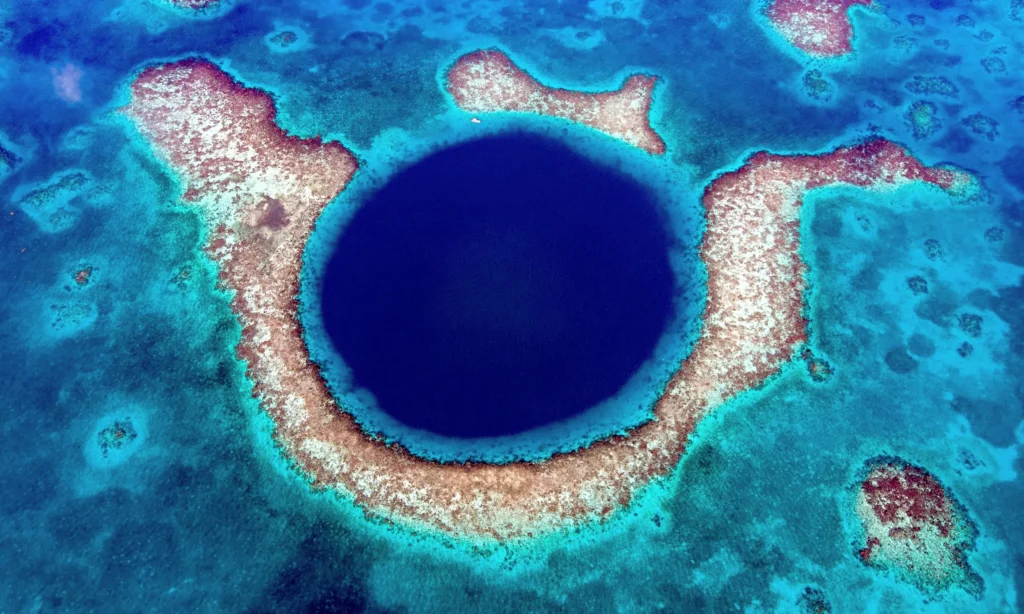
What it is: A near-circular submarine sinkhole just north of town, roughly 60–100 metres across and well over 100 metres deep, ringed by coral reef. A shallow saddle at about 6 metres links it to the reef, and the Arch — a tunnel about 26 metres long opening to the open sea at roughly 52–56 metres — gives the site its technical-diving reputation. Seen from the shore, the Blue Hole looks deceptively calm, a circle of deep sapphire water set into a shallow coral rim, with snorkellers floating over gardens at its edge and dive groups kitting up on the rocks beside it, and a first-time visitor could easily mistake it for a swimming pool in the sea. That calm surface hides a vertical world, because the hole drops steeply from a shallow rim to depths far beyond recreational diving, and the contrast between the shallow rim and the deep shaft is the whole drama of the place: a snorkeller in waist-deep water over coral can look down and see blue that simply does not end, while a diver descending the wall watches the light fade and the water change colour with depth. The reef that rings the hole is itself worth attention, because it shelters the shallow gardens where parrotfish, clownfish and turtles feed, and because the saddle that links the hole to the reef is the threshold between two worlds, the sunlit reef flat and the deep shaft, crossed by divers and by fish moving between shelter and open water. Cafés at the site make it an easy half-day trip by taxi from town, and the presence of those cafés, with their shade, their tea and their view over the hole, makes the Blue Hole one of the few world-famous dive sites that a non-diver can also enjoy as a place to sit, watch and understand.
Why it matters: Few dive sites in the world combine such clear water, vertical walls and a visible geological story in one shore-accessible place, which is why it draws divers, freedivers and snorkellers from every continent. That combination — shore access, clear water, a dramatic shaft and a famous tunnel — is rare, because most deep sinkholes are far offshore or accessible only by boat, while the Blue Hole can be reached by road, entered from the shore and dived, within limits, by a competent recreational diver, which is precisely why it has become a place of pilgrimage for the diving world. Its reputation, however, carries a responsibility that every guide to Dahab must state plainly. Visiting: Snorkellers enjoy the rim and nearby Bells area, where the shallow coral gardens offer the site’s colour and life without its depth, and where a confident swimmer can float over the rim and look into the blue without ever leaving shallow water. Divers should use a licensed centre and respect depth and certification limits, especially for the Arch, because the tunnel linking the hole to the open sea at depth is technical diving territory, not a recreational goal, and because the Arch has claimed lives when divers have gone deeper, further or longer than their training, gas supply and experience allowed. A diver who treats the Blue Hole as a place to test limits will find it unforgiving; a diver who treats it as a beautiful, deep, clear site to be enjoyed within limits, with a guide who knows the route, will find it unforgettable. Check the official site before visiting for current entry rules and fees, confirm what a dive centre or tour includes, and arrive with the understanding that the Blue Hole is best enjoyed slowly, from the rim, from a shallow dive, or from a guided dive within your training, rather than as a test of courage.
The Blue Lagoon and Ras Abu Galum Protected Area
What it is: North of the Blue Hole, the coast road ends and Ras Abu Galum begins: a protected area declared in 1992 to safeguard South Sinai’s marine and desert ecosystems, with Bedouin fishing and grazing traditions continuing alongside conservation. Within it lies the Blue Lagoon, a sheltered, mirror-flat turquoise cove famed among kitesurfers. The end of the road is itself part of the experience, because it marks a boundary between the town, with its cafés, dive centres and promenade, and a coastline that has deliberately been left without roads, resorts or permanent facilities, so that its reefs, its desert and its Bedouin camps remain as they were. The protected area covers both sea and land, from coral reefs offshore to wadis, mountains and desert plains inland, and that breadth matters, because the reefs depend on the land remaining undisturbed, and the desert wildlife depends on the coast remaining undeveloped, so conservation here is not a single-issue effort but a whole-landscape one. The Blue Lagoon, set within that landscape, is a shallow, sheltered cove whose water, protected from wind and waves, lies flat and turquoise under the mountains, and whose stillness contrasts sharply with the open sea beyond the reef, giving kitesurfers a flat-water playground and swimmers a calm, warm place to float. Background on the protected coastline is available at International Parks’ Abu Galum guide, which sets out the area’s conservation status and its marine and desert habitats in more detail than a short attraction summary can. Its reefs, its desert plains and its wadis together form a single protected landscape, and that wholeness is why a visit here feels different from a visit to a single beach or reef elsewhere in Sinai.
Why it matters: Because it is reachable only by camel, boat or a coastal walk of about 5.5 km from the Blue Hole, its reefs remain notably untouched, and its Bedouin hushas (simple huts) offer one of Egypt’s last truly off-grid coastal stays. That inaccessibility is not an inconvenience to be solved but the reason the place matters, because a reef that cannot be reached by road cannot be crowded, a beach that cannot be driven to cannot be built on, and a coastline that requires a camel, a boat or a walk to reach will always feel wilder than one reached by taxi. The hushas, simple shelters of palm and stone on the beach, continue that logic, because they offer shelter, food and a place to sleep without the infrastructure of a resort — no mains electricity, no piped water, no sealed rooms — and a night spent in one, under desert stars with the sea nearby, is an experience of Sinai as it was, not as tourism has remade it. Visiting: Go as a full-day camel or boat safari with a Bedouin guide, bring water, food and sun protection (there are no permanent visitor facilities), and confirm entry-permit arrangements in advance — check the official site before visiting. A full day is the right amount, because the journey itself, whether by camel along the shore, by boat over the reef, or on foot along the coastal path, is part of the attraction, and a rushed half-day will leave you arriving, photographing and leaving without ever settling into the lagoon’s stillness. For activities and logistics at the lagoon and the protected area, see our guide to things to do in Dahab, and for where to sleep before and after the trip, see our guide to places to stay in Dahab.
The Coloured Canyon and White Canyon
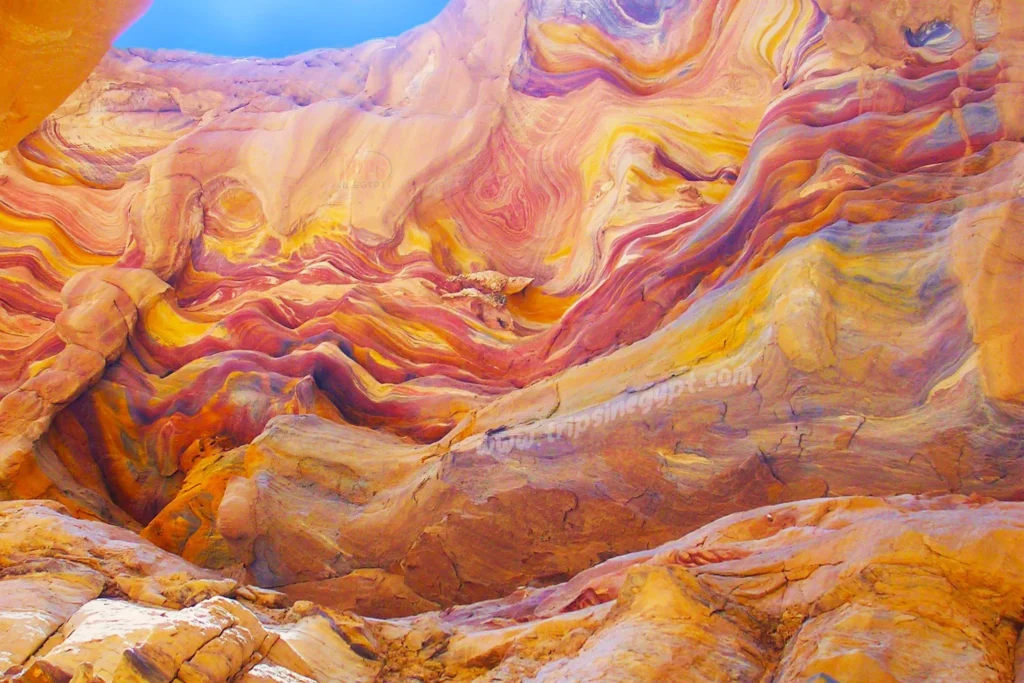
What it is: The Coloured Canyon (also called Salama Canyon) near Nuweiba is a narrow passage through sandstone whose walls shade from red and orange to purple, silver and gold — colours left by minerals deposited when the rock was part of an ancient seabed, then sculpted by erosion and tectonic movement over millions of years. The nearby White Canyon offers a contrasting walk through pale, smooth rock. Walking the Coloured Canyon is an exercise in looking up and looking closely at the same time, because the passage is narrow enough that its walls tower on both sides, close enough to touch, and coloured in bands that change with every turn, from deep red where iron oxides dominate, to orange and gold where other minerals prevail, to purple and silver where the rock’s composition shifts again. Those bands are not paint but geology, laid down layer by layer when the sandstone was still sediment on an ancient seabed, then lifted, tilted and cracked by tectonic movement, and finally cut by water — by rare but powerful flash floods that, over millions of years, carved a passage through rock that looks too solid to be cut at all. The White Canyon, by contrast, is pale, smooth and almost luminous, its rock worn to rounded forms that feel more like sculpture than geology, and the contrast between the two canyons, visited on the same safari, shows how mineral content, not just erosion, paints desert geology, because the same forces of water and wind have produced two utterly different galleries from two different rocks. Together they are the best inland complement to Dahab’s coastal sights, because they replace blue water with coloured stone and open horizons with enclosed passages.
Why it matters: Walking either canyon feels like entering a natural gallery, and the contrast between the two shows how mineral content, not just erosion, paints desert geology. That gallery feeling is not a metaphor imposed by guides but the actual experience of the walk, because the canyons are narrow, quiet and enclosed, with light falling in shafts from above, with walls that change colour as the sun moves, and with a silence that makes footsteps and voices sound close and clear, so that a visitor walks slowly, looks carefully and photographs constantly, not out of duty but out of genuine wonder. Visiting: Both are best visited on an organised 4×4 safari from Dahab, often combined with Ein Khudra Oasis, where a palm grove and a spring in the desert offer shade, water and a green contrast to the canyons’ stone, and where a Bedouin guide can explain the oasis’s place in desert travel, as a watering point on routes that linked the coast with the interior. Check current access and travel advice before going, wear closed shoes, and go with a guide who knows flash-flood safety, because canyons, however dry they look, are flood channels, and a guide who knows the weather signs, the escape routes and the seasonal risks is the difference between a safe walk and a dangerous one. Closed shoes matter because canyon floors are uneven, with loose rock, sand and occasional boulders, and sandals are a recipe for a twisted ankle. Confirm prices before booking, check the official site before visiting for current access rules, and allow a full day for the combined canyon and oasis safari, because the drive from Dahab, the walks themselves and the return all take time, and a rushed canyon visit, squeezed between other activities, will miss the slow looking that the canyons reward.
Eel Garden
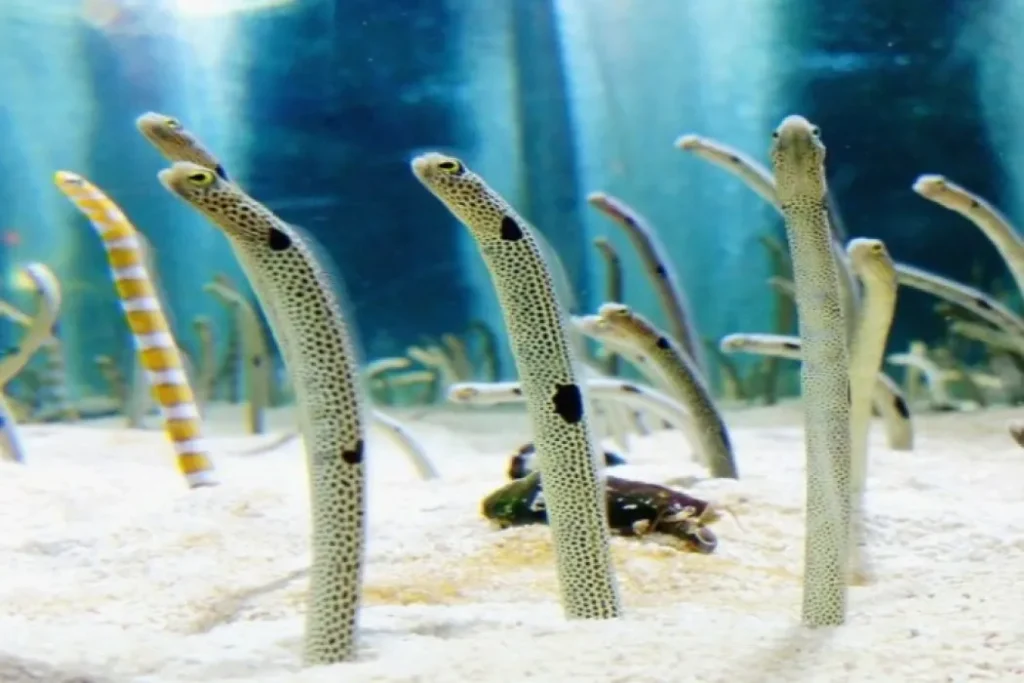
What it is: A reef north of central Dahab, along the Assalah shore, named for the sand eels — more properly garden eels — that rise up to a metre or more from their sandy burrows to feed. Garden eels are among the Red Sea’s most charming and most timid inhabitants, because they live in burrows in the sand, emerge head-first to feed on plankton drifting in the current, and retreat in a ripple of vanishing tails the moment a shadow, a swimmer or a sudden movement disturbs them, so that a whole field of eels can disappear in seconds and re-emerge, slowly and cautiously, over the following minutes. That behaviour makes Eel Garden a place that rewards patience and stillness rather than chasing, because a snorkeller who floats quietly, without kicking hard or approaching closely, will see the eels rise, sway and feed in the current, while a snorkeller who swims directly at them will see only empty sand. The reef itself, beyond the eels, is a shallow, accessible slope of sand and coral, with gardens of hard and soft coral, with cleaning stations where small fish service larger ones, and with the full cast of Red Sea reef life passing through — a habitat that, because it is shallow and close to shore, is ideal for a first snorkel, for a family swim, or for a diver’s gentle first dive of the day. Its position along the Assalah shore also matters, because it sits in the town’s original village quarter, where the shore is quieter, the lanes are residential, and the walk to the reef passes traditional houses, goats and children playing, rather than dive shops and cafés, giving the whole visit a village feeling that the central reefs lack.
Why it matters: It is one of Dahab’s most rewarding easy reefs: snorkellers and divers regularly see swarms of sardines, lionfish, scorpionfish, boxfish and moray eels, all close to shore and without the depth or crowds of the Blue Hole. That ease is the point, because Eel Garden proves that a world-class reef experience does not require depth, distance or difficulty, and because it gives non-divers, families and first-time snorkellers a reef that is as rich, in its own way, as the famous sites further north. The sardine swarms, in particular, are a spectacle in themselves, because a bait ball of thousands of small fish, moving as one shimmering cloud, parting around a snorkeller and reforming behind them, is a sight that even experienced divers remember, and because it happens in shallow water, close to shore, where a snorkeller can watch it for as long as they can float. Lionfish, scorpionfish, boxfish and moray eels add the reef’s character, each in its own niche — the lionfish hovering with fins spread, the scorpionfish camouflaged against coral, the boxfish drifting in bright yellow, the moray peering from a crevice — and together they give Eel Garden a diversity that rewards a slow, repeated look rather than a single pass. Visiting: Walk or take a short taxi north from Masbat, enter at a marked point, and keep your distance from the eels — they are timid and retreat if approached. Pair it with a wander through Assalah’s village lanes for a fuller morning, and for where to stay near Assalah and the northern shore, see our guide to places to stay in Dahab. Wear reef shoes for the rocky entry, use reef-safe sun protection, do not touch coral, and do not chase marine life, because the reef’s health depends on visitors who look without touching.
Lighthouse Reef, the Canyon and Three Pools
Lighthouse Reef is Dahab’s central, sheltered reef, steps from the promenade cafés — the easiest first snorkel in town and a classic night-dive site. Its position, directly off the Masbat promenade, makes it unique among Dahab’s reefs, because a snorkeller can finish breakfast, walk across the road, put on a mask and be over coral within minutes, without a taxi, a boat or a guide, and because that ease means Lighthouse is the reef most visitors see first, most often and most fondly. By day it offers shallow coral gardens, parrotfish, clownfish, moray eels and, on a good day, turtles, all in water clear enough for a snorkeller to see the reef’s full colour from the surface, while by night it transforms into a different place altogether, with nocturnal hunters, sleeping parrotfish in mucus cocoons, and the beams of dive torches picking out creatures invisible by day, which is why it is a classic night-dive site for certified divers with a licensed centre. The Canyon, a dive site north of town, is a dramatic fissure in the reef opening into a cavern where sunbeams pierce cracks in the rock; it suits experienced divers more than casual swimmers, because the swim through its narrow, sunlit fissure into a cavern, where light falls in shafts through the opening above, is an overhead environment in places, and a diver should only enter it with a guide who knows the route, the depth and the exit, and with buoyancy control good enough not to damage the reef or stir up sediment. The Canyon’s light is its fame, because the sunbeams that pierce the rock create a cathedral-like interior that photographers prize, but that beauty should not distract from its demands.
Three Pools, south of town, is a set of natural pools with vibrant coral gardens, popular for relaxed snorkelling away from the Blue Hole crowds. Its three pools, separated by coral ridges and linked by shallow channels, offer a gentler geography than the open reef, because a snorkeller can move from pool to pool in calm, sandy-bottomed water, gaining confidence in each one before trying the next, and because families with children find the pools safer and more manageable than an exposed reef edge. That gentleness is Three Pools’ attraction, and it makes it the ideal afternoon reef after a morning at the Blue Hole or the Canyon, when energy is lower, light is softer and a relaxed swim suits the day better than a demanding dive. Together they show Dahab’s range in a single day: town reef in the morning, Canyon for certified divers at midday, Three Pools for a gentle afternoon swim. That range, from a promenade reef to a cavern dive to a family pool, is Dahab in miniature, because it shows how the same coastline can offer, within a few kilometres, a first snorkel, a technical dive and a family swim, each in a different kind of water, each with a different kind of life, and each reachable without a boat. For how to dive, snorkel and plan a day across these three sites, see our guide to things to do in Dahab, and for a fuller route that orders them with the town’s other places, see our guide to places to visit in Dahab. Use a licensed dive centre for the Canyon, follow its briefing, never dive or freedive alone, and check the official site before visiting for current entry rules.
Dahab Promenade, Masbat and Assalah
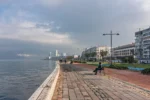
Not every attraction in Dahab is underwater or in the desert. The Masbat promenade — Dahab’s social spine, lined with Bedouin-run cafés, dive shops, craft stalls and rooftop restaurants — is itself a sight, especially at sunset when the mountains turn gold and the call of the town’s daily life takes over. The promenade’s appeal is not architectural, because its buildings are low, modest and varied, but social, because it is where Dahab’s life happens in public: divers debriefing after a morning dive, shopkeepers arranging craft stalls, café owners calling out to regulars, families strolling with children, and travellers from every continent sharing tables, stories and dive plans. At sunset that social life reaches its peak, because the light over the Gulf turns the Sinai mountains gold, then pink, then purple, the sea calms, the cafés fill, and the whole town seems to move outdoors at once, to eat, to drink tea, to watch the light and to plan the next day’s diving or desert trip. A visitor who walks the promenade at that hour, slowly, without a destination, will understand Dahab’s double identity better than any guidebook paragraph can explain it, because the promenade is where the town’s two lives — the fishing village and the traveller town — meet, overlap and negotiate, in the same cafés, on the same walkway, under the same sunset. Rooftop restaurants add a second level to that experience, because a table on a roof, above the promenade crowd, gives a view across the bay to the mountains and a quieter vantage from which to watch the town below. That rooftop view, across water to mountains, is one of Dahab’s most quietly memorable sights, because it places the whole town, its bay and its desert backdrop in a single frame at the day’s most beautiful hour.
Assalah, the original village to the north, offers the other side of that life: traditional houses, roaming goats and camels, and children playing in lanes that have changed far less than the promenade. Assalah’s lanes are residential rather than touristic, and that is precisely their attraction, because they show Dahab as a place where people live, not only as a place where people visit — where goats wander, where camels are tethered near houses, where neighbours talk outside their doors, and where the pace is set by daily life rather than by tour schedules. A walk through Assalah, especially in the morning when the village is waking, or in the late afternoon when children are playing and the light is soft, gives a direct encounter with the community that founded the town, and it complements the promenade walk in the way that a quiet chapter complements a busy one. Walk both in one evening and you will understand Dahab’s double identity as fishing village and traveller town, because the contrast between the promenade’s bustle and Assalah’s quiet, between dive shops and family houses, between rooftop restaurants and village lanes, is the town’s story in a single walk. For where to stay in each of these quarters, see our guide to places to stay in Dahab, which compares Masbat’s promenade life with Assalah’s village quiet and with Medina’s residential calm, and for a broader Dahab overview, see ConnollyCove’s Dahab guide. Both quarters reward a slow walk, a respectful photograph — people only with permission — and a willingness to sit, drink tea and watch, rather than to rush through with a camera. A slow walk, a shared tea and a willingness to linger are the best ways to enjoy both quarters, because their charm lies in daily life itself, not in any single shop, café or viewpoint.
Mount Sinai and St Catherine’s Monastery (Day Trip)
What it is: About two hours inland from Dahab, Mount Sinai (Jabal Musa, 2,285 metres) is the mountain where tradition says Moses received the Ten Commandments. At its foot stands St Catherine’s Monastery, founded in the 6th century, one of the oldest continuously inhabited Christian monasteries in the world, a UNESCO World Heritage Site whose library is second only to the Vatican’s in ancient manuscripts. The monastery’s age alone commands respect, because a community that has lived, prayed and studied in the same desert valley for some fifteen centuries, through invasions, earthquakes, political changes and the rise and fall of empires, has preserved something rare: a living tradition, not a ruin, with monks still in residence, services still held, and a library, icons and manuscripts still cared for as working treasures rather than as museum exhibits. Its setting adds to that weight, because the monastery sits in a narrow valley at the foot of Mount Sinai, ringed by granite peaks, with high walls that have protected it for centuries, and with a garden, a well and a chapel traditionally associated with the Burning Bush, all within a compact, walled enclosure that feels, on entering, like stepping out of the desert and into another century. The mountain itself, rising behind the monastery, is the other half of the attraction, because its summit, reached by a long path and a final flight of stone steps, offers a sunrise over a sea of granite peaks that pilgrims and travellers have sought for centuries, and because the climb, hard as it is, is itself a form of understanding, giving a physical sense of what pilgrimage meant before roads and vehicles. That physical effort, shared with fellow climbers, is part of the mountain’s meaning.
Why it matters: Even for non-religious visitors, the sunrise climb — about 3,750 stone steps on the final section — and the monastery’s icons, Burning Bush tradition and walled courtyards are among the most significant cultural experiences in Egypt. That significance is not only religious, though the religious story is central, because the monastery is also a monument to scholarship, to art and to desert survival, with icons painted over centuries, with manuscripts in Greek, Arabic, Syriac and other languages, and with a history of welcoming travellers, scholars and pilgrims from many traditions. The sunrise climb, meanwhile, matters for a different reason, because it is a shared, communal experience — hundreds of climbers, from many countries, waiting in the cold before dawn for the same sun — that gives the summit a feeling no solitary viewpoint can match, and because the climb’s difficulty, with its long path, its stone steps and its cold summit, makes the sunrise feel earned rather than merely seen. Visiting: Take an organised overnight tour from Dahab, dress modestly, and check the official site before visiting for opening days, as the monastery does not open every day. An overnight tour typically leaves Dahab late in the evening, drives about two hours to St Catherine, climbs overnight, watches sunrise at the summit, descends, and visits the monastery in the morning, before returning to Dahab late morning or early afternoon, and that shape, hard as it is, is the standard for a reason, because it puts the sunrise and the monastery together in a single journey. Dress modestly for the monastery, wear closed hiking shoes, bring a warm layer, a torch and snacks, book with a reputable operator that provides a Bedouin guide, and allow a rest day afterwards in Dahab, because the trip is a hard night, not a casual excursion. Confirm prices before booking.
Practical Guide: Best Time, Getting There and Visiting Order
| Topic | Practical tip |
|---|---|
| Best time to visit | March–May and September–November for warm water and comfortable walking weather; summer for wind sports, winter for quieter sights. |
| Getting to Dahab | Fly to Sharm El Sheikh, then taxi or bus north, about 80–100 km. Confirm transfers before arrival. |
| Suggested order | Day 1: Promenade, Lighthouse, Assalah. Day 2: Eel Garden and Three Pools. Day 3: Blue Hole and Canyon. Day 4: Ras Abu Galum and Blue Lagoon. Day 5: Coloured Canyon or Mount Sinai. |
| What to bring | Reef shoes, sun protection, water, modest clothing for the monastery, warm layer for desert nights and the Sinai summit. |
March to May and September to November are the best months for most Dahab attractions, because the sea is warm, the air is comfortable for walking, and the town is busy enough to feel alive without being crowded. Diving and snorkelling are at their most comfortable in those shoulder seasons, when water temperatures suit long sessions without a thick wetsuit and visibility is generally good, while canyon walks and promenade evenings are pleasant in the morning and evening rather than punishing at midday. Summer, from June to August, is hot — genuinely hot, in a way that a visitor from a temperate climate may underestimate — but it remains popular for wind sports in the Laguna, because the wind is strong, and for diving, because the sea is warm, provided days are built around dawn starts, shade breaks and long midday rests. Winter, from December to February, is milder and quieter, with cooler evenings, fewer visitors and often better value for accommodation, and it suits a traveller who values quiet, value and comfortable walking over warm-water swimming, though a wetsuit becomes more important for long dives and a warm layer becomes essential for desert nights and the Sinai summit. The suggested order in the table works because it builds gradually, from the town’s own sights on day one, through easy reefs on day two, to the famous Blue Hole and Canyon on day three, to the wild coast on day four, and finally to a full-day inland trip on day five, so that each day prepares for the next and no single day asks too much of a first-time visitor. That gradual order also protects energy, because a rested snorkeller, hiker or climber enjoys each sight more than an exhausted one rushing through a packed schedule.
Getting to Dahab and getting around its sights are both simpler than many first-timers expect, provided transfers are confirmed in advance. Most visitors fly to Sharm El Sheikh, then take a taxi or bus north, about 80 to 100 kilometres, and a pre-arranged transfer, confirmed with a hotel or driver before departure, removes the negotiation at the airport after a flight and ensures a driver who knows the road, the checkpoints and the timing. Once in town, central Dahab is walkable, and that walkability covers the promenade, Lighthouse Reef and Assalah, while taxis and pick-ups cover Eel Garden, Three Pools, the Blue Hole and safari starts, provided the fare is agreed before setting off. For Ras Abu Galum, the Coloured Canyon and Mount Sinai, an organised trip with a Bedouin guide is the standard and safest way, because those journeys involve protected-area rules, desert roads, early starts and local knowledge that a town taxi cannot always provide, and because a guide who knows the tracks, the weather signs and the monastery timetable is part of the safety system, not an optional extra. What to bring follows the same practical logic: reef shoes for rocky entries, sun protection for open water and desert, water for every land trip, modest clothing for the monastery, and a warm layer for desert nights and the Sinai summit, because desert temperatures drop sharply after sunset even after a hot day. Check the official site before visiting for current entry rules, fees and access, confirm prices before booking any safari, boat trip or guided tour, and keep one buffer day in the plan, because a windy boat day, a closed monastery day or a delayed transfer can otherwise unravel a tight schedule.
To plan activities at these sights, see things to do in Dahab; for where to stay near them, see places to stay in Dahab and our full places to visit in Dahab itinerary. Background on the protected coastline is available at International Parks’ Abu Galum guide, and a broader Dahab overview at ConnollyCove’s Dahab guide.
Conclusion
Dahab’s attractions do not compete with each other — they complete each other. The Blue Hole gives you drama, the Blue Lagoon gives you stillness, the canyons give you deep time, Eel Garden gives you easy wonder, and Mount Sinai gives you history you can climb. That completion is the key to a good Dahab visit, because each sight balances the others: the Blue Hole’s depth is balanced by the Blue Lagoon’s stillness, the canyons’ enclosed stone is balanced by the open sea, Eel Garden’s easy reef is balanced by the Canyon’s demanding dive, and the promenade’s social life is balanced by Assalah’s village quiet and by Ras Abu Galum’s wild coast. A visitor who sees only one kind of sight — only reefs, only canyons, only the town — will leave with a partial Dahab, while a visitor who moves between kinds, from water to desert to mountain, from town to wild coast, from a sinkhole to a monastery, will leave with a Dahab that feels whole, because the town’s attractions were never meant to be ranked against each other but to be experienced together, in an order that builds from easy to demanding, from near to far, from town to wilderness. Visit them in that spirit, with a guide where the land or sea demands one, and Dahab will feel less like a resort stop and more like a place you have actually understood, because understanding, in Dahab, comes not from a single famous site but from the pattern that the sites make together, a pattern of sea, desert and sacred mountain that has shaped this coast for millions of years, for centuries and for generations, and that continues to shape every visit today.
For a first visit, the simplest shape remains the best, and it is the shape set out in the practical table above: promenade, Lighthouse and Assalah on day one, Eel Garden and Three Pools on day two, Blue Hole and Canyon on day three, Ras Abu Galum and the Blue Lagoon on day four, and a canyon or Mount Sinai trip on day five, with rest built in and with a guide wherever the land or sea demands one. That shape leaves room for the sight you discover on arrival — a reef recommended by a dive centre, a wadi recommended by a Bedouin guide, a rooftop recommended by a fellow traveller — because Dahab’s informal, shore-based structure means new possibilities appear daily, in dive-centre conversations, on promenade noticeboards and in the recommendations of people you meet. Book trips through licensed centres and reputable operators, confirm what is included before you pay, check the official site before visiting for current entry rules, fees and access, and leave at least one afternoon unplanned for the promenade at sunset, when the mountains turn gold and the town’s daily life takes over. Done that way, with water, rock and sacred mountain mixed, with rest built in, and with guides respected rather than resented, Dahab’s attractions stop being a list and become a place: a sinkhole, a lagoon, a canyon, a reef and a monastery, held together by a small town on the Gulf of Aqaba, and remembered, long after the photographs fade, as a coastline, a desert and a mountain that belonged together all along. That memory, of a coastline, a desert and a mountain held together by one small town, is the reason many visitors return, and it is the best measure of whether a Dahab trip was truly well spent.
FAQs
What is the most famous tourist attraction in Dahab?
The Blue Hole. It is the site most travellers name first, for its depth, colour and world reputation among divers and freedivers.
Can non-divers enjoy Dahab’s attractions?
Absolutely. Snorkelling at Lighthouse, Eel Garden and Three Pools, the Blue Lagoon, the promenade, canyon walks and the Mount Sinai area all work without scuba certification.
How do I get to the Blue Lagoon?
Only by camel, boat or a coastal walk from the Blue Hole — there is no road into Ras Abu Galum. Book a Bedouin-guided safari and allow a full day.
Is the Coloured Canyon near Dahab?
It is a day trip from Dahab, near Nuweiba, usually visited on an organised 4×4 safari combined with an oasis stop. Check current access before going.
Do I need a guide for St Catherine’s Monastery and Mount Sinai?
Organised tours with a Bedouin guide are the standard and safest way from Dahab, covering the overnight climb and the monastery visit in one trip.
What should I not do at Dahab’s reefs?
Do not touch or stand on coral, do not chase eels or other marine life, and do not attempt deep or overhead dives beyond your certification. Check the official site before visiting for protected-area rules.