The best things to do in Dahab are not a checklist of ticketed attractions — they are a rhythm: reef in the morning, wind in the afternoon, desert at sunset. This laid-back Sinai town on the Gulf of Aqaba is one of the world’s great shore-diving bases, a serious wind-sport lagoon, and a gateway to Bedouin desert culture and the Mount Sinai pilgrimage route. That rhythm is the first thing a first-time visitor should understand, because Dahab does not reward the kind of sightseeing that rushes from one famous site to the next with a camera and a timetable. It rewards a slower pattern, in which the morning is given to the sea, when the water is calmest, the light is clearest and the reefs are at their most alive, the afternoon is given to the wind, when the thermal breeze fills the Laguna and the sails come out, and the evening is given to the desert and the promenade, when the heat fades, the tea is poured and the stars come out over the mountains. A traveller who fights that rhythm — diving at midday when the sun is harsh, hiking at noon when the wadis are hottest, or trying to fit the Blue Hole, the Laguna and a desert safari into a single frantic day — will miss what makes Dahab special. A traveller who follows it, building days around energy rather than around a list, will find that even a simple week here feels unhurried and full at the same time, because each part of the day has its own activity, its own light and its own pace, and none of them needs to be hurried to make room for the next.
Below is an activity-first guide: what each experience actually involves, who it suits, and how to do it safely, so you can build days around your energy rather than copying a generic tour list. It is deliberately kept as an activities guide, not as a guide to where to sleep or a catalogue of every sight in town. For where to base yourself for these activities, see our companion guide to places to stay in Dahab, which compares Lighthouse and Masbat, Medina, Laguna, Blue Hole Road and Assalah by feel, budget and traveller type. For the sights behind the activities — the reefs, headlands and historic places as places in their own right — see our guides to tourist attractions in Dahab and places to visit in Dahab, and for fitting Dahab into a wider Cairo, Luxor and Aswan journey, see our general Egypt travel guide. Timings, prices and access change by season and operator, so check the official site before visiting or booking any tour, course or entry, and confirm what is included before you pay, because transport, equipment, guide fees and entrance charges are bundled differently by different operators. Safety runs through every section of this guide, not as a warning added at the end but as part of each activity itself, because diving, freediving, wind sports, desert travel and mountain climbing all carry real risks that are managed by training, by licensed guides, by briefings and by honest self-assessment, and a traveller who respects those limits will enjoy Dahab far more than one who treats them as obstacles to be talked around. That respect is not caution for its own sake; it is what keeps diving, wind sports and desert travel enjoyable, day after day, in a place where conditions change with wind, tide and season.
At a Glance
| Activity | Best for | Effort / level | Where it happens |
|---|---|---|---|
| Scuba diving & freediving | Certified divers; beginners on intro dives | Beginner to technical | Blue Hole, Canyon, Lighthouse, Eel Garden |
| Snorkelling | Confident swimmers, families | Easy, shore-based | Lighthouse, Three Pools, Blue Hole rim |
| Windsurfing & kitesurfing | Beginners to advanced | Lessons available | Dahab Laguna |
| Desert safari & Bedouin dinner | Everyone; families especially | Easy evening trip | Sinai wadis around Dahab |
| Hiking & rock climbing | Fit walkers, climbers | Moderate to hard | Wadi Gnai, Sinai mountains |
| Mount Sinai day trip | Fit, early risers | Hard overnight hike | St Catherine area, about 2 hours away |
Timings, prices and access change by season and operator. Check the official site before visiting or booking any tour, course or entry.
A Short History: From Fishing Village to Dive Town
Dahab, Arabic for “gold”, began as a Bedouin fishing settlement of the Muzeina tribe, moving seasonally between mountain wadis and the coast. For generations that seasonal life shaped everything about the place: families fished the Gulf of Aqaba when the sea allowed, herded in the interior wadis when it did not, and traded along routes that linked the coast with the mountains, building low houses from local stone and palm, pulling boats up on the shore, and organising social life around kinship, hospitality and the sea rather than around visitors. The name itself is linked in local accounts to golden sands and to sunset light on the bay, and that image — a small, golden, working shoreline rather than a resort — is still recognisable in the older parts of town, where traditional houses, animals in the lanes and a slower pace survive alongside dive centres and cafés. That continuity matters for a visitor, because it explains why Dahab feels different from the large, purpose-built resorts further south on the Red Sea coast. Dahab was not designed as a holiday product and then filled with tourists; it was a living settlement that gradually, and on its own terms, began to welcome travellers, and the town’s accommodation, its promenade and its dive culture all still carry the shape of that history, in low buildings, walkable distances, courtyards and rooftops rather than tower blocks, and in a social life that mixes residents and visitors in the same cafés. Visitors who walk the older lanes today can still see that original settlement in the low houses, the boats and the unhurried pace, even as dive centres and cafés fill the promenade nearby, and that visible continuity is part of Dahab’s appeal.
After Sinai returned to Egypt in 1982, backpackers, divers and windsurfers arrived in growing numbers, drawn by reefs reachable on foot and desert that started at the edge of town. Dahab never became a single enclosed resort: dive centres, wind-sport schools, cafés and camps grew along the shore, and that informal, shore-based structure is exactly why so many activities here still start with a walk to the water rather than a coach transfer. A diver can still walk from a promenade hotel to Lighthouse Reef, kit up and be in the water within minutes; a windsurfer can still watch the wind from a Laguna café and be on the water when it arrives; a hiker can still meet a Bedouin guide in town and be in a wadi within the hour. That informality is Dahab’s greatest strength and also its greatest demand on the visitor, because it means activities are arranged locally, through centres, guides and small operators, rather than through a single resort desk, and a traveller who books through reputable local operators, asks what is included, and respects local customs will get far more from the town than one who expects everything to be packaged in advance. It also means the town’s history is not confined to a museum: it is visible in the way activities are organised, in the Bedouin guides who lead desert trips, in the family-run guesthouses and camps, and in the promenade itself, where the same cafés, dive centres and small hotels have served travellers for years. Understanding that history before you dive, surf or hike will make each activity richer, because you will see it as part of a living town, not as an attraction imposed upon it.
Dive and Snorkel the Shore Reefs
Start with Lighthouse Reef in town, where you can snorkel or dive straight from the promenade, then work outward to Eel Garden — named for the garden eels that poke from the sand — and Three Pools, a series of natural pools south of town known for colourful fish. Lighthouse is the ideal first reef for almost everyone, because it is accessible on foot, its coral gardens begin in shallow water, and its marine life — parrotfish, clownfish, moray eels, turtles on a good day — can be seen by a snorkeller in the first few metres as readily as by a diver at depth. That accessibility is the point of Dahab diving: unlike boat-diving destinations, where a reef is a destination reached by a long sail, Dahab’s reefs are the town’s front garden, entered from the shore, explored at your own pace, and returned to day after day as your confidence grows. Eel Garden, a short walk or ride north of the centre, adds a different habitat, with a sandy slope where garden eels sway in the current and where larger fish patrol the edge of the reef, while Three Pools, south of town, offers a gentler, family-friendly set of sandy-bottomed pools separated by coral ridges, where children and first-time snorkellers can gain confidence in calm, shallow water before trying a deeper reef. Together those three sites give a complete introduction to Red Sea reef life without ever needing a boat, and they are the sites to master before moving on to the more demanding dives further afield. That gradual progression, from a promenade reef to a sandy pool to a more exposed site, is the safest and most enjoyable way to learn Dahab’s underwater geography, because each step builds confidence, buoyancy and reef awareness before the next one asks more of you.
Certified divers can add the Canyon, a fissure in the reef leading to a cavern lit by shafts of sun, and the Bells, a chimney-like entry near the Blue Hole. Non-divers lose nothing by snorkelling: much of Dahab’s reef life lives in the first few metres. Use a licensed dive centre, follow its briefing, and never dive or freedive alone. The Canyon deserves its reputation, because the swim through its narrow, sunlit fissure into a cavern, where light falls in shafts through the opening above, is one of the most photogenic dives in the Red Sea, but it also deserves respect, because it is an overhead environment in places, and a diver should only enter it with a guide who knows the route, the depth and the exit, and with buoyancy control good enough not to damage the reef or stir up sediment. The Bells, similarly, is a chimney entry that drops through a narrow opening into open water beside the Blue Hole, and it is best done as a guided dive, with a clear briefing on depth, current and the exit route, rather than as an improvised swim. For non-divers, the message is simpler and more encouraging: snorkelling in Dahab is not a second-class version of diving, because the Red Sea’s coral gardens, its clouds of anthias, its turtles and its rays are all visible from the surface, and a snorkeller who learns to float calmly, to look rather than chase, and to respect the reef will see as much, in a different way, as a diver at twenty metres. Whatever your level, the rules are the same: use a licensed centre, follow its briefing, never dive or freedive alone, do not touch coral, use reef-safe sun protection, and carry reef shoes for rocky shore entries, because a cut foot on coral is the most common, and most avoidable, Dahab injury.
Experience the Blue Hole — With Respect for Its Depth
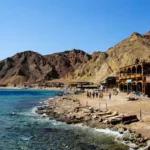
The Blue Hole, a submarine sinkhole north of town dropping well over 100 metres, is Dahab’s most famous site and its most misunderstood. Seen from the shore it looks deceptively calm: a circle of deep, sapphire water set into a shallow coral rim, with snorkellers floating over gardens at its edge and dive groups kitting up on the rocks beside it, and a first-time visitor could easily mistake it for a swimming pool in the sea. That calm surface hides a vertical world, because the hole drops steeply from a shallow rim to depths far beyond recreational diving, and its most famous feature, the Arch — a tunnel linking the hole to the open sea at depth — has claimed lives precisely because it tempts divers to go deeper, further and longer than their training, gas supply and experience allow. For snorkellers, the shallow outer rim offers coral gardens and reef fish in clear water, and it is a superb snorkel in its own right, with the deep blue of the hole itself providing a dramatic backdrop to the shallow reef life at its edge. For divers, the Blue Hole is a serious site, not a novelty, and it should be approached with the same preparation as any deep dive: a recent dive history, a clear plan, a guide who knows the site, and a firm decision, made before entering the water, about maximum depth and turn-around gas. A diver who treats the Blue Hole as a place to test limits will find it unforgiving; a diver who treats it as a place to enjoy a beautiful, deep, clear site within limits will find it unforgettable. That contrast, between a calm surface and a deep vertical world, is exactly why local guidance matters here more than at any other Dahab site.
For divers, it is a serious site: sources consistently describe the Arch, the tunnel linking the hole to the open sea, as technical diving territory, not a recreational goal, and advanced certification and recent logged dives are commonly required by dive centres for deeper routes. If you are a beginner, enjoy the Blue Hole from the surface, take an intro dive elsewhere first, and treat any operator promising a casual Arch dive as a warning sign. Check the official site before visiting for current entry rules and fees. That warning sign test is worth applying to every operator you consider, because a centre that promises a casual Arch dive to an inexperienced diver does not take safety seriously, and a centre that refuses such a dive, explains why, and offers a shallow reef dive or an intro dive instead is telling you the opposite. Beginners have excellent alternatives in Dahab: an intro dive on Lighthouse Reef or at Three Pools, under close instructor supervision, gives the sensation of diving without the depth, the overhead environment or the current of the Blue Hole, and a snorkel on the Blue Hole rim gives the famous view without any of the risk. Freedivers, too, should treat the Blue Hole with respect, because freediving a deep sinkhole carries its own risks — blackout, disorientation and the temptation to chase depth — and freediving should never be done alone, should always be done with a buddy and a safety diver, and should follow the same depth discipline as scuba. Entry rules and fees at the Blue Hole change, so check the official site before visiting for current entry rules and fees, confirm what your dive centre or tour includes, and arrive with the understanding that the Blue Hole is best enjoyed slowly, from the rim, from a shallow dive, or from a guided dive within your training, rather than as a test of courage.
Windsurf and Kitesurf in Dahab Laguna
Dahab Laguna, the shallow sandy lagoon south of town, is why wind sports thrive here: steady Gulf of Aqaba wind, flat shallow water for beginners, and schools offering lessons and rental on site. The lagoon’s geography is the key to its reputation, because it is sheltered enough to be shallow and flat, yet open enough to the prevailing wind to give reliable conditions, and that combination — flat water plus steady wind — is exactly what a beginner needs to learn and what an intermediate needs to practise. A first-time windsurfer can stand in waist-deep water, fall, climb back on the board and try again without drifting far or facing waves, while a kitesurfer can launch from a sandy beach, ride in a marked zone and return to shore without the shore-break that makes many coastal spots intimidating. Schools in the Laguna offer lessons, rental and rescue cover, and they are the right way to start, because wind sports, like diving, are skills with real safety rules — right of way, launch and landing procedures, wind limits and self-rescue — that are best learned from an instructor rather than improvised from a video. Even the choice of equipment matters: a beginner on too large a sail, or a kitesurfer on too powerful a kite for the day’s wind, will struggle and may endanger others, while a school will match sail, board and kite to your weight, level and the day’s conditions. That matching is part of what you pay for, and it is worth paying for, because it turns a potentially frustrating first day into a day of real progress. That guidance also covers wind assessment, rescue procedures and what to do if you drift, so a first lesson is as much about safety as about standing up.
Windsurfing is traditionally strongest from spring into early autumn, and kitesurfing shares the same lagoon with separate zones — follow the schools’ safety rules and launch areas rather than improvising. Even if you never stand on a board, the lagoon is a fine afternoon: watch the sails, swim in the shallows, and stay for a beach café sunset. The seasonal pattern matters for planning, because wind strength and consistency vary through the year, and a traveller who comes in the classic wind season, from spring into early autumn, with April to July often highlighted, will find more reliable wind and more schools operating at full capacity, while a traveller who comes in winter will still find wind on many days but should check conditions and school opening times before booking a course. The separation of zones matters for safety, because windsurfers and kitesurfers share the lagoon but use different areas, with launch and landing zones, right-of-way rules and rescue cover organised by the schools, and a visitor who launches outside those zones, or who swims in a launch area, creates a hazard for everyone. For non-participants, the Laguna is still one of Dahab’s best afternoons, because the shallow, sandy water is ideal for swimming and paddling, the beach cafés offer a front-row view of the sails, and the sunset over the lagoon, with the mountains behind and the sails still on the water, is one of the town’s most photographed moments. Families, too, find the Laguna easier than the reef shore, because children can paddle in shallow sand rather than over rock and coral, and parents can watch from a café rather than from a rocky entry point. Whether you ride, learn or simply watch, the Laguna rewards an afternoon given to it, not rushed between other activities, because its pleasure is in the wind, the light and the open space, and those are best enjoyed slowly.
Take a Desert Safari and a Bedouin Dinner
A 4×4 or camel safari into the Sinai wadis is Dahab’s essential land experience, and the evening version — a Bedouin dinner cooked over fire, with tea, stories and stargazing — is the one most travellers remember longest. Day safaris often combine sandboarding, a wadi walk and a Bedouin tent stop for tea; longer camel treks head along the coast toward Ras Abu Galum. The day version and the evening version serve different purposes, and a traveller with time for both will enjoy both, because the day safari shows the desert in its colours — the red and ochre rock, the palm pockets in the wadis, the sand dunes where sandboarding is possible — while the evening version shows the desert in its other, quieter mood, when the heat fades, the fire is lit, the tea is sweet and strong, and the stories begin. A Bedouin dinner is not a restaurant meal moved outdoors; it is a social occasion, hosted by Bedouin guides whose families have lived in these wadis for generations, and whose knowledge of water, tracks, weather and stars is the reason the trip works at all. The food — typically grilled meat or chicken, rice, salads and bread cooked over fire, followed by Bedouin tea — is simple and generous, and it tastes better for being eaten sitting on rugs, under a sky that, away from town lights, shows the Milky Way in a way that city visitors rarely see. That combination of food, fire, story and sky is why the evening safari, more than any single dive or wind-sport session, is the experience travellers mention first when they return home, because it is the one that feels most unlike everyday life.
Choose a Bedouin-guided trip, dress for a cold desert night even after a hot day, and ask what is included before you book: transport, dinner, entrance fees and guide costs are bundled differently by different operators. The Bedouin-guided point is not a matter of authenticity alone, though authenticity matters; it is a matter of safety and knowledge, because Sinai’s wadis are unmarked, water points are few, and a guide who knows the tracks, the weather signs and the protected-area rules is the difference between a safe trip and a lost one. Dressing for a cold night is equally practical, because desert temperatures drop sharply after sunset, even after a day hot enough to make a jacket seem absurd at noon, and a traveller in shorts and a T-shirt will be cold by the time dinner is served, while a traveller with a warm layer, closed shoes and a scarf will enjoy the evening comfortably. Longer camel treks, along the coast toward Ras Abu Galum, deserve a separate decision, because they are multi-hour or overnight journeys, not evening outings, and they require a different level of fitness, preparation and time, with camping, food and water carried for the whole trek. For a family, the evening Bedouin dinner is the safer and more rewarding choice, because children enjoy the fire, the tea and the stars without the endurance demands of a long camel trek, and because the trip returns to town the same night. Whatever version you choose, confirm in advance what is included — transport, dinner, entrance fees, guide costs and return time — because operators bundle those items differently, and a trip that looks cheap can become expensive once fees are added, while a trip that looks dear may include everything. Confirm prices before booking, and check the official site before visiting for current access rules.
Hike, Climb and Cycle the Wadis
Wadi Gnai (also spelled Wadi Gunei) and Wadi Qunai, short rides from town, offer half-day hikes among rock formations, palm pockets and climbing routes, with local guides providing instruction and gear. Cycling is a gentler alternative: hire a bike, ride the promenade, and take established tracks into the desert fringe. For any wadi hike, go with a guide — trails are often unmarked — carry more water than you think you need, and start early to avoid midday heat. This is also the right preparation, in miniature, for the bigger mountain night ahead. The wadis themselves are worth describing, because they are not empty desert but living valleys, where a narrow band of palms, acacia and water pockets survives in a landscape of rock, and where the geology — sandstone and granite carved by flash floods over millennia — creates natural amphitheatres, narrow passages and rock faces that attract climbers from around the world. A half-day hike in Wadi Gnai typically combines a walk through that landscape with stops at palm groves, rock pools after rain, and viewpoints over the Gulf, and a guide will point out the plants, the animal tracks and the Bedouin history of the valley in a way that a solo walker, following an unmarked track, would miss entirely. Rock climbing in the wadis ranges from easy bouldering to multi-pitch routes, and local guides provide instruction and gear, matching routes to experience, which is essential, because Sinai rock, heat and remoteness punish a climber who overestimates ability or underestimates water needs. Cycling, by contrast, is Dahab’s gentlest land activity, because the promenade is flat, bikes are easy to hire, and established tracks into the desert fringe offer a taste of the wadis without the commitment of a full hike.
For any wadi hike, the practical rules are simple, non-negotiable and worth repeating, because they are the rules that keep a pleasant half-day from becoming a rescue. Go with a guide, because trails in the wadis are often unmarked, junctions are ambiguous, and a guide who knows the valley knows not only the route but the water points, the shade stops and the places where a flash flood, however unlikely on a clear day, would be dangerous. Carry more water than you think you need, because desert hiking dehydrates faster than a walker from a temperate climate expects, and because there is no shop, tap or café in a wadi to top up from, so a litre per person per hour in heat is a safer planning figure than a single bottle for the morning. Start early to avoid midday heat, because a hike begun at dawn finishes in comfortable light, while the same hike begun at noon finishes in punishing heat, with the rock radiating warmth and the shade gone. Wear closed shoes with grip, a hat, sunscreen and a warm layer if the hike extends into evening, because wadi rock is uneven, loose in places and sharp in others, and sandals are a recipe for a twisted ankle or a cut foot. Tell someone your route and expected return, carry a charged phone but do not rely on signal in a deep wadi, and respect protected-area rules, including not removing rocks, plants or artefacts, because the wadis are both a natural and a cultural landscape. Done that way, a wadi hike is also the perfect preparation, in miniature, for the Mount Sinai night, because it teaches the same lessons — early start, guide, water, layers, pacing — on a half-day scale, before they matter on a mountain at night.
Do the Mount Sinai Sunrise Trip as a Day Trip
From Dahab, organised tours typically leave late in the evening, drive about two hours to St Catherine, climb Mount Sinai (Jabal Musa, 2,285 metres) overnight — around three hours up and two to three down, including the famous stone steps near the summit — and visit St Catherine’s Monastery, a 6th-century Orthodox monastery and UNESCO World Heritage Site, in the morning. Dress modestly for the monastery, wear closed hiking shoes, bring a warm layer, a torch and snacks, and book with a reputable operator that provides a Bedouin guide. This is a hard night, not a casual excursion, and it deserves a rest day afterwards in Dahab. The night itself follows a pattern that every operator, and every guidebook, describes in similar terms, because the mountain dictates it: a late-evening departure from Dahab, a drive of about two hours through desert darkness to St Catherine, a climb that begins around midnight or soon after, in torchlight, up a long, winding path that gains height steadily, then the famous stone steps near the summit — some 750 steps, steep and uneven — and finally the summit itself, reached in time for sunrise, when the light spreads across a sea of granite peaks and the cold, the tiredness and the early start are, for most climbers, suddenly justified. That sunrise is the reason for the whole night, and it is genuinely spectacular, because the Sinai mountains, seen from 2,285 metres at dawn, form a landscape of ridges, valleys and shadows that no photograph quite captures, and because the shared experience — hundreds of climbers, from many countries, waiting in the cold for the same sun — gives the summit a communal, almost pilgrim feeling that a daytime climb would not have.
The practical preparation for that night deserves as much attention as the sunrise itself, because a climber who arrives unprepared will spend the night cold, footsore and miserable, while a climber who arrives prepared will enjoy it. Dress modestly for the monastery, because St Catherine’s is a working Orthodox monastery, not a museum, and modest clothing, covered shoulders and knees, and respectful behaviour are expected, with photography restricted in some areas. Wear closed hiking shoes with grip, because the path is rocky, the steps are uneven, and sandals or smooth-soled shoes are unsafe on a night climb. Bring a warm layer — indeed, bring two, because the summit before dawn is cold even in summer, and wind at the top adds a chill that a single fleece will not hold off — plus a torch with spare batteries, snacks and water, because there are stalls on the lower path but not reliably at the top, and because a night climb without water is a short route to dehydration and headache. Book with a reputable operator that provides a Bedouin guide, because the guides, who know the mountain, the weather and the monastery timetable, are part of the experience and part of the safety system, and because an operator that cuts corners on guides, transport or timing will leave you to improvise on a mountain at night. Allow a rest day afterwards in Dahab, because the trip returns late morning or early afternoon, tired, and a day of reef, promenade and sleep is the right way to recover, rather than a day of diving, which should not follow a night of exhaustion and altitude without rest. Check the official site before visiting for current monastery opening times, access rules and tour conditions, because those details change, and confirm prices before booking.
Practical Guide: Best Time, How to Get Around and Planning Tips
| Topic | Practical tip |
|---|---|
| Best time for activities | March–May and September–November for diving, snorkelling and hiking; April–July is often cited for wind sports. Summer is hot; winter is mild and quieter. |
| Getting to Dahab | Fly to Sharm El Sheikh, then taxi or bus north (about 80–100 km). Confirm transfers in advance. |
| Getting around town | Walk the promenade; use taxis or pick-ups for the Blue Hole, Three Pools and safari starts. |
| Safety basics | Dive and freedive only with certified instructors; never freedive alone; use reef-safe sun protection and do not touch coral. |
| One-week shape | 2 days reef diving/snorkelling, 1 day Laguna wind sports, 1 day desert safari, 1 overnight Mount Sinai trip, 1–2 rest days on the promenade. |
March to May and September to November are the best months for most Dahab activities, because the sea is warm, the air is comfortable for hiking, and the town is busy enough to feel alive without being crowded. Diving and snorkelling are at their most comfortable in those shoulder seasons, when water temperatures suit long sessions without a thick wetsuit and visibility is generally good, while hiking in the wadis is pleasant in the morning and evening rather than punishing at midday. April to July is often cited for wind sports, when the thermal wind in the Laguna is most reliable, and a wind-sport traveller who plans a course in those months will find schools operating at full capacity and conditions that suit learning. Summer, from June to August, is hot — genuinely hot, in a way that a visitor from a temperate climate may underestimate — but it remains popular for wind sports, because the wind is strong, and for diving, because the sea is warm, provided days are built around dawn starts, shade breaks and long midday rests. Winter, from December to February, is milder and quieter, with cooler evenings, fewer visitors and often better value for accommodation, and it suits a traveller who values quiet, value and comfortable walking over warm-water swimming, though a wetsuit becomes more important for long dives. Whatever the season, the one-week shape in the table works well as a starting point, because it balances water, wind, desert and rest, rather than stacking every activity into the first three days and leaving the rest of the week empty. That balance also protects your energy, because a rested diver, hiker or windsurfer enjoys each activity more than an exhausted one rushing through a packed schedule.
Getting to Dahab and getting around town are both simpler than many first-timers expect, provided transfers are confirmed in advance. Most visitors fly to Sharm El Sheikh, then take a taxi or bus north, about 80 to 100 kilometres, and a pre-arranged transfer, confirmed with a hotel or driver before departure, removes the negotiation at the airport after a flight and ensures a driver who knows the road, the checkpoints and the timing. Once in town, central Dahab is walkable, and that walkability is one of its greatest pleasures, because the promenade, the dive centres, the cafés and Lighthouse Reef can all be reached on foot, while taxis and pick-ups cover the Blue Hole, Three Pools and safari starts, provided the fare is agreed before setting off. Safety basics run through every activity in this guide, and they are worth restating as a single set of habits: dive and freedive only with certified instructors, never freedive alone, follow dive-centre briefings on depth and gas, use reef-safe sun protection and do not touch coral, wear reef shoes on rocky entries, carry water on every land trip, and use licensed guides for desert, wadi and mountain trips. For where to base yourself for these activities, see places to stay in Dahab; for the sights behind the activities, see tourist attractions in Dahab and places to visit in Dahab. Further activity ideas are covered in MileHacker’s Dahab things-to-do guide and The Travel Lovers’ Dahab guide. Planning that way — season first, transport confirmed, safety habits fixed — leaves the actual days free for the sea, the wind and the desert, which is precisely what a Dahab trip should feel like, unhurried, sunlit and shaped by conditions rather than by a rigid timetable.
Conclusion
Dahab rewards travellers who mix water, wind and desert instead of choosing just one. Dive the shore reefs, respect the Blue Hole’s depth, learn a wind sport in the Laguna, spend one evening with Bedouin hosts under the stars, and — if you are fit enough — climb Mount Sinai for sunrise. Done in that order, with rest days built in, Dahab stops being a list of activities and becomes the slow, salty, sunlit place people return to. That mixing is the key to a good Dahab week, because each element balances the others: diving gives the mornings structure and wonder, wind sports give the afternoons energy and play, the desert gives the evenings quiet and perspective, and rest days on the promenade give the whole trip time to settle, so that no single activity exhausts you and no single day feels wasted. A traveller who dives every day without a break will tire, lose buoyancy control and enjoy the reef less on day five than on day one; a traveller who alternates diving with wind sports, desert and rest will enjoy each activity more, because each returns with fresh energy. The order matters too, because the shore reefs teach the sea before the Blue Hole tests respect for it, the wadis teach desert walking before Mount Sinai tests mountain endurance, and the Laguna teaches wind before a longer wind-sport course demands it. That progression — from easy to demanding, from town to desert to mountain — is the natural shape of a Dahab trip, and it is the shape that experienced visitors, returning year after year, tend to follow without thinking, because the town itself suggests it, in its tides, its winds and its desert light.
For a first trip, the simplest shape remains the best, and it is the shape set out in the practical table above: two days of reef diving or snorkelling, one day of Laguna wind sports, one day of desert safari, one overnight Mount Sinai trip, and one or two rest days on the promenade, with the order adjusted to wind, weather and energy. Build those rest days in deliberately, rather than treating them as days when nothing is planned, because a rest day in Dahab is not an empty day: it is a morning snorkel at Lighthouse, a long lunch on the promenade, an afternoon swim in the Laguna shallows, and an evening watching the sun set over the Gulf, and it is often the day travellers remember most fondly, because it is the day Dahab itself, rather than any single activity, is enjoyed. Book activities through licensed centres and reputable operators, confirm what is included before you pay, check the official site before visiting for current entry rules, fees and conditions, and leave room in the plan for the activity you discover on arrival — a freediving course, a camel trek, a climbing day — because Dahab’s informal, shore-based structure means new possibilities appear daily, in dive-centre conversations, on promenade noticeboards and in the recommendations of fellow travellers. Done that way, with water, wind and desert mixed, with rest built in, and with safety respected rather than resented, Dahab stops being a list and becomes a rhythm: reef in the morning, wind in the afternoon, desert at sunset, and a return visit already forming in the mind before the first one has ended. That rhythm, once learned, is hard to forget, and it is why so many first visits become second ones.
FAQs
What is the number one thing to do in Dahab?
Shore diving or snorkelling. The reefs at Lighthouse, Eel Garden and the Blue Hole rim are accessible on foot and showcase the Red Sea at its best.
Can beginners dive in Dahab?
Yes — intro dives and beginner courses run from town dive centres, usually starting on gentle reefs. The Blue Hole’s deeper routes, including the Arch, are not beginner dives.
Is snorkelling at the Blue Hole safe?
For confident swimmers following basic snorkelling safety, the shallow rim is widely described as comparable to other Dahab snorkel sites. Non-swimmers and first-time snorkellers should go with a guide and consider a flotation vest.
When is the best time for windsurfing in Dahab?
Spring through early autumn is the classic wind season, with April–July often highlighted. Schools run year-round — check the official site before visiting for current conditions.
How long does the Mount Sinai trip from Dahab take?
Allow a full overnight trip: late-evening departure, a 2–3 hour climb up, sunrise at the summit, descent, a monastery visit, and return to Dahab late morning or early afternoon.
Do I need a guide for desert safaris and wadi hikes?
Yes, in practice. Bedouin guides know unmarked trails, water points and protected-area rules, and organised trips handle transport and permits. Check the official site before visiting for current access rules.