Places to visit in Dahab make most sense in geographic order: start in town, follow the coast north, return south to the lagoon, then turn inland to desert and mountain. Dahab is a linear town on the Gulf of Aqaba, stretched along a single shore rather than arranged around a centre, and that shape is the key to planning a visit, because the town itself tells you the order in which to see it. Walk the promenade first, let the coast pull you north to the Blue Hole and beyond, and save the big inland days for when you know the town’s rhythm, because a visitor who understands the town’s geography on day one will waste far less time on later days. This itinerary does exactly that, in five stages you can stretch from three days to a full week, and it is deliberately a route guide rather than a catalogue of sights. For what each place is in its own right, see our companion guide to tourist attractions in Dahab; for how to dive, surf, hike and sail at those places, see our guide to things to do in Dahab; and for where to sleep between stages, see our guide to places to stay in Dahab. Keeping those jobs separate lets this guide do its own job, which is to put places in order, to explain where each one sits relative to the others, and to show how a day in one place prepares you for the next. A route that follows the coast, rather than hopping between famous names at random, also protects your energy, because it groups nearby places together, avoids backtracking along the same road, and builds from easy to demanding in a way that a scattered list never does.
The order matters because Dahab’s places are not interchangeable stops on a checklist but stages in a single landscape, each one teaching you something the next one needs. The town teaches you the promenade, the reef and the pace of daily life, so that by the time you reach the Blue Hole you already know how to enter the water, how to read a reef and how to judge a guide. The south coast teaches you sand, shallow water and wind, so that the deep north coast, when you reach it, feels like a contrast rather than a shock. The north coast teaches you depth and drama, so that the wild coast beyond the road, where there are no facilities at all, feels like a logical next step rather than a leap into the unknown. The wild coast teaches you remoteness, so that the desert and the mountain, which demand still more self-reliance, feel like a culmination rather than a detour. And the desert teaches you scale, so that when you return to the promenade at the end of the trip, the town itself looks different, smaller and more precious, because you have seen the landscape it sits within. That progression, from town to coast to wild coast to desert to mountain, is also the progression of Dahab’s own history, from a fishing village to a diving town to a gateway for desert and pilgrimage travel, and a visitor who follows it will understand the place as a whole rather than as a collection of photographs. For fitting Dahab into a wider journey, see our general Egypt travel guide, which places Dahab after Cairo, Luxor and Aswan in a full Egypt route. Distances, opening days and entry rules change, so check the official site before visiting any protected area, canyon or monastery, and confirm prices before booking any tour, transfer or guided trip.
At a Glance
| Stage | Places | Time needed | How you travel |
|---|---|---|---|
| 1. Town | Masbat promenade, Lighthouse, Assalah, Medina | 1 day | On foot |
| 2. South coast | Laguna, Three Pools | Half to 1 day | Taxi, bike or walk |
| 3. North coast | Eel Garden, Canyon, Blue Hole, Bells | 1 day | Taxi north along the coast road |
| 4. Wild coast | Ras Abu Galum, Blue Lagoon | 1 full day or overnight | Camel, boat or coastal walk |
| 5. Desert & mountain | Coloured Canyon, Ein Khudra, Wadi Gnai, Mount Sinai & St Catherine’s | 1–2 days | Organised 4×4 or overnight tour |
Distances, opening days and entry rules change. Check the official site before visiting any protected area, canyon or monastery.
History in Brief: Why Dahab Is Laid Out This Way
Dahab — Arabic for “gold”, for its sands and sunset light — grew from a Muzeina Bedouin fishing settlement that used the coast in summer and the mountain wadis in winter, and that seasonal movement explains the town’s shape today more clearly than any map. The original village at Assalah in the north was the fishing settlement itself, where families lived close to the shore, kept boats, and traded with the interior; the traveller promenade at Masbat and Lighthouse in the centre grew later, where dive centres, cafés and guesthouses clustered around the most accessible reef; the residential quarter at Medina inland grew as the town’s everyday life needed houses, shops and schools away from the tourist strip; and the wind-sport lagoon at Laguna in the south developed because the geography there, a shallow sandy bay open to the prevailing wind, suited windsurfing and kitesurfing in a way no other part of the coast did. After Sinai returned to Egypt in 1982, divers and backpackers added dive centres, camps and guesthouses along the same shore, rather than replacing it, so the town kept its linear, low-rise character, with each quarter retaining the function that created it. Following the town north to south, then inland, is therefore also following its history, because the walk from Assalah’s village lanes to Masbat’s promenade to Medina’s residential streets to Laguna’s resorts is a walk through the town’s own development, from fishing village to diving town to residential town to wind-sport resort. A visitor who walks that line slowly on the first day will understand, without needing a history lesson, why Dahab feels like several small towns joined by one shore rather than one resort built all at once.
That history also explains why the route in this guide works in the order it does, and why reversing it would feel wrong even if the same places were visited. The town comes first because it is where the town’s own story begins, in Assalah’s lanes and in the promenade’s cafés, and because a visitor who has walked the town understands the people, the pace and the practicalities that every later stage depends on. The coast comes next because the sea is what made Dahab a destination in the first place, and because the reefs, from Lighthouse in town to the Blue Hole in the north, are arranged along the same shore in the order a diver or snorkeller naturally discovers them, from easy to demanding. The wild coast comes after the north coast because it is literally where the road ends, and because a place reachable only by camel, boat or foot makes sense only after a visitor has already learned the coast road, the reef entries and the desert light. The desert and the mountain come last because they are inland, because they demand the most preparation, and because they belong to a different history altogether, the history of Sinai’s interior, of Bedouin trade routes, of canyons carved over millions of years, and of a monastery founded in the 6th century at the foot of a sacred mountain. A route that respects that layering, from fishing village to reef to wild coast to desert to mountain, gives each stage its proper weight, and it also gives the traveller a narrative to carry home, which is worth more than a list of names, because a journey with a shape is remembered long after a journey without one has faded into photographs.
Stage 1: Dahab Town — Masbat, Lighthouse and Assalah
Begin on the Masbat promenade, where cafés, dive shops and craft stalls line the bay and Lighthouse Reef lies just offshore — an ideal first snorkel without leaving town, and the gentlest possible introduction to the Red Sea. The promenade is Dahab’s social spine, and a morning spent walking it, slowly, without a destination, teaches you more about the town than any guidebook paragraph, because it shows you where the dive centres cluster, where the cafés set their tables close to the water, where the craft stalls sell Bedouin jewellery and textiles, and where the rooftop restaurants offer a view across the bay to the Sinai mountains. Lighthouse Reef, directly off the promenade, is the natural first swim, because its coral gardens begin in shallow water, its fish are visible from the surface, and its entry points are marked and easy, so a first-time snorkeller can test a mask, practise buoyancy and gain confidence without a taxi, a boat or a guide. From the promenade, walk north into Assalah to see the older village, where traditional houses, goats and camels in residential lanes, and the shore path toward Eel Garden show a Dahab that predates tourism, and where the pace, the sounds and the smells are those of a living village rather than a resort. That contrast, between promenade bustle and village quiet, is the town’s story in a single walk, and it is best experienced on foot, at a wanderer’s pace, with time to stop for tea, to talk to a shopkeeper, and to watch the town wake up from a rooftop café. A first snorkel here also lets you check your mask fit, your fins and your comfort in open water before any later stage asks more of you.
Come back through Medina if you want a sense of everyday Dahab beyond the tourist strip, because Medina, inland and south-west of the promenade, is where residents shop, where children go to school, and where apartments and small hotels offer a quieter, more residential base for longer stays. Medina’s streets are not picturesque in the postcard sense, but they give a truer sense of how Dahab lives when the visitors have gone home, and a walk through them, especially in the morning when shops are opening and the town is starting its day, rounds out the first stage in a way that a promenade-only day cannot. End the day with dinner on the promenade as the Sinai mountains turn gold, because the sunset hour is when the town moves outdoors, when the light over the Gulf turns the mountains pink and then purple, and when a table close to the water, with the day’s diving and walking behind you, feels like a reward rather than a meal. This first day is deliberately gentle, and that gentleness is its purpose: it orients you, it tests your snorkel gear, it lets you book later trips face to face with local operators rather than online in a hurry, and it gives you the practical knowledge, from taxi fares to dive-centre reputations to the best café for breakfast, that every later stage will rely on. That practical knowledge, gathered quietly over a single unhurried day, is worth more than any rushed online booking made before arrival. For where to sleep in each quarter, see our guide to places to stay in Dahab, and for what the promenade, Lighthouse and Assalah are as sights in their own right, see our guide to tourist attractions in Dahab.
Stage 2: South to Laguna and Three Pools
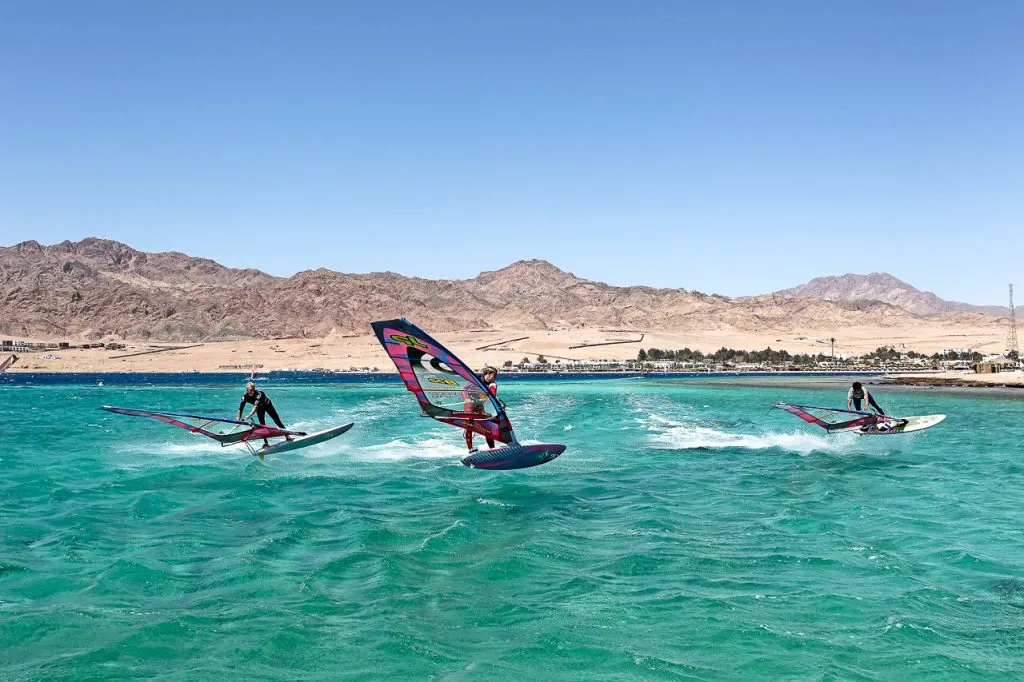
Head south to Laguna, Dahab’s sandy, shallow lagoon and wind-sport centre, where beginners can take a lesson and non-sailors can swim in water shallow enough to stand in, and where the town’s character changes in a single short journey. The road south from the promenade leaves the reef shore behind and opens onto sand, open water and wind, because Laguna is a shallow, sandy bay, sheltered enough to be flat and calm, yet open enough to the prevailing Gulf of Aqaba wind to give reliable conditions for windsurfing and kitesurfing. That geography makes it the town’s family-friendly counterweight to the dramatic north coast: sand instead of rock, shallow water instead of depth, and a slower afternoon that works well as a rest day between diving days, because children can paddle safely, adults can swim without reef shoes, and a beach café can serve as a base for a whole afternoon without any further planning. Wind-sport schools on the lagoon offer lessons, rental and rescue cover, and they are the right way to start, because wind sports, like diving, are skills with safety rules that are best learned from an instructor rather than improvised. Even for a visitor who never stands on a board, the lagoon is worth an afternoon, because the sails on the water, the mountains behind, and the sunset over the lagoon together make one of Dahab’s most photographed scenes, and because the open space, after the promenade’s bustle, feels like a release. If you are staying in Laguna, this stage is already on your doorstep, and it can be spread across several relaxed mornings rather than compressed into one. That open, sandy character is exactly why families return to Laguna year after year.
Continue to Three Pools, a series of natural pools south of town with coral gardens that suit relaxed snorkelling, and the southern stage completes itself as a gentle, confidence-building day. Three Pools, separated by coral ridges and linked by shallow channels, offers a geography that suits first-time snorkellers and families, because a swimmer can move from pool to pool in calm, sandy-bottomed water, gaining confidence in each one before trying the next, and because the coral gardens in the pools, with their clouds of small fish, give a full reef experience without the depth or the current of an exposed reef edge. The order of this stage matters: Laguna first, for sand, wind and open space, then Three Pools, for a quieter, more sheltered snorkel, gives a day that starts with energy and ends with calm, which is the right shape for a second day, when a traveller is still learning the town’s rhythm and does not yet want the demands of the north coast. Travel between the town, Laguna and Three Pools is simple, by taxi, by hired bike, or on foot for the fitter walker, and the fare should be agreed before setting off, as with every Dahab taxi journey. For how to surf, snorkel and plan a day at these southern places, see our guide to things to do in Dahab, and for where to stay near the lagoon, see our guide to places to stay in Dahab. A southern day also makes a useful rest day later in the trip, because it can be repeated, shortened or skipped without disturbing the rest of the route, and because a day of sand and shallow water, between diving days, protects energy for the wild coast and the desert that follow.
Stage 3: North Along the Coast — Eel Garden, Canyon and the Blue Hole
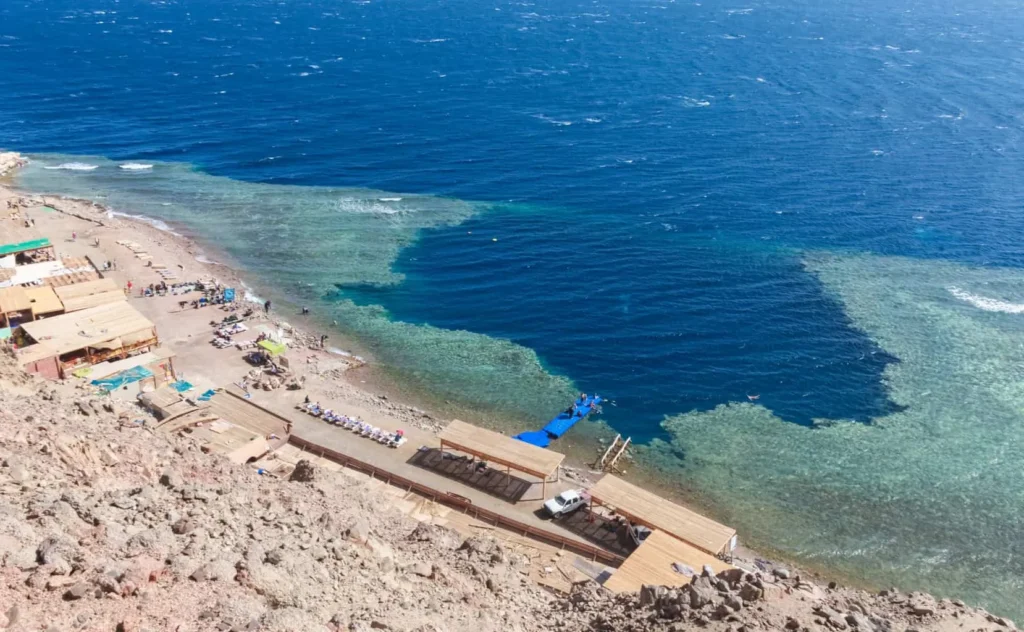
Now follow the coast road north in order: Eel Garden first, for garden eels and reef fish in shallow water; then the Canyon dive site, a fissure in the reef with a sunlit cavern for certified divers; then the Blue Hole itself, the submarine sinkhole over 100 metres deep, with its shallow snorkelling rim and the nearby Bells entry. Travelling in this order matters, because each site is progressively more dramatic, and you arrive at the Blue Hole warmed up rather than cold, with a morning of reef experience behind you rather than a single leap from town to the town’s most famous site. Eel Garden, along the Assalah shore north of the centre, is the gentlest start, because its shallow slope of sand and coral, its garden eels swaying in the current, and its sardine swarms and reef fish give a full reef experience without depth or crowds, and because a snorkeller who floats quietly there will see the eels rise and feed, while a snorkeller who rushes will see only empty sand. The Canyon, further north, raises the stakes, because its fissure in the reef, opening into a cavern where sunbeams pierce cracks in the rock, is an overhead environment in places, and it suits experienced divers with a guide, good buoyancy and a clear briefing, rather than casual swimmers. The Blue Hole, at the end of the road, is the culmination, because its near-circular shaft, ringed by coral, with a shallow saddle linking it to the reef and the Arch tunnel opening to the open sea at depth, combines clear water, vertical walls and a visible geological story in one shore-accessible place, and because its calm surface, seen from the shore, hides a vertical world that demands respect.
Snorkellers should stay on the rim and follow guide advice, because the Blue Hole’s shallow outer rim offers coral gardens and reef fish in clear water, and it is a superb snorkel in its own right, with the deep blue of the hole itself providing a dramatic backdrop, while the deep shaft and the Arch are not snorkelling territory at all. Divers should respect certification limits, particularly for the Arch, because the tunnel linking the hole to the open sea at depth is technical diving territory, not a recreational goal, and because it has claimed lives when divers have gone deeper, further or longer than their training, gas supply and experience allowed. A diver who treats the Blue Hole as a place to test limits will find it unforgiving, while a diver who treats it as a beautiful, deep, clear site to be enjoyed within limits, with a licensed centre and a guide who knows the route, will find it unforgettable. Cafés at the Blue Hole make this an easy full-day coastal outing by taxi, because a visitor can arrive by road, snorkel or dive in the morning, eat and rest at a café with a view over the hole, and return to town in the afternoon, without needing to arrange a boat or a complex transfer. For how to dive and snorkel each of these northern sites, see our guide to things to do in Dahab, and for what each site is as a place in its own right, see our guide to tourist attractions in Dahab. Check the official site before visiting for current entry rules and fees, use a licensed dive centre, never dive or freedive alone, and wear reef shoes for the rocky entries along this coast.
Stage 4: The Wild Coast — Ras Abu Galum and the Blue Lagoon
Where the road ends, the wild coast begins, and that boundary, more than any single sight, is what makes this stage different from everything before it. Ras Abu Galum Protected Area, declared in 1992 to safeguard South Sinai’s marine and desert ecosystems, is reachable only by camel, boat or a coastal walk of about 5.5 km from the Blue Hole, and that isolation is the point, because a reef that cannot be reached by road cannot be crowded, a beach that cannot be driven to cannot be built on, and a coastline that requires a camel, a boat or a walk to reach will always feel wilder than one reached by taxi. The protected area covers both sea and land, from coral reefs offshore to wadis, mountains and desert plains inland, and that breadth matters, because the reefs depend on the land remaining undisturbed and the desert wildlife depends on the coast remaining undeveloped, so conservation here is a whole-landscape effort rather than a single-issue one. Within it lies the Blue Lagoon, a sheltered, mirror-flat turquoise cove famed among kitesurfers, whose still water, protected from wind and waves, lies flat under the mountains and contrasts sharply with the open sea beyond the reef. A typical day safari combines a camel trek along the cliffs, snorkelling at Ras Abu Galum, a Bedouin lunch by the sea, and an afternoon at the lagoon, and that combination, of journey, swim, meal and stillness, is the stage in miniature, because each element depends on the others and none of them would work alone. The journey itself, whether by camel along the shore, by boat over the reef, or on foot along the coastal path, is part of the attraction, not a transfer to it.
Overnight stays in simple Bedouin hushas are possible for travellers who want stars instead of streetlights, and a night in a husha, a simple shelter of palm and stone on the beach, with no mains electricity, no piped water and no sealed rooms, is an experience of Sinai as it was, not as tourism has remade it. That overnight option changes the stage from a day trip into a different kind of journey, because a traveller who sleeps on the wild coast wakes to a sunrise over an empty reef, swims before any day-trip group arrives, and understands remoteness in a way that a day visitor, however impressed, cannot quite grasp. Bring water, food and sun protection, because there are no permanent visitor facilities on the wild coast, and confirm permit arrangements in advance, because entry to a protected area involves rules that change, and because a Bedouin-guided trip, which handles permits, transport and lunch, is the usual, safer option. Check the official site before visiting for current access rules, and confirm prices before booking any camel, boat or guided safari, because operators bundle transport, food, guide fees and permits differently. For activities and logistics at the lagoon and the protected area, see our guide to things to do in Dahab, and for what Ras Abu Galum and the Blue Lagoon are as places in their own right, see our guide to tourist attractions in Dahab. A full day is the right amount for this stage, and an overnight is better if time allows, because a rushed half-day will leave you arriving, photographing and leaving without ever settling into the lagoon’s stillness. An overnight also lets you watch the wild coast at its quietest, before day visitors arrive.
Stage 5: Inland — Desert Canyons, Oasis and the Sinai Mountains
Turn inland for the final stage, in two parts, because the desert and the mountain, though both inland, belong to different days, different energies and different kinds of preparation. First, a 4×4 safari to the Coloured Canyon near Nuweiba, whose mineral-red, orange, purple and gold sandstone walls come from an ancient seabed, lifted, tilted and carved by water over millions of years, and whose narrow passages, close enough to touch, change colour with every turn. The Coloured Canyon, also called Salama Canyon, is best walked slowly, looking up as well as closely, because its walls, banded by iron oxides and other minerals, are evidence of seas that came and went, and because the light falling in shafts from above changes the colours as the sun moves. The nearby White Canyon offers a contrasting walk through pale, smooth rock, and the contrast between the two shows how mineral content, not just erosion, paints desert geology. A canyon safari is often combined with Ein Khudra Oasis, a green refuge in the desert where a palm grove and a spring offer shade, water and a green contrast to the canyons’ stone, and where a Bedouin guide can explain the oasis’s place in desert travel as a watering point on routes that linked the coast with the interior. A shorter hike in Wadi Gnai, with its rock formations, palm pockets and climbing routes, completes the desert day, because it gives a taste of wadi walking, with a guide, with water and with an early start, before the harder mountain night that follows. Wear closed shoes, go with a guide who knows flash-flood safety, and check current access and travel advice before going, because canyons, however dry they look, are flood channels.
Second, the overnight Mount Sinai trip, which deserves its own day and a rest day afterwards, because it is a hard night, not a casual excursion. A late-evening departure from Dahab, a drive of about two hours, a 2–3 hour climb to the 2,285-metre summit of Jabal Musa for sunrise, and a morning visit to St Catherine’s Monastery, the 6th-century UNESCO-listed monastery at its foot, form a journey that has drawn pilgrims and travellers for centuries, and that still follows the same shape today for a reason, because it puts the sunrise and the monastery together in a single night. The climb itself, in torchlight, up a long winding path and then the famous stone steps near the summit, is demanding, and the summit before dawn is cold even in summer, so a warm layer, closed hiking shoes, a torch, snacks and water are essential, and a reputable operator that provides a Bedouin guide is part of the safety system, not an optional extra. Dress modestly for the monastery, because it is a working Orthodox monastery, not a museum, and check the official site before visiting for opening days, as it does not open every day. Do the canyon day before the mountain night if you can, because it teaches you desert pacing, early starts, water discipline and guide-led walking before the hardest walk of the trip, and because a traveller who has already walked a canyon and a wadi will climb the mountain with a better sense of pace, of layers and of rest. For activities at these inland places, see our guide to things to do in Dahab, and for what the canyons, the oasis and the monastery are as places, see our guide to tourist attractions in Dahab.
Practical Guide: How to Reach Dahab, Best Time and a Sample Itinerary
| Topic | Practical tip |
|---|---|
| Getting there | Fly to Sharm El Sheikh, then taxi or bus north to Dahab (about 80–100 km). Confirm transfers in advance. |
| Best time | March–May and September–November for the full town–coast–desert range; summer for wind sports; winter for quieter travel. |
| 3-day version | Day 1 town, Day 2 Blue Hole coast, Day 3 Laguna or Ras Abu Galum. |
| 5-day version | Add a desert canyon safari and a rest day on the promenade. |
| 7-day version | Add the overnight Mount Sinai trip plus a second wild-coast or diving day. |
| Getting around | Walk in town; taxis for north and south coast; camel, boat or guide for Ras Abu Galum; organised tours for canyons and Sinai. |
Getting to Dahab is simpler than many first-timers expect, provided transfers are confirmed in advance, because most visitors fly to Sharm El Sheikh, then take a taxi or bus north, about 80 to 100 kilometres, across desert with Sinai mountains on one side and the Gulf of Aqaba on the other. A pre-arranged transfer, confirmed with a hotel or driver before departure, removes the negotiation at the airport after a flight and ensures a driver who knows the road, the checkpoints and the timing, while a daytime arrival lets you see the landscape change from resort coast to quiet town, which is itself part of the experience. Once in town, the transport logic of the whole route follows the stages: walk in town, where the promenade, Lighthouse Reef and Assalah are all on foot; take taxis for the north and south coasts, where the fare should be agreed before setting off; use a camel, a boat or a guide for Ras Abu Galum, where no road exists; and use organised tours for the canyons and for Mount Sinai, where desert roads, early starts, protected-area rules and monastery timetables all require local knowledge. March to May and September to November are the best months for the full town–coast–desert range, because the sea is warm, the air is comfortable for walking, and the town is busy enough to feel alive without being crowded, while summer is hot but good for wind sports in the Laguna, and winter is milder and quieter, with cooler evenings, fewer visitors and often better value, though a wetsuit becomes more important for long dives and a warm layer becomes essential for desert nights and the Sinai summit.
The sample itineraries in the table work because they protect the route’s order while letting a traveller compress or stretch it without breaking its logic. A three-day version, with day one in town, day two on the Blue Hole coast and day three at Laguna or Ras Abu Galum, gives a complete first taste, because it covers town, reef and either sand or wild coast, and because it leaves the desert and the mountain, the two most demanding stages, for a return visit rather than squeezing them into an exhausted third day. A five-day version adds a desert canyon safari and a rest day on the promenade, and that rest day matters more than it looks, because a day of promenade, reef and sleep between a diving day and a desert day protects energy and lets the trip settle, rather than stacking every demanding stage back to back. A seven-day version adds the overnight Mount Sinai trip plus a second wild-coast or diving day, and that fuller version is the one that most rewards a first-time visitor with time, because it gives each stage its proper day, with rest built in, and because it leaves room for the place discovered on arrival, a reef recommended by a dive centre, a wadi recommended by a Bedouin guide, or a rooftop recommended by a fellow traveller. For details on each stage, see things to do in Dahab, tourist attractions in Dahab and places to stay in Dahab. Day-trip background is covered in MileHacker’s Dahab day-trips guide and Makara’s complete Dahab guide. A buffer day also absorbs a delayed transfer, a windy boat day or a closed monastery day without unravelling the whole itinerary.
Conclusion
Followed in order — town, south coast, north coast, wild coast, desert and mountain — Dahab stops feeling like a scattered list of names and starts feeling like a journey, and that transformation is the whole point of a route guide. Each stage prepares you for the next: the promenade teaches you the town, the reefs teach you the sea, the wild coast teaches you remoteness, and the desert teaches you scale, so that by the time you stand on the summit of Mount Sinai at sunrise, or walk a canyon whose walls change colour with every turn, you are not seeing an isolated sight but the culmination of a landscape you have already learned, stage by stage, over several days. That learning is cumulative in a way that a list cannot be, because the town’s reef entries teach you how to enter the Blue Hole’s rim, because the Blue Hole’s depth teaches you why the wild coast’s stillness matters, because the wild coast’s remoteness teaches you why a desert oasis matters, and because the desert’s scale teaches you why a mountain sunrise matters, each lesson building on the one before it until the whole coast, from town to mountain, feels like a single place rather than a set of disconnected stops. Leave a rest day in the middle, because a rest day is not an empty day in Dahab: it is a morning snorkel at Lighthouse, a long lunch on the promenade, an afternoon swim in the Laguna shallows, and an evening watching the sun set over the Gulf, and it is often the day travellers remember most fondly, because it is the day Dahab itself, rather than any single stage, is enjoyed. A route with rest built in also protects the later stages, because a rested diver, hiker or climber enjoys each place more than an exhausted one rushing through a packed schedule.
For a first visit, the simplest shape remains the best, and it is the shape set out in the practical table above: town first, south coast second, north coast third, wild coast fourth, and desert and mountain last, with the order adjusted to wind, weather and energy, and with a guide wherever the land or sea demands one. That shape leaves room for the place you discover on arrival, because Dahab’s informal, shore-based structure means new possibilities appear daily, in dive-centre conversations, on promenade noticeboards and in the recommendations of people you meet, and a route that is too rigid to absorb a new recommendation will miss the very spontaneity that makes Dahab special. Book trips through licensed centres and reputable operators, confirm what is included before you pay, check the official site before visiting for current entry rules, fees and access, and keep at least one afternoon unplanned for the promenade at sunset, when the mountains turn gold and the town’s daily life takes over. Done that way, with town, coast, wild coast, desert and mountain in order, with rest built in, and with guides respected rather than resented, Dahab stops being a list and becomes a journey, and it will give you back the thing its name has always promised: time that passes like gold, slowly, warmly and memorably, from the first morning on the promenade to the last evening watching the sun set over the bay, with the sea, the desert and the mountain all held together by one small town on the Gulf of Aqaba. That golden time, once experienced in order, is hard to forget, and it is why so many first visits to Dahab become second ones.
FAQs
How many days do I need for Dahab?
Three days cover town, Blue Hole and Laguna. Five days add the desert canyons or Ras Abu Galum. Seven days comfortably add Mount Sinai and a rest day.
What is the best order to visit places in Dahab?
Town first, then south to Laguna and Three Pools, north to Eel Garden and the Blue Hole, on to Ras Abu Galum and the Blue Lagoon, and finally inland to canyons and Mount Sinai.
Can I visit Ras Abu Galum without a tour?
You can walk the coastal trail from the Blue Hole, but a Bedouin-guided camel or boat trip is the usual, safer option and handles permits and lunch. Check the official site before visiting.
Is Mount Sinai a day trip from Dahab?
Yes, as an overnight trip: leave late evening, climb for sunrise, visit St Catherine’s Monastery in the morning, and return late morning or early afternoon.
What is the closest airport to Dahab?
Sharm El Sheikh, about 80–100 km south, with taxi and bus connections north to Dahab. Confirm transfer details before arrival.
Is Dahab suitable for families?
Yes, especially the town promenade, Laguna’s shallow water and Three Pools. The Blue Hole deep routes, Ras Abu Galum treks and Mount Sinai climb suit older children and fit adults more than toddlers.