Aswan Travel Guide – Nubian Villages, Island Temples and the Calm End of the Nile
Every Egypt itinerary leans north — Cairo, the pyramids, the museums — and then, if it is well built, it exhales. Aswan is the exhale. Some 880 kilometres south of the capital, at the First Cataract of the Nile, the noise drops away and the country becomes granite, palm groves and wide water: a border town that was ancient Egypt’s southern gate, the quarry that supplied its obelisks, and the door to Nubia, whose villages, temples and language still set the tone here in a way no other Egyptian city quite matches. An aswan travel guide has to hold three cities at once — the pharaonic frontier post, the Victorian winter resort of the grand hotel terraces, and the modern working town reshaped by two dams — because a visitor walks through all three in a single afternoon.
What surprises people is the pace. Aswan is a sight-rich city that refuses to be rushed: its greatest temple stands on an island and is reached by boat, its second-greatest experience is a sailboat with no engine and no schedule, and its single most famous excursion leaves before dawn and returns by lunch. The sections below take the city in the order a good visit takes it — the island temple of Philae first, the ancient town on Elephantine, the west bank’s tombs and monastery, the Nubian villages, the long road south to Abu Simbel — and then deal honestly with the practicalities: the heat, the boats, the bargaining, and the question of how many days this calm end of the Nile actually deserves. For the country-wide routes that bring you here, our egypt travel guide carries the full picture.
At a Glance
Short on time? Here is Aswan on one screen — what there is, why each part earns its place, and the time it honestly asks for. Nothing in this guide prints a ticket price or an opening hour, deliberately: prices at Egypt’s sites change by decree and have changed repeatedly in recent seasons, so any figure you find in print — here or anywhere — should be re-checked on the official site before you budget on it.
| Place or thing | Why it earns its place | Time it honestly takes |
|---|---|---|
| Philae Temple | The Temple of Isis, rescued onto its own island – Egypt’s most beautiful temple setting | Half a day, by boat |
| Abu Simbel | Ramesses II’s cliff temples, 280 km south – the great pre-dawn day trip | Half a day, very early start |
| Elephantine Island | The ancient border town itself – ruins, a Nilometer and living villages in one walk | Two to three hours |
| Nubian villages | Gharb Soheil and the west-bank villages – colour, language and a different Egypt | Half a day, by boat |
| A felucca sail | The city’s essential hour – no engine, no itinerary, just wind and granite | One to two hours, late afternoon |
| The West Bank | Tombs of the Nobles, St Simeon’s Monastery and the Aga Khan Mausoleum | Half a day |
| The High Dam | The twentieth century’s answer to the Nile – and the reason the temples had to move | One to two hours, pairs with Philae |
| Unfinished Obelisk | The largest obelisk ever attempted, still lying in the quarry where it cracked | About an hour |
| The souk and Corniche | Spices, Nubian craft and the evening promenade along the river | An evening |
Two judgements sit behind that table. First, Aswan rewards slowness more than any other stop in Egypt — its sights are spread across islands and banks, almost all of them involve a boat, and travellers who give it a rushed day between trains remember the transfers rather than the place. Two nights is the honest minimum; three turns Abu Simbel from an ordeal into a pleasure. Second, nearly everything in the table belongs to a single UNESCO property: the Nubian Monuments from Abu Simbel to Philae, inscribed in 1979, whose ten components run from the great temples in the deep south to the quarries, tombs, island ruins and monastery in Aswan itself. The visitor is not staying near this World Heritage Site — the visitor is staying inside it, and the official record at whc.unesco.org reads like a table of contents for the whole trip.
Philae – the Temple of Isis on Its Island
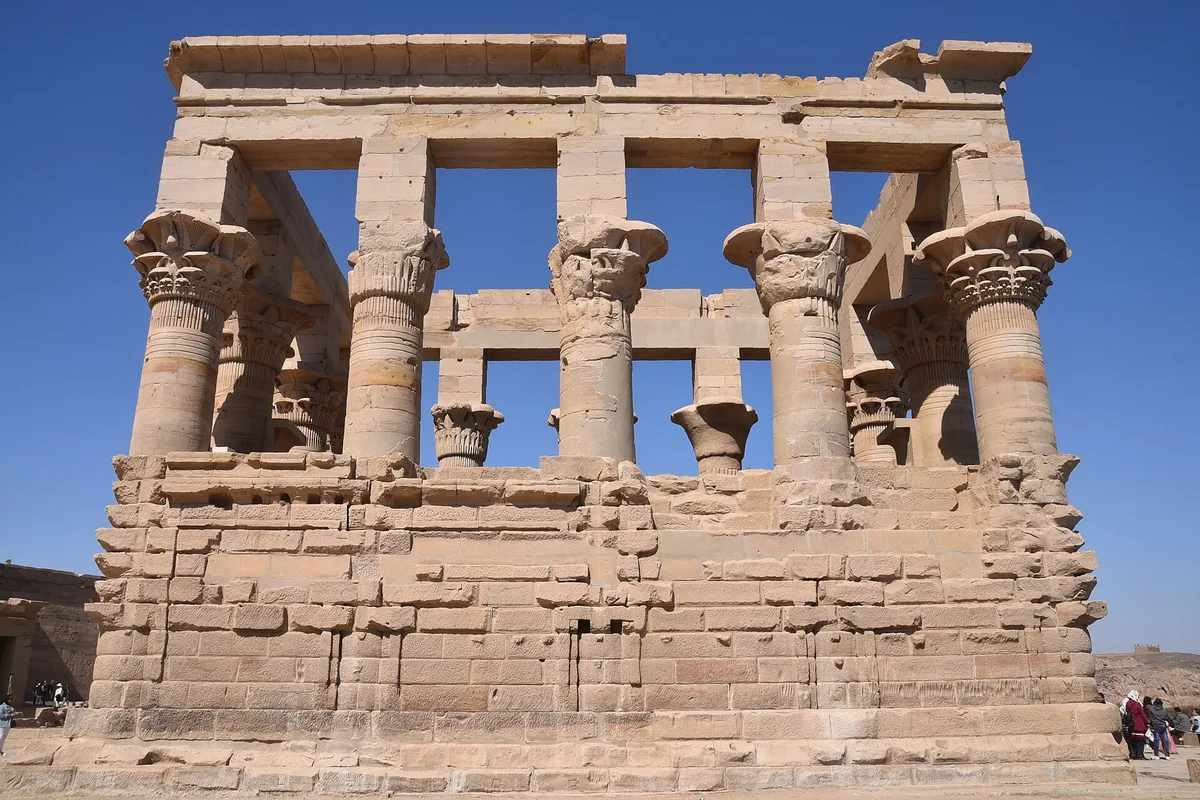
Begin where every Aswan visit should: on the water, in a small motorboat, crossing a few hundred metres of reservoir to an island that holds the most graceful temple in Egypt. Philae was the great sanctuary of the goddess Isis, built mainly in the Ptolemaic period and added to by Roman emperors — the final bastion of the old Egyptian religion, where the cult of Isis held on centuries after it had faded everywhere else and where the last hieroglyphic inscription anywhere was carved, in AD 394. The temple’s setting is the point. Colonnades run down to the water, the great pylon rises over the landing stage, and at the island’s edge stands Trajan’s Kiosk, an open pavilion of tall carved columns that was never finished and never needed to be — UNESCO’s own account calls it the jewel of the sanctuary, and arriving by boat at the hour when the stone is still cool is one of the set-piece entrances of ancient travel.
What you are standing on, though, is a rescue. The temple originally stood on the neighbouring island of Philae itself, and after the first Aswan dam was completed in 1902 the rising reservoir left it half-drowned for much of each year — travellers once rowed between its submerged columns. When the High Dam threatened it with permanent flooding, the UNESCO campaign dismantled the entire complex and rebuilt it, block by block, on this higher island of Agilkia, landscaped to echo the original. It says something about the quality of that work that most visitors never feel the join. Walk it slowly: the birth house with its reliefs of Isis and the infant Horus, the gate of Hadrian with its famous depiction of the Nile’s source, the kiosk at the water’s edge. Philae takes half a day at the tempo it deserves — boat out, the temple at a wandering pace, tea at the island cafe, boat back — and it should be the first morning of any Aswan stay, before the day’s heat builds and while the light is still kind to the stone.
Elephantine Island – the Town That Started It All
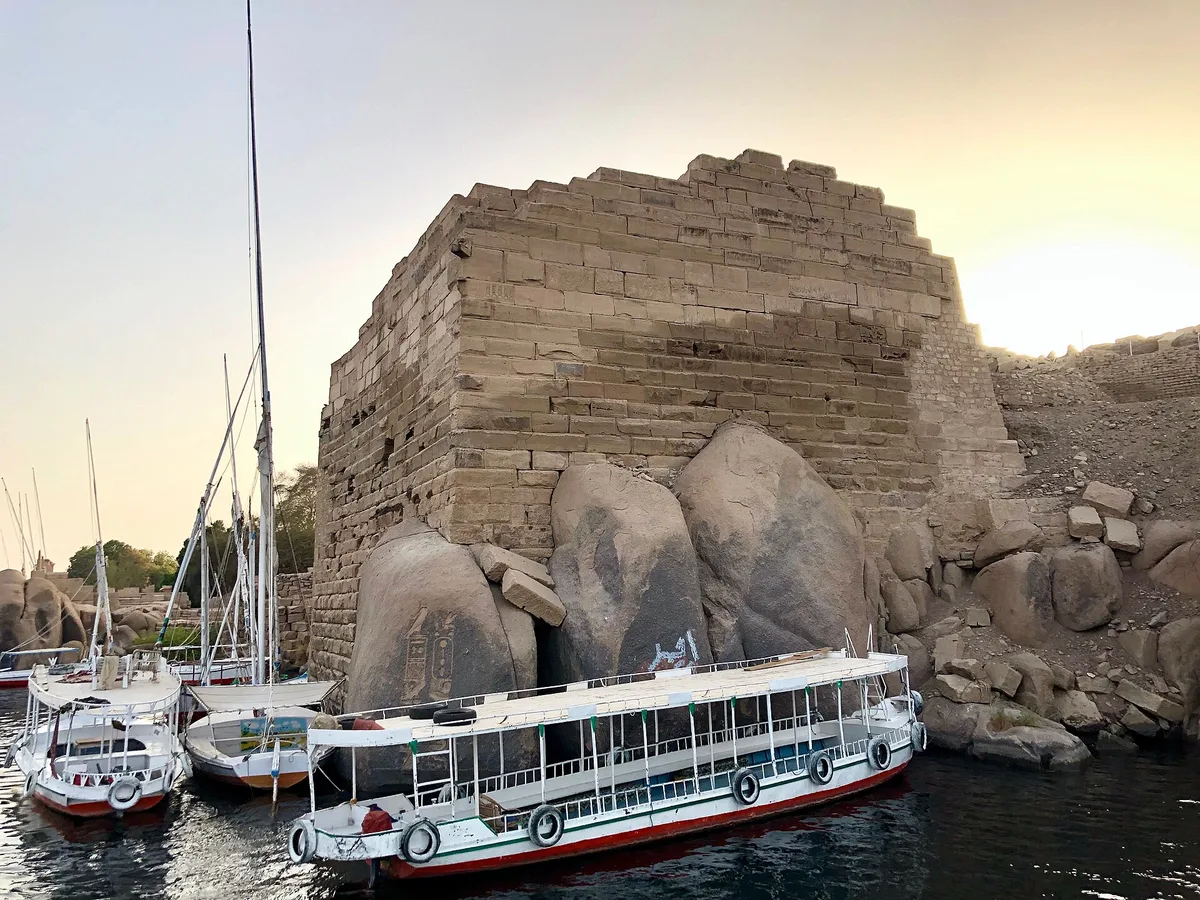
Elephantine is the reason Aswan exists. This island in mid-river, facing the east-bank town, held the ancient city of Abu — the name meant elephant, and ivory, traded up from the south — the fortress and customs post that guarded Egypt’s frontier at the First Cataract for some three thousand years. Its southern end is one of the official components of the UNESCO property: the ruins of the ancient town, layer on layer of it, with temples to Satet, the goddess of the flood, rebuilt across two millennia, and to the ram-headed Khnum, lord of the cataract. Between the ruins stands the island’s most quietly fascinating survival, the Nilometer — a stairway descending into the river, marked with scales, where priests and officials read the height of the annual inundation and set the year’s taxes by it. Before the dams, the whole economy of Egypt was announced each summer on those steps.
The island is not a museum piece, and that is its second pleasure. North of the ruins, past the small museum that houses finds from the site — mummies, weapons, pottery, the objects of a frontier town’s daily life — Elephantine dissolves into two living Nubian villages, Siou and Koti, all lanes, painted houses and small fields, where the island’s farmers still work the same plots their families have always worked. The correct way to do Elephantine is on foot and without a programme: the public ferry across from the Corniche costs almost nothing and runs all day, and an hour’s wandering takes you from a pharaonic temple to a village cafe without once losing sight of the river. Of all Aswan’s sights, this is the one that shows the city’s layers in a single walk — garrison, temple, village — and it costs you nothing but time.
The West Bank – Tombs, a Monastery and a Mausoleum
The east bank has the town; the west bank has the dead, the monks and the desert. Cross the river — by the public ferry, then on foot or by the camels that wait at the landing — and the bank rises in three distinct sights. Lowest and oldest are the Tombs of the Nobles, cut into the hill of Qubbet el-Hawa: the burial places of the Old and Middle Kingdom officials who governed Nubian affairs for the pharaohs, another named component of the UNESCO property. Their painted scenes are not royal propaganda but working lives — expeditions south, tribute arriving, families at table — and the climb to them earns the finest panorama in Aswan, the whole cataract laid out below: town, island, green banks, and the desert beginning exactly where the water stops.
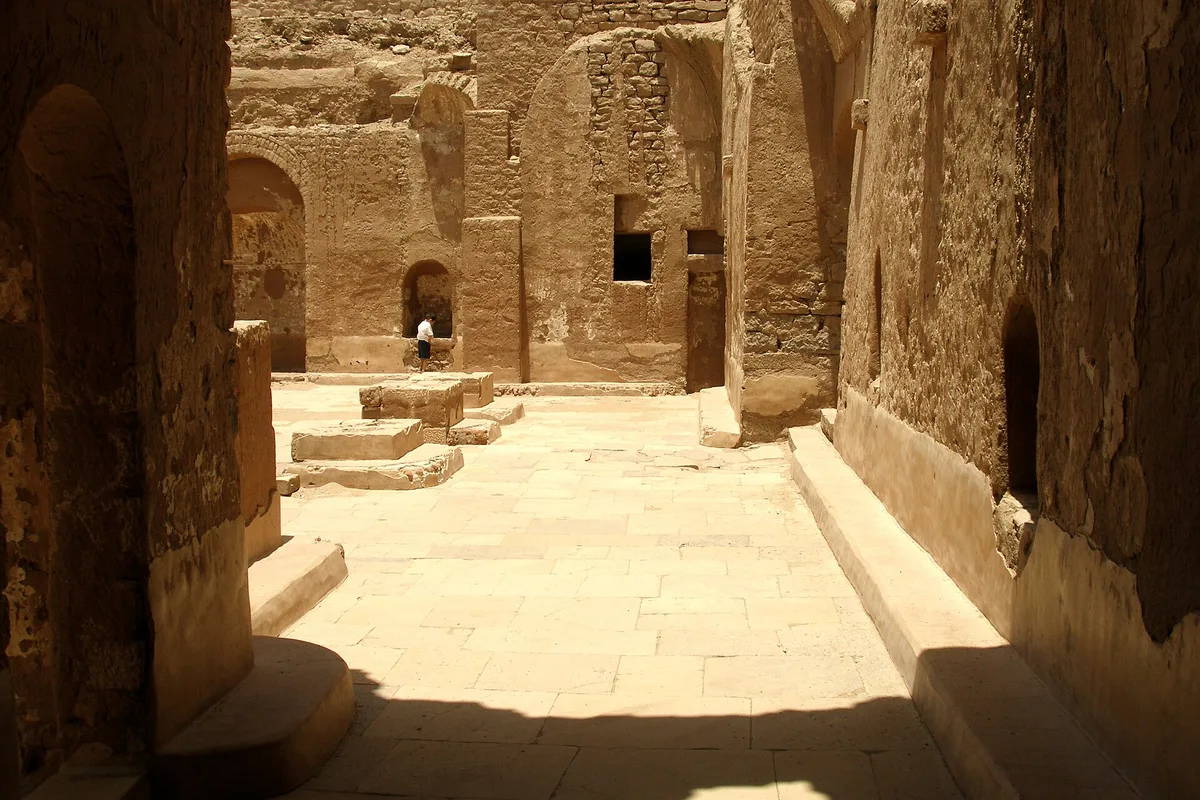
Higher into the desert stands the Monastery of St Simeon, a vast fortified Coptic complex of stone and mud brick, founded in the early Christian centuries and abandoned in the medieval period — UNESCO counts it among the biggest monasteries in Egypt, and its church, refectory and rows of monks’ cells survive as a roofless city of faith in the sand. Between the tombs and the monastery, the west bank’s third landmark belongs to another era entirely: the pale domed Mausoleum of the Aga Khan, the tomb of Aga Khan III, spiritual leader of the Ismaili Muslims, who wintered in Aswan and was buried here above the river in 1959. It is generally viewed from the water rather than visited, and from a felucca at sunset — white dome, pink granite hill, desert behind — it composes the single most photographed silhouette in the city. A west-bank half day, done in that order, reads Aswan’s whole religious history in one walk: pharaonic officials, Christian monks, and a modern Muslim tomb above the same bend of the Nile.
The Nubian Villages – Colour, Language and a Harder Story
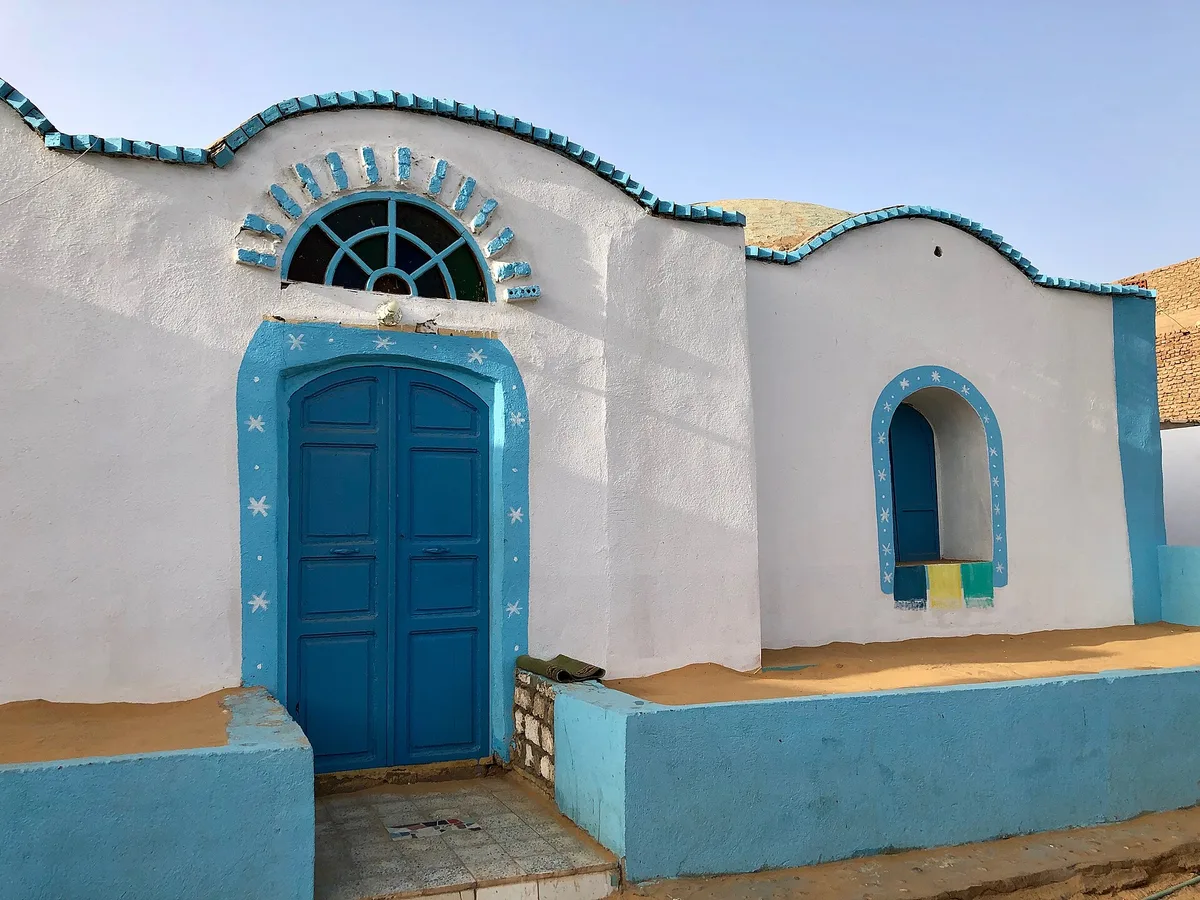
South of the cataract, the Nile belongs to Nubia. The Nubian villages strung along the west bank and the islands — Gharb Soheil is the best known and the easiest to reach — announce themselves in colour: houses whitewashed and painted in blues, greens and ochres, domed and vaulted roofs, doors picked out with stars, boats and crocodile motifs. The people are Nubian first and Egyptian second in their own account of themselves, speakers of Nubian languages as well as Arabic, with a musical and culinary culture — the spiced teas, the peanut-rich stews, the henna, the drumming — that feels distinct from the Nile valley to the north within minutes of arriving. A boat from the Corniche, a walk through sandy lanes, mint tea or hibiscus in a family courtyard, perhaps lunch: it is the gentlest half day in Aswan, and the villages’ painted guesthouses have made Gharb Soheil a place many travellers choose to sleep, not just visit.
But an honest guide has to say why these villages are where they are. When the High Dam filled Lake Nasser in the 1960s, the rising water drowned historic Nubia — hundreds of kilometres of it, villages, palm groves and antiquities alike — and the Nubian population was resettled, most of them to planned villages far north around Kom Ombo, away from the river that had organised their entire civilisation. The west-bank villages at Aswan are the communities that remained or regrouped at the edge of the lost homeland, and the famous colour is not decoration for visitors; it is the architecture of a culture that was told to start again and chose to do so in its own style. The Nubian Museum, on the east bank near the great domed tombs of the Fatimid Cemetery — itself a UNESCO component — tells this story properly, with the displaced villages documented alongside three thousand years of Nubian history, and it deserves an hour of any thoughtful visit. Come to the villages for the welcome, which is genuine. Leave understanding what the lake cost.
Abu Simbel – the Great Day Trip South
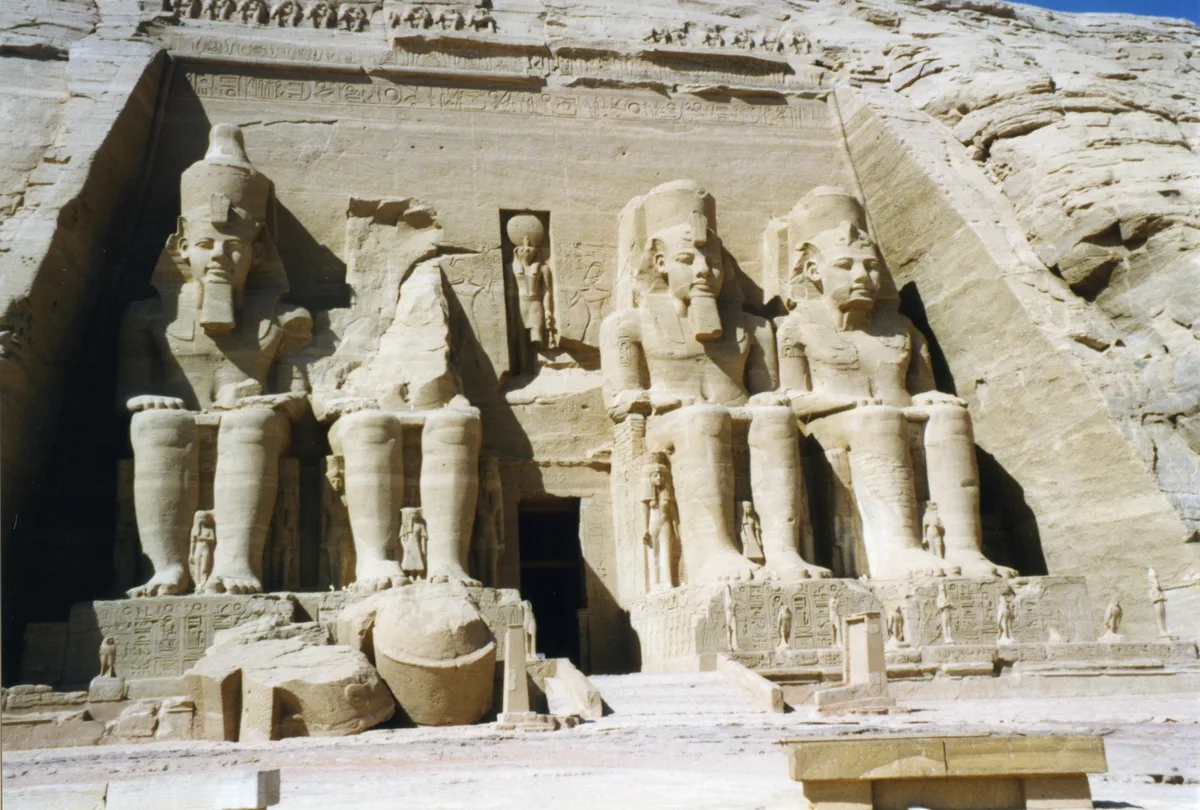
Two hundred and eighty kilometres south, near the Sudanese border, stands the sight that justifies the earliest alarm of your trip. Abu Simbel is two temples cut into a cliff by Ramesses II in the thirteenth century BC: the Great Temple, fronted by four seated colossi of the king some twenty metres high, and the smaller temple he dedicated to Hathor and his queen Nefertari — a compliment almost unique in pharaonic art, where queens were rarely carved at a king’s scale. Inside the Great Temple the halls narrow towards a sanctuary where, by the builders’ alignment, the sun’s rays penetrate to the statues of the gods twice a year — UNESCO’s synthesis singles out exactly this marriage of sculpture, architecture and astronomy, and on those two mornings, around 22 February and 22 October, crowds gather before dawn for what has become known as the Sun Festival. On any other morning you will have the halls nearly quiet, which many travellers quietly prefer.
The second wonder of Abu Simbel is that it exists at all. When the High Dam’s lake rose, the temples stood in its path, and the UNESCO campaign performed here its most famous operation: the cliff and temples were cut into more than a thousand blocks and reassembled, piece by numbered piece, on higher ground above the water, inside an artificial mountain built to hold them. The fallen head of the second colossus — dropped by an earthquake in antiquity — was moved exactly as it lay, a scruple that says everything about the rescue’s philosophy. Practically: the standard visit is a road convoy south in the small hours, a couple of hours at the temples, and the drive back by early afternoon, though flights and slower private arrangements exist, and a night in the small village beside the site lets you see the facade in evening and dawn light with the day crowds gone. It is a long half day by any method. It is also, simply, one of the great monuments of the world, and no Aswan trip that skips it has finished the job.
Felucca Sailing – Aswan at Water Level
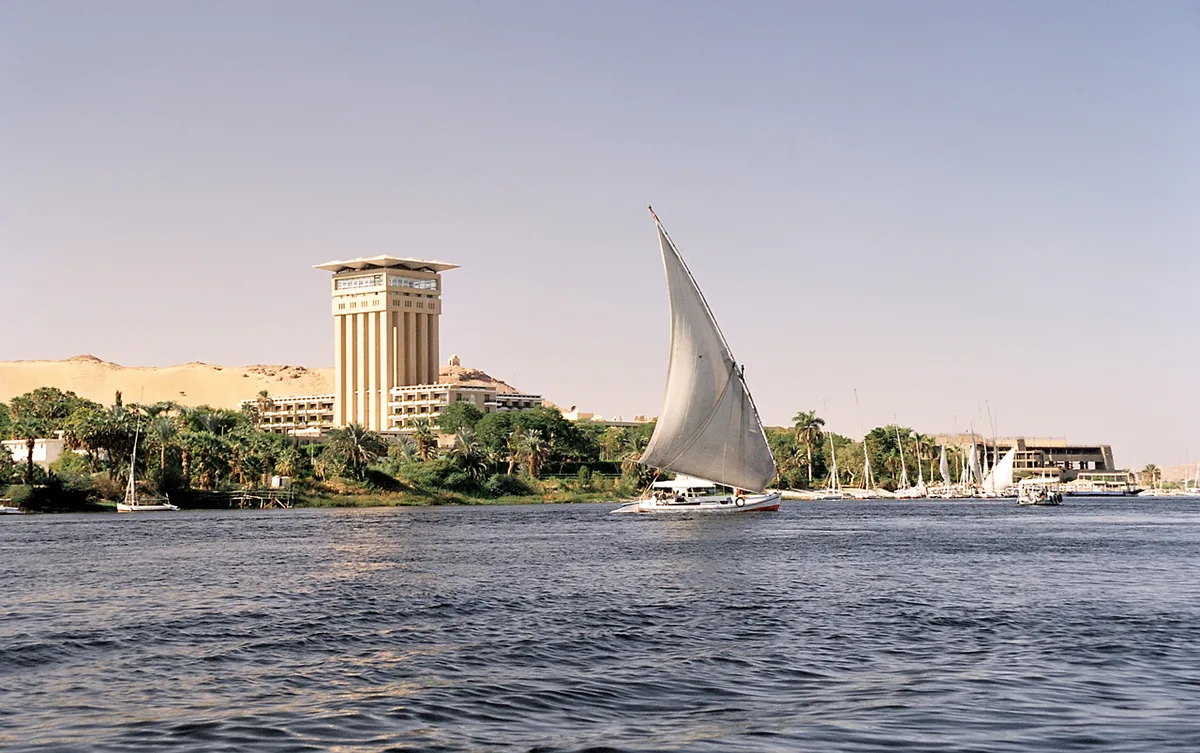
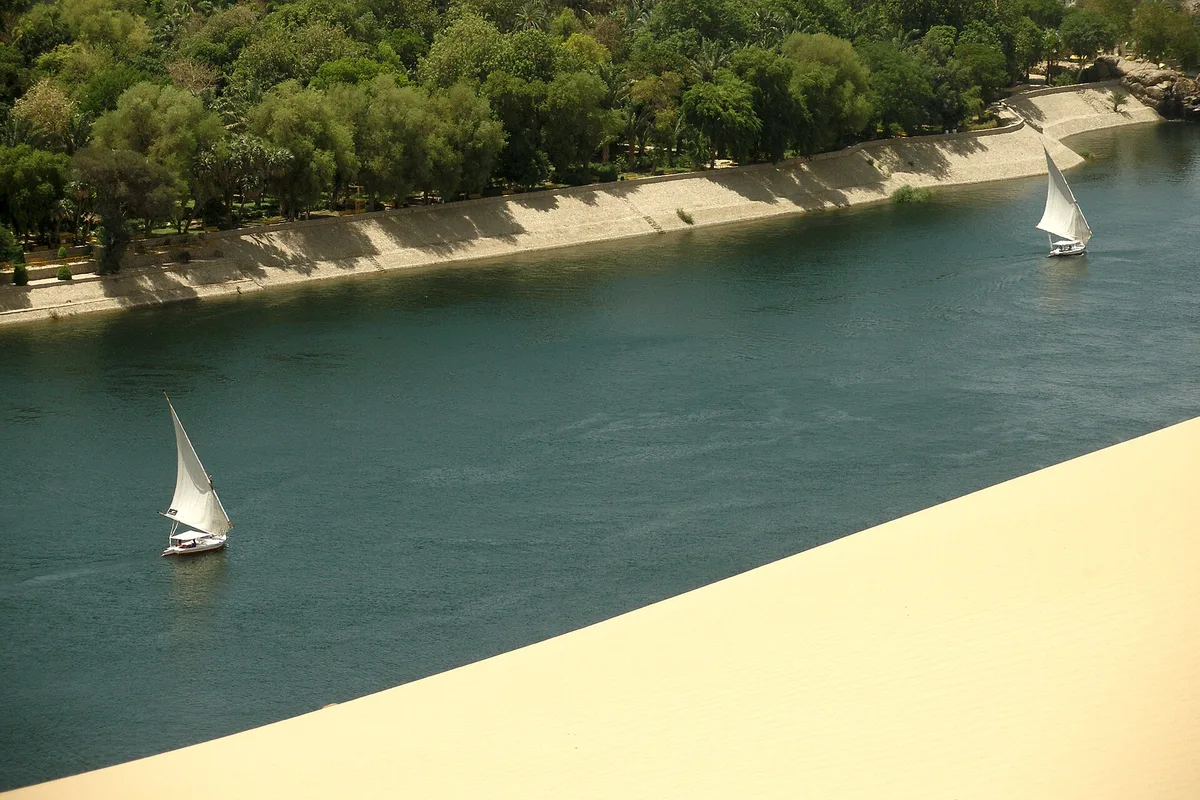
Every Aswan day should end the same way: stepping onto a white-sailed felucca in the late afternoon and doing, gloriously, almost nothing. The felucca is the Nile’s traditional lateen-sailed boat, unpowered, steered with an enormous rudder and utterly dependent on the wind, and Aswan is its natural home — the river here is wide, the breeze reliable, and the scenery, granite boulders and green islands against the desert, is the most beautiful stretch of the Nile in Egypt. A standard sail drifts around Elephantine and Kitchener’s Island — the latter Aswan’s botanical garden, planted with palms and exotic trees collected from across Africa and Asia, and worth the wander ashore it usually includes — past the Aga Khan Mausoleum on its hill and the swimming spots where local boys dive off the rocks. An hour is good; two, with the sun dropping and the west bank turning gold, is better.
The practicalities are few but real. Feluccas are hired at the Corniche, captains tout for business along the whole promenade, and everything — route, duration, and above all price — should be agreed in full before the boat leaves the bank, because once you are mid-river the negotiation is over in every sense. A calm, friendly firmness at this stage is a skill worth practising; Aswani captains are, as a breed, charming and persistent in roughly equal measure. Wind rules the trip: on a still day a felucca may barely move, and the honest captain will say so, while multi-day felucca journeys downriver towards Luxor — sleeping on deck, cooking on the bank — remain one of Egypt’s great slow adventures for those with the days to spare. However long you give it, the felucca hour is not a tour. It is the city at its own pace, seen from the level it was built to be seen from.
The Corniche and the Souk – Aswan After Dark
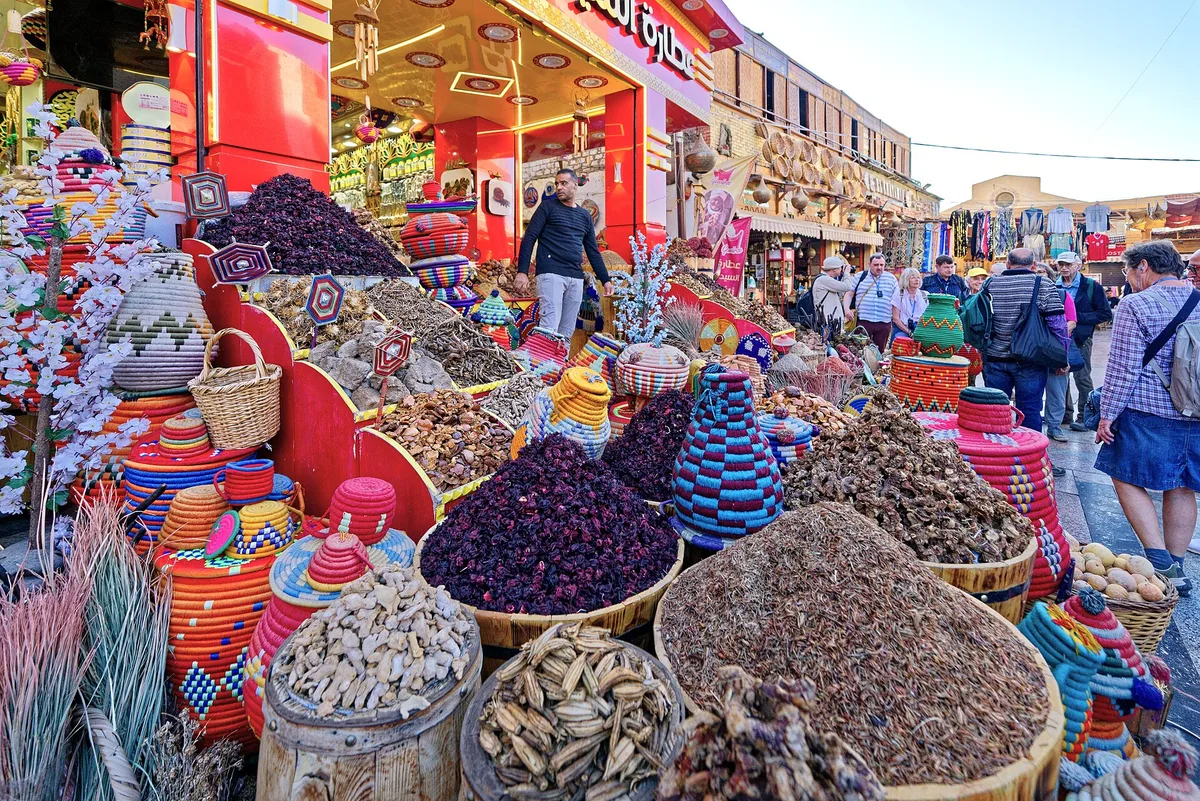
Aswan’s living room is its Corniche, the broad riverside promenade that runs the length of the east bank, and its parlour is the souk — the Sharia al-Souq, which runs parallel a street or two inland from the station southwards. By day the market is a working one, and all the better for it: spice merchants heap their pyramids of turmeric, cumin and dried hibiscus — karkadeh, the deep-red tea of Upper Egypt, is the souvenir that actually gets used — alongside Nubian basketwork in bright woven patterns, scarves, galabeyas, carved soapstone and the general commerce of a southern city. This is not a bazaar frozen for tourists in the manner of the great northern markets; locals shop here in earnest, which keeps both quality and theatre at a more honest level, though prices for visitors still open high and settle through negotiation, conducted — as everywhere in Egypt — as a social ritual rather than a fight.
As the heat drains out of the day, the balance shifts to the river. The Corniche fills with families, the felucca masts crowd the shore, the cafes set out their chairs, and Aswan performs its evening self: tea and shisha, grilled corn, the call to prayer rolling over the water, cruise ships lit up along the bank. It costs nothing and it is, for many travellers, the memory that lasts longest — more than any single temple, the feeling of a city entirely at ease beside its river. Eat where the evening takes you: the restaurants along and behind the Corniche run from Nubian home cooking to the classic fish-and-tahini places of the south, and a dinner of grilled Nile fish after a felucca sunset is this city’s idea of a perfect day, honestly shared with anyone who visits.
The High Dam – the Wall That Changed Egypt
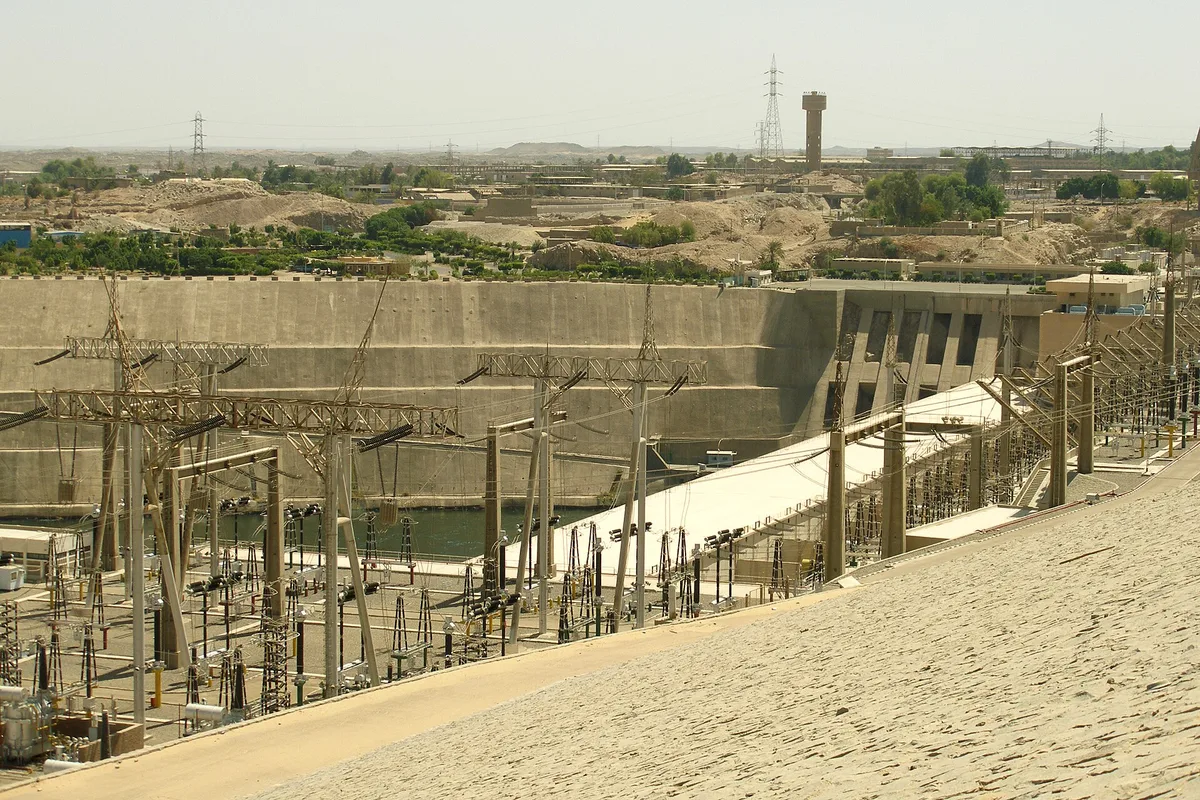
It is worth being clear about something most guides blur: there are two dams at Aswan, and the difference matters. The first, the Aswan Low Dam, was completed by the British in 1902 just north of the First Cataract — a fine granite wall in its own right, and the structure that first drowned Philae’s island for much of the year. The second, the High Dam, stands several kilometres further south and belongs to another order of ambition altogether: built through the 1960s and finished in 1970, a rock-fill wall more than three and a half kilometres long and over a hundred metres high, which ended the Nile’s annual flood forever, gave Egypt year-round irrigation and hydroelectric power, and created Lake Nasser behind it — a reservoir some five hundred kilometres long reaching into Sudan, among the largest artificial lakes on Earth. Almost everything else in this guide is a consequence of that wall: the rescued temples, the drowned homeland, the museum built to remember both.
The visit itself is short and pairs naturally with Philae, which lies just below the dam. You cross the crest on the road, look north over the old cataract and the town, and south over the unnatural calm of Lake Nasser stretching to a horizon that used to be Nubia. As spectacle it is concrete and scale rather than beauty — the monument pavilion and the sheer drop of the downstream face do most of the work — but as an explanation it is unmatched, and guides who skip it leave their travellers unable to answer the question the whole region asks: why is everything here moved, rescued or underwater? Give it an hour, read it as the hinge between the ancient city and the modern one, and the rest of Aswan falls into place.
The Unfinished Obelisk – a Mistake Preserved in Granite
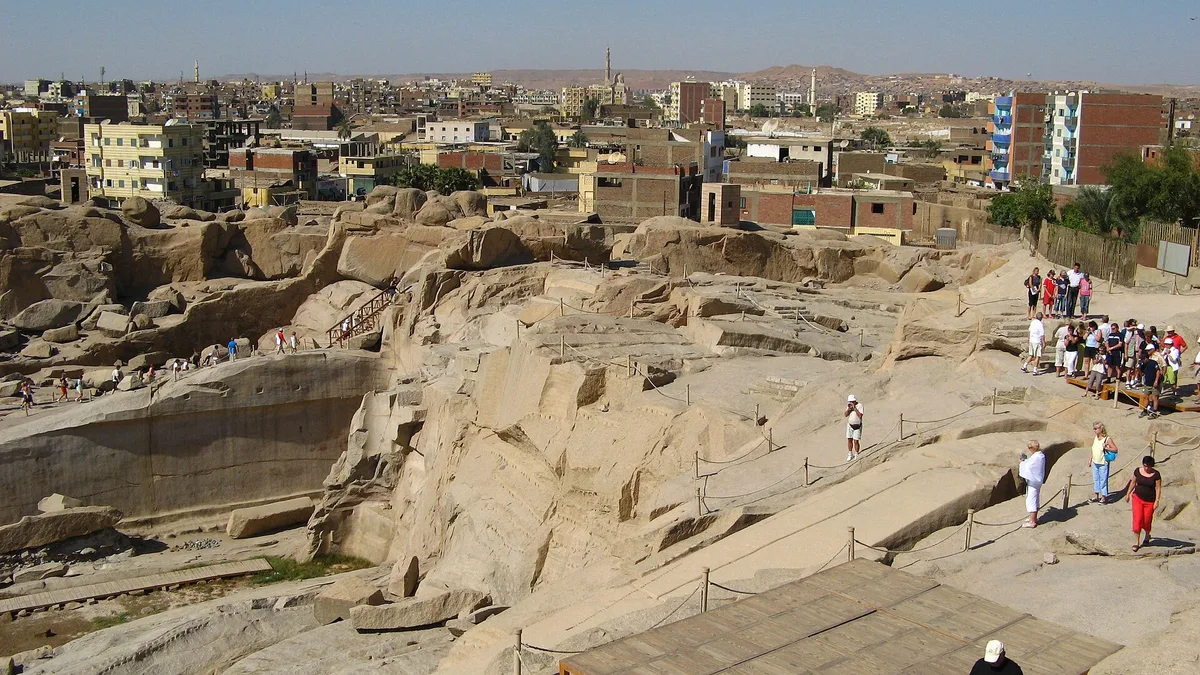
Aswan’s wealth began as stone. The pink granite of its quarries — hard, handsome and durable — was prized from the Old Kingdom onwards, shipped north for pyramids, temples and above all obelisks, and the quarries that supplied it are, as UNESCO puts it, the basis of everything known about how the Egyptians actually cut stone. Their most famous resident never left. The Unfinished Obelisk lies in its trench in the northern quarry, a single tapering shaft more than forty metres long, still attached to the bedrock on its underside: had it been completed and raised, it would have been the largest obelisk ever attempted anywhere in Egypt. Partway through the work a crack appeared in the granite, and the project was abandoned where it lay — which is precisely why it is priceless, because the trench around it, the pounding marks of the dolerite balls used to cut it, and the half-finished shaft preserve the whole method of obelisk-making in a way no finished monument can.
The quarry site repays its hour. Around the great shaft the bedrock is a worked landscape — trenches, half-separated blocks, red-ochre guide lines — and a small open-air display sets the ancient tools and techniques in context, while the Fatimid Cemetery’s domed mud-brick tombs stand a short walk south for those continuing to the Nubian Museum nearby. This is not a beautiful sight in the way Philae is beautiful, and it is hot, exposed work in the middle of the day: go early, take water, and treat it as what it is, the industrial archaeology of the pharaonic world, and the clearest possible evidence that Egypt’s most famous skyline ornaments began here, in this pit, at the empire’s southern edge.
Where to Stay – Grand Hotels, Corniche Stays and Village Guesthouses
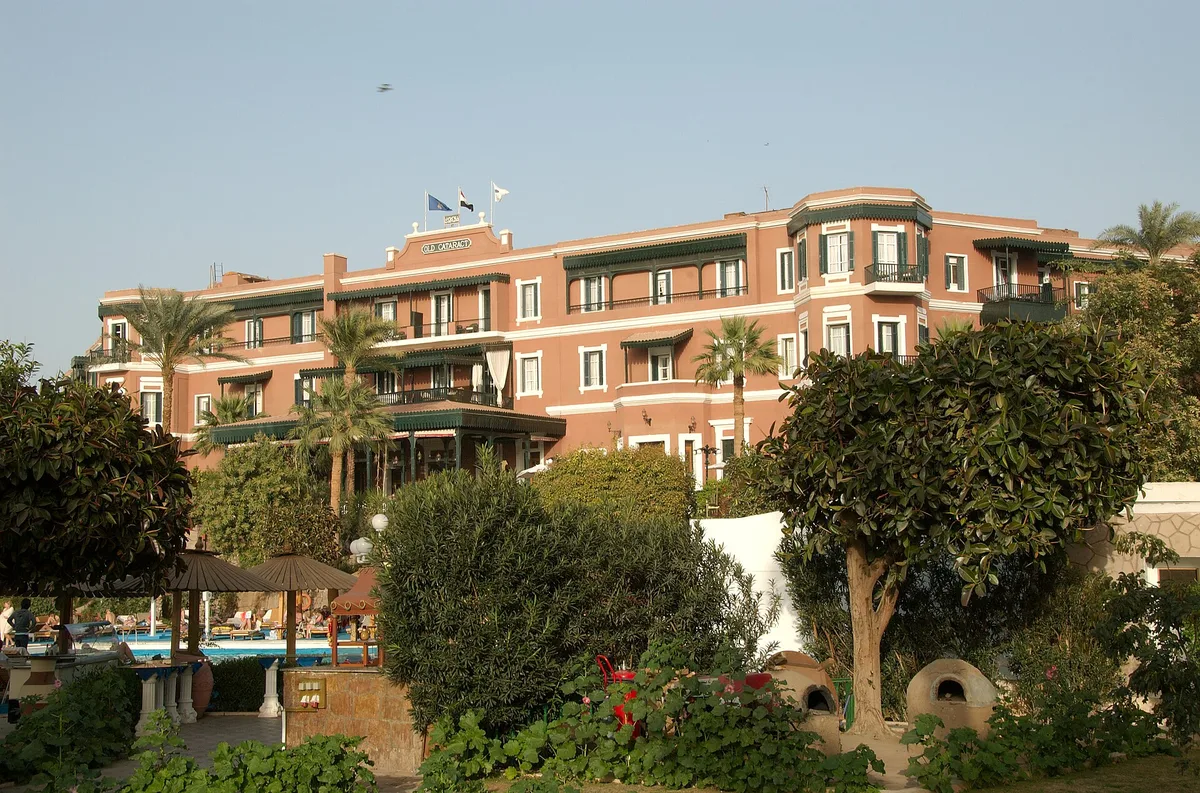
Aswan’s places to sleep divide by bank and by temperament, and the choice shapes the trip more than the star rating does. The east bank holds the classic options, crowned by one of the world’s great hotels: the Old Cataract, opened in 1899 on a granite bluff above the rapids, all rose-pink Victorian palace outside and Moorish halls within, its terrace still the finest seat in the city at sunset. Agatha Christie stayed here and drew on it for Death on the Nile, and the hotel has been the address for everyone from Churchill to royalty — it is a splurge with a genuine claim to being a sight in itself, though plenty of travellers content themselves with a drink on that terrace and sleep more cheaply elsewhere. Around it, the Corniche carries the town’s mid-range hotels and small guesthouses, convenient for the station, the souk and the boats, and the practical default for a short stay.
The alternatives are the interesting ones. On Elephantine Island, a few minutes by ferry, village guesthouses and small ecolodges put you inside the Nubian lanes, waking to birdsong rather than traffic. Across on the west bank, Gharb Soheil’s painted guesthouses offer the full village version — domed rooms, home cooking, the river at the end of the lane — at the price of being a boat ride from town, which many guests count as the entire point. A fourth option floats: the Nile cruise boats moored along the Corniche, covered in the transport section below, double as hotels for the nights between Aswan and Luxor. The honest summary: the Old Cataract for the terrace and the legend, the Corniche for convenience, and the islands and west bank for the Aswan that most visitors only day-trip into — which is, not coincidentally, the Aswan this guide keeps recommending.
Getting There and Getting Around
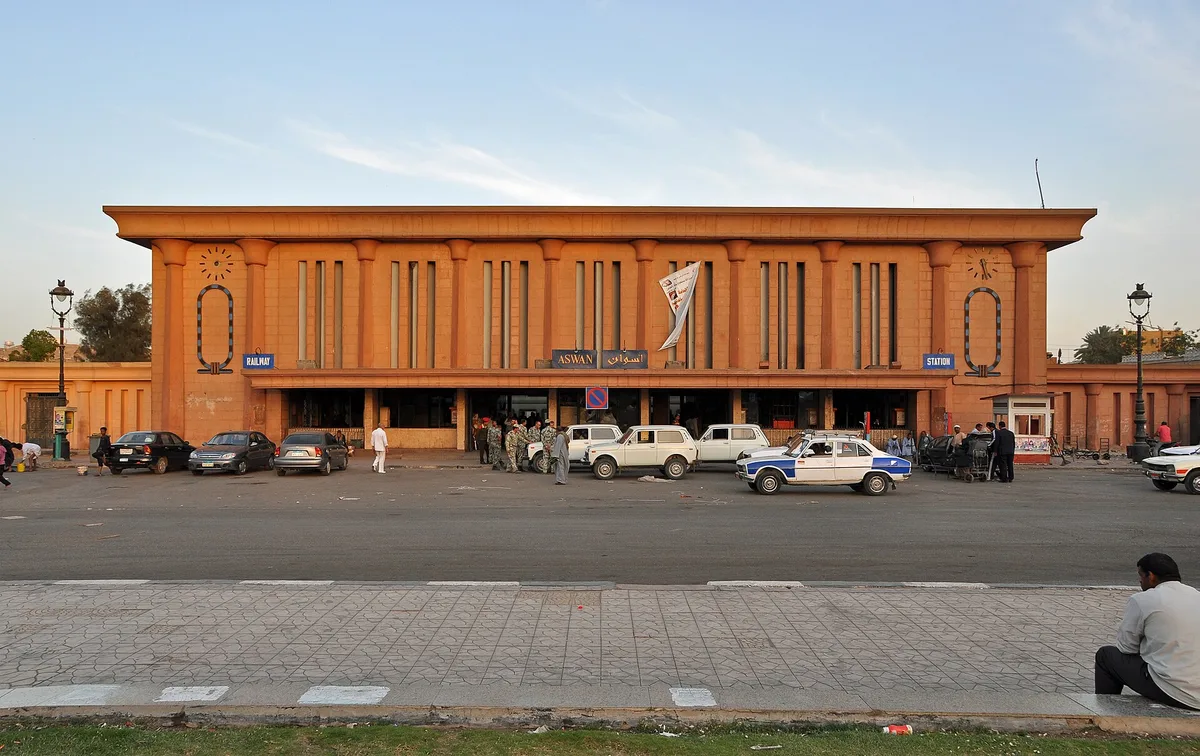
Aswan is closer than it looks on the map, in every way except one. By air it is the simplest journey in Egyptian travel: flights from Cairo take about an hour and a half, landing at Aswan’s small airport south of the town, and there are also connections from other Egyptian cities in season — the right choice for anyone whose days are counted. By rail it is the romantic one: the sleeper train runs overnight from Cairo, delivering you to Aswan’s handsome sandstone station in the morning after a night of the Nile valley unrolling in the dark, while the day trains make the same journey a long, absorbing haul best treated as a travel day in itself. By road from Cairo is the one option to refuse — the distance is the better part of nine hundred kilometres and flying or sleeping both beat it. From Luxor, about 200 kilometres north, the equation reverses: the train and the road along the valley are both easy half-days, and the river itself is the classic route, with cruise boats sailing the Aswan–Luxor stretch in three or four nights in either direction, stopping at the temples between — our guide to luxor temple covers the great temple that anchors the northern end of that run.
Inside Aswan, geography is transport. The town is a thin strip along the east bank, walkable end to end along the Corniche, with taxis and minibuses for anything beyond strolling range and horse-drawn carriages working the promenade at carriage pace and negotiable prices. Everything else floats: the public ferries to Elephantine and the west bank, cheap and constant; the motorboats to Philae, the botanical garden and the Nubian villages, hired at the landings with the price and the programme agreed before departure; and the feluccas for pleasure. There is no transport problem in Aswan that a boat does not solve — there is only the recurring negotiation, which a settled price agreed on dry land solves too.
Best Time to Visit – Heat, Light and the Two Sun Festivals
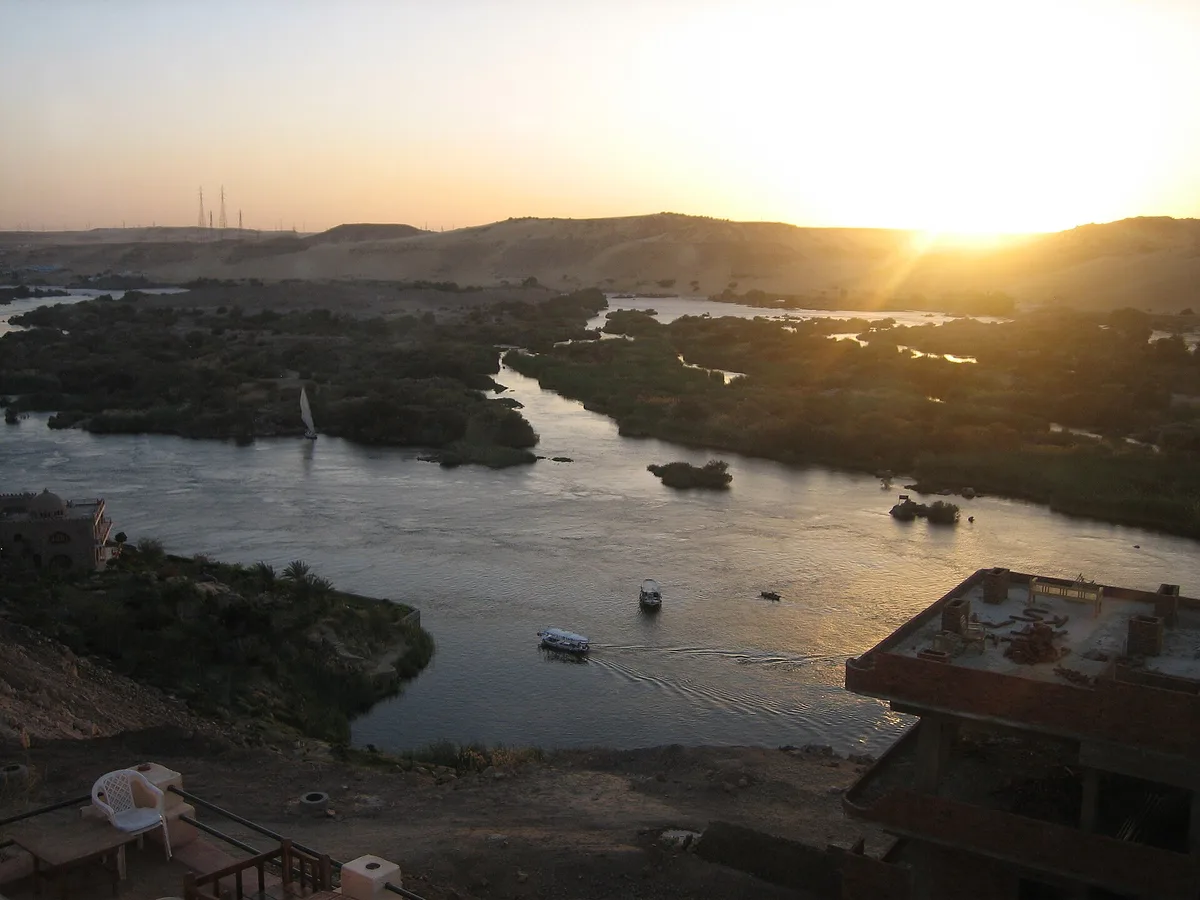
Aswan is one of the driest and sunniest cities on Earth — rain is a rumour here, and the climate conversation is entirely about degrees of heat. The visiting season runs from October to April, when days are warm rather than ferocious: winter afternoons sit comfortably in the low-to-mid twenties Celsius, the light is long and kind, and the evenings turn cool enough to make the Corniche promenade the pleasure this guide has described. December and January are the peak, with the fullest hotels and the dawn Abu Simbel road at its busiest — the price of the city’s best weather, paid by everyone at once. The shoulder months, October and March into April, keep most of the comfort with thinner crowds, and the two Abu Simbel sun festivals fall conveniently inside them, around 22 October and 22 February.
Summer is a different proposition and should be chosen, not stumbled into: from May to September the thermometer passes forty degrees as a matter of routine and keeps climbing, the sun is vertical and pitiless, and sightseeing becomes a dawn-and-dusk discipline with a long surrendered middle. Some travellers take the trade willingly — empty temples, low prices, the river to themselves — and Aswan, with its water and its shade, bears heat better than Luxor or the desert sites; but a first visit belongs in the cool half of the year if the choice is free. A final timing note applies year-round: whatever the season, build Aswan’s days around the early morning. Philae at opening, the quarries before the stone heats, the souk and the feluccas after four — the city’s own rhythm is the oldest travel advice there is, and it has not changed since the Nilometer priests were reading the river.
Frequently Asked Questions
How many days do you need in Aswan?
Two nights is the honest minimum — a day for Philae, Elephantine and the felucca hour, a day for Abu Simbel and the west bank or the villages. Three nights is the comfortable version, turning the Abu Simbel trip from a dash into a pleasure and leaving room for the Nubian Museum and a second, slower evening on the river. One night is possible and commonly done, and it short-changes the calmest city in Egypt in a way travellers consistently regret.
Is Abu Simbel worth the early start?
Yes — it is the single most common verdict in Upper Egypt travel. The temples are among the greatest monuments of the ancient world, the rescue story doubles their interest, and the journey is half a day, not a whole one: south in the small hours, a couple of hours at the site, back by early afternoon. Travellers with the time and budget can fly, or sleep in the village beside the temples and see the facade at dawn and dusk with the convoys gone — but the standard trip, alarm and all, earns its reputation.
How do you get from Aswan to Luxor?
By river, rail or road. The cruise boats are the classic choice — three or four nights sailing between the two cities with the temples of Kom Ombo and Edfu between them, in either direction. The train along the valley and the road both take a few hours and run through the day. Flying the short hop is possible but usually the worst of the options once airport time is counted; this is a journey to make slowly, at river or rail level.
Is Aswan safe, and how bad is the hassle?
Aswan has a well-earned reputation as the most relaxed city in Egypt, and the honest answer matches it: normal big-town awareness applies, and the daily reality is commercial rather than threatening. The friction points are predictable — felucca captains, carriage drivers and souk sellers all open negotiations high and with enthusiasm — and the technique is the same everywhere: agree the full price before anything moves, decline with a smile and no heat, and keep walking. Visitors consistently report Aswan’s version of this gentler than Cairo’s or Luxor’s.
Can you swim in the Nile at Aswan?
People do — there are recognised swimming spots around the cataract islands where locals and travellers bathe, and the water here, fast and rocky, is cleaner-feeling than anywhere downstream. The sensible version of the answer is: swim where the locals swim, take your cue from your boat captain or guesthouse, and treat the river with the respect any big river deserves — currents around the boulders are real. The hotel pool remains the uncomplicated option.
What is the best month to visit Aswan?
The heart of the cool season — November to February — holds the city’s kindest weather, with warm days, cool evenings and the river at its most beautiful; late February adds the Abu Simbel sun festival for those who time for it. October and March run it close with fewer crowds. If your dates fall in the hot months, the trip is still workable on an early-and-late rhythm, but the cool months are when Aswan is the city this guide describes.
The Short Version
Aswan is where Egypt slows down, and the correct response is to slow down with it. Give it at least two nights. Sail to Philae on your first morning and let the Temple of Isis, rescued whole onto its island, set the standard for everything after; walk Elephantine from its pharaonic ruins into its living Nubian villages; cross to the west bank for the tombs, the great empty monastery and the Aga Khan’s dome against the sunset; and take the dawn road south to Abu Simbel, where the greatest temple rescue in history rebuilt a mountain. Spend your evenings the way the city does — a felucca on the river at golden hour, the souk’s spice pyramids, dinner on the Corniche — and leave one honest hour for the Nubian Museum, so the colour of the villages comes with its story attached. Come between October and April if you can, start the ancient days early, agree every boat price on dry land, and let the place work at its own pace. Cairo shows you Egypt’s power and Luxor its glory; Aswan, the granite gateway where the country began, shows you its soul — and it does it quietly, from a sailboat, at about four in the afternoon.