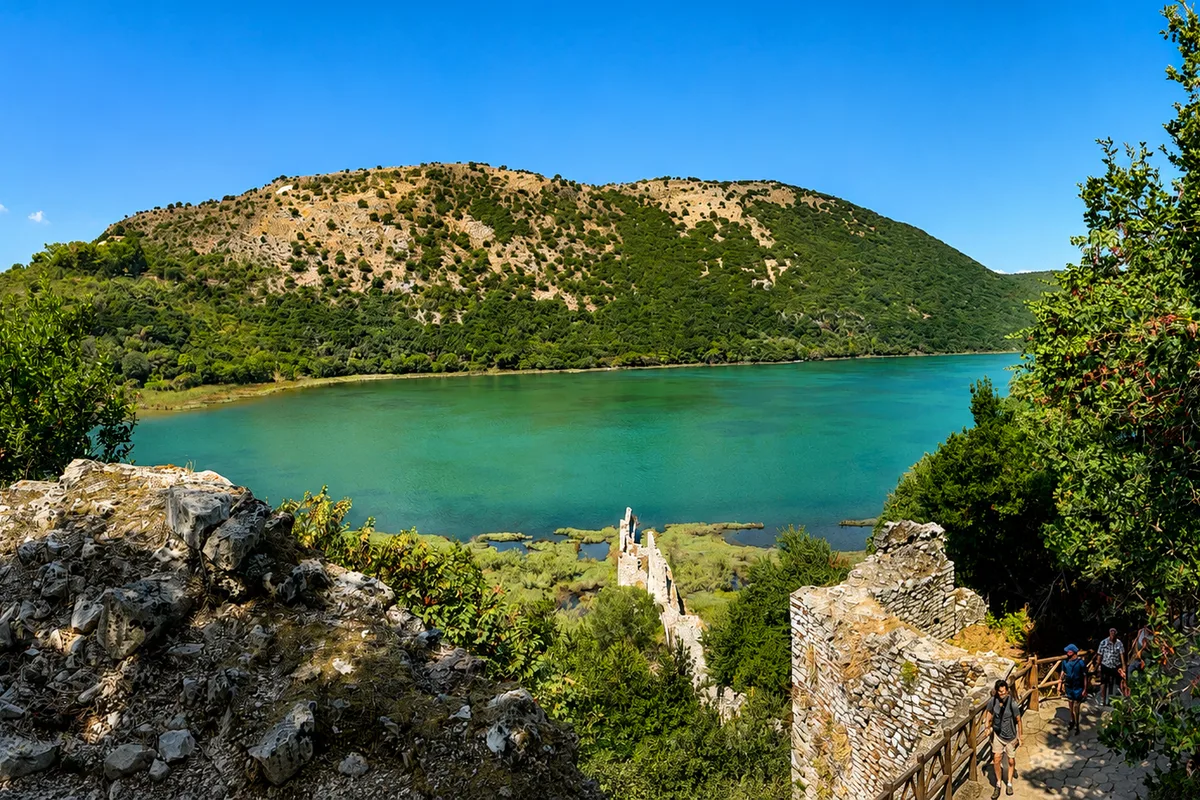
Butrint Travel Guide – The Ancient City in the Woods Between Saranda and Ksamil
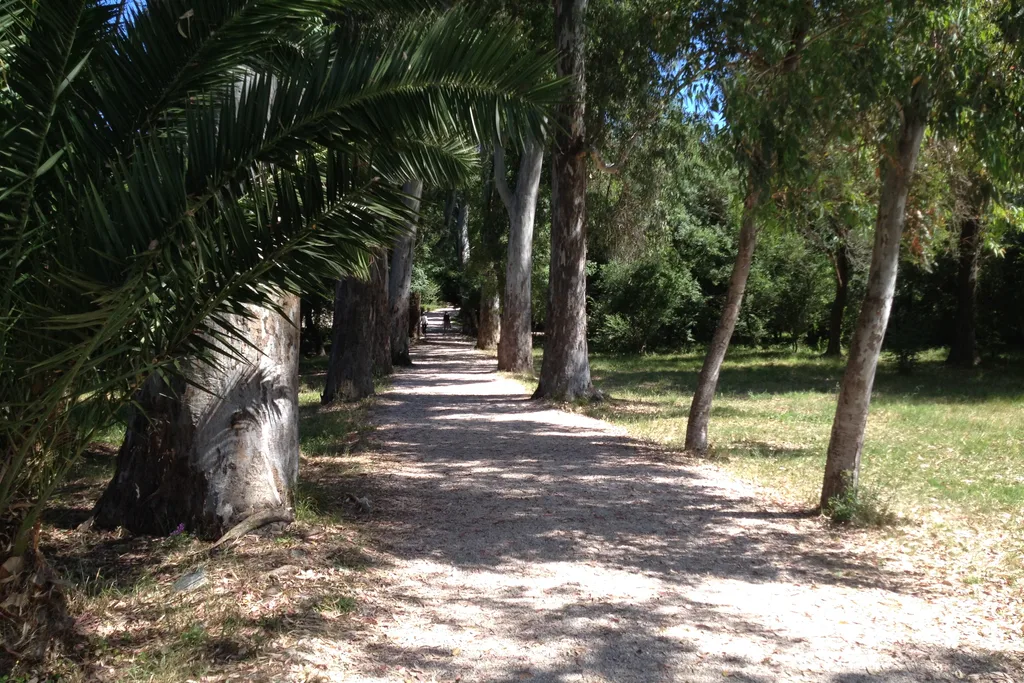
Most famous ruins stand in the open, bleached and treeless, and you read them the way you read a plan. Butrint is the opposite. Albania’s greatest ancient city sits on a low, wooded peninsula between a lake and a channel, and you visit it the way you would walk a forest path that keeps interrupting itself with civilisations — a Greek theatre under the trees, a baptistery in a clearing, a basilica in the shade, and at the top of the hill a small castle looking out over water on three sides. The stones are serious, but the setting does half the work, and it is the combination that earned Butrint its place on UNESCO’s World Heritage List.
The cold facts are these. Butrint, known in Latin as Buthrotum, was a Greek-influenced city of the Chaonian tribes, then a Roman colony, then an early Christian bishopric, then a Byzantine town, then an Angevin and Venetian outpost, before the changing water levels of its own lagoon finally emptied it at the end of the Middle Ages. UNESCO inscribed it in 1992 under criterion (iii), as valuable evidence of the ancient and medieval civilisations of this coast, and the listing was later extended to take in more of the landscape around the walls. The walled city itself is compact — you walk it, it does not sprawl — but the layers inside it are stacked deeper than at almost any other site in Albania.
Practically, Butrint is a half-day trip, and an easy one. It stands at the end of the coast road south of Saranda, a few kilometres beyond the beach village of Ksamil, and almost everyone who visits the Albanian Riviera’s southern end comes here for a morning or an afternoon between swims. This guide is built to be used in that spirit. It walks the site in the order you will actually walk it, explains what each ruin was before it tells you what it looks like, and is honest about the two things rival guides routinely fudge — the famous mosaic floor that is usually hidden, and the ticket-and-hours details that change often enough that no printed figure should be trusted without checking the park’s own current notice. If you are still planning the wider trip, our Albania travel guide sets Butrint in the context of the whole country; this page is for the visit itself.
At a Glance
Here is the whole site on one screen before the walk begins. Butrint is a single walled peninsula, and the standard visit is a rough circuit — in through the gate by the channel, across the lower city to the theatre and the Christian quarter, up the hill to the castle, and back down along the walls. Nothing is far from anything else; what takes the time is the layering, because almost every stop is two or three buildings from different centuries sharing one footprint.
| Layer | Rough dates | Where you meet it on the walk |
|---|---|---|
| Greek city and sanctuary | 8th century BC onwards | The theatre, the Asclepius sanctuary, the earliest walls |
| Roman colony | From 44 BC | The forum quarter, the baths, the Triconch Palace |
| Early Christian city | 5th–6th centuries AD | The baptistery, the Great Basilica in its first form |
| Byzantine town | 9th century onwards | The rebuilt basilica, strengthened walls, the Lion Gate as reset |
| Angevin and Venetian outpost | 14th–16th centuries | The acropolis castle, the triangular fortress across the channel |
| Final chapter | Early 19th century | Ali Pasha’s small castle at the channel mouth |
Two honest notes belong in this summary rather than buried later. First, the single most celebrated object at Butrint — the baptistery’s mosaic floor — is kept covered with a protective layer of sand for most of the year and is only uncovered occasionally, so the baptistery section below explains what you will actually see: a beautiful ring of columns around a floor you will probably have to imagine. Second, this article deliberately prints no ticket price and no opening hours. Those details are set by the park, they change with the season and the year, and the guides that print them disagree with each other; the practical section explains how to confirm the current arrangements on the park’s official website and on UNESCO’s Butrint listing before you go. Everything else about the visit — the route, the buildings, the water, the shade — changes much more slowly, and that is what the rest of this page covers.
A City Held by Water – the Lagoon, the Channel and the Peninsula
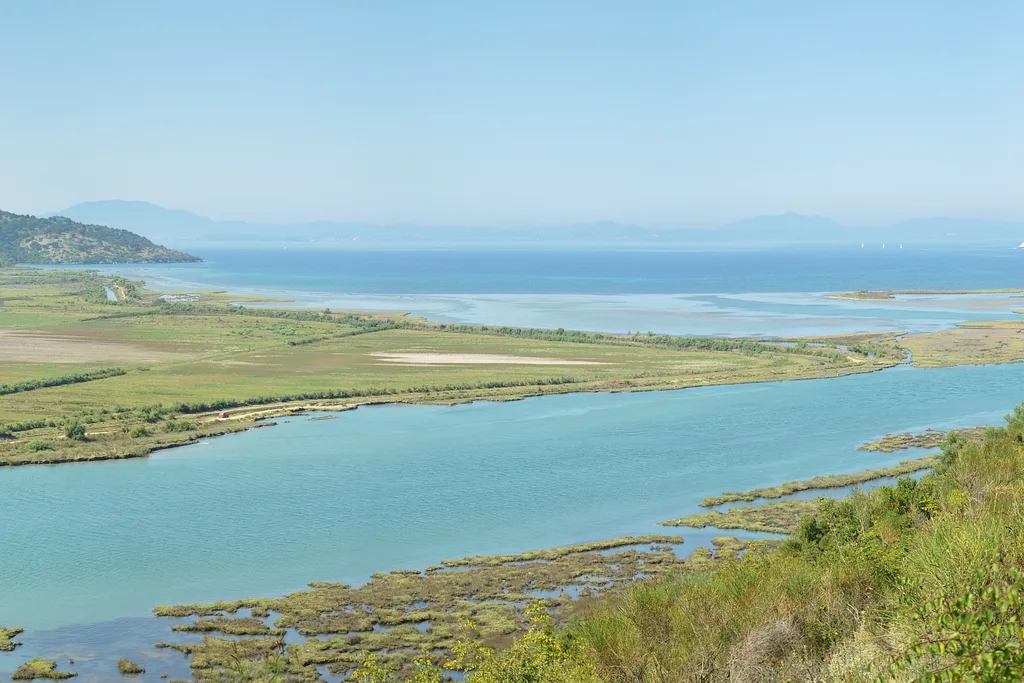
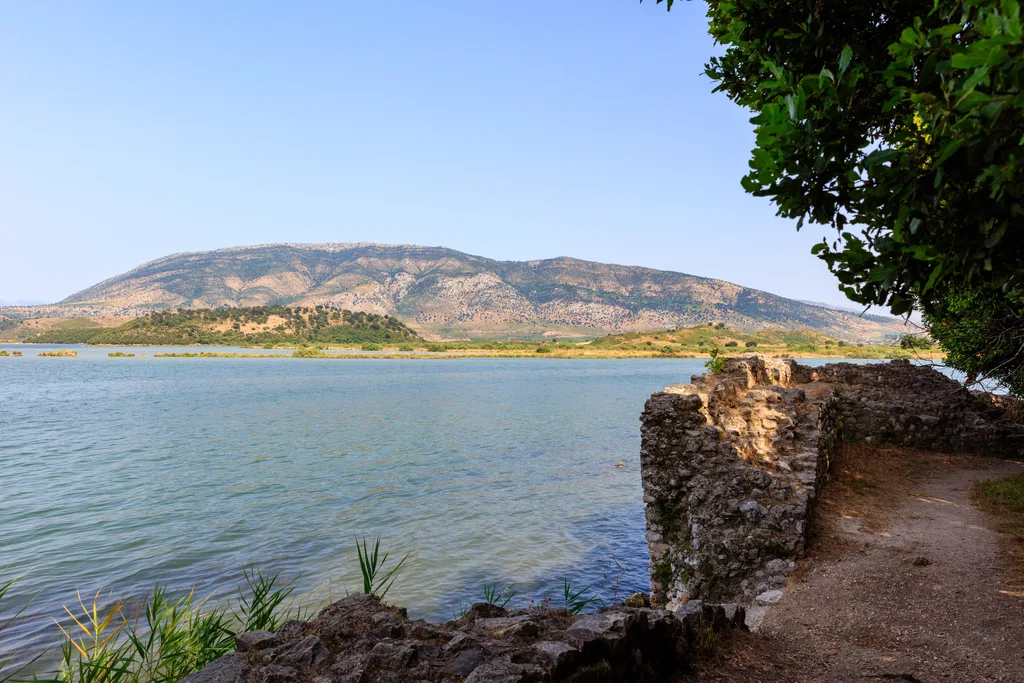
To understand anything at Butrint, start with the water, because the water chose the site, fed it, defended it and finally took it back. The city stands on a small hill at the southern end of Lake Butrint, where the lake drains to the Ionian Sea through the short, river-like Vivari Channel. A settlement here controlled the channel, fished the lake, farmed the plain across the water and watched the strait towards Corfu — which is why people kept rebuilding on this one modest hill for well over two thousand years, and why UNESCO’s description of the place stresses the landscape as much as the monuments. The property it protects is a cultural landscape, not just a ruin field, and the wider wetland around it is protected as a national park and an internationally recognised Ramsar wetland.
The same geography explains the ending. Butrint’s ground is barely above the water that surrounds it, and as the lagoon’s levels and silting shifted in the later Middle Ages, the lower city grew wetter and less workable until the place was effectively abandoned — UNESCO’s stated reason for the inscription is precisely that this drowning preserved the evidence, freezing the ancient and medieval city instead of letting a modern town build over it. You can still see the process politely continuing today. The theatre’s orchestra often holds a sheet of shallow water, some paths skirt marshy ground, and the whole site has the soft, green, slightly swampy beauty of a place that water never quite gave back.
For the visitor, the water is not background — it is the frame of every photograph and the reason the walk feels the way it does. The channel runs along the city’s southern edge, where a small cable ferry still carries vehicles across beside the park entrance; the lake opens to the north, farmed for the mussels it is famous for; and from the castle terrace at the top you can take in both at once, with Corfu lying across the strait. Bring the setting into your expectations and the site makes sense: this is not a dry acropolis with a view, it is a port city that spent its life at water level, and its ruins have the lagoon in almost every sightline.
The Greek City – the Theatre and the Sanctuary of Asclepius
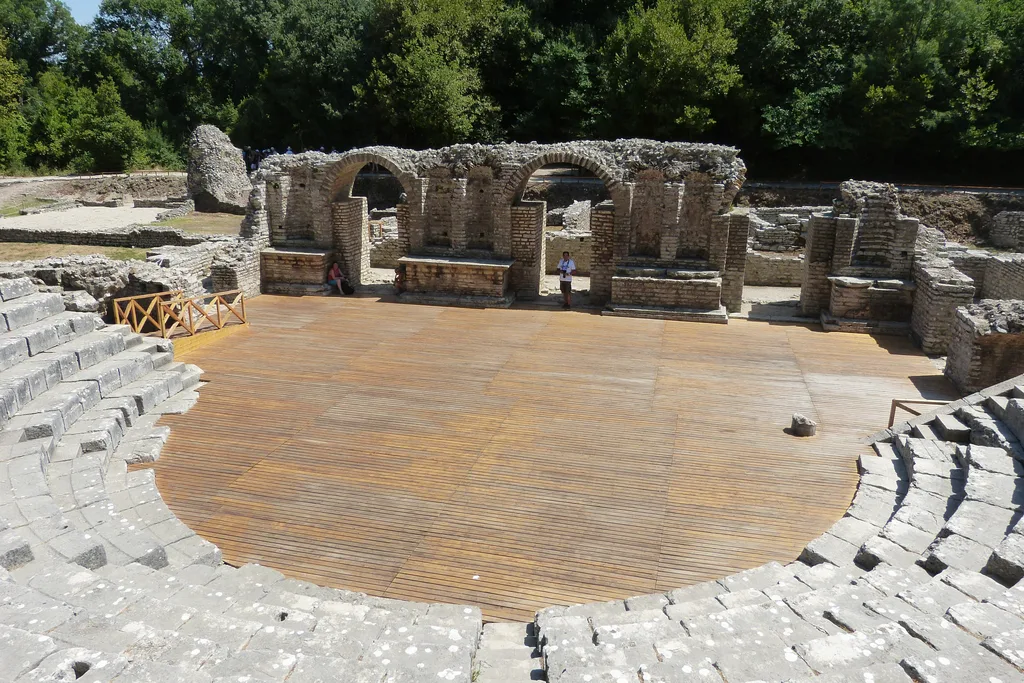
The first great age of Butrint is Greek in language and culture. Settlement on the hill goes back far earlier — UNESCO notes evidence of human presence in the territory reaching into deep prehistory — but from around the eighth century BC the place took on the shape of a Greek-style city, a polis of the Chaonian tribes, with the acropolis above and a sanctuary below. The sanctuary was dedicated to Asclepius, the healing god, and sanctuaries of Asclepius were working places, part temple and part clinic, where the sick came to sleep in the god’s precinct and be cured in dreams. Its terraces and remains still sit beside the theatre, in the flat ground between the hill and the channel, and the two buildings belong together: Greek cities paired healing and performance long before anyone called it a cultural quarter.
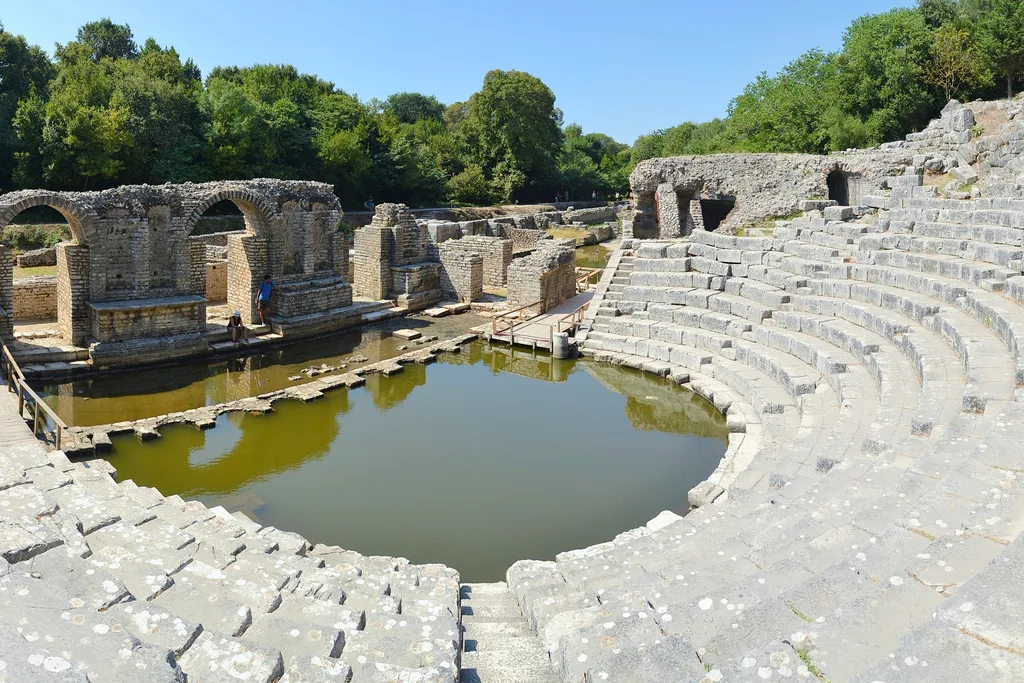
The theatre is the monument most visitors remember, and it earns the attention honestly. Built in the Greek period and enlarged and remodelled under Rome, its stone seating climbs the slope in a neat semicircle, facing a stage building whose arches and doorways still stand — and, on many days, facing that shallow pool in the orchestra where the water table breaks the surface. Inscriptions found here record, among other things, the freeing of slaves in ceremonies tied to the sanctuary, which is a reminder that this was a working civic building, not a showpiece: announcements, festivals, assemblies and manumissions all passed across this floor. It is also, happily, not a dead monument; performances are still held in it occasionally, and sitting in the seats with the trees behind you and the stage below gives a clearer sense of a Greek theatre’s scale than any diagram — big enough for a town, small enough for a voice to carry.
Stand here a moment before moving on, because the theatre is where the site’s whole method becomes clear. The seats are Greek in conception, the stage is substantially Roman work, the water in the orchestra is the medieval ending still arriving, and the trees pressing in on all sides are the modern national park. Four of Butrint’s layers are visible in a single glance, and once you have learned to read one view that way, every later stop on the walk becomes easier. The route now turns from performance to the business of the Roman city that replaced the Greek one.
The Roman City – Forum, Baths and a Colony Across the Channel
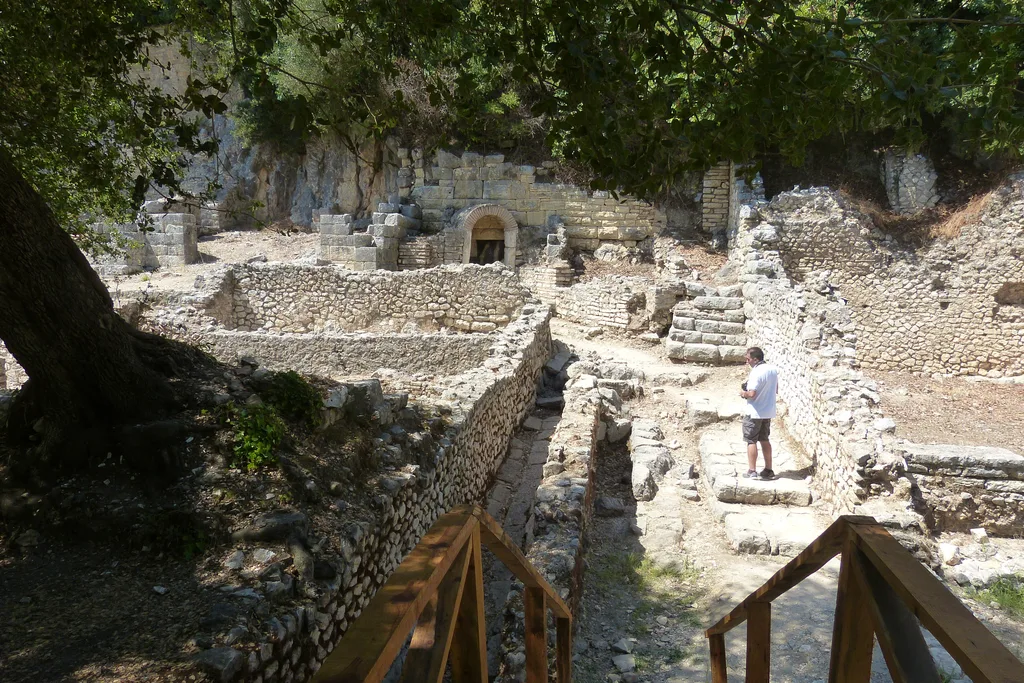
Rome arrived at Butrint the way it arrived everywhere in this period — first as influence, then as ownership. In 44 BC the settlement became a Roman colony, refounded with veteran settlers, and UNESCO’s summary of the place notes how considerably it then grew: an aqueduct was built to serve it, and the city spilled beyond its old Greek footprint, expanding across reclaimed marshland, principally southwards across the Vivari Channel, where a suburb grew up on the far bank. A colony was a piece of Rome planted abroad, with a forum, baths, temples and a street plan to prove it, and the excavated quarter below the acropolis — the forum area, with its surrounding public buildings — is where that identity is still legible in stone.
The baths deserve a slower look than most visitors give them, because at Butrint they explain Roman daily life better than the grander ruins explain Roman power. A bathhouse was the town’s club, clinic and news exchange, and the remains here — their brickwork, heating systems and sequence of rooms laid out in the trees — show the standard machinery of the institution at a modest provincial scale. Between the forum, the baths and the houses, the Roman sections of the walk have a different feel from the Greek sanctuary below the hill: less ceremonial, more municipal, the archaeology of errands and evenings rather than festivals. That ordinariness is the point. Empires are usually presented through their monuments; a colony town like this one shows the plumbing underneath.
One more Roman survival completes the picture, though you will meet it properly on the walking route: the grand late Roman residence now called the Triconch Palace, built on the channel shore as the empire was turning Christian. Its three-apsed dining room gives it the name, and its position — a rich house at the water’s edge, in a city whose bishop was becoming as important as its magistrates — is a small, perfect emblem of the transition the next two sections describe. Rome made Butrint bigger, richer and more ordinary; Christianity then remade it from the inside, and the two most famous buildings on the whole site belong to that remaking.
The Baptistery – the Great Mosaic You Will Probably Not See
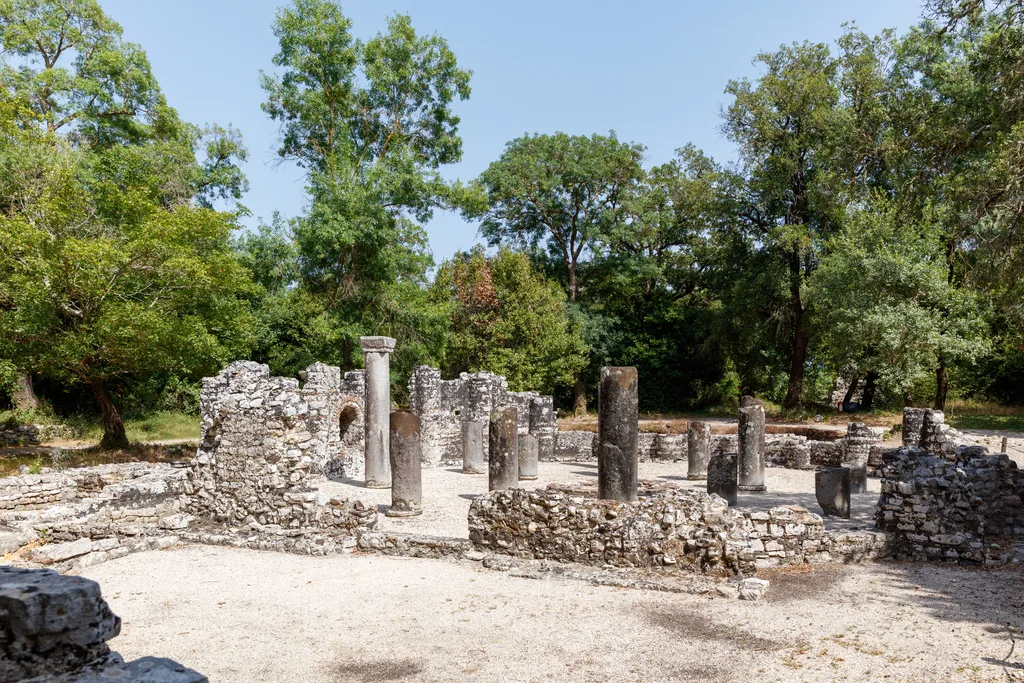
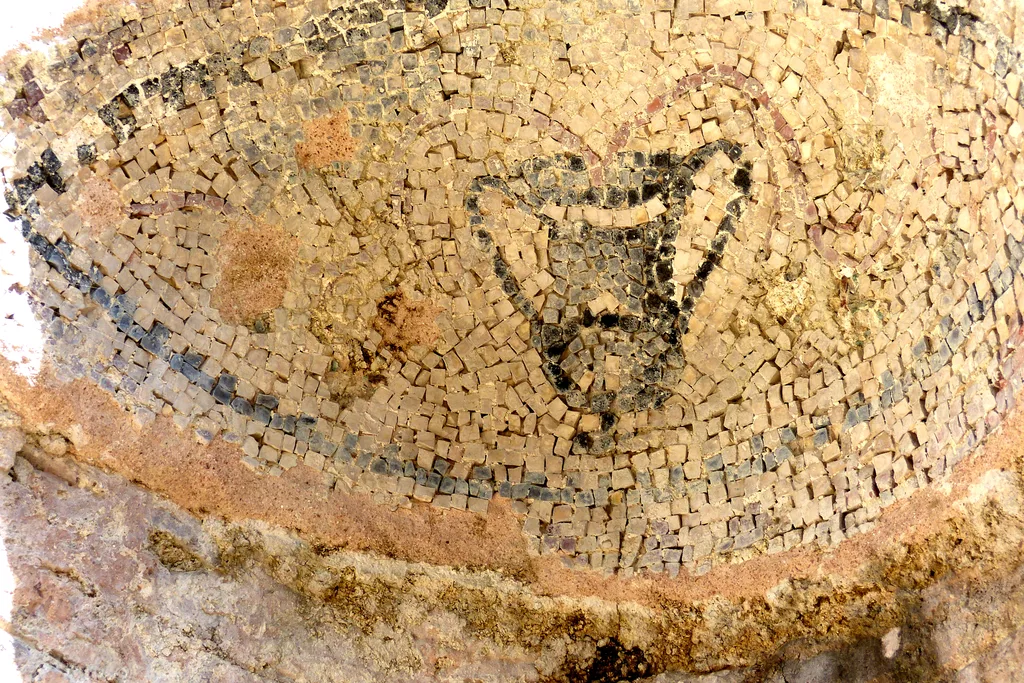
In the fifth century AD Butrint became an episcopal centre — a bishop’s seat — and the early Christian city that followed left the site’s most treasured single object: the baptistery, a circular building of the sixth century whose floor is one of the largest and finest early Christian mosaic pavements to survive anywhere around the Mediterranean. UNESCO singles it out as the major ruin of the early Christian era here, an older Roman structure adapted to Christian use, its floor carrying a beautiful mosaic decoration of animals, birds and symbols arranged around the font where converts were baptised. In photographs it looks like a carpet of stone — medallions and creatures in coloured tesserae, ringed by the columns that once carried the roof.
Now the honest part, which too many guides mumble or skip. That floor spends most of its life covered. To protect the mosaics from weather, roots and feet, the pavement is kept under a layer of sand, and it is uncovered only occasionally, for conservation and short periods — which means the large majority of visitors, on the large majority of days, will stand at the baptistery’s edge and see the elegant ring of columns, the circular plan and the font, but not the famous floor itself. This article’s advice is simple: do not build your visit around the mosaics. Come for the building, which is genuinely lovely — a calm, round, colonnaded space in the trees — and treat any uncovering as luck, not entitlement. If the state of the floor matters to you, the time to ask is before you travel, through the park’s own channels, because only the park can tell you its current conservation plans.
None of this makes the baptistery a disappointment unless a guidebook promised you the photographs. Read properly, it is one of the most eloquent stops on the walk: a building whose treasure is being deliberately hidden from you, at real inconvenience to the site’s own marketing, because keeping it is worth more than showing it. Plenty of famous sites could learn from that. And the wider Christian city around it — the great church a short walk away — is under no such wraps, which is where the route goes next.
The Great Basilica – the Church That Outlived the Empire That Built It
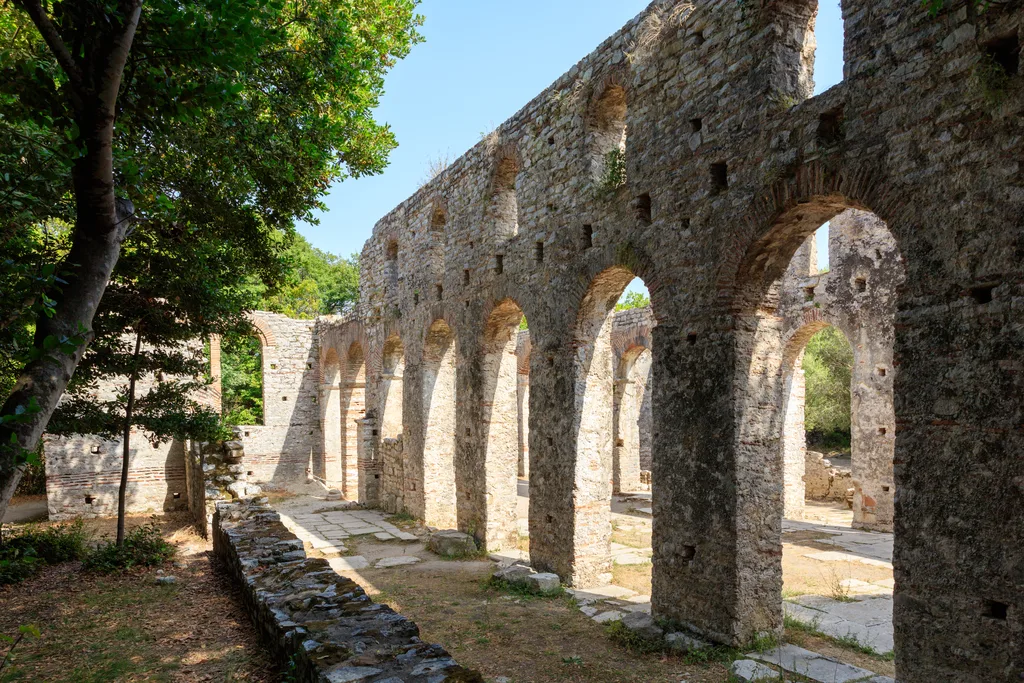
The Great Basilica stands towards the eastern end of the city, and it is the largest church ruin at Butrint — a three-naved basilica with a transept and a polygonal apse, in the form UNESCO describes, first raised in the early Christian centuries and then rebuilt in the ninth century, when Butrint was being refortified and repopulated under Byzantine rule after a period of abandonment. That double life is written all over the building. The plan belongs to the age of the baptistery; much of the standing masonry — the tall arcades that still march down the nave, the arched windows high in the walls — belongs to the medieval rebuilding, raised by a poorer, more defensive town that nonetheless wanted its great church back.
Churches on this scale were statements about what a city thought it was. The sixth-century original announced that Christian Butrint had arrived, a bishop’s city with a baptistery for converts and a basilica for crowds. The ninth-century rebuild announced something almost more impressive: that after decline and abandonment, the town that returned still measured itself by this building, and rebuilt it in stone on the old lines rather than settling for a chapel. Walking its nave today, with the arcades open to the sky and the trees looking in over the walls, you are standing in both announcements at once — which is, once again, the essential Butrint experience, two eras sharing one address and neither cancelling the other out.
Take the basilica together with the baptistery as a pair, because that is how the early Christian city worked: baptism in the round, mosaic-floored baptistery, then worship in the long basilica, the two buildings forming the machinery of conversion in a late Roman town. Between them they also mark the high point of Butrint’s second life — the centuries when the city was no longer a Roman colony but was still wealthy, walled and confident. The confidence did not last uninterrupted, and the walls you will walk next were strengthened again and again by people who expected trouble. The most characterful piece of those walls is a gate with a lion on it.
The Lion Gate and the Walls – a City Closing Its Doors
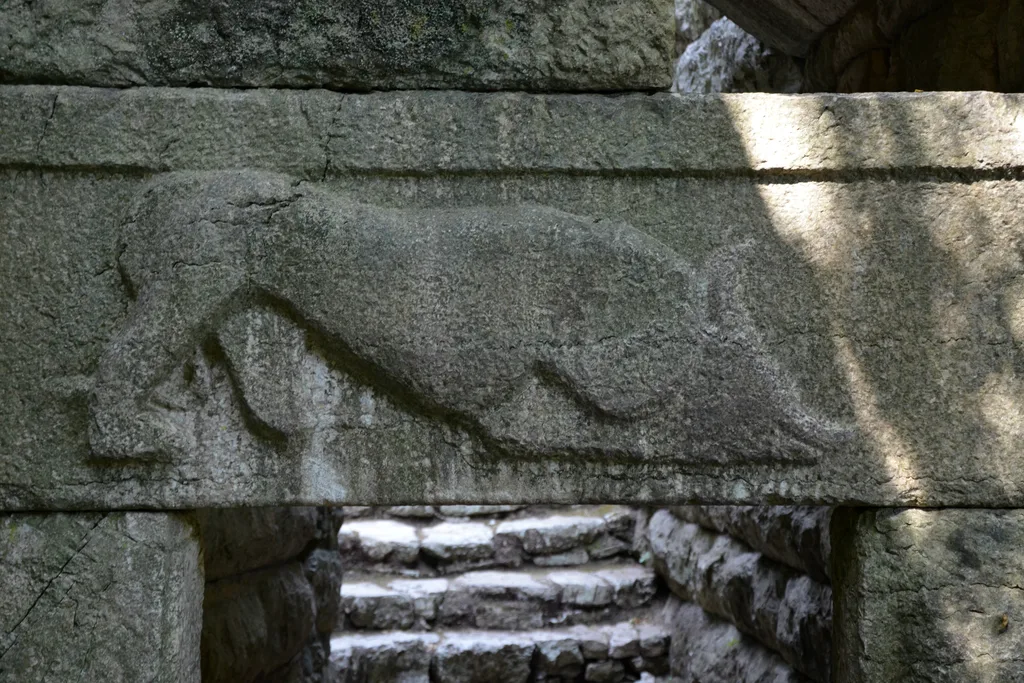
Butrint’s walls are a document in themselves, rebuilt in almost every era the city lived through — Greek work at the core, Roman repairs, a major late antique circuit raised when the empire was fortifying against a more dangerous world, and medieval strengthening on top of that. Walking stretches of them, in the shade along the channel or up towards the acropolis, you can read the changes in masonry the way you read chapters: big early blocks below, smaller later work above, and everywhere the slightly improvised quality of a town that kept having to make itself defensible with whatever stone was to hand — including, famously, its own older monuments.
The Lion Gate is the best-known piece of that story. Set into the later wall circuit, the gate is topped by a great carved block showing a lion tearing at a bull — a relief carved in the sixth century BC, in the city’s Greek youth, and then reused roughly a thousand years later, in the fifth century AD, as a lintel to lower and narrow the gateway, making it easier to defend. Everything about that decision is eloquent. The late antique builders were not vandals; they were frightened engineers working fast, and they reached for the biggest, strongest carved stone in the yard. The result is that you enter this part of the walls by ducking, in effect, under a masterpiece — the passage beneath the relief is low and tight, and the squeeze is the history.
The gate also makes a useful honesty check for the whole visit. It would be easy to present Butrint as a serene sequence of beautiful buildings, but the walls tell the truer story: a rich little port that spent its later centuries expecting attack, narrowing its gates, thickening its circuit and pulling in on itself. The despots of Epirus, the Angevins, the Venetians and the Ottomans all feature in the site’s later history in UNESCO’s account, and the defences were strengthened and extended in response. Serenity is the modern condition, purchased by abandonment. The lion, mid-maul above your head as you stoop through, is the reminder that it was not always so.
The Acropolis and the Venetian Castle – the Museum at the Top
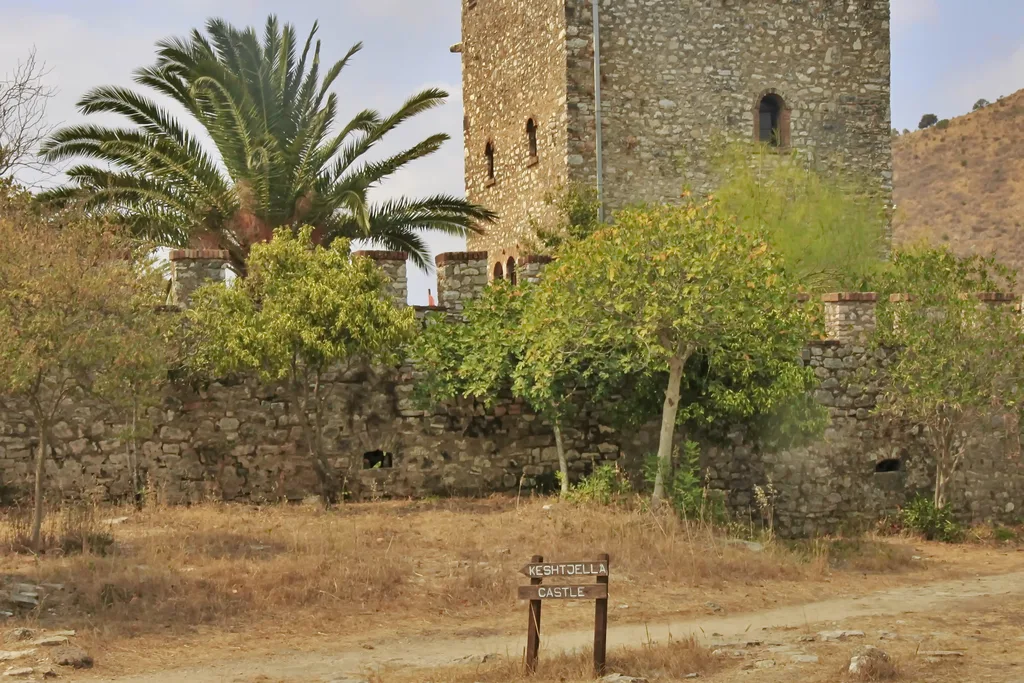
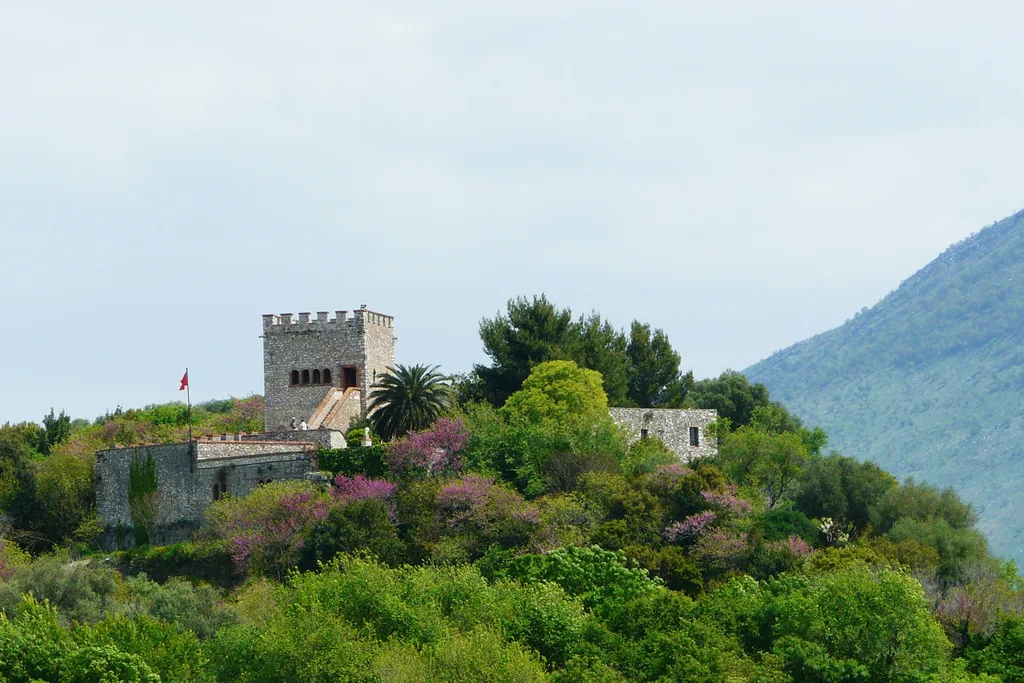
Every route through Butrint ends by climbing, because the acropolis — the city’s original high ground, where its earliest temples stood — carries the last act of the story. From the fourteenth century the site passed under Angevin and then Venetian control, one outpost in Venice’s chain of Adriatic and Ionian strongpoints facing the Ottoman world, and the Venetians fortified the hilltop with the small castle that still crowns it. The building you see today is that castle in its restored form — its towers and walls were substantially rebuilt in the twentieth century, during the era of the first great excavations, to house the site’s museum — and it is best understood as both things at once: a genuinely Venetian strongpoint in plan and position, wearing a careful modern restoration.
Inside is the site museum, and it is worth your time rather than a polite ten minutes. The finds from a century of excavation — the systematic work began with an Italian archaeological mission in the late 1920s, which among much else cleared the theatre — are displayed where they were found: sculpture, inscriptions, coins, pottery and the small change of two thousand years of daily life. A museum on the spot does something a national collection cannot; you walk out of the cases and straight back into the streets the objects came from, and the theatre seats, the baptistery columns and the basilica’s arcades read differently with the faces and names of their users still in mind. Check the museum’s current opening arrangements with the park when you check your tickets, since they are set separately from the grounds.
And then there is the terrace. The castle stands at the one point where the whole geography of Butrint assembles itself in a single turn of the head: the lake to one side, the channel below, the plain across the water where the Roman suburb stood, the strait and Corfu beyond, and the green roof of the park spreading under it all. It is the natural end of the visit and the right place to take the site’s measure — a small hill, a short walk, and a depth of history out of all proportion to both. Come down by the walls when you are ready; the circuit the next section describes ties the whole walk together in order.
The Walking Route – the Circuit in the Order You Will Walk It
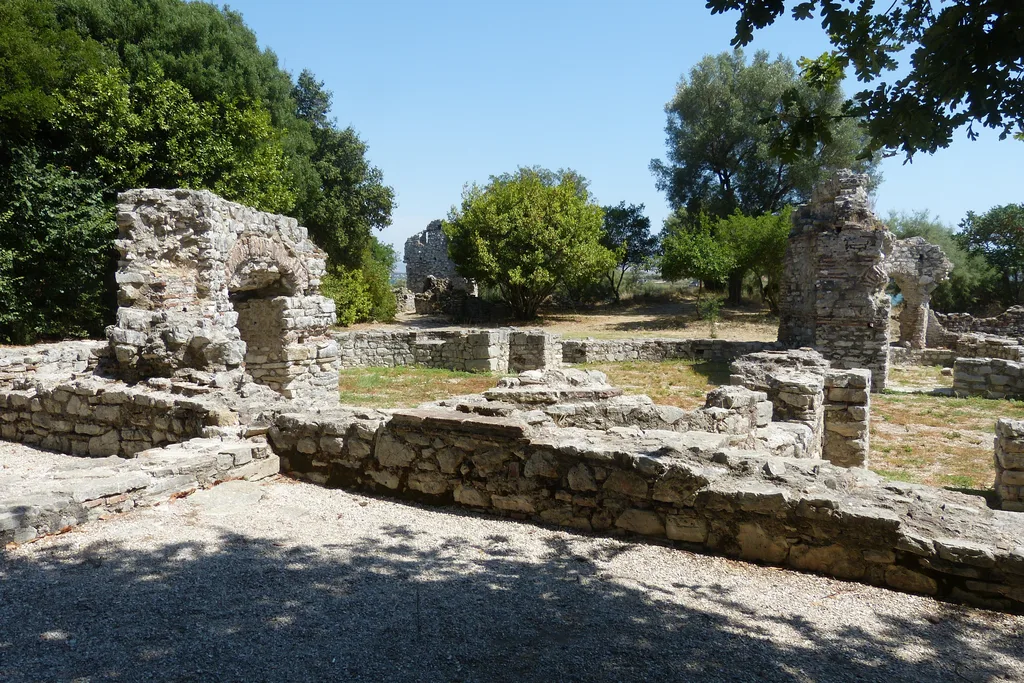
Butrint does not need a strategy, but it rewards a sequence, because the site tells its story in order if you let it. The entrance stands by the channel, near the cable ferry, and the natural circuit runs anti-clockwise through the lower city, up to the castle and back along the walls — roughly the order of the sections above, and roughly the order in the table below. Distances are short; the whole circuit is a gentle walk of a few kilometres at most, with one real climb at the end. What follows is the route as a checklist, with the reasoning kept brief because the buildings themselves have already had their sections.
| Stop | What it is | Why it sits here on the route |
|---|---|---|
| 1. Entrance and channel side | The gate, the Vivari Channel, the ferry | The water story first – everything else follows from it |
| 2. Sanctuary of Asclepius and the theatre | Greek healing sanctuary and theatre | The city’s first great age, at the foot of the hill |
| 3. Forum and baths | The Roman colony’s civic centre | Rome’s municipal layer, a few minutes on |
| 4. Triconch Palace | A grand late Roman house on the shore | The empire turning Christian, told through one rich address |
| 5. The baptistery | Sixth-century baptistery, mosaic floor usually under sand | The Christian city’s treasure, honestly covered |
| 6. The Great Basilica | Early Christian church rebuilt in the ninth century | The pair to the baptistery – conversion’s other half |
| 7. The Lion Gate and walls | Late antique gate with its reused lion relief | The city defending itself; the walk turns uphill |
| 8. Acropolis and Venetian castle | Venetian strongpoint, restored, now the museum | The last layer, the finds, and the view over everything |
Two route judgements are worth making explicitly. First, do not reverse the circuit to “do the castle first while you are fresh” unless the day is very hot; the climb is short, and the museum means more after the ruins than before them. Second, give the channel shore its moment. The Triconch Palace and the stretch of path along the water are where the site’s two subjects — antiquity and lagoon — sit closest together, with the triangular Venetian fortress visible across the channel on the far bank, guarding the same water the Roman house once overlooked. Across that channel, on its own small island at the strait end, also stands the little castle built for Ali Pasha in the early nineteenth century, the final fortification in UNESCO’s account; it is a view from the park rather than part of the standard circuit, and any boat arrangements for it are a separate matter to settle locally on the day.
Getting There from Saranda and Ksamil – the Road That Ends at the Ferry
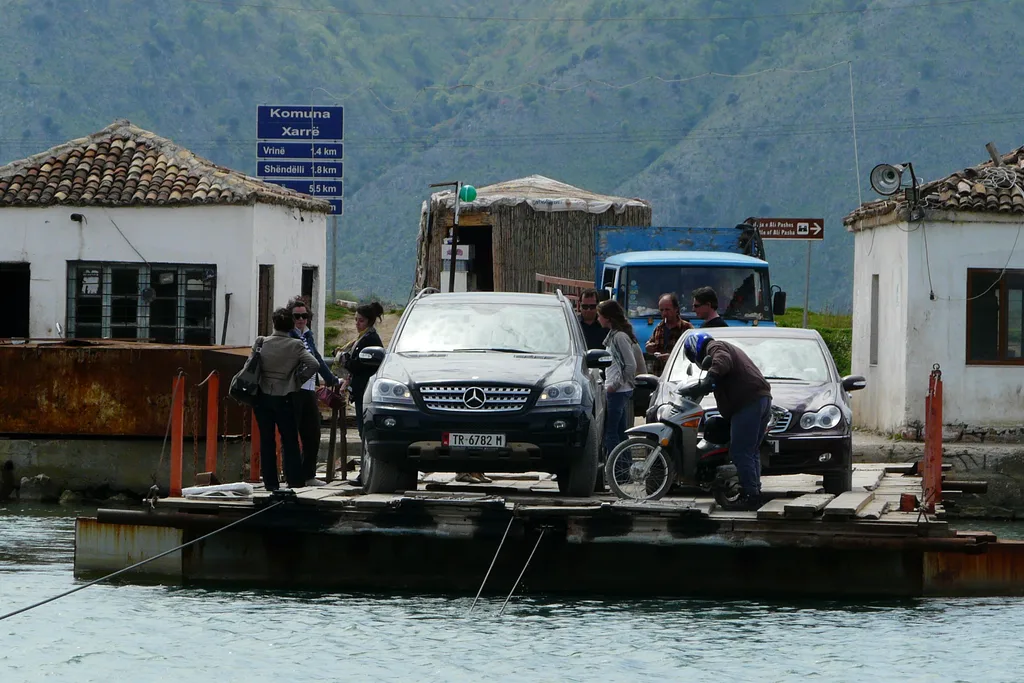
Butrint is one of the easiest major sites in the Balkans to reach, because the geography does the organising. One coast road, the SH81, runs south from Saranda through Ksamil and simply continues to the park gates, some eighteen to twenty kilometres from Saranda depending on where in town you start counting — UNESCO’s own description says approximately twenty — and only a few kilometres beyond Ksamil, which is why the site pairs so naturally with a stay in either place. The road ends at the Vivari Channel, where the little cable ferry crosses to the far bank; the archaeological park’s entrance is right there, and the sense of arrival is part of the pleasure, the road giving out at water with a walled, wooded hill beyond it.
By car it is a straightforward drive of roughly half an hour from Saranda in normal conditions, and noticeably less from Ksamil, with parking by the entrance — arrive reasonably early in high summer if you want the straightforward version of both the parking and the site. By bus, a local service runs down the same road from Saranda through Ksamil to Butrint, and it is the standard way to come for travellers without a car. This page deliberately gives no timetable and no fare for it, and you should be suspicious of any page that gives you either with confidence: local services on this coast adjust with the season, and the details belong to the week you travel, not to an article. Ask at your accommodation or at the stop in Saranda or Ksamil, confirm the last return bus before you set off, and build your visit backwards from it.
That last point deserves emphasis, because it is the only genuinely consequential logistics of the whole trip. Butrint is not a place you can hail a ride from at dusk; if you come by bus, the return service is the frame of your day, and if you drive, the frame is the park’s closing time, which you will have checked on the park’s own current information before setting out. Taxis from Saranda or Ksamil are the flexible third option and are commonly arranged through hotels — agree the terms, including any waiting or return arrangement, before you leave town. None of this is difficult. It is simply a site at the end of a road, and the end of a road asks for thirty seconds of planning that a city-centre museum does not.
Combining Butrint with Ksamil and Saranda – How the Day Fits Together
Almost nobody sleeps at Butrint — the park is a visit, not a base — so the real planning question is how it shares a day with the two places everyone does sleep. From Ksamil, it is barely a trip at all: the village sits a few kilometres north of the gates, and the classic pattern is ruins in the cooler morning, then back to Ksamil’s bays and islands for the afternoon’s swimming, with the contrast between the two halves of the day doing much of the work. From Saranda the shape is the same at a slightly larger scale, with the town’s promenade, restaurants and evening life as the counterweight to the park’s shade and quiet. Either way, Butrint is the cultural anchor of the southern Riviera’s beach country, and the best places to visit in Albania roundup on this site puts it in exactly that company.
The pairing works because the two halves are opposites in everything except distance. Ksamil in season is bright, busy and entirely about the water in front of you; Butrint is shaded, spacious and entirely about the water around a vanished city. Travellers who do both on the same day consistently describe the ruins as the surprise of the trip — partly because expectations for “a site near the beach resort” are low, and partly because the park’s peace is genuine: even in summer, the woodland spreads visitors out in a way an open ruin field never does. If you are following the southern loop in our Albania itinerary for 7 days, Butrint is the day’s fixed point and the beaches are the flexible part, which is the right way round.
One more combination is worth knowing about, because it changes the flavour of the visit: Lake Butrint itself. The lagoon is a working landscape — its mussels are the local speciality, farmed on structures out in the water — and the lakeside road and shore give the ruins a present-tense economy to sit inside, rather than a purely archaeological one. Restaurants in Ksamil and Saranda make much of the lake’s mussels, and eating them within sight of the water they grew in, a few hours after walking the city that fished the same lagoon two thousand years ago, is the sort of small, unplanned coherence that this corner of Albania keeps offering. Butrint plus a swim plus a plate of mussels is not an itinerary anyone needs to sell you. It is just the day, assembled correctly.
Practical Realities – Shade, Water, Footing, Time and Timing
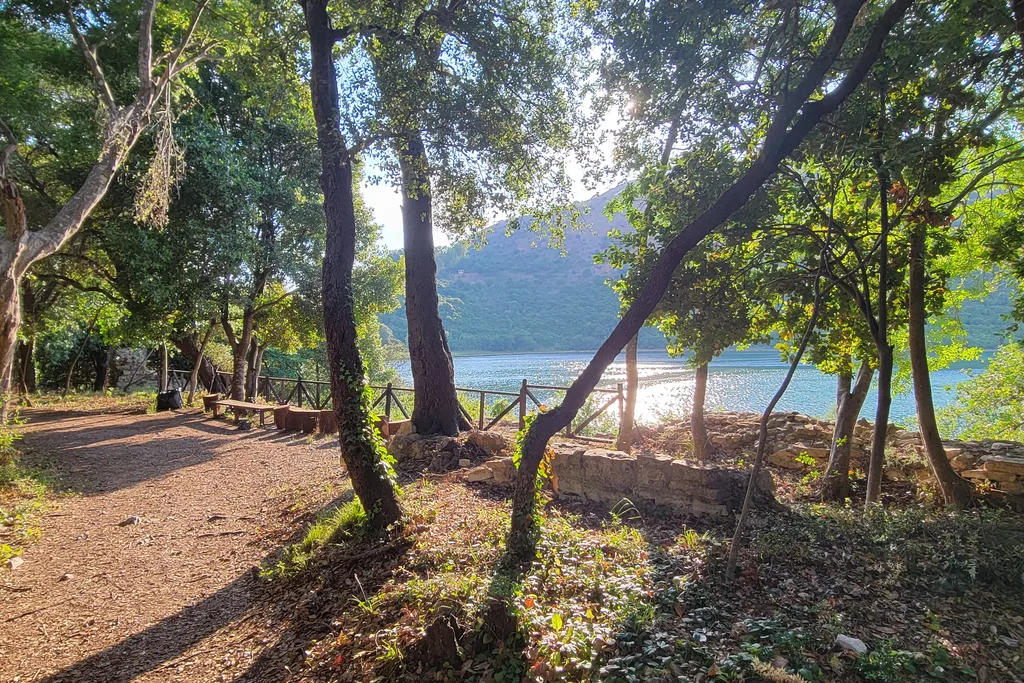
The practical character of Butrint can be summed up in one sentence: it is an unusually kind major site that still asks for basic respect. Kind, because the overwhelming fact of the place is shade — most of the circuit runs under mature trees, which in a southern Albanian summer is the difference between a pleasure and an endurance test — and because the paths are well-trodden and the distances short. Respect, because it is nonetheless an archaeological park at water level, not a paved museum: expect uneven ground, worn stone, steps at the theatre and basilica, a genuinely uphill pull to the castle, and patches near the channel that can be soft or slippery after rain. Shoes you would walk a country path in are the right shoes; anything with a smooth sole will find the one polished stone on the route.
Water — the drinking kind — is the one thing to organise before you enter. The park’s shade lowers the temperature but not the humidity, a full circuit takes hours rather than minutes, and refreshments inside an archaeological park are not something to assume. Carry a bottle per person, more in high summer, and treat anything available near the entrance as a top-up rather than the plan. The same common-sense applies to the sun on the exposed stretches: the acropolis, the channel shore and the theatre seats are all open to the sky, so the hat-and-sunscreen routine of the beach morning still applies between the trees.
How long to allow is the question every visitor asks, and the honest answer is a range with reasoning. A brisk hour will show you the theatre and little else, and selling that as “doing Butrint” is how the site gets its occasional reputation for being skippable. Two hours covers the circuit at a walking pace with short stops. Three hours lets you read, linger in the museum, sit in the theatre and take the castle terrace slowly — and that is the version of the visit this page has described, so three hours is the planning figure to carry, with the morning start that the heat and the day-trip rhythm both favour. As for season: the site is open through the year, and its character shifts with it — green and quiet in spring and autumn, hot and busiest in high summer, stark and very peaceful in winter, when the shorter days make an early start matter more. Confirm the current opening hours and ticket arrangements on the park’s official website before any of this, because those are the park’s to set and change; everything in this section is the slow-moving part of the visit, and it is the part you can plan around with confidence.
Frequently Asked Questions
Is Butrint worth visiting if I am based in Ksamil or Saranda for the beaches? Yes — it is the strongest single excursion on this stretch of coast, and one of the easiest to make. The ancient city is a few kilometres from Ksamil and a short drive from Saranda, the visit takes two to three hours at a proper pace, and the contrast between the shaded ruins and the bright beaches either side of them is exactly what makes the day work. Travellers who skip it usually cite a lack of interest in ruins rather than any difficulty, and even they tend to be converted by the theatre and the castle view.
Will I see the baptistery mosaics? Probably not, and you should plan on that basis. The baptistery’s mosaic floor — one of the great early Christian pavements of the Mediterranean — is kept covered with protective sand for conservation and is uncovered only occasionally, so on most days you will see the baptistery’s ring of columns and its circular plan, but not the floor itself. Any guide that promises you the mosaics as a certainty is working from photographs, not from the site’s current practice. Ask the park before you travel if the floor’s status matters to your plans.
How much does it cost to enter Butrint, and what are the opening hours? This article deliberately does not print a figure or a timetable, because both are set by the park, both change, and the guides that do print them currently disagree with each other about the basics. Check the park’s official website for the arrangements in force when you travel, and treat any price quoted anywhere else — including in print guidebooks — as a rough expectation to be confirmed at the gate rather than a fact.
How long does a visit to Butrint take? Plan on two to three hours. One hour is a rush that covers the theatre and little else; two hours walks the full circuit at a steady pace; three hours adds the museum, the castle terrace and time to sit and read. The distances are short — the time goes on the layering, not the walking — so the real variable is your appetite for ruins rather than your fitness, the short climb to the acropolis aside.
Can I visit Butrint and the Blue Eye on the same day? Yes, and it is a common combination from Saranda, since the Blue Eye spring lies inland on the Saranda side while Butrint lies south down the coast — the two make a natural loop of a day with Saranda as the hinge. From Ksamil the pairing is a little less direct but still straightforward by car or arranged taxi. What the combination needs is not ingenuity but sequencing: check the return transport for whichever half of the day you do second, and do not let the spring’s shorter visit tempt you into rushing the ruins.
Do I need a guide at Butrint? No, but the site rewards interpretation more than most. The ruins are beautiful in themselves and the circuit is easy to follow, so a self-guided visit works perfectly well — this page is written to be enough. What a guide or a good guidebook adds is the layering: the difference between a pile of stones and a Greek sanctuary that became a Roman theatre that became a flooded orchestra is narration, and if that difference is what you came for, arranging a guide at the entrance or through your accommodation is money spent in the right place.
The Short Version
Butrint is the best half-day in southern Albania: a Greek, Roman, Christian, Byzantine and Venetian city stacked onto one wooded, water-ringed hill at the end of the Saranda road, deep enough to have earned its UNESCO listing in 1992 and gentle enough to walk in an afternoon under the trees. Walk it in order — theatre, forum, baptistery, basilica, Lion Gate, castle museum — give it three hours rather than one, carry water, check the park’s own site for the day’s arrangements, and do not build the trip around the baptistery’s famous floor, which spends most of its life asleep under sand.
Then do what the geography has been suggesting all along: go back up the road to Ksamil and swim. The ruins and the beaches are not competing halves of this coast; they are the same day, read in two registers — the city that the water took, and the water itself, still there, still turquoise, a few minutes north. That is the whole secret of Butrint, and it takes less than a day to learn it.