“Oldest” in Egypt needs care. Some temples began very early and were added to for 2,000 years. Others were built in a single reign and survive almost complete. This guide separates those two ideas, so you can see which temples are oldest by foundation, which are best preserved, and which are most rewarding to visit.
Most temples below sit on the Nile between Luxor and Aswan, which makes a Nile cruise or a Luxor–Aswan route the natural way to see them. Check the official site before visiting for current tickets and hours.
At a Glance
| Temple | Main period | Known for |
|---|---|---|
| Karnak, Luxor | From c. 2000 BC, added to for 2,000 years | Largest ancient religious complex |
| Luxor Temple | c. 1400 BC | Opet Festival, Avenue of Sphinxes |
| Abu Simbel | 1264 BC, Ramesses II | Colossal rock-cut temples, relocation |
| Philae Temple | Graeco-Roman period | Isis, relocated by boat access |
| Edfu Temple | Ptolemaic period | Best-preserved temple in Egypt |
What “Oldest” Means for Egyptian Temples
Egyptian temples were not built for congregations in the modern sense, and understanding that single fact changes how every visit feels. They were houses for gods, where a small group of priests performed daily rituals of washing, dressing, and feeding the cult statue hidden inside a dark sanctuary. That is why temples feel like a sequence of thresholds rather than one open hall: a great pylon gateway, an open courtyard, a hypostyle hall filled with columns, smaller offering rooms, and finally the sanctuary at the back. A temple that was added to by about thirty pharaohs, like Karnak, therefore tells a very different story from a temple built largely in one period, like Edfu. Karnak is a record of changing power, taste, and theology across two thousand years, with older walls reused, new pylons built in front of older ones, and obelisks added to mark royal achievements. Edfu, by contrast, lets a visitor read a single architectural idea from entrance to sanctuary without the same layering. Neither approach is better in itself, but they answer different questions. If the question is how a temple actually worked as a complete building, Edfu is the clearest answer. Visitors who keep both questions in mind will enjoy the Nile temples far more than visitors who simply rank them by age. The guide below therefore separates foundation date, period of main building, state of preservation, and quality of the visiting experience, because a temple can be oldest in one sense and less rewarding in another. It also explains why some temples look unfinished, why others were moved in modern times, and why the same gods appear in different forms from one site to the next. Reading them as working religious buildings, rather than as empty monuments, makes their scale, their darkness, and their decoration suddenly make sense.
The history of Egyptian temple building stretches from early stone experiments in the third millennium BC to the great New Kingdom complexes and then to the Graeco-Roman temples of the last centuries BC. Early temples were often made of mud brick and timber, so very little of them survives in complete form, and the earliest stone temples are usually parts of larger funerary complexes rather than free-standing gods’ houses. As stone building matured, architects developed a stable grammar of pylons, columns shaped like papyrus and lotus plants, astronomical ceilings, and walls covered with ritual scenes. Kings used temples to record their legitimacy, their victories, and their devotion, and priests used them to maintain cosmic order through daily offerings. A guide to ancient Egyptian temples can help first-time visitors understand this processional layout before they arrive, but nothing replaces walking the route itself and noticing how light, shadow, and column spacing change the mood. Later rulers, including Ptolemaic kings and Roman emperors, continued building in Egyptian style, adding temples such as Edfu, Kom Ombo, Dendera, and Philae long after the age of the great pharaohs. Their work is sometimes dismissed as late or derivative, yet it preserves ritual texts, astronomical knowledge, and architectural detail that earlier, more ruined temples have lost. Modern rescue work has also shaped what visitors see today, most famously at Abu Simbel and Philae, where whole temples were moved to save them from rising water. Practical planning matters too, because heat, distance, and crowds shape the experience. Early morning visits, comfortable walking shoes, water, sun protection, and time to sit and look at a single wall of carving will reward a visitor more than rushing through five sites in one day. Check the official site before visiting for current tickets and hours, and allow extra time at Karnak, Edfu, and Abu Simbel, where the scale and detail deserve unhurried attention.
1. Karnak Temple, Luxor
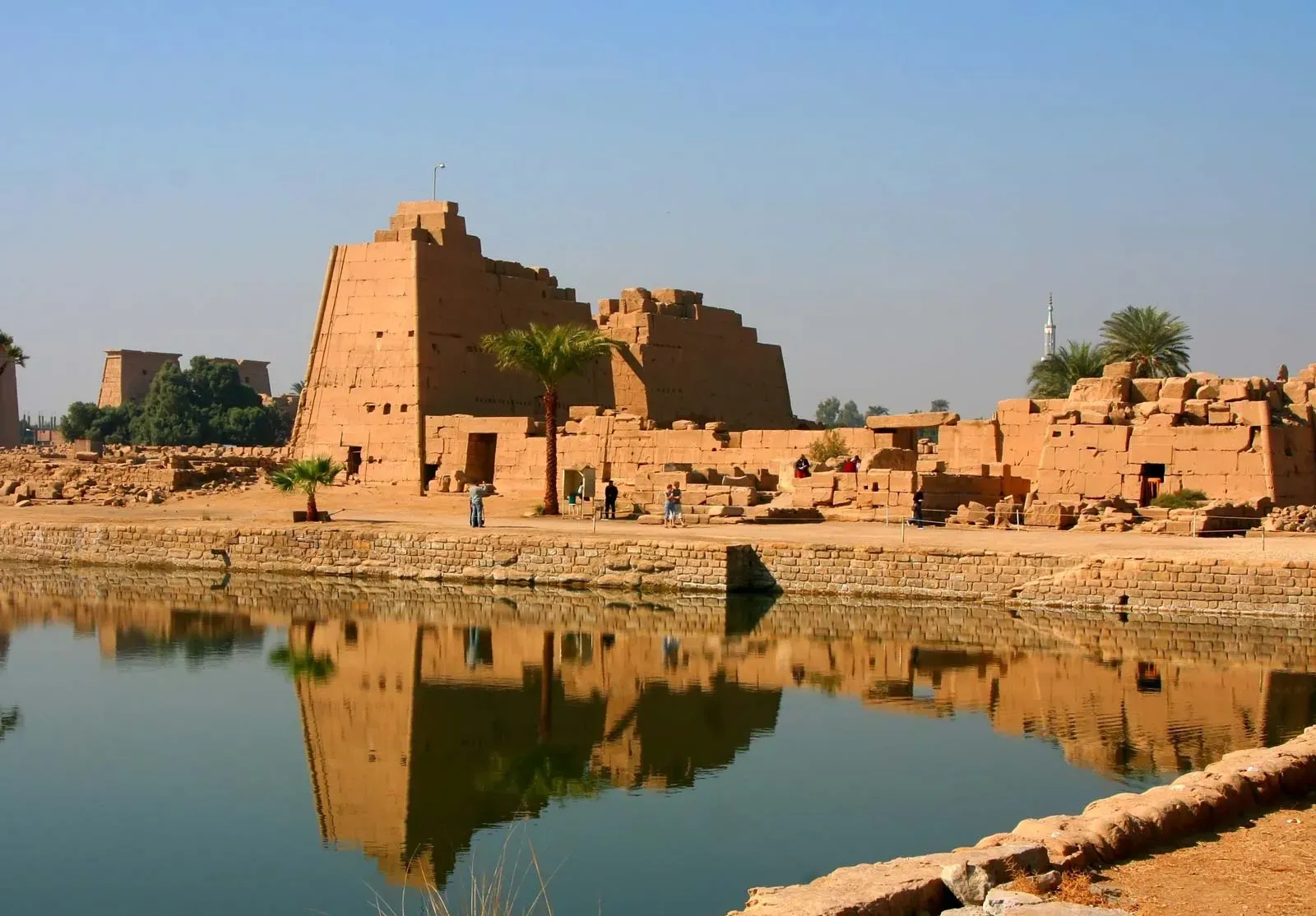
Karnak, dating from around 2000 BC and built over about 2,000 years, is the largest ancient religious complex in the world, and its size is difficult to grasp from photographs alone. The site covers a vast area on the east bank of the Nile at Luxor, and it contains not one temple but a whole religious city: the great precinct of Amun, smaller precincts for Mut and Montu, temples, chapels, obelisks, pylons, courts, and a sacred lake. Early building began in the Middle Kingdom, but the greatest expansion came in the New Kingdom, when successive kings added pylons, courts, and colonnades, each trying to outdo the last while also honouring the gods. The central columns are taller than the side columns, allowing light to enter through clerestory openings, and the original painted decoration, though much faded, once made the hall glow with colour. Walking between the columns, visitors notice how scale shifts: the hall was designed to impress, but it was also designed for processions, with wide central aisles for carrying sacred boats and statues. Outside the hall, the sacred lake, the obelisks of Hatshepsut and Thutmose III, the Festival Hall of Thutmose III, and the open-air museum of reused blocks all add layers to the visit. Karnak rewards slow looking, because a single wall may contain a royal campaign, a religious ritual, and a later reuse all at once. Visitors planning a wider trip will find Karnak naturally paired with the other best cities to visit in Egypt, because Luxor itself is best understood as a city built around its temples rather than a city that happens to contain them. Arrive early for cooler light and quieter halls, and allow at least half a day if the visit is to be more than a quick walk through the Hypostyle Hall.
A practical way to enjoy Karnak is to follow its main axis from the first pylon inward, noticing how each new court narrows the space and raises the sense of enclosure. The first pylon, never fully finished, already shows the scale of New Kingdom ambition, with its massive towers and the long avenue that once linked Karnak to Luxor Temple. The second pylon leads into the Hypostyle Hall, and from there the visitor moves toward the sanctuary of Amun, where only priests once entered. Along the way, look for the details that make Karnak more than a collection of large stones: the varying height of columns, the carved scenes of offerings, the hieroglyphs that name kings and gods, and the small chapels tucked into corners. The Festival Hall of Thutmose III, with its unusual tent-pole columns, shows a different architectural idea from the Hypostyle Hall and reminds visitors that Karnak was not built in a single style. The obelisks, especially the surviving obelisk of Hatshepsut, show how a single stone could be used to record royal power and divine favour. Hatshepsut herself is a key figure at Karnak, because she ruled as pharaoh and left a strong building programme, even though later kings tried to erase parts of her record. That tension between building and erasing is visible across the site, and it makes Karnak a history book in stone. Check the official site before visiting for current tickets and hours, wear comfortable shoes for the large site, and bring water, because shade is limited in the open courts. A guided explanation of the main axis helps first-time visitors, but even without a guide, a slow walk, a pause in the Hypostyle Hall, and time beside the sacred lake will give a lasting sense of why Karnak remains the greatest temple complex in Egypt.
2. Luxor Temple
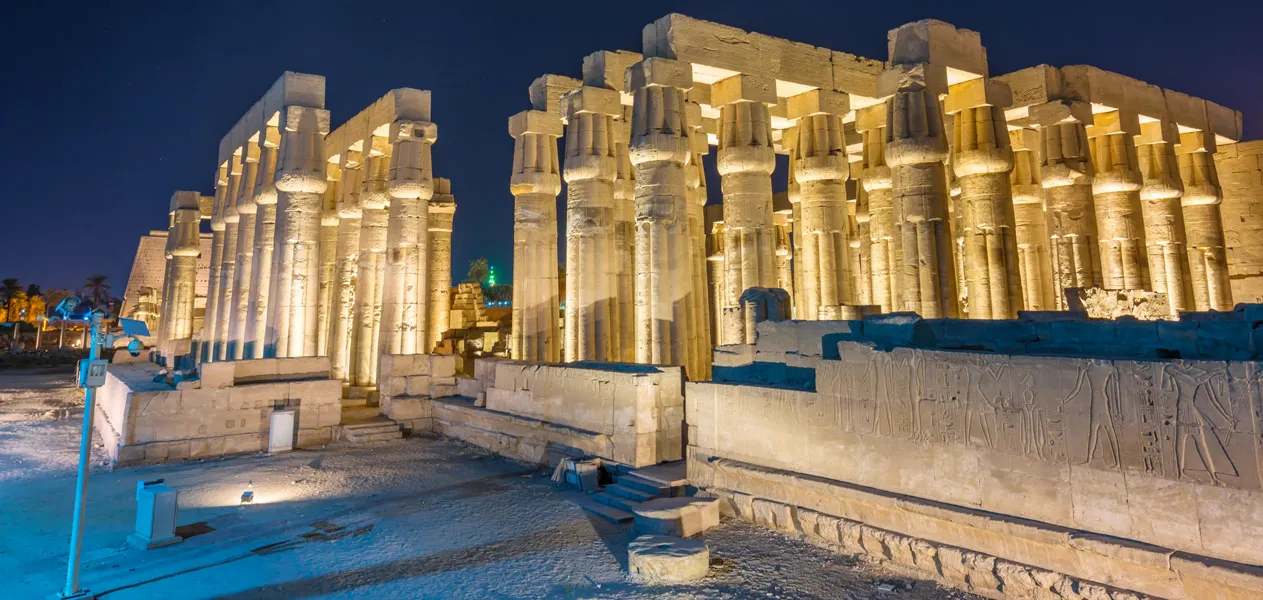
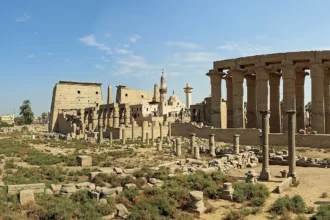
Luxor Temple, built around 1400 BC, stands on the Nile’s east bank in the heart of modern Luxor, and it feels more intimate and urban than Karnak, even though it was closely linked to its larger neighbour. It was built mainly under Amenhotep III and expanded by Ramesses II, and it was linked to Karnak by the Avenue of Sphinxes, a processional route lined with sphinx statues that has been substantially restored in recent years. That festival role explains the temple’s layout, which is less like a single god’s house and more like a stage for procession, celebration, and royal ritual. Beyond that court lies the colonnade of Amenhotep III, a long hall of tall columns that once formed an open processional way and later became an enclosed hall, and its walls still carry fine reliefs of the Opet Festival itself. Further inside, the solar court, the offering halls, and the sanctuary of Amun show how the temple narrowed toward its sacred heart, while a small Roman shrine and a mosque built within the temple complex show how the site continued to be used long after ancient Egyptian religion ended. The mosque of Abu al-Haggag, built on top of part of the temple, is a reminder that Luxor Temple has been a living religious site for centuries, not only an archaeological monument. Evening visits are especially rewarding, because the temple is lit and the stone takes on a warm colour, and the crowds are often smaller than in the heat of the day. Check the official site before visiting for current tickets and hours, and combine Luxor Temple with Karnak on the same day only if time and energy allow, because both sites deserve unhurried attention.
The Opet Festival is the key to understanding Luxor Temple, and it is worth pausing to imagine the scene before judging the building by its surviving stones alone. During the festival, the sacred boats carrying the statues of the Theban Triad were brought by river and by land from Karnak, accompanied by priests, musicians, dancers, and crowds, and the journey itself was part of the ritual. At Luxor Temple, the statues were received, offerings were made, and the king’s divine nature was renewed in a ceremony that linked the ruler, the gods, and the annual Nile flood. The reliefs in the colonnade of Amenhotep III show boats, bearers, and offerings in detail, and they help visitors see the temple as a place of movement and sound rather than silent stone. Ramesses II’s additions, including his court and pylon, show a later king stamping his own authority onto an older ceremonial centre, with battle scenes and royal statues that proclaim his power. Yet the core of the temple remains Amenhotep III’s elegant design, with its tall, graceful columns and refined reliefs. The later Roman and Islamic layers should not be treated as intrusions, because they show how a sacred place can adapt while keeping its central importance to the town around it. For visitors interested in how Luxor works as a modern city as well as an ancient site, Luxor Temple is the easiest temple to visit on foot, since it sits beside the Nile promenade and the town centre. Take time to look at the colonnade reliefs in good light, notice the difference between Amenhotep III’s refined style and Ramesses II’s bolder decoration, and finish the visit in the evening if possible, when the lit columns and the nearby river create one of the most memorable views in Egypt.
3. Abu Simbel Temples
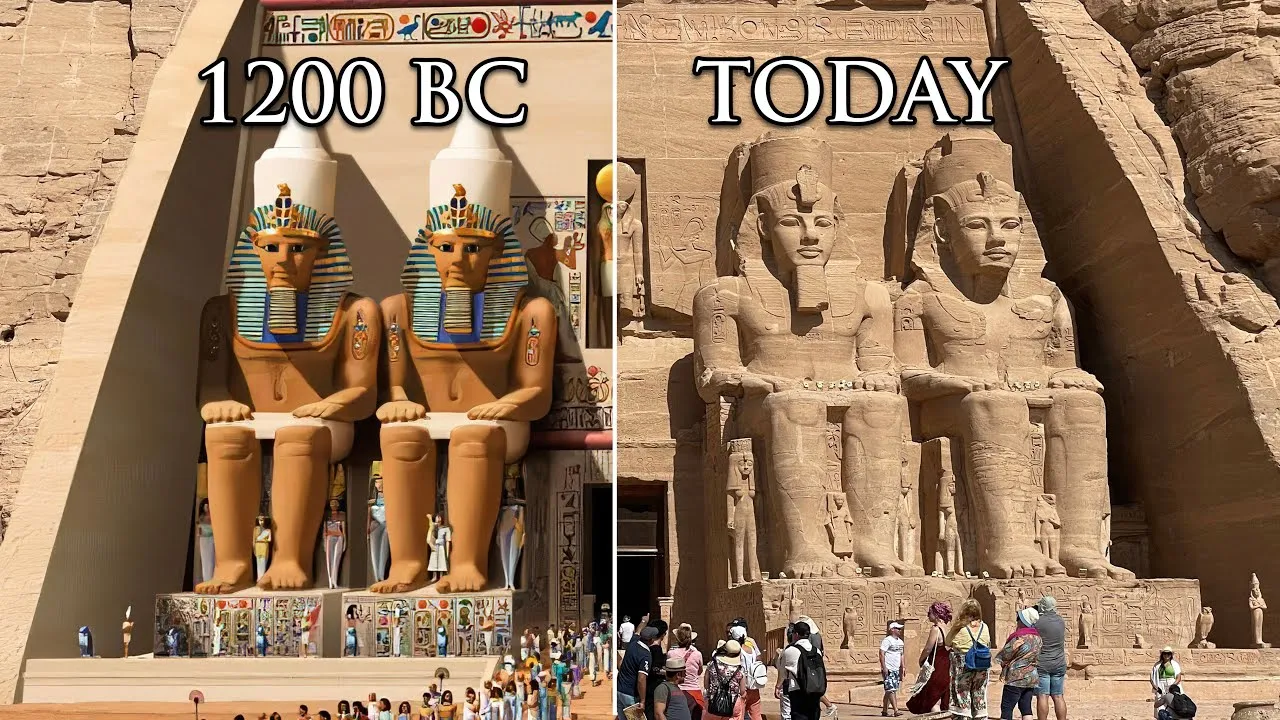
Abu Simbel, built by Ramesses II around 1264 BC, holds two rock-cut temples on the western shore of Lake Nasser in Nubia, far south of Aswan, and their remote setting is part of their power. The Great Temple was dedicated to Ramesses himself and to the gods Amun, Ra-Horakhty, and Ptah, while the smaller temple was dedicated to his wife Nefertari and to the goddess Hathor, a rare honour that shows Nefertari’s exceptional status. Four colossal seated statues, each about 20 metres tall, guard the Great Temple entrance, and their calm, monumental faces were meant to impress anyone arriving from Nubia and to proclaim Egyptian power at the southern frontier. Inside the Great Temple, a sequence of halls leads to the sanctuary, where four seated statues sit in darkness, and twice a year sunlight was designed to reach the inner statues, a phenomenon that still draws visitors, although the modern relocation slightly changed the exact timing. The smaller temple is more intimate, with six standing colossi at its facade, four of Ramesses and two of Nefertari, all of similar height, which was an unusual statement of equality for a queen. Inside, scenes show Nefertari making offerings to Hathor and other gods, and the decoration has a grace and warmth that contrasts with the martial tone of the Great Temple. Together, the two temples show both the public and the personal sides of Ramesses II’s reign: the king as conqueror and god, and the king as husband honouring a beloved queen. Their location, carved directly into a sandstone cliff above the Nile, made them dramatic in antiquity and makes them dramatic today, especially at sunrise when the statues are lit from the east. Check the official site before visiting for current tickets and hours, and allow time to see both temples without rushing, because the smaller temple is too often treated as an afterthought.
The modern story of Abu Simbel is as famous as its ancient story, and it explains why the temples stand where they do today. In the 1960s, the building of the Aswan High Dam created Lake Nasser, which threatened to submerge the temples completely. In response, an international campaign led by UNESCO cut both temples into large blocks, moved them piece by piece to higher ground about 65 metres above their original site and about 200 metres back from the river, and reassembled them under an artificial hill that mimics the original cliff. The operation, completed in 1968, saved not only Abu Simbel but also other Nubian monuments, and it became a founding moment for modern heritage conservation. That fact does not diminish the visit; it adds a layer of meaning, because Abu Simbel now represents two great engineering achievements separated by more than three thousand years. The relocation also saved the temples’ alignment with the sun, although the move and the artificial hill mean the solar phenomenon now occurs about a day later than in antiquity. For a fuller sense of Nubian heritage, visitors can also explore the story of the Nubian people whose villages were flooded by the lake, and the museums and monuments that preserve their culture. Abu Simbel is often visited as a day trip from Aswan, and the early start is worthwhile for the sunrise light and for quieter viewing before larger groups arrive. The smaller temple deserves equal time, especially for its scenes of Nefertari, which are among the most human and tender images in Egyptian art. Leaving Abu Simbel, with Lake Nasser stretching behind the temples, visitors often understand for the first time why the rescue was considered worth such effort, and why Abu Simbel remains one of the most moving sites in Egypt.
4. Mortuary Temple of Hatshepsut, Deir el-Bahari
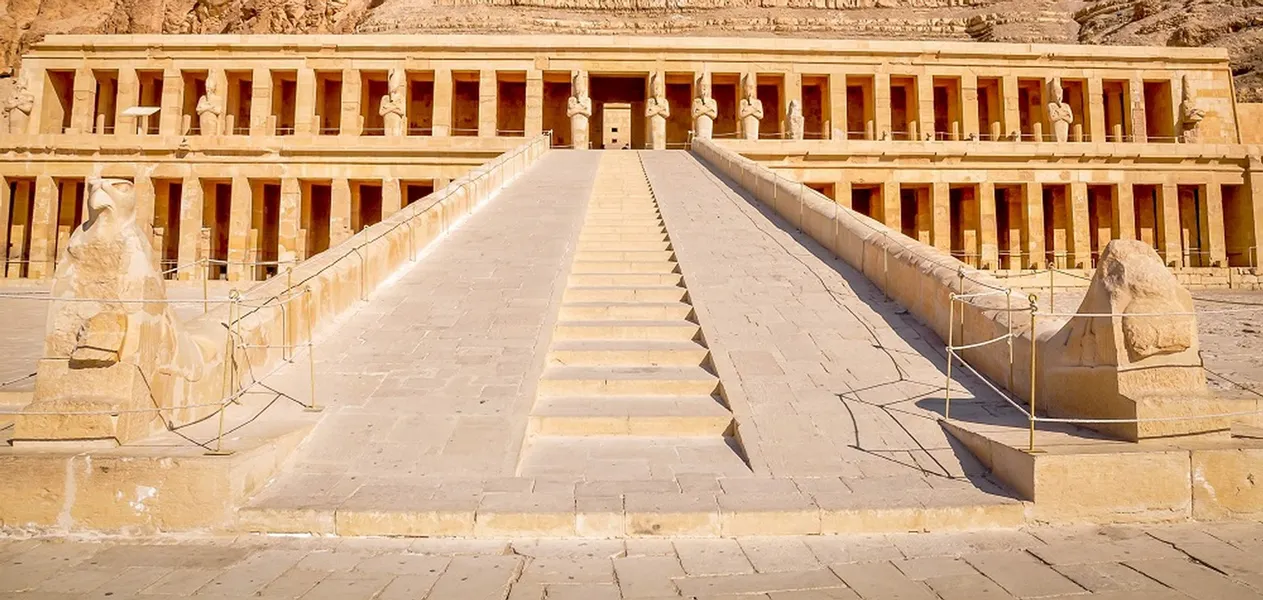
Hatshepsut’s terraced temple, set against sheer cliffs on Luxor’s West Bank at Deir el-Bahari, is one of the most striking New Kingdom buildings, and its power comes from the contrast between human architecture and natural rock. Three wide terraces rise in steps toward the cliff, connected by long ramps and fronted by colonnades, so that the temple seems to grow out of the bay itself rather than sit in front of it. The temple’s decoration recorded her divine birth, her expedition to the Land of Punt, which brought back gold, ivory, exotic animals, and myrrh trees, and her building works at Karnak, all presented as proof of her legitimacy as a female king. The colonnades, with their square pillars and carved scenes, create a rhythm of light and shadow that changes through the day, and the now-missing trees and gardens that once lined the terraces would have made the approach feel like a cultivated paradise against the desert cliff. Later, Thutmose III and later kings damaged parts of Hatshepsut’s images and inscriptions, in an attempt to erase her memory, and those damaged areas are still visible today, telling a story of political revenge as well as religious devotion. The temple later served as a monastery in Christian times, which gave Deir el-Bahari its modern Arabic name, meaning the northern monastery, and that later use also helped preserve parts of the building. Visitors reach the temple by a long approach from the West Bank road, and the first view, with the terraces framed by cliffs, is one of the great moments of a Luxor visit. Check the official site before visiting for current tickets and hours, and visit in the morning if possible, when the light on the cliff and colonnades is clearest.
Inside the temple, the most rewarding details are often the smaller chapels and reliefs rather than the grand terraces alone. The Hathor chapel, on the southern side, contains columns with Hathor-headed capitals and scenes showing the goddess as a cow, nursing and protecting the king, and it retains more colour than many other parts of the temple. The Punt reliefs, on the middle terrace, show ships, foreign peoples, houses on stilts, and exotic goods in a level of ethnographic detail that is rare in Egyptian art, and they show Hatshepsut’s reign as a time of trade and diplomacy as well as building. The Anubis chapel, on the northern side, is smaller and darker, with scenes of offerings and funerary ritual that suit its god of embalming and the dead. That festival connection links Hatshepsut’s temple directly to Karnak and Luxor Temple on the east bank, and it helps visitors understand Thebes as a single religious landscape divided by the river rather than as separate sites. The temple’s architecture also deserves attention in its own right: the use of terraces to mediate between the flat desert floor and the vertical cliff, the repetition of columns to create rhythm, and the careful alignment with the cliff and the sun. Modern restoration has rebuilt fallen colonnades and stabilised the structure, and some areas are closed or under work at different times, so visitors should follow on-site guidance. The West Bank as a whole, including the Valley of the Kings, the Valley of the Queens, and the Colossi of Memnon, is best visited with Hatshepsut’s temple as a central stop, because it bridges royal tombs, mortuary cult, and festival religion. Hatshepsut’s temple is not only a beautiful building; it is a statement by a remarkable ruler, a record of trade and religion, and a survivor of both ancient erasure and modern restoration.
5. Temple of Philae, Aswan
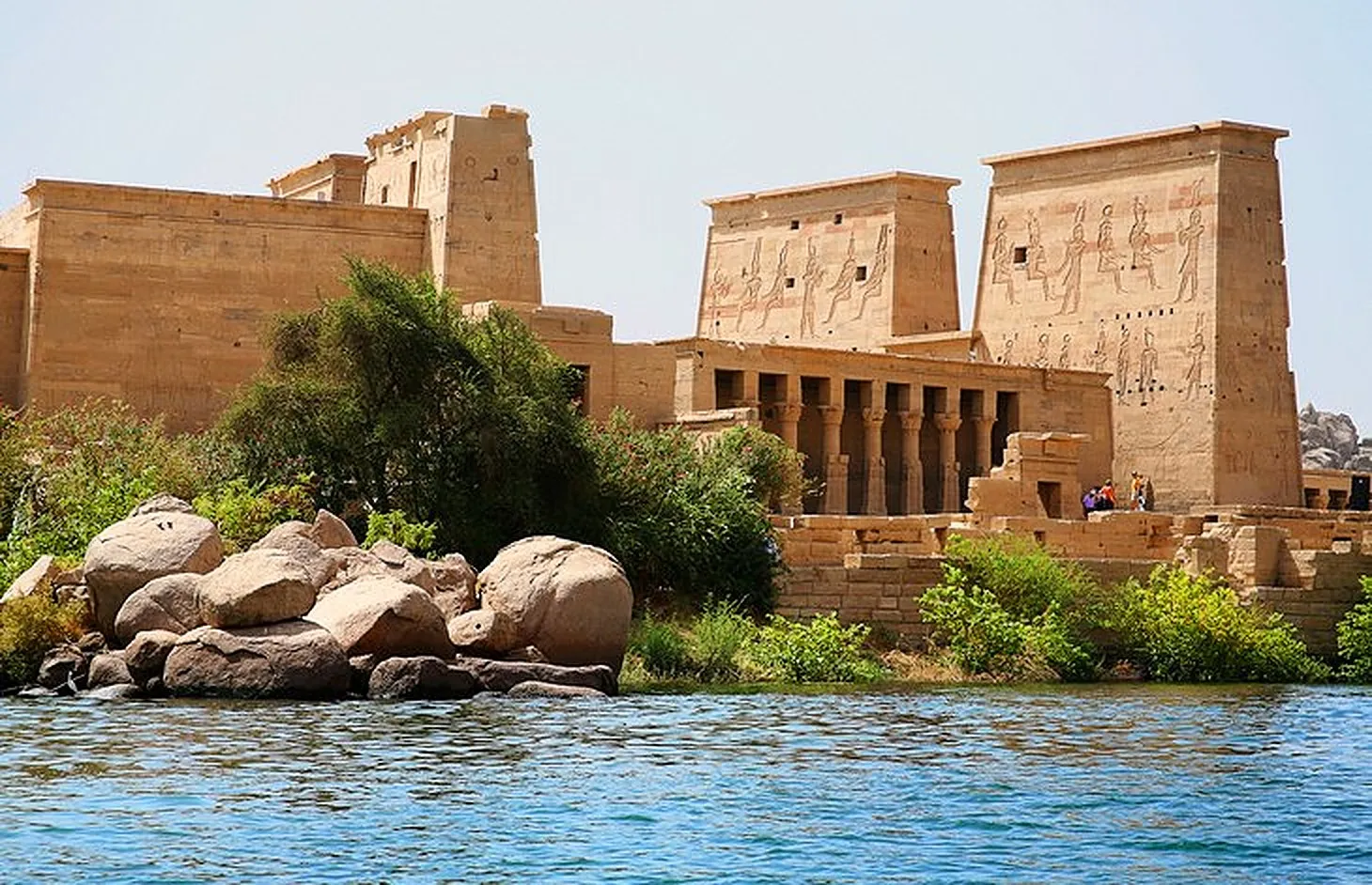
Philae, dedicated to Isis, was originally on Philae Island near the First Cataract of the Nile at Aswan, and it was relocated stone by stone in the 1970s to nearby Agilkia Island to save it from Nile flooding after the building of the Aswan dams. It is reached by boat, which makes the approach part of the visit, as the temple rises from the water and the visitor arrives by the same element that shaped its mythology. The temple complex was built mainly in the Ptolemaic and Roman periods, although earlier shrines existed on the island, and its architecture shows the mature Graeco-Roman style: a great pylon with reliefs of Ptolemaic kings smiting enemies, a birth house or mammisi, a hypostyle hall, and a sanctuary for Isis. Inside, the halls and chapels show scenes of Isis, Osiris, Horus, and Hathor, and the temple also contains some of the last hieroglyphic inscriptions ever carved, including a famous inscription dated to AD 394, which marks the end of a writing tradition that had lasted for more than three thousand years. The island also contains smaller temples and structures, including the Temple of Hathor, the Kiosk of Trajan, a graceful open pavilion with plant-form columns that has become an emblem of Philae, and a small temple for the Nubian god Mandulis. The setting, with granite rocks, palm trees, and calm water, gives Philae a gentler, more romantic character than the great stone halls of Luxor, and many visitors rank it among the most beautiful temple sites in Egypt. Check the official site before visiting for current tickets and hours, and allow time for the boat journey and for walking the whole island, not only the main temple.
The mythology of Isis and Osiris is essential to understanding Philae, and it helps explain why the temple remained active long after many older temples had fallen silent. According to the myth, Osiris was murdered by his brother Seth, his body was scattered, and Isis searched for the pieces, reassembled them, and restored Osiris to life as ruler of the underworld, while their son Horus later avenged his father. Philae was believed to be one of the burial places of Osiris, and the island was considered so sacred that, in some periods, only priests were allowed to live there and birds were said not to fly over it. Pilgrims came to Philae seeking healing, protection, and help in childbirth, and the temple’s festivals, especially those celebrating Isis and Osiris, drew large crowds. That work saved the temple from permanent submersion under Lake Nasser, but it also means that the island visitors see today is a carefully created landscape rather than the original Philae Island, which now lies underwater. The evening sound and light show at Philae, when it operates, tells the Isis and Osiris story against the lit temple, and it can be a memorable introduction for visitors who have already seen the temple by day. Practical tips help the visit: boats depart from a jetty south of Aswan, and the fare and timing should be confirmed locally, because arrangements can change; comfortable shoes are needed for the island paths, and shade is limited in the open courtyards. Philae also pairs well with a visit to Aswan itself, including the Nubian Museum, the unfinished obelisk, and the granite quarries, which together explain how temples were built and how the First Cataract shaped Egypt’s southern frontier. Its beauty, its mythology, and its rescue story together make Philae an essential stop, not merely a pretty island.
6. Temple of Edfu
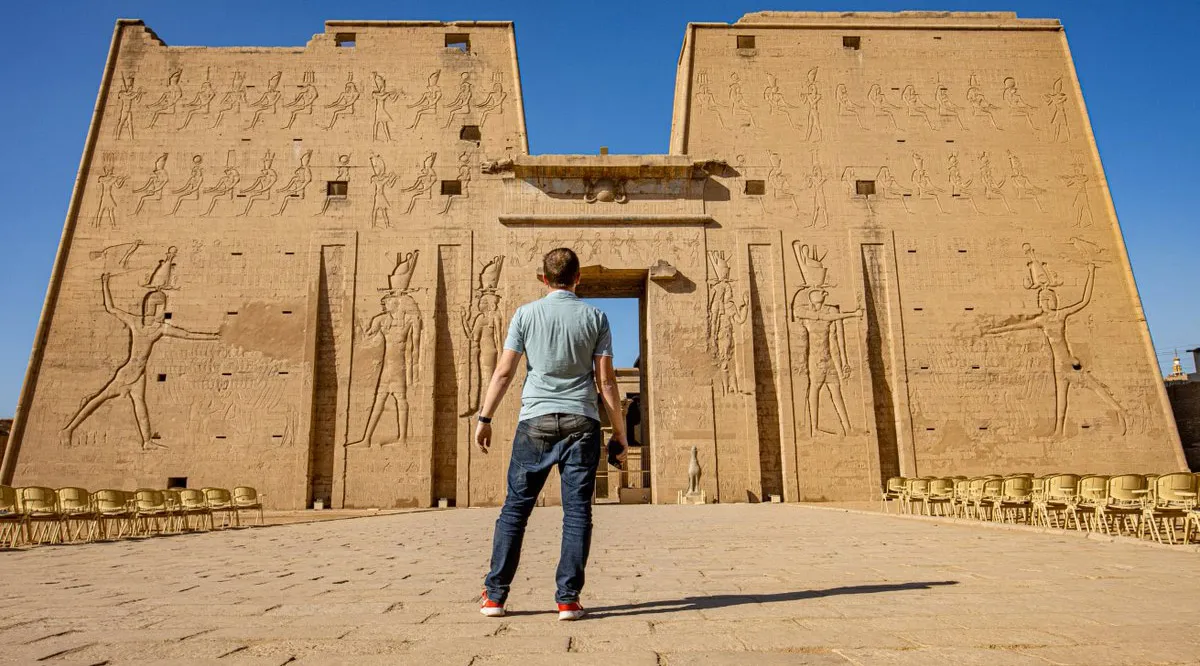
Edfu, dedicated to Horus, is considered the best-preserved ancient Egyptian temple, and that preservation is its greatest gift to visitors. Built in the Ptolemaic period between 237 BC and 57 BC, on the site of an earlier New Kingdom temple, Edfu survives with its roof, its pylon, its courts, its hypostyle halls, and its sanctuary largely intact, so that a visitor can walk the full temple axis from entrance to sanctuary in the way ancient priests once did. The visitor enters through a massive pylon, about 36 metres high, decorated with reliefs of the king smiting enemies before the gods, and then passes into an open peristyle court, where columns and offering scenes frame the sky. Side rooms around the sanctuary held offerings, sacred objects, and temple equipment, and their inscriptions include detailed lists of festivals, offerings, and temple regulations that scholars use to reconstruct daily temple life. The temple was dedicated to Horus the Behdetite, the falcon god who was also a protector of kingship, and its walls tell the myth of Horus defeating Seth, with dramatic scenes of harpooning and battle that were re-enacted in temple festivals. Edfu is usually visited from a Nile cruise between Luxor and Aswan, or by road from Luxor, and it is often paired with Kom Ombo on the same day, which makes for a rewarding comparison between a single-god temple and a double temple. Check the official site before visiting for current tickets and hours, and allow enough time to walk slowly from pylon to sanctuary, because rushing through Edfu misses the very completeness that makes it special. The town of Edfu around the temple is busy and lively, and the short journey from the river or road to the temple entrance is part of the local experience.
What makes Edfu especially valuable is not only its preservation but the quality and quantity of its inscriptions, which cover walls, columns, and ceilings with ritual texts, mythological scenes, and practical records. The Festival of the Beautiful Reunion, when the statue of Hathor from Dendera travelled to Edfu to visit Horus, is recorded in detail on the temple walls, and it shows how temples were linked by river journeys and festivals, not isolated monuments. The building texts at Edfu also describe the construction process, the consecration of the temple, and the roles of priests, which together give a rare, almost documentary view of Ptolemaic temple life. Architecturally, Edfu shows the mature Ptolemaic style at its best: massive but refined, with columns that combine Egyptian plant forms with Hellenistic influences, and with a roof that creates a dramatic shift from the bright open court to the dark, intimate sanctuary. The side chapels around the sanctuary include the chapel of the New Year, the chapel of the throne, and rooms for offerings, and their reliefs show the care with which every aspect of temple life was ritualised. For visitors who have already seen Karnak and Luxor Temple, Edfu offers a corrective: where Karnak shows two thousand years of addition and change, Edfu shows a single, coherent design carried through to completion. For visitors who have not yet seen other temples, Edfu is an ideal introduction, because its layout can be read without needing to imagine missing roofs or walls. The temple’s location, between Luxor and Aswan, also makes it a natural stop on a Nile journey, and its pairing with Kom Ombo, further south, allows a direct comparison of how Egyptian architects handled a single dedication versus a double dedication. Edfu does not need dramatic scenery to impress; its power lies in completeness, coherence, and the rare chance to walk a temple as it was meant to be walked.
7. Temple of Kom Ombo
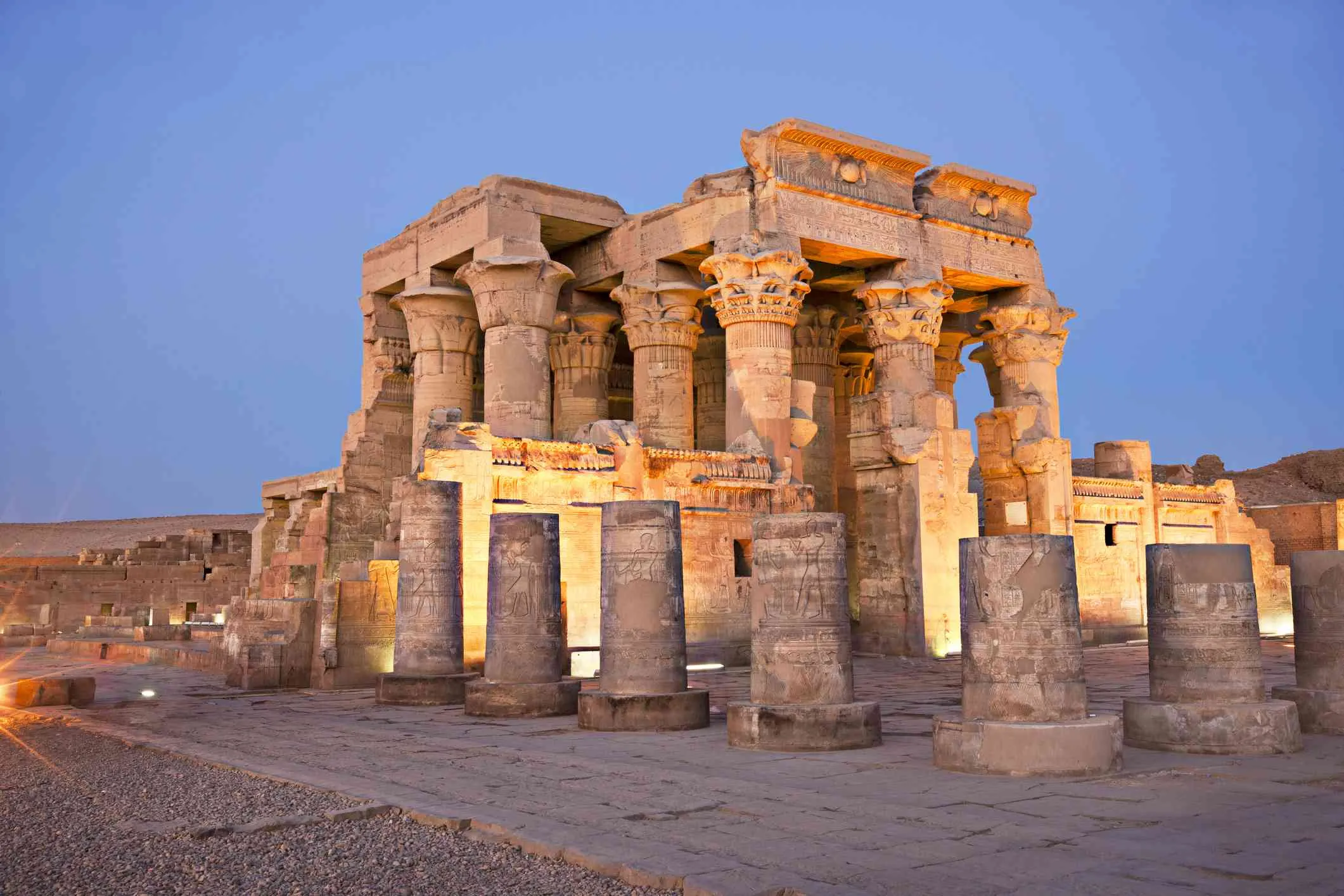
Kom Ombo, on the Nile bank between Edfu and Aswan, is unique as a double temple, dedicated at once to Sobek, the crocodile god, and Horus the Elder, the falcon god, and its symmetrical design makes that dual dedication visible in stone. The temple was built mainly in the Ptolemaic period, with Roman additions, and it follows a single axis but doubles almost every element: two entrances, two hypostyle halls, two sanctuaries, and two sets of offering rooms, one for each god. That symmetry is not merely decorative; it expresses a theological idea that two different divine powers could share one sacred space without merging into one god. Sobek, associated with the Nile, fertility, and the power of crocodiles, was especially important in this region, where crocodiles were both feared and revered, and where the Nile’s strength was a daily reality. By housing both gods together, Kom Ombo acknowledged the complexity of local religion, where a community might need protection from the river and from human enemies at the same time. The temple’s position, on a high bank overlooking a bend in the Nile, is itself part of the experience, because the river that Sobek embodied is visible from the temple courts. The pylon, courts, and halls are less complete than at Edfu, because parts of the temple were damaged by the Nile, by earthquakes, and by later stone reuse, but the double plan remains clear to anyone who walks the site with a little guidance. A small crocodile museum nearby adds context, displaying mummified crocodiles found in the area and explaining the cult of Sobek in a way that the temple ruins alone cannot. Check the official site before visiting for current tickets and hours, and allow time to walk both sides of the temple, because seeing only one half misses the point of the design.
Looking closely at Kom Ombo rewards visitors who enjoy detail and curiosity, because the temple contains some of the most interesting small-scale reliefs in Egypt. The most famous are the medical instruments carved on a wall in the southern part of the temple, showing surgical tools, birthing chairs, and other instruments that have led scholars to discuss the temple’s connection with healing and medicine. Whether those reliefs prove that Kom Ombo was a healing centre in the modern sense is debated, but they certainly show that Egyptian temple art could record practical knowledge as well as mythology and royal propaganda. Other reliefs show calendars, offerings, and scenes of the two gods receiving worship, and the careful pairing of scenes on the two sides of the temple shows how artists maintained symmetry while varying details for each god. In ancient times, live crocodiles were kept in temple pools and adorned with jewellery, and after death they were mummified and buried with honours, a practice that seems strange today but made sense within a religion that saw divine power in the natural world. The temple’s riverside setting also explains its history of damage, because the Nile has eroded the bank over centuries, and parts of the original structure have fallen into the river. That erosion is a reminder that temples were built in a living landscape, not in a museum, and that conservation must work with the river rather than against it. For visitors travelling by cruise, Kom Ombo is often a shorter stop than Edfu or Philae, but it should not be rushed, because its double plan, its medical reliefs, and its museum together offer a different kind of temple experience. Walk the full axis, compare the two sanctuaries, look for the medical instruments, visit the crocodile museum, and finish with a view over the Nile from the temple terrace, where the reason for Sobek’s presence becomes immediately clear.
8. Temple of Dendera
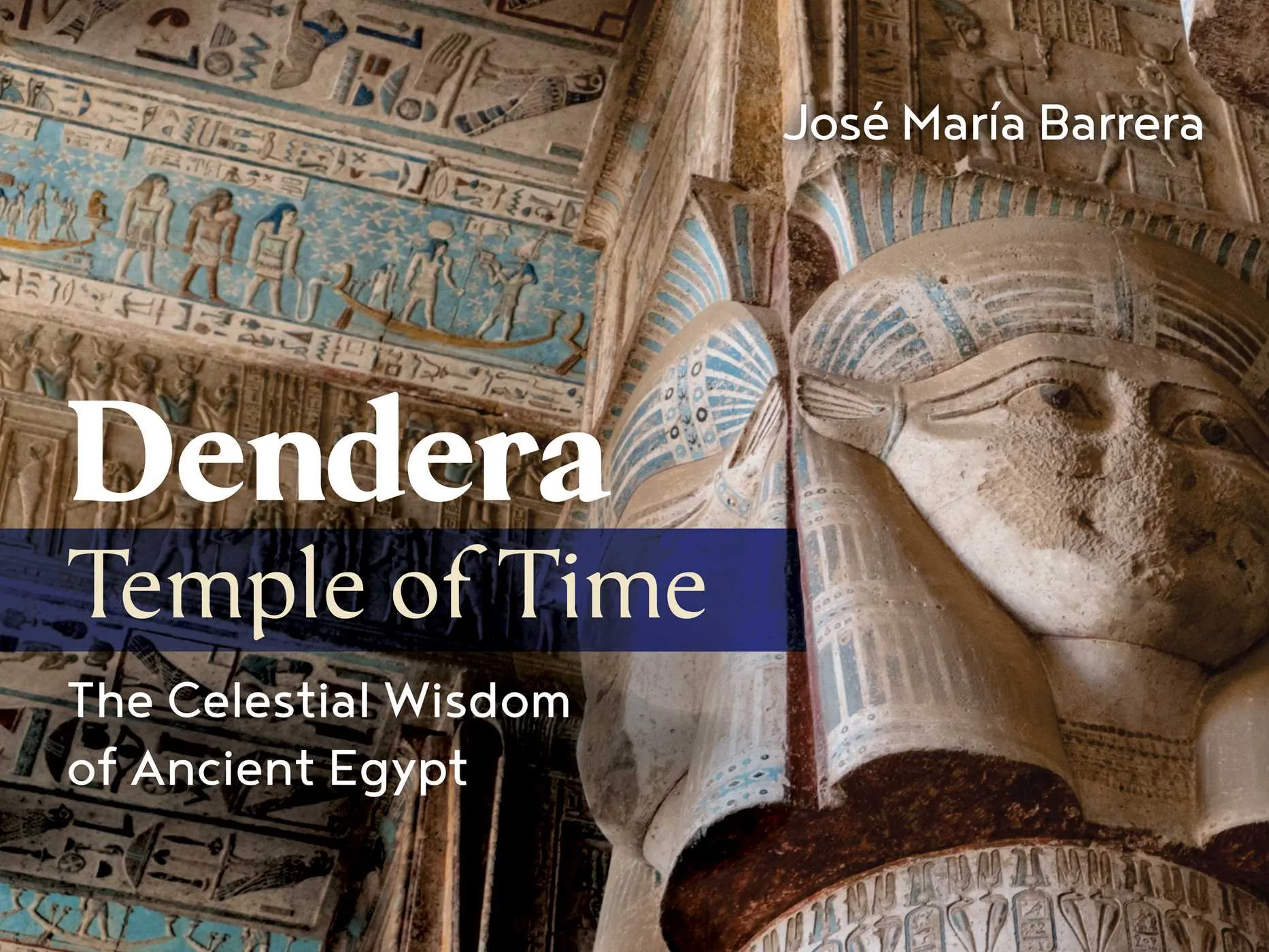
Dendera, dedicated to Hathor, is known for its well-preserved ceilings, columns, and astronomical imagery, and it is a good day trip from Luxor for visitors who want a temple that is less crowded than Karnak but still rich in decoration. Hathor was a goddess of love, music, dance, joy, and motherhood, often shown as a cow or as a woman with cow ears, and her temple at Dendera was one of her most important cult centres. The great hypostyle hall, with its twenty-four columns topped by Hathor-headed capitals, is the heart of the temple, and its ceiling shows astronomical scenes, including the famous zodiac, although the original zodiac ceiling is now in the Louvre in Paris and a replica stands in its place. Beyond the hall, offering rooms and the sanctuary of Hathor continue the temple axis, with chapels for other gods and for the New Year festival, when the statue of Hathor was carried to the roof to be united with the sun. The roof itself, accessible in some visits, contains chapels and reliefs related to the resurrection of Osiris, and it offers a different perspective on the temple’s ritual life. The temple complex also includes a birth house, a sacred lake, a sanatorium where pilgrims sought healing dreams, and a small temple for Isis, which together show that Dendera was a complete religious centre, not only a single temple building. The site’s relative quiet, compared with Karnak and Luxor Temple, makes it ideal for visitors who want to look closely at reliefs without crowds. Check the official site before visiting for current tickets and hours, and combine Dendera with Abydos on a day trip from Luxor if time allows, because the two sites together show different sides of Egyptian temple art.
The astronomical ceilings at Dendera are among the most discussed features of any Egyptian temple, and they deserve careful, unhurried looking. The ceilings show the sky as a goddess, Nut, arched over the world, with stars, constellations, and the zodiac arranged in a circular pattern that blends Egyptian astronomy with Hellenistic influences. The replica zodiac in the hypostyle hall allows visitors to see the composition in its original position, while the original, removed in the nineteenth century, remains a subject of debate about heritage and restitution. The Hathor columns are equally important, because Hathor’s face, with its cow ears and gentle smile, appears on every capital, creating a sense of divine presence that is warmer and more approachable than the stern royal imagery at many other temples. The temple’s reliefs also show the Festival of the Beautiful Reunion, when Hathor travelled by river from Dendera to Edfu to visit Horus, a journey that linked the two temples and their gods in an annual celebration. The sanatorium, with its small rooms and healing inscriptions, shows another side of temple life, where pilgrims slept in the temple hoping for healing dreams sent by the gods. That combination of astronomy, music, healing, and joy makes Dendera feel different from temples dedicated to warlike kings or to the mysteries of the underworld. Visitors should look up often at Dendera, because the ceilings are the main attraction, and they should also look at the outer walls, where Roman emperors are shown as pharaohs making offerings in Egyptian style. Dendera is less famous than Karnak or Abu Simbel, but for visitors who love art, astronomy, and atmosphere, it is often remembered as a favourite, precisely because it can be enjoyed slowly and without the pressure of large crowds.
9. Temple of Abydos
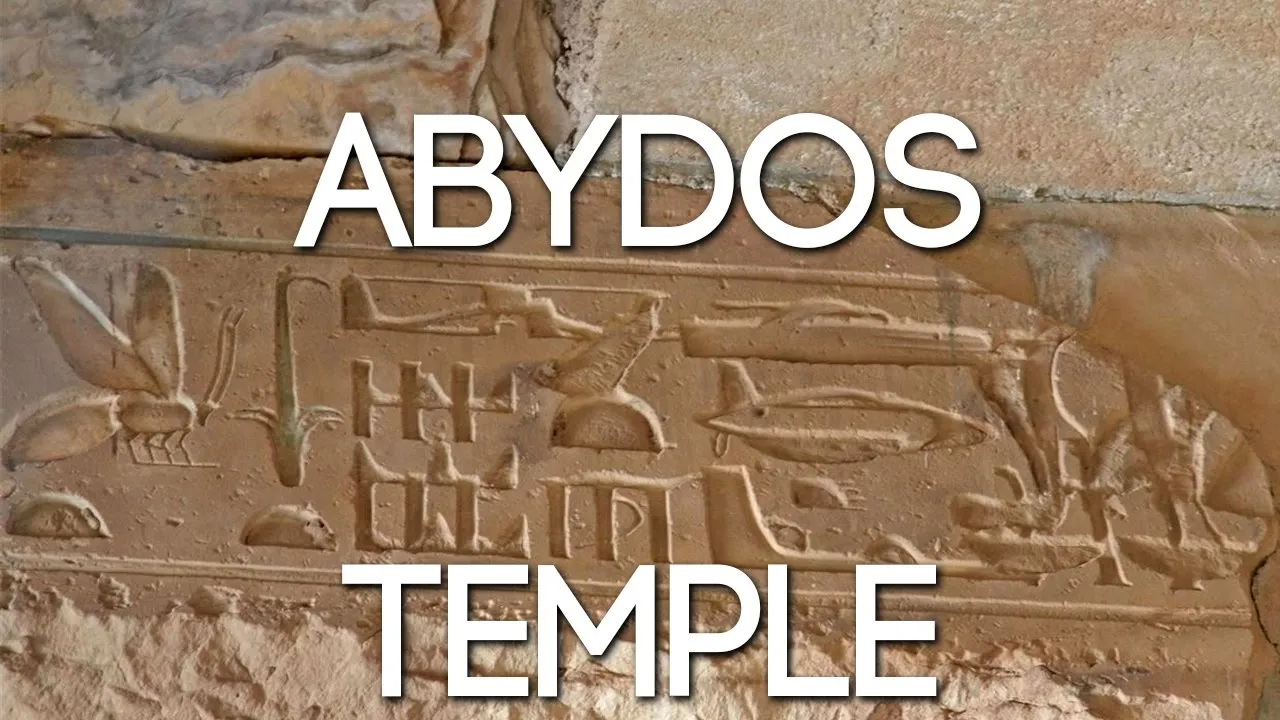
Abydos, dedicated to Osiris, is famous for the finely carved reliefs in the Temple of Seti I, and its art is often cited as among the finest in Egypt, with crisp, coloured scenes that survive better than in many larger temples. Abydos was one of the most sacred places in ancient Egypt, because it was believed to be the burial place of Osiris, god of the underworld and resurrection, and pilgrims came there for thousands of years to be buried near Osiris or to leave offerings in his honour. Those sanctuaries were dedicated to Seti I himself, Ptah, Re-Horakhty, Amun, Osiris, Isis, and Horus, in that order, and the arrangement shows how a royal mortuary temple could also serve as a temple for the great gods. Scenes show Seti I making offerings, performing rituals, and being embraced by gods, with a delicacy of line and a sense of movement that contrasts with the bolder, more monumental style of Ramesses II’s additions. The temple also contains the famous Abydos King List, a carved list of seventy-six kings from Menes to Seti I, which omits some rulers considered illegitimate and which remains an important source for Egyptian chronology, even though it is selective rather than complete. Behind the temple lies the Osireion, a mysterious underground structure built in a style that looks older than the temple itself, with massive granite pillars and a central island surrounded by water channels, which was associated with the tomb of Osiris and with primeval creation. Abydos suits visitors who care about reliefs and colour as much as scale, and it is best visited as a day trip from Luxor, often combined with Dendera, because the journey through the Nile valley countryside is itself part of the experience. Check the official site before visiting for current tickets and hours, and allow time to look closely at the inner reliefs, where the artistry is at its finest.
The religious importance of Abydos goes far beyond the beauty of its reliefs, and understanding that importance makes the temple’s quiet atmosphere feel appropriate. For ancient Egyptians, Abydos was a place of pilgrimage, burial, and rebirth, where the myth of Osiris was not an abstract story but a lived hope for life after death. The Osireion, with its water and island, may have been intended as a symbolic tomb of Osiris, and its massive, archaic-looking architecture creates a sense of primeval depth that contrasts with the refined reliefs of Seti’s temple. The town of Abydos itself, with its modern village and fields, gives a sense of how ancient sacred sites sit within living communities, and the journey from Luxor passes through agricultural land, canals, and small towns that show the Nile valley as a working landscape. For art lovers, the key rooms to seek out are the second hypostyle hall and the sanctuaries, where the reliefs are finest and the paint is best preserved, and where the difference between Seti I’s refined style and Ramesses II’s bolder, sometimes coarser style can be seen side by side. The King List, in a corridor on the north side, is worth finding, not only for its historical value but for the way it shows how ancient Egyptians themselves constructed their own history, choosing which kings to remember and which to forget. Photography in the inner rooms may be restricted or require special permission, so visitors should follow on-site rules and take time to look rather than only to photograph. Combining Abydos with Dendera makes a full day of temple art, with Dendera’s joyful Hathor and astronomical ceilings contrasting with Abydos’s solemn Osiris and refined reliefs, and together they show the range of Egyptian temple religion far better than either site alone.
10. Abu Ghurab and Saqqara Temple Sites
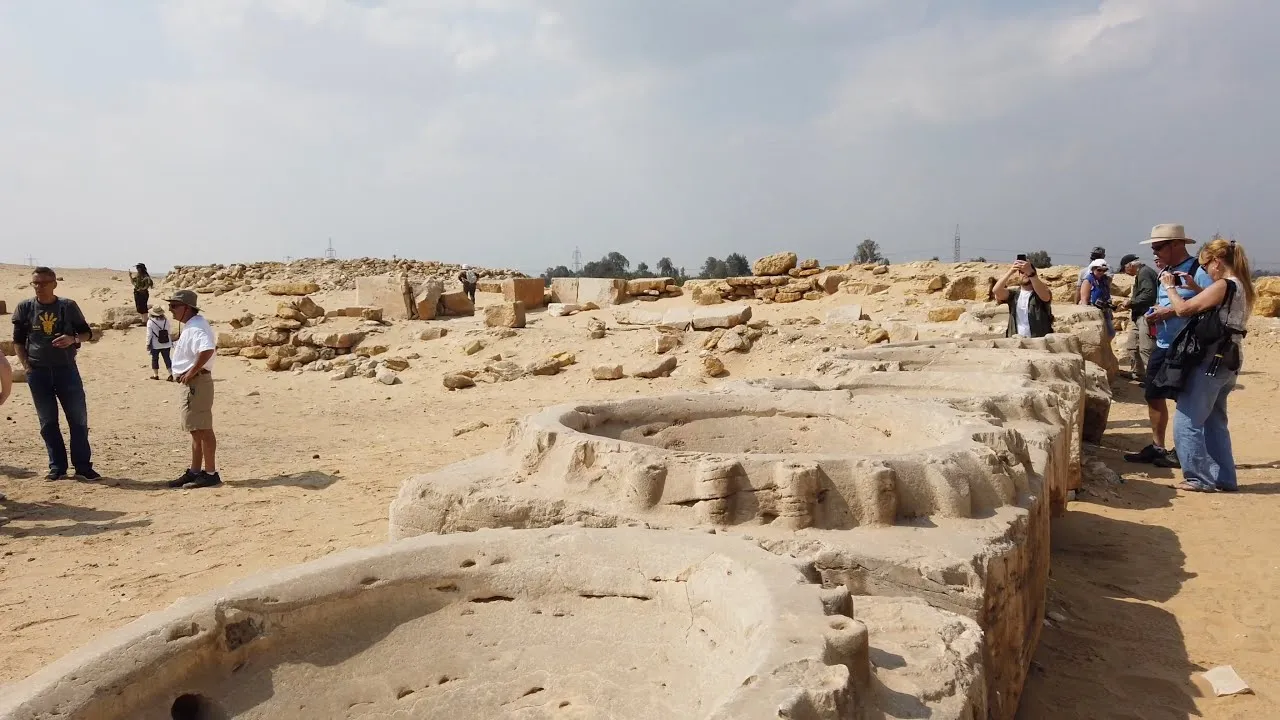
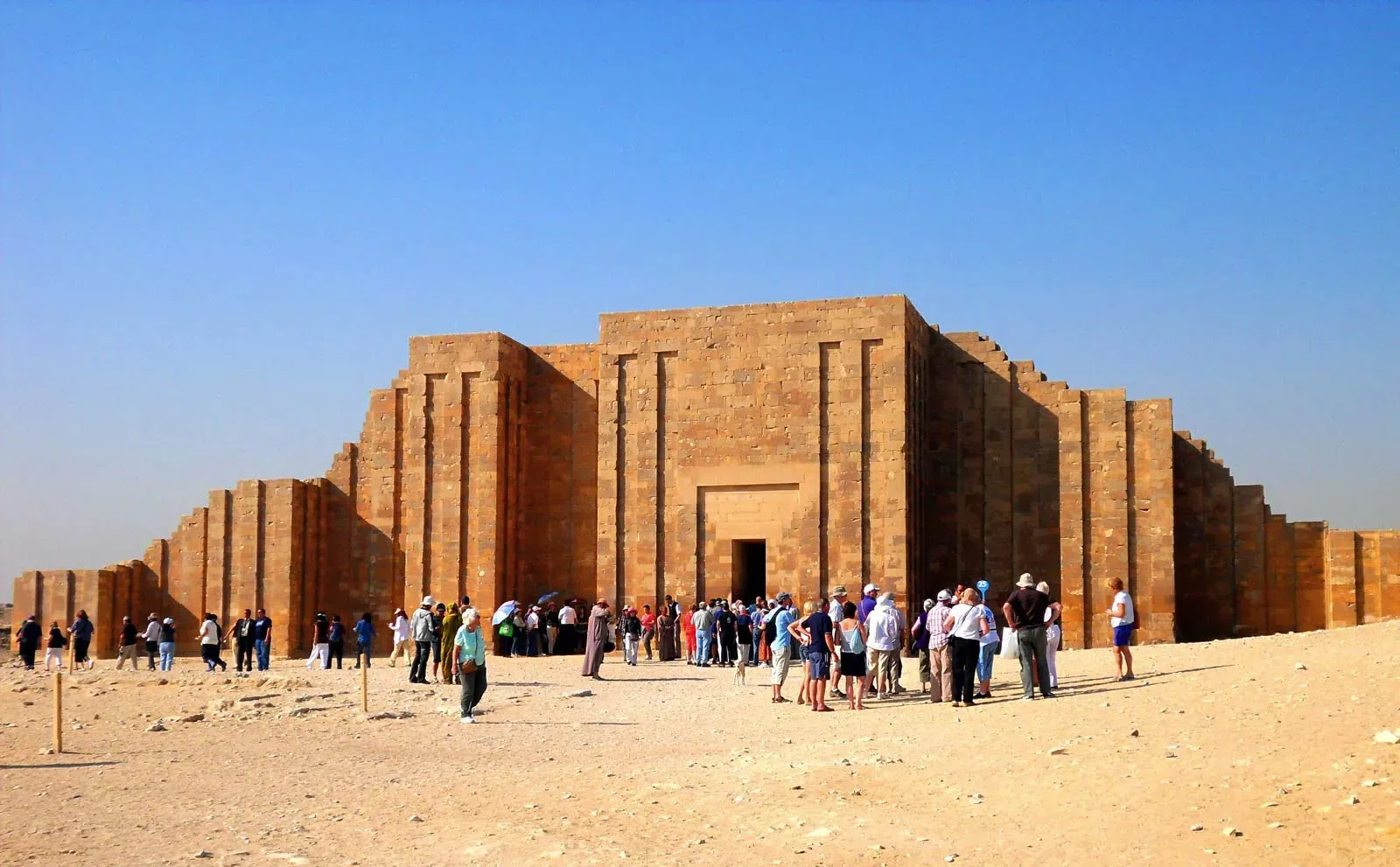
For the earliest temple architecture, look to Saqqara and Abu Ghurab, two sites that are less complete than Luxor’s temples but older in foundation and essential for the full timeline of Egyptian temple building. Saqqara’s funerary complex around Djoser’s Step Pyramid, from around 2670 BC, includes some of Egypt’s earliest stone temple buildings, and it marks a revolution in architecture: the move from mud brick and timber to stone on a monumental scale. Abu Ghurab, a short distance north of Saqqara, contains the remains of Fifth Dynasty sun temples, built for kings such as Userkaf and Niuserre in the twenty-fifth century BC, and dedicated to the sun god Re. Those temples were open-air structures centred on a large obelisk on a platform, with an altar in front of it, and with side rooms and causeways, showing a different idea of temple form: a temple open to the sun rather than enclosed in darkness. The sun temples at Abu Ghurab are now largely ruined, with only foundations, the obelisk base, and some reliefs surviving, but they are important because they show Fifth Dynasty experiments in temple form and in solar theology. Together, Saqqara and Abu Ghurab allow visitors to see the beginning of the story that ends at Karnak, Edfu, and Philae, and they make the later temples’ grandeur more meaningful by showing how it began. Visitors interested in this early period will also enjoy the nearby fascinating Egyptian pyramids guide, because Saqqara’s pyramids and temples cannot be separated from each other. Check the official site before visiting for current tickets and hours, and allow a full day for Saqqara if possible, because the site is large and contains tombs, pyramids, and temples from many periods.
Saqqara as a whole is one of the richest archaeological sites in Egypt, and its temple sites should be seen as part of a landscape that was used for burial and worship for more than three thousand years. Beyond Djoser’s complex, Saqqara contains the pyramids of Unas, Userkaf, Teti, and Pepi, the Serapeum with its massive sarcophagi for the Apis bulls, and hundreds of tombs for officials, nobles, and priests, many with fine reliefs and paintings. The later temples and tombs at Saqqara show how the site continued to be used long after Djoser’s time, with new building, reuse, and restoration in every period, including the Late Period animal necropolises and the Roman period. The sun temple of Niuserre, the best preserved at Abu Ghurab, still shows the platform for the obelisk, the altar, and the remains of side chambers, and its reliefs, now partly in museums, show the seasons, agriculture, and the king’s relationship with the gods. For visitors, the contrast between Saqqara’s enclosed, stone temple courts and Abu Ghurab’s open, sunlit platforms is instructive: Egyptian temple design was not fixed, but changed with theology, kingship, and the landscape. Practical planning matters at Saqqara, because the site is large, exposed, and best visited in the morning, with water, sun protection, and comfortable shoes. A guide or a good site plan helps, because the different pyramids, tombs, and temple courts are spread across a wide area, and it is easy to miss the early temple elements within Djoser’s complex if the visit focuses only on the pyramid itself. Saqqara and Abu Ghurab may not offer the intact roofs of Edfu or the colossal statues of Abu Simbel, but they offer something rarer: the beginning of Egyptian temple architecture, in stone that is nearly five thousand years old, and a sense of how a civilisation learned to build in stone for eternity.
Practical Plan: Luxor to Aswan
| Stage | Temples |
|---|---|
| Luxor, 2 days | Karnak and Luxor Temple on the East Bank; Hatshepsut and Valley of the Kings on the West Bank |
| Nile cruise, 1–2 days | Edfu and Kom Ombo between Luxor and Aswan |
| Aswan, 1–2 days | Philae Temple by boat, then Abu Simbel as a day trip |
Conclusion
If you want age, start at Saqqara and Karnak. If you want completeness, go to Edfu. Luxor Temple shows how festivals made temples public and joyful, Hatshepsut’s temple shows how a remarkable ruler used architecture to claim legitimacy, Philae shows how a goddess cult could outlast the pharaohs and attract pilgrims from across the ancient world, and Kom Ombo shows how two gods could share one temple without losing their distinct identities. Dendera shows the joy, music, and astronomy of Hathor’s cult, Abydos shows the finest relief art and the hope of resurrection through Osiris, and Abu Ghurab shows the earliest experiments in building for the sun. Each temple therefore answers a different question about Egyptian religion, kingship, art, and architecture, and together they form a story that no single site can tell alone. The Nile is the thread that links them, because most of these temples were built beside the river, reached by boat, and connected by festivals that moved statues and people along its banks. Visitors who plan with that thread in mind will understand why temples cluster where they do, why some are grand and others intimate, and why the same gods appear in different forms from one site to the next. The best approach is not to rush through all ten temples in a few days, but to choose a few to see slowly, and to return to the others on a later trip with fresh eyes. Check the official site before visiting for current tickets and hours, and remember that heat, distance, and crowds are real factors, so early starts, water, shade, and rest are not luxuries but part of good temple visiting. A temple seen slowly, with time to look at a single wall of carving, will stay in the memory longer than five temples seen in a hurry.
The lasting lesson of Egypt’s oldest temples is that they were never only monuments to the past, even in antiquity. They were working buildings, where priests performed daily rituals, where festivals brought gods and people together, where kings recorded their achievements, and where ordinary people sought healing, protection, and hope for the afterlife. That story continues today, as conservators work to protect stone from water, salt, tourism, and climate, and as visitors are asked to respect fragile reliefs, follow site rules, and support responsible tourism. For travellers planning a wider Egyptian journey, these temples pair naturally with the other great sites of the Nile valley, and a look at things to do in Cairo or at temples of Egypt can help place the Luxor and Aswan temples within a longer itinerary that begins in the capital and moves south. The Christian monasteries of Egypt, covered in the site’s guide to Christian monasteries in Egypt, show how sacred landscapes in Egypt continued to change long after the pharaonic temples fell silent, and they offer a useful contrast for visitors interested in religious history as a whole. Whether the first temple visited is Karnak, with its forest of columns, Edfu, with its complete axis, or Abu Simbel, with its colossal facade above Lake Nasser, the experience will be richer if the visitor remembers that these buildings were houses for gods, stages for festivals, and records of kingship all at once. Start with age at Saqqara, enjoy completeness at Edfu, feel drama at Abu Simbel, and then let the quieter temples, Dendera, Abydos, Kom Ombo, and Philae, add their own colours to the picture. That is the real meaning of oldest temples in Egypt: not a simple ranking by date, but a journey through five thousand years of faith, art, and architecture along the Nile.
FAQs
What is the oldest temple in Egypt?
By foundation, Saqqara’s early stone complex and Karnak’s earliest phases are among the oldest. Karnak itself was built and added to over about 2,000 years, so it is not a single-date building.
Which temple is the largest in Egypt?
Karnak Temple in Luxor, the largest ancient religious complex in the world.
Which temple is best preserved?
The Temple of Edfu, dedicated to Horus, is considered the best-preserved ancient Egyptian temple.
Why was Abu Simbel moved?
It was moved in the 1960s to save it from flooding by Lake Nasser after the Aswan High Dam was built.
What is the Avenue of Sphinxes?
It is the processional route linking Karnak Temple and Luxor Temple, used during festivals such as Opet.
Can I see these temples without a Nile cruise?
Yes, by road and rail from Luxor and Aswan, but a cruise links Edfu and Kom Ombo conveniently between the two cities.
Related guides: Things to Do in Cairo, Best Cities to Visit in Egypt, Fascinating Egyptian Pyramids, Christian Monasteries in Egypt. Further reading: Ancient Egyptian Temples Guide, Temples of Egypt.